
Turn a Stock Sunglasses Frame Into an Exclusive SKU
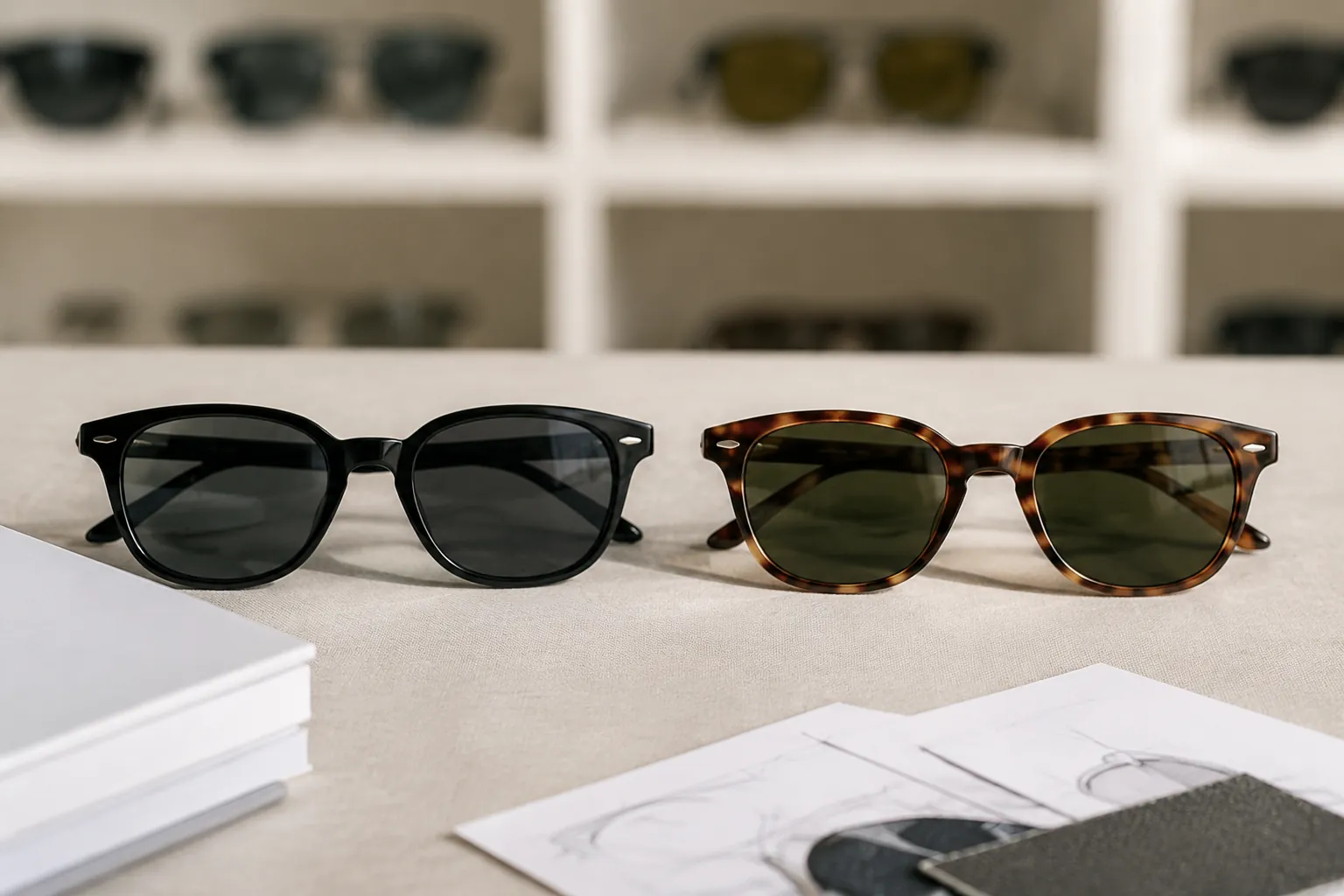
This guide is for brand owners, importers, distributors, and retailers that want a differentiated sunglasses SKU without paying for a new mold. The practical route is to start with an existing production frame and customize the parts customers see and handle: frame color, lens specification, logo execution, and packaging. Done well, this cuts development time and upfront cost versus a new tool. Done poorly, it leads to remakes, compliance issues, and shipping delays. The difference is usually simple: a clear commercial specification before sampling starts.
Start With the Right Frame, Not the Cheapest One
If the goal is an exclusive SKU without mold cost, the first decision is the base frame. Start with a stock style that already runs in stable production, not one that only looks good in a catalog photo. The frame should have consistent assembly, reliable hinge performance, and a front construction that can accept the target lens and decoration method without structural changes.
Before you spend time on color cards and logo files, check the stock frame on four practical points:
- Material route: injected PC and TR90 are common choices for repeat production and color variation. Acetate gives a different look and a more premium presentation, but it usually needs more processing and can show natural variation from sheet to sheet.
- Lens geometry: a low-base fashion lens is not interchangeable with a higher-wrap sport lens. Groove depth, bevel angle, front curve, and lens edge profile must match the frame.
- Decoration area: a temple that looks wide in a photo may have very little usable flat area once taper, curve, and hinge hardware are considered. That limits whether pad print, laser marking, or a metal insert is realistic.
- Assembly stability: front symmetry, hinge alignment, and temple opening feel matter more than surface appearance if you expect repeat orders. If a sample needs repeated adjustment to sit correctly, it is a weak candidate.
In QC terms, many buyers ask the supplier to confirm lens fit, left-right balance, and logo placement before approving the base style. Review those points on a physical sample. Do not rely on artwork or a rendering.
If a supplier says it handles molding, acetate processing, lens tinting, decoration, or QC in-house, ask what is truly internal and what is subcontracted. That matters. Stock-frame customization moves faster when the frame workshop, lens processing, decoration, and final inspection are working to one production plan.
One rule saves time and money: if the stock frame needs changes to the front shape, bridge structure, hinge block, or core wire layout, it is no longer a simple stock customization project. Treat it as a new development program and confirm tooling implications in writing.
Choose the Changes That Actually Create Exclusivity
Buyers often overvalue a small temple logo and undervalue a tight specification package. In the market, exclusivity usually comes from the full visible stack: frame color, lens appearance, finish, branding method, and retail presentation. That is why many private-label programs use an existing mold but control the specification carefully.
The fastest route is to combine two or three meaningful changes instead of changing everything at once. For example, a matte olive injected frame with polarized smoke lenses, an inside-temple laser logo, and a branded microfiber pouch can read as a distinct brand SKU without a new mold. Add a custom box and account-specific barcode setup, and the same frame platform becomes channel specific.
| Customization lever | Typical MOQ impact | Lead-time impact | Cost effect | What the buyer gains |
|---|---|---|---|---|
| Frame color change | Low to moderate | Low | Usually limited to color setup or material difference | Fast visual differentiation by season, channel, or region |
| Lens tint or coating change | Low to moderate | Low to moderate | Varies by lens material and finish | Strong shelf impact and clearer product segmentation |
| Pad print or laser logo | Low | Low | Usually the lowest branding cost | Brand recognition without new tooling |
| Metal logo plate | Moderate | Moderate | Extra hardware and fitting cost | Higher perceived value and a stronger private-label signal |
| Custom packaging set | Moderate | Moderate | Depends on paper spec, case type, and inserts | Retail differentiation and account-level exclusivity |
If you are launching across several channels, separate exclusivity at the commercial level rather than at the mold level. The same frame can carry different lens colors, inside-temple codes, or packaging sleeves for different accounts. That keeps the budget on features the end customer actually notices.
Manage Colorways Carefully
Color is usually the fastest visible change. It is also easy to mishandle. Injection materials and acetate do not behave the same way, and not every shade repeats cleanly from batch to batch.
For injected frames, the supplier may work from a Pantone reference, color chip, or approved physical sample. Standard black, crystal, smoke, and many commercial tortoise looks are usually easier to match than pale transparents, milky translucents, or very specific fashion pastels. On glossy surfaces, even a small shift in transparency can stand out under retail lighting.
TR90 and PC also behave differently in finish and appearance. TR90 is common where flexibility matters. PC is common in value-oriented sunglass programs and can hold sharp molded detail well. Acetate is different again. The final result depends heavily on the sheet pattern and color lot. Laminated blocks, marbling, and layered transparent effects can create stronger differentiation than a basic injected color, but natural variation is part of the material and should be accepted within an agreed standard.
A reliable approval flow for color normally looks like this:
- Confirm the frame material and target finish.
- Approve a real color sample, not only a screen image.
- Confirm whether inside and outside surfaces need the same finish level.
- Request one assembled pre-production sample under more than one lighting condition.
Matte finish needs extra attention. It often looks strong online, but it can show rub marks more easily during transport or retail handling. If the product is meant for open display or other high-touch settings, ask for a sample that reflects the final finish and review it after basic handling before approving bulk production.
Define Lens Specs in Full
The lens is where appearance, function, and regulatory risk meet. Change the lens and you may change visible light transmission, filter category, test requirements, and market suitability. So define the lens specification fully. Terms like "dark smoke" or "fashion mirror" are not enough.
A clear purchase specification should state lens material, color, solid or gradient effect, polarization if required, mirror requirement if any, and the approved cosmetic target. If curve or wrap matters to the frame design, confirm that at sample stage too.
Common commercial lens options include PC, acrylic, nylon, and TAC polarized constructions. For many private-label programs, standard tinted lenses and TAC polarized lenses cover the main price points and merchandising needs. Polarization can raise perceived value, but it also changes the commercial specification and should be treated as a separate version in testing and labeling.
| Lens option | Typical use | Cost level | Compliance sensitivity | Buyer note |
|---|---|---|---|---|
| Standard PC tinted | Fashion and promotional sunglasses | Low | Moderate | Suitable for entry-level programs if tint performance is verified |
| PC with mirror coating | Trend-driven retail styles | Low to moderate | Higher | Specify mirror appearance and coating consistency clearly |
| TAC polarized | Mid-range private label | Moderate | Higher | Often used where buyers want a stronger value proposition |
| Nylon sport lens | Performance and wrap styles | Higher | Higher | Usually better suited to technical eyewear than simple fashion stock frames |
For export programs, compliance should match the final sellable configuration. Common references include CE EN ISO 12312-1, ANSI Z80.3, AS/NZS 1067, REACH, and FDA registration where applicable. Decoration rarely changes sunglass performance requirements. Lens specification often does. If one frame is sold with multiple lens options, treat each version as a separate commercial specification for testing, approval, and carton identification.
Pick a Branding Method That Fits the Frame
Not every branding method fits every frame. The right choice depends on the substrate, logo size, expected wear, and target price. On low-MOQ stock programs, the best method is usually the one that stays consistent in production without adding unnecessary setup or fitting complexity.
Three common branding methods are pad printing, laser engraving, and metal logo plates:
- Pad printing: usually the fastest and lowest-cost option for standard temple logos. It works best on smooth, stable surfaces and is commonly used for one-color or simple multi-color marks. Durability depends on the material, ink system, curing, and end use, so approve a real sample rather than assuming performance.
- Laser engraving: often chosen for a quieter look and generally offers better wear resistance than surface print on suitable materials. The final appearance depends on the substrate and may be tonal rather than high contrast.
- Metal logo plate: often used when the buyer wants a stronger private-label signal. It adds hardware development, fitting work, and alignment control, so weigh it against order volume and target price.
Ask the supplier to place the logo on the exact sampled frame, not on a generic mock-up. Small placement shifts can be obvious on the finished product, especially on narrow or tapered temples. Metal plates should also be checked for straightness, flush fit, and clean adhesive or insert finishing on the approved sample.
If the opening order is small, keep the branding simple. A printed or laser logo is often more practical than mixing several branding treatments across low-volume color splits.
Use Packaging to Create Channel Exclusivity
Packaging is often the fastest way to make a stock frame feel exclusive to one retailer, distributor, or market. It is also easier to localize than the frame itself. A shared frame can become a different commercial SKU simply by changing the outer box, pouch, cloth, barcode labels, leaflet language, or warning text.
Useful packaging variables include the folding carton, rigid case, microfiber pouch, cleaning cloth, barcode sticker, warranty card, and instruction leaflet. In many programs, the frame stays identical while pack-out changes by channel. That is a practical way to separate online programs, chain retail, travel retail, and distributor packs without touching the mold.
What matters is operational control. If you want custom packaging, the supplier needs a precise packing specification that covers:
- Pack-out sequence: frame, protective bag if required, pouch or case, cloth, leaflet, inner box, and master carton arrangement
- Label content: style code, color code, lens code, barcode, destination mark, and carton quantity
- Language control: market-specific warnings and claims aligned with the approved lens specification
- Carton split logic: how many units per colorway, per account, and per carton
Do not leave barcode assignment, insert artwork, or carton marks until the end. That is a common cause of delay. Production may be physically complete, but shipping cannot move because packaging files, labels, or carton instructions are still unresolved.
Understand the Cost, MOQ, and Lead-Time Tradeoff
The financial logic of a stock-frame program is simple: avoid tooling cost, keep minimums more flexible, and spend on visible differentiation instead of front-end development. That does not mean every custom element is cheap. It means the budget goes into variable upgrades such as color matching, lens processing, logo execution, and packaging rather than a new mold.
Because MOQs and lead times vary by supplier, material, and season, ask for written confirmation for the exact configuration being quoted. The factors that usually affect MOQ most are custom acetate requirements, special lens treatments, metal logos, and multi-version packaging splits. The factors that usually affect lead time most are sample approval speed, material availability, and packaging readiness.
| Program type | MOQ | Sample lead time | Bulk lead time | Main cost driver |
|---|---|---|---|---|
| Stock frame with standard color and print logo | Supplier dependent | Supplier dependent | Supplier dependent | Decoration and packing |
| Stock frame with custom color and tinted lens | Supplier dependent | Supplier dependent | Supplier dependent | Color matching and lens processing |
| Stock frame with polarized lens and metal plate | Supplier dependent | Supplier dependent | Supplier dependent | Lens upgrade and logo hardware |
| One frame with multi-market packaging splits | Supplier dependent | Supplier dependent | Supplier dependent | Packaging complexity and carton control |
If your goal is margin, keep the base frame common and differentiate the visible details. If your goal is speed, limit low-volume variation. Every extra colorway, barcode, or packaging version adds sorting, labeling, and inspection work. Small details add up fast.
Use a Buyer Workflow That Stops Expensive Errors
Most stock-frame customization failures come from vague approvals, not from the manufacturing route itself. The supplier builds what the buyer approved, not what the buyer assumed was obvious. A disciplined workflow reduces rework and helps prevent a shipment that is technically correct but commercially wrong.
- Select the base frame: confirm material, measurements, lens shape, hinge type, and usable logo area.
- Freeze the visual spec: frame color, finish, lens color, polarization, branding method, and packaging set.
- Confirm the compliance route: align the final sunglass specification with the target market and confirm which documents are needed, such as test reports to CE EN ISO 12312-1, ANSI Z80.3, or AS/NZS 1067, plus REACH declarations or FDA registration details where relevant.
- Approve a real sample: inspect lens appearance, left-right balance, logo position, hinge feel, and full package assembly.
- Issue one final PO spec sheet: style code, version codes, quantities, carton marks, barcode data, and acceptance points.
- Require pre-shipment QC reporting: verify appearance, assembly, packing accuracy, and quantity by SKU version.
If a supplier says it operates under ISO 9001 or has passed BSCI audit requirements, ask for current documentation and confirm which factory site the documents cover. Those credentials can support supplier assessment, but they do not replace product-level approval and specification control.
The cheapest mistake is the one caught at sample stage. The expensive mistake is a correct factory build against an unclear buyer brief.
That is the real advantage of using a stock frame properly. You avoid mold cost and move faster. But only if the specification is detailed enough to control production, compliance, and shipment accuracy.
Have a custom sunglasses project in mind?
Send us your styles, target market and quantities and we will return a detailed quote with MOQ, lead time and a sample plan.
Get a QuoteWhy source this from Wenzhou with LumiShades
Wenzhou in Zhejiang Province is widely regarded as China’s eyewear manufacturing capital, producing a large share of the world’s sunglasses. That concentration matters to buyers: a deep local supply chain for acetate sheet, hinges, lens blanks, plating and packaging means shorter component lead times, easier color and material matching, and a workforce with decades of eyewear-specific skill. LumiShades has manufactured in this ecosystem since 2009, and our vertical integration — in-house injection molding, acetate cutting, CNC milling, lens tinting, decoration and quality control — means no part of your order is quietly subcontracted to a workshop you cannot audit.
For international buyers, that vertical control translates into accountability. When a single factory owns every step, defects are traced and fixed at source rather than bounced between vendors, and your specifications survive intact from first sample to bulk. We back this with 15+ years of experience, shipments to 60+ countries, more than 5 million pairs produced per year and a 98.5% on-time delivery rate. Our certifications — CE EN ISO 12312-1, FDA registration, ANSI Z80.3, AS/NZS 1067, REACH, ISO 9001 and BSCI audit — mean the compliance documentation your market requires already exists. Explore our manufacturing capabilities and quality control process to see how this works in practice.
Frequently asked questions
Can I make a stock frame exclusive if other buyers can also access the same mold? Yes, but define exclusivity in the sellable specification, not only in the frame platform. Ask the supplier to confirm in writing which elements can be reserved or controlled for your program, such as frame color, lens combination, logo execution, packaging artwork, barcode series, or market-specific pack-out. If channel protection matters, put that agreement into the quotation or supply contract instead of assuming the mold itself is exclusive.
What usually changes compliance: logo, color, or lens? Lens changes are usually the main trigger because tint category, visible light transmission, polarization, mirror coating, and lens material can affect testing and market suitability. Frame color and logo are usually cosmetic, although any change in substrate, coating, or chemical input may require updated material declarations for requirements such as REACH. In practice, treat every lens version as a separate SKU for approval and ask which existing test reports still apply after the change.
Is a small opening order enough for a serious private-label trial? Yes, if the trial is tightly controlled. Limit the program to one frame, one or two colorways, one lens specification per colorway, and one packaging format. Before placing the order, ask the supplier to confirm the exact MOQ, sample charge, approval process, and what documentation will be available for compliance and shipment. A trial works best when the goal is to validate demand, price position, and product presentation rather than test many variations at once.
Which branding method lasts longest on sunglasses temples? Laser engraving is often the safest choice when wear resistance matters, but the result depends on the temple material and the visual effect you want. Pad printing can still be the right option when the logo needs higher contrast or color, but it should be approved on a real sample with the intended substrate and curing method. Metal plates can also perform well if fitted correctly, though they add component and assembly complexity. Ask the supplier to show samples on the same material as your chosen frame, not on a different platform.
What causes delays on stock-frame custom orders more often than frame production itself? Late sample approval, incomplete packaging artwork, missing barcode data, unclear carton split instructions, and unresolved compliance documents are frequent causes of delay. To reduce risk, issue one final specification sheet before bulk starts and make sure it covers product version codes, artwork approvals, label data, and destination requirements. If the order has multiple packaging versions, ask for a packing list format and carton marking example before production is finished.
Ready to start?
Explore our rimless sunglasses or request a quote — our sales team replies within 12 hours.
Request a Quote