
Source Promotional Sunglasses Without Blowing Budget
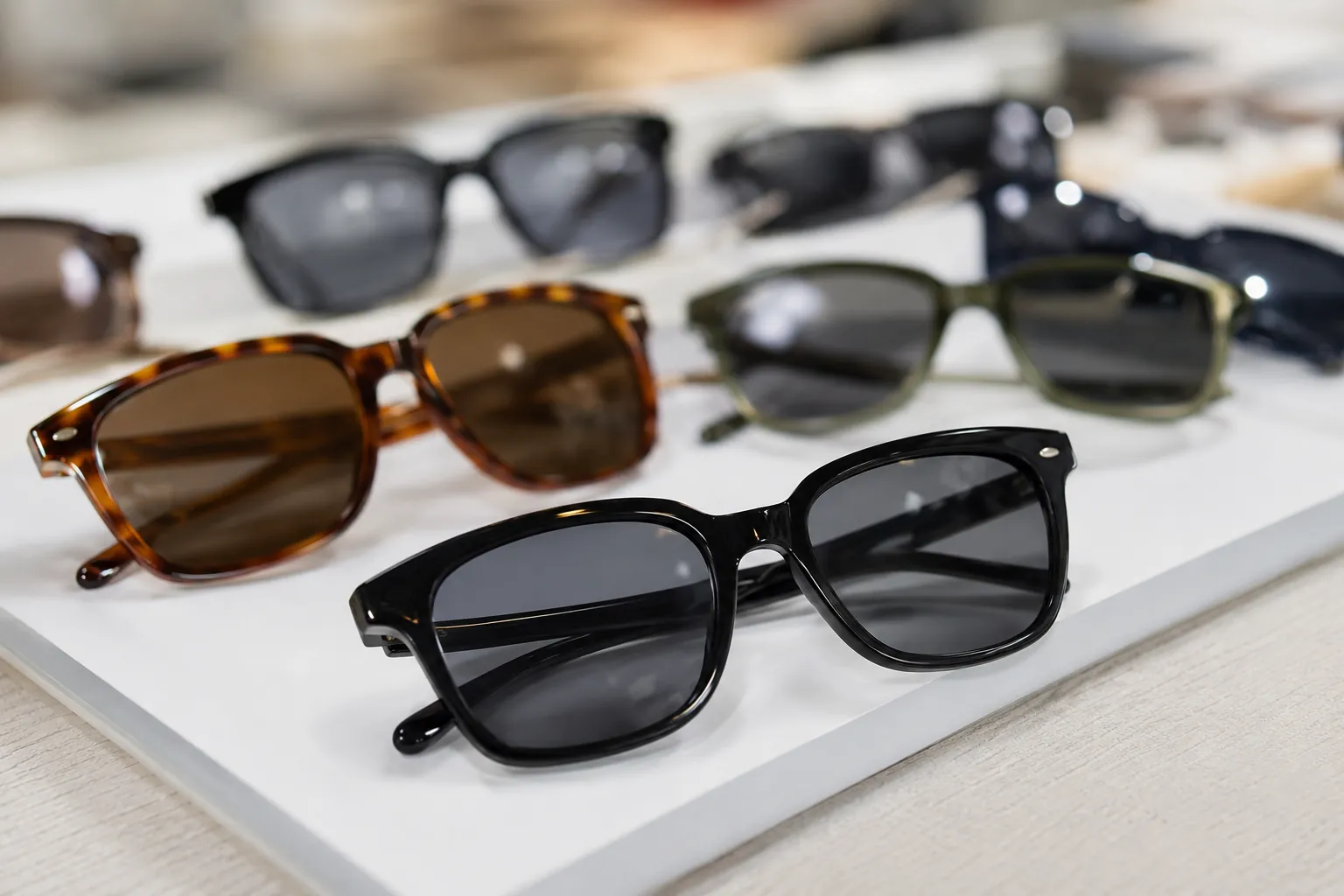
If you buy sunglasses for giveaways, trade shows, staff kits, or retail promotions, the common mistake is chasing the lowest unit price and paying later in delays, weak branding, poor fit, or compliance trouble. This guide is for brand owners, importers, distributors, and retailers who need low-cost styles that still look decent at volume. The aim is simple: cut landed cost without making the product look cheap or creating avoidable risk. Choose the right frame, lens, decoration, and packaging mix, and you can stay on budget and still ship something people will wear.
Start with the use case, not the catalog
Promotional sunglasses are not one product. A 20,000-pair marathon giveaway, a 500-pair employee kit, and a 50,000-pair retail promo all have different economics, quality expectations, and compliance needs. Start with four basics: the audience, the channel, the delivery date, and whether the sunglasses are for actual outdoor use or mainly for branding.
That choice affects everything downstream. If the glasses are meant for sun protection, ask which product standard applies in your market and request documentation for the exact frame, lens, and decoration combination you plan to buy. Common references include CE EN ISO 12312-1 for the EU, ANSI Z80.3 for the U.S., and AS/NZS 1067 for Australia and New Zealand. REACH matters if your supply chain needs chemical compliance checks for restricted substances. In the U.S., FDA registration may appear in a supplier profile, but it is not a substitute for product testing or product-specific documents.
At LumiShades, the first filter is always target landed cost and ship date. If the buyer needs the lowest practical cost, a simple injection-molded frame, a standard smoke or solid tint lens, and one-color pad printing or laser engraving is usually the cheapest workable mix. If the campaign needs a more retail-ready look, acetate or mixed-material styles can still work, but the budget needs room for extra finishing time and tighter QC.
Keep this rule in mind: if the intended retail value is under $10, stay conservative on structure and decoration. Spend on clean finish and consistency. Do not pay for features the audience will not notice.
Choose the frame construction that fits the budget
Most budget overruns start with the frame. Buyers pick a shape that needs too much tooling, too much hand finishing, or too much scrap risk in mass production. For promotional runs, the safest options are injection-molded plastic and basic acetate designs. Injection molding gives the strongest cost advantage at scale because once the mold is approved, the unit cost falls quickly. Acetate costs more in both material and labor, but it delivers a denser feel and takes polish and decoration well.
| Build option | Best use | Cost behavior | Lead-time impact | Buyer notes |
|---|---|---|---|---|
| Injection-molded frame | Mass giveaways, event campaigns | Lowest unit cost at scale; mold cost is front-loaded | Fast after tooling is approved | Best for repeat orders and simple branding |
| Acetate frame | Premium promos, retail-facing gifts | Higher material and finishing cost | Often adds polishing and QC time | Better hand feel and richer color depth |
| CNC-milled components / mixed build | Higher-end corporate programs | Higher process cost and more labor | Usually slower than straight injection | Good for sharper detailing and metal accents |
| Stock platform with custom decoration | Fast-turn campaigns with limited design changes | Lowest tooling exposure | Shortest approval cycle | Best when the deadline matters more than uniqueness |
If you want the lowest-risk budget, keep the geometry simple. Avoid deep undercuts, tiny hinge details, thick temple ends, and aggressive surface texture. Those features raise scrap risk, slow molding, and make the part harder to release cleanly. A straight temple line, standard lens shape, and stable hinge design are easier to quote and easier to inspect. On a repeat program, ask what platform styles already have tooling in place. Reusing an existing mold can cut lead time and remove a meaningful chunk of upfront cost.
A practical target: many buyers can keep frame-side cost under control if the design uses fewer than three major custom parts and avoids secondary assembly steps that need manual alignment.
Know the real cost drivers before asking for quotes
Buyers often ask for a price too early. The better question is simple: what is pushing the price up? In promotional sunglasses, the main drivers are tooling, material grade, lens specification, decoration method, pack-out, and compliance scope. A cheap frame with a custom mold can cost more overall than a slightly higher-priced stock mold that is ready to produce immediately.
Volume matters more than most teams expect. A sensible quote should show clear breaks at low MOQ, mid-volume, and production volume. For example, a factory may quote one level at 50 pairs for artwork validation, another at 300 pairs for small campaigns, a stronger break at 1,000 pairs, and a better rate again at 5,000+ pairs. The exact price depends on the spec, but the pattern should be obvious: fewer units mean more setup cost per pair, while larger runs spread those costs over more pieces.
MOQ is not free. A 50-pair MOQ is useful for samples, market tests, or localized promotions, but the unit cost is higher because setup and changeover are spread across fewer units. That is normal. Use low MOQ to validate the concept. Use volume to capture the real savings.
Use this quote logic:
- Lock the frame family first.
- Choose one lens tint and one decoration method.
- Confirm packaging before asking for final pricing.
- Ask for pricing at 50, 300, 1,000, and 5,000+ pairs.
- Compare landed cost, not only ex-factory cost.
When comparing suppliers, ask what is included in the quote. A low unit price that excludes cartons, testing, logo setup, and freight can cost more than a cleaner all-in offer. Also ask whether the quoted price assumes stock colors or a custom Pantone match. Custom color work often adds lead time and can raise reject risk if the shade tolerance is tight.
Pick branding methods that look clean, not loud
Promotional eyewear fails when the logo looks like an afterthought. Good branding is readable, durable, and sized to the product. On sunglasses, the practical decoration methods are laser engraving, pad printing, and metal logo plates. Each has a different cost profile and a different failure mode.
- Laser engraving: Best for temples and metal parts. It is clean, permanent, and does not rely on ink adhesion. It works especially well on coated or darker surfaces where the contrast is visible. On smooth black acetate or coated metal, check legibility at normal viewing distance, not just in close-up photos.
- Pad printing: Usually the lowest-cost common method for simple one- or two-color logos on smooth plastic. It is fast and economical, but ink wear can be an issue if the logo sits on a high-rub area or if the surface has too much curvature. It works best when the artwork uses a minimum stroke thickness of about 0.2 to 0.3 mm and avoids fine knockouts.
- Metal logo plates: A good choice for premium-looking giveaways and corporate programs. They cost more and need extra assembly, but they create a sharper, more finished appearance. They also give more visual contrast than print on dark plastic.
Do not overload the frame with branding. One temple logo is usually enough. On small frames, a large front print looks awkward and can interfere with lens visibility. Ask the supplier about logo placement tolerance before approval. In production, a sensible target is often within about ±1 mm for logo position on a temple, with print density and alignment checked against a signed sample. If the logo is off-center, too light, or too close to an edge, many buyers will reject it even if the glasses still work.
If the order is price-sensitive, use one imprint location, one ink color, and one decoration method. Every extra variation adds setup time and more chances for mismatch.
Treat lens choice as a cost and compliance decision
Lens selection affects more than appearance. It changes cost, lead time, and the compliance path. For promotional runs, the common choices are smoke, solid color tint, mirrored tint, and clear or lightly tinted lenses for indoor or fashion use. Dark smoke and standard tints are usually the safest starting point because they are easy to source, easy to inspect, and less likely to show visible batch differences.
If the glasses are meant for sun protection, ask which test path matches the destination market. CE EN ISO 12312-1 is not the same as ANSI Z80.3 or AS/NZS 1067. The standards differ in UV protection claims, lens transmittance, category labeling, and test conditions. Ask for documentation on the exact frame and lens combination, not just a family-level certificate or a report from a similar model.
For large campaigns, consistency matters almost as much as the spec itself. Ask about color tolerance from batch to batch. A small shift in gray, brown, or mirrored tint may not show up in a single sample, but it becomes obvious when thousands of pairs are lined up in a display or mixed in cartons. The same goes for coating quality: if the mirror layer is uneven or the tint looks patchy at the edge, the product looks lower grade even if it passes basic checks.
For cost planning, plain smoke lenses are usually the cheapest and least risky. Mirrored lenses can look stronger, but they add process steps and can raise the defect rate if coating control is weak. Clear lenses may work for fashion promotions, but they need careful positioning so the product does not look like a toy.
Match the lead time to the event calendar
Promotional programs fail when sourcing starts too late. The real timeline is usually longer than the sales team expects. Sample lead time of 7-10 days is useful for approvals, but bulk production still needs about 25-35 days after sample confirmation if the spec is stable and the factory has capacity. Add freight on top of that. If the event date is fixed, build in a buffer. Do not assume every step will hit the fastest number.
The clean sequence is straightforward:
- Send target price, order quantity, destination market, and logo file.
- Confirm frame style, lens tint, branding method, and packaging.
- Approve samples before mass production.
- Review compliance documents for the exact model.
- Book freight before the goods are finished if the deadline is tight.
Every change after sample approval costs time. A color swap, a logo move, a different box insert, or a new carton count can push the schedule back by several days. If you need a fast turn, keep the design simple and use standard components where possible. The fastest jobs are the ones with the fewest open questions.
Ask the supplier to confirm packed carton dimensions early if freight is tight. Even a small increase in carton size can change air freight cost enough to hurt the project margin.
Check QC the way a buyer would reject product
QC for promotional sunglasses should be basic but strict. You do not need luxury-grade inspection. You do need a clear acceptance standard. The most common defects are easy to spot: lens scratches, crooked temples, loose hinges, poor logo placement, shade mismatch, and packing damage. If the glasses are meant for real outdoor use, lens clarity and tint consistency also matter.
A practical inbound inspection plan should cover full visual and functional checks, not just carton count:
- Frame alignment and temple symmetry
- Lens fit, edge finish, and seating depth
- Logo position, sharpness, and print density
- Hinge torque and open-close action
- Surface scratches, dust, flash marks, and polish quality
- Carton count, inner-pack labeling, and accessory match
For promotional orders, cosmetic defects can destroy perceived value faster than almost anything else. A sunglass frame that costs under a few dollars can still look good if the finish is even and the logo is clean. It looks cheap if the lens is scratched, the temples are crooked, or the logo is off by several millimeters. That is the real trade-off, not price alone.
Set tolerances before production starts. Buyers often accept minor cosmetic variation but reject obvious asymmetry, hinge issues, or missing decoration. If you want fewer disputes, define what is acceptable for lens scratches, logo placement, and surface marks in writing and compare the output against an approved golden sample.
If the supplier has ISO 9001 certification, it can support a documented quality process. If the supplier also has BSCI participation or an equivalent audit program, that may help with social compliance review, but it does not replace product inspection or product testing.
Build a quote request that gets useful answers
The quote is only as good as the brief. Send a vague request and you get a vague price. A useful RFQ for promotional sunglasses includes the target market, quantity bands, frame material, lens type, decoration method, packaging, delivery window, and required compliance standard. Ask for pricing at 50, 300, 1,000, and 5,000+ pieces so you can see where the break points sit and what is driving the jump between tiers.
Use an internal comparison table before you approve the order:
| Option | Unit price trend | Brand appearance | Risk level | Best fit |
|---|---|---|---|---|
| Simple injected frame + pad print | Lowest | Clean but basic | Low | Mass giveaways and event handouts |
| Injected frame + metal logo plate | Mid | More premium | Medium | Corporate gifting and distributor programs |
| Acetate frame + laser engraving | Higher | Retail-friendly | Medium | Premium promos and branded resale |
| Stock frame + standard tint + plain pouch | Lowest landed cost | Simple | Low | Fast-turn, budget-sensitive campaigns |
A strong RFQ also asks for the hidden numbers: setup fee, tooling amortization, sample cost, decoration surcharge, carton count, and freight assumption. If the supplier gives only a unit price and no breakdown, it is hard to tell whether the quote is competitive or just incomplete. Ask for the sample approval timeline in writing, plus a clear statement of what happens if the sample needs one revision.
Last point: if you want the lowest landed cost, do not obsess over unit price alone. A cheaper frame that fails QC, slips on compliance, or misses the ship date is expensive. The right promotional sunglass is the one that arrives on time, looks consistent, and survives the event without complaints.
Have a custom sunglasses project in mind?
Send us your styles, target market and quantities and we will return a detailed quote with MOQ, lead time and a sample plan.
Get a QuoteWhy source this from Wenzhou with LumiShades
Wenzhou in Zhejiang Province is widely regarded as China’s eyewear manufacturing capital, producing a large share of the world’s sunglasses. That concentration matters to buyers: a deep local supply chain for acetate sheet, hinges, lens blanks, plating and packaging means shorter component lead times, easier color and material matching, and a workforce with decades of eyewear-specific skill. LumiShades has manufactured in this ecosystem since 2009, and our vertical integration — in-house injection molding, acetate cutting, CNC milling, lens tinting, decoration and quality control — means no part of your order is quietly subcontracted to a workshop you cannot audit.
For international buyers, that vertical control translates into accountability. When a single factory owns every step, defects are traced and fixed at source rather than bounced between vendors, and your specifications survive intact from first sample to bulk. For procurement review, buyers can request process records, approved samples, quality checkpoints and project-specific compliance files before placing a bulk order. Required testing and documentation are confirmed against the destination market and product specification rather than assumed from a generic certificate list. Explore our manufacturing capabilities and quality control process to see how this works in practice.
Frequently asked questions
What is a realistic MOQ for promotional sunglasses? For custom programs, 50 pairs per design is a practical low MOQ for sampling or very small campaigns. Better unit pricing usually starts around 300 pairs, improves again at 1,000, and is strongest at 5,000+ when the specification stays stable.
Which branding method is cheapest and still acceptable? Pad printing is usually the lowest-cost logo option. For a cleaner premium look, laser engraving or a small metal logo plate is better, but both add cost and may add assembly time.
How fast can I get samples and bulk production? A normal sample lead time is 7-10 days. Bulk production is typically 25-35 days after sample approval, assuming the specification is fixed and no late changes are introduced.
Which compliance documents should I ask for? Ask for documentation that matches your destination market and the exact model: CE EN ISO 12312-1, ANSI Z80.3, AS/NZS 1067, REACH, and FDA registration details where relevant. Do not accept generic paperwork only.
What frame type is best for low-cost giveaways? Injection-molded frames are usually the best fit for high-volume giveaways because they hold cost down once tooling is in place. Keep the design simple to reduce scrap, rework, and delays.
How do I avoid sunglasses that look cheap? Use one strong logo placement, keep the frame shape simple, choose a consistent lens tint, and reject crooked temples, poor hinge action, scratches, and sloppy print. Clean finish matters more than extra features.
Ready to start?
Explore our round sunglasses or request a quote — our sales team replies within 12 hours.
Request a Quote