
How to Source Sunglasses With Territory Protection
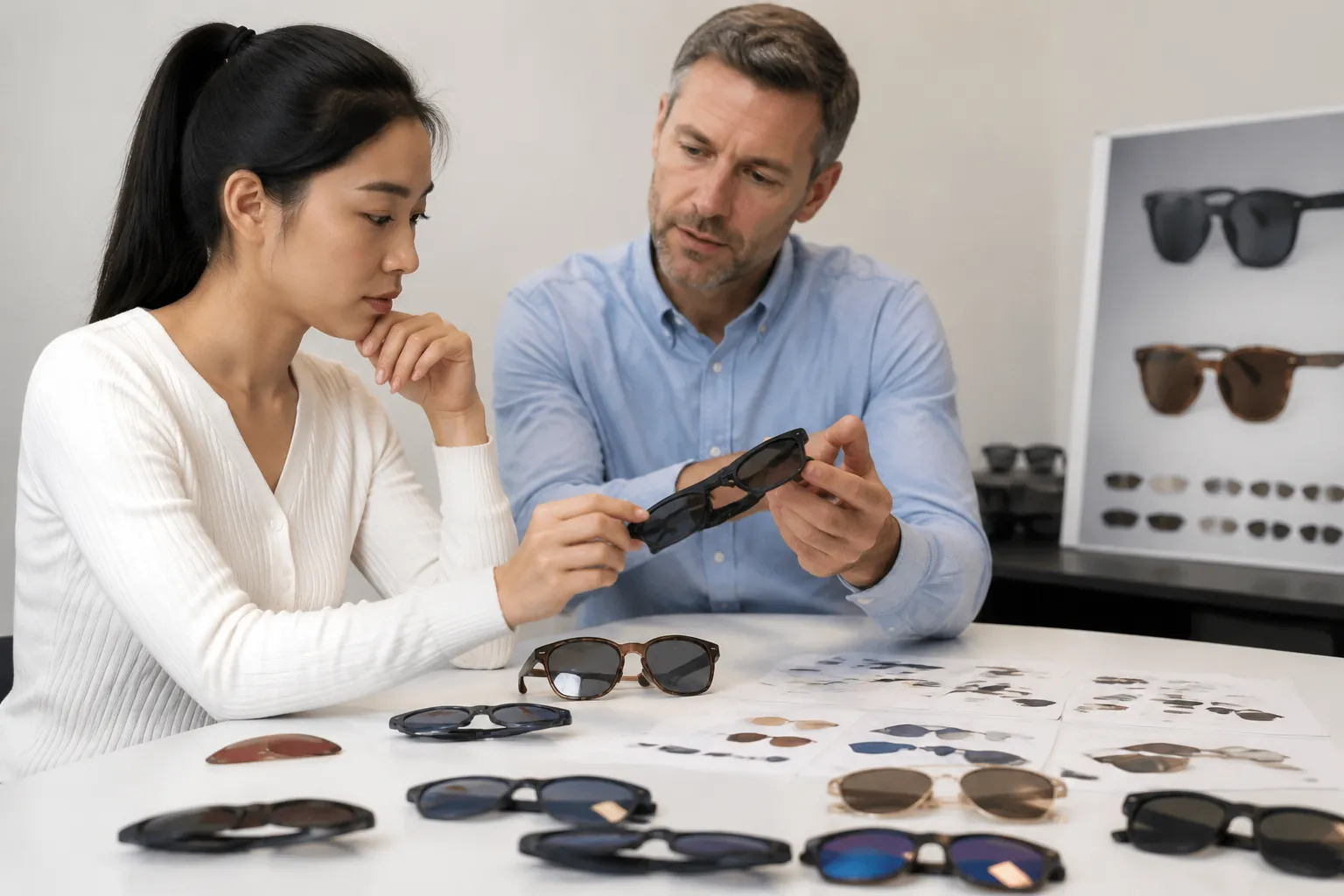
This guide is for importers, regional distributors, retail groups, and brand owners who want territory protection they can defend. Not vague promises. Not oversized commitments before sell-through is proven. It explains how to define territory, protect SKUs, use private colorways, set reorder rules, document quality requirements, and keep compliance claims tied to recognized sunglass standards. The aim is practical: protect the market you can develop, give the factory rules it can follow, and increase volume only after the product has earned it.
Define Territory Before Price
Territory protection sounds simple until the first conflict appears. A buyer says, "I need Europe." The factory may hear "a few priority countries and some online accounts." That gap causes trouble later. Define the territory before price negotiation starts.
For sunglasses, channel control matters as much as geography. A factory may agree not to sell your protected SKU to another wholesaler in Chile, but still supply a travel-retail chain, marketplace seller, or promotional buyer whose goods move across borders. If your business depends on optical stores, surf retailers, petrol stations, pharmacies, marketplaces, chain retail, corporate gifting, or private-label programs, name those channels. Do not rely on loose wording such as "all retail."
- Country scope: list countries one by one; avoid "EU," "Middle East," or "LATAM" unless every country is named.
- Channel scope: define wholesale, optical stores, chain retail, duty-free, online marketplaces, promotional buyers, corporate gifting, or private-label programs.
- Product scope: identify model number, frame material, frame color, lens color, lens category, logo method, packaging, and barcode ownership.
- Time scope: set an initial launch window, then renew protection based on documented reorder performance.
A serious factory will not block a broad region forever on a small first order. That is reasonable. A stronger structure links protection to a launch plan, approved SKU sheet, and reorder ladder. The protected scope should match the risk both sides are taking.
Protect SKUs, Not Everything
Blanket exclusivity is hard to manage. It also costs more, because the factory must turn away other buyers across a wide product range. A protected SKU is cleaner. It reserves a specific model-color-lens-logo-package combination while allowing the factory to sell other versions.
For example, a TR90-style sports frame in matte black with category 3 smoke lenses, a stainless logo plate, retail box, and GS1 barcode can be reserved for your territory. The same mold in translucent gray with blue mirror lenses and neutral packaging may remain open unless you reserve that version too. The difference matters. Production, sales, and QC teams can check a precise SKU. They cannot police a vague promise.
| Protection Type | What It Covers | Typical Commitment | Best Use |
|---|---|---|---|
| Open stock | Standard factory model and colors | Supplier MOQ only | Market testing and retailer samples |
| Private colorway | Reserved frame color, lens tint, or finish | Higher than open stock; depends on materials | Distributor differentiation without tooling |
| Protected SKU | Model, color, lens, logo, packaging, barcode | Launch order plus reorder plan | Regional wholesale and chain retail programs |
| Territory exclusivity | Defined product family in defined countries | Annual forecast, minimums, or staged renewals | Established distributors with proven sell-through |
Attach one SKU sheet to each protected item. Include the factory model code, frame material, Pantone or signed master sample reference, lens category and visible light transmission range, logo position, packaging artwork revision, carton marks, and barcode. Good SKU sheets prevent emotional arguments. They turn disputes into facts.
Build Private Colorways With Real Tolerances
Private colorways are one of the most useful protection tools. They create visible market difference without a new mold. A new mold brings tooling ownership, development time, maintenance duties, and larger volume commitments. A private colorway can move faster, but only if the resin, acetate sheet, lenses, and decoration materials are available and approved.
For injection frames, color is controlled through resin masterbatch or other approved material inputs. Approve color against a physical Pantone chip or signed master sample, not a screen image. State the light source used for approval, the acceptable shade tolerance, and whether gloss, matte, translucent, rubberized, or two-tone finishing is included. The same pigment can look different after surface finishing. Small changes show.
For acetate, pattern variation is normal. Two temples cut from the same acetate sheet can show different grain, especially with tortoise, horn, crystal, or laminated sheets. If you want more consistent left-right temple appearance, specify sheet code, cutting direction, acceptable pattern contrast, and the sample used as the commercial reference. CNC-milled acetate also needs clear polishing standards around the bridge, end pieces, and temple tips.
Lenses need the same discipline. Category 3 gray, brown gradient, G15-style green, smoke, polarized TAC, and mirror-coated lenses all affect appearance, cost, and compliance. Confirm visible light transmission before printing "category 3" or "driving suitable." Mirror coatings can shift between sample and mass coating. Approve a lens master sample separately from the frame color.
- Reserve at least one frame color outside the factory's open catalog.
- Pair it with a lens tint or mirror coating that fits the retail position.
- Lock the decoration method: pad print, laser engraving, hot stamping, metal logo plate, or temple insert.
- Specify packaging so another buyer cannot receive the same retail presentation.
- Approve one backup color in case the first run sells faster than forecast or a material becomes unavailable.
Ask which processes are done in-house and which are outsourced. In-house frame finishing, lens handling, logo application, or packaging can reduce coordination risk. It does not remove the need for samples, tolerances, and written approvals before bulk production.
Link MOQ, Price Breaks, and Reorders
The weakest exclusivity deal forces a distributor to buy too much too early. Sunglasses are seasonal, color-sensitive, fit-sensitive, and tied closely to retail positioning. Start with a staged ladder: samples for retailer feedback, a first placement order for market testing, protected SKU status after a serious launch, and wider territory terms only after repeat orders prove demand.
Price should move with volume. It should also reflect construction. A simple injected frame with standard category 3 lenses and basic packing does not cost the same as a polarized lens, metal logo plate, custom retail box, barcode labels, and third-party inspection. Treat any low unit price as conditional until material, lens, decoration, packaging, compliance, inspection, and delivery terms are fixed in writing.
Lead time depends on approval status. Sampling and bulk production timelines should start only after the supplier has final artwork, approved samples, confirmed materials, packaging files, payment terms, and any required test or inspection plan. If resin color must be matched, acetate sheets sourced, polarized lenses ordered, or gift-box artwork revised, those steps cannot hide inside a vague "standard lead time."
Use a rolling forecast, not a fantasy annual commitment. The factory gets visibility. The distributor keeps room to adjust colors based on sell-through.
A fair deal may protect a SKU for an initial launch period, then renew if the buyer reaches an agreed reorder quantity by a defined review date. If sales are slower than expected, narrow the protected scope. Do not pretend the whole territory still deserves protection if the numbers do not support it.
Set Decoration, Packaging, and QC Early
Factory support must be operational. Define sample revisions, artwork checks, compliance documents, spare parts, inspection photos, defect standards, and reorder priority. If support cannot be measured, it will be hard to enforce under production pressure.
Decoration methods behave differently. Pad printing is economical and flexible, but adhesion depends on surface treatment and ink curing. Laser engraving is durable on suitable metal or coated parts, but may be less visible on some transparent plastics. Metal logo plates can look premium, but they require accurate recess size, glue control, and scratch protection during assembly. Hot stamping can look sharp on temple sides. Check foil durability by rub testing before shipment.
- Approve a pre-production sample with final frame color, lens tint, hinge, screw, logo, warning text, and packaging.
- Keep one signed master sample at the factory and one in the buyer's office.
- Confirm barcode size, carton marks, inner bag warnings, hangtags, and destination labels before mass packing.
- Request in-line checks during assembly, not only final carton inspection.
- Define acceptable defect categories for scratches, loose screws, lens gaps, logo misalignment, frame imbalance, and packaging scuffs.
Common sunglass defects are basic but costly: temple imbalance, hinge noise, screw looseness, lens scratches, frame warpage, weak logo adhesion, uneven polishing, color mismatch, and crushed retail boxes. Injection frames need checks for gate marks, shrinkage, and deformation. Acetate frames need clean polishing around the bridge and temple tips. Mirror lenses need careful scratch control during handling. Put these points in writing before production, and QC can prevent problems instead of arguing after cartons are sealed.
Use factory capacity responsibly. Freeze artwork before fixtures are made. Approve samples quickly. Avoid late logo or packaging changes after bulk materials are prepared. Late changes should trigger a written review of cost, lead time, and whether the approved master sample must be replaced.
Put Compliance in the SKU File
Compliance is not a document hunt at the end of production. It belongs in the SKU file from day one. Each protected SKU should identify frame material, lens material, lens category, claimed UV protection, coating, logo method, packaging, destination market, and required standard.
For Europe, CE marking should be supported by conformity to EN ISO 12312-1 for sunglasses. For the United States, ANSI Z80.3 is commonly requested by serious buyers, and FDA registration may be relevant for import handling. Registration does not replace product testing or correct labeling. For Australia and New Zealand, AS/NZS 1067 applies. REACH is relevant for restricted substances in plastics, coatings, colorants, metal parts, and components in contact with skin. ISO 9001 and BSCI may support factory management and social-compliance review, but they do not prove lens performance.
Do not mix claims casually. "UV400," "polarized," "category 3," "blue blocker," and "driving suitable" each need support. Some dark lenses look strong in photos but create labeling risk if visible light transmission is not controlled. Ask the factory to confirm lens category, UV claim, warning text, and marking rules before retail artwork is printed.
- Keep test reports tied to model, lens type, color, and production period.
- Check that warning symbols and language match the destination market.
- Do not print unverified claims such as safety eyewear, medical protection, or impact protection.
- Confirm restricted-substance expectations before approving colored plastics, coatings, or metal trims.
The rule is blunt: if a claim helps sell the sunglasses, it must be supportable. Retailers, customs brokers, and compliance teams will not accept "the supplier said so" as evidence.
Control Similar Models Without Blocking Sales
Distributors often worry that a factory will sell a near-copy into the same market. The risk is real. Full exclusivity is not always the best fix. A similarity clause can work better because it defines what the factory cannot sell to another buyer in your territory during the protection period.
Use visible, measurable features. A clause can restrict the same mold with the same front shape, same temple decoration position, same lens-color combination, or same private Pantone frame color. For acetate frames, protect the sheet code, lamination, or color family. For injection frames, protect the masterbatch color and finish: matte, gloss, translucent, rubberized, or two-tone. For lenses, protect tint, gradient, mirror color, polarization, and category combination. For packaging, protect box structure, artwork, barcode, and retail insert layout.
Avoid broad wording such as "no similar sunglasses." A factory with many shapes cannot manage that reliably. It also creates conflict with other buyers. Define the protected features and add a review process: compare samples, SKU sheets, color references, and packaging files. If the product matches the protected combination, the factory should not supply it into the protected country or channel during the active term.
Also decide how global key accounts are handled. If a multinational chain outside your territory asks for the same SKU, the agreement should say whether that account is excluded, blocked, or subject to first refusal. A practical first-refusal process needs short written notice, a response deadline, and a clear rule for whether the distributor must place a matching reorder to keep priority.
Use an Agreement the Factory Can Follow
A territory agreement does not need legal bulk to be useful. It needs accurate attachments. The SKU sheet, approved colors, packaging artwork, compliance requirements, price ladder, reorder schedule, inspection standard, and protected countries matter more than generic exclusivity language.
Include price breaks by quantity, but make each break conditional on confirmed material, lens type, decoration, packaging, testing, inspection, and delivery terms. State sample timing and bulk timing only after defining when the clock starts. Usually that means after deposit, final artwork, approved sample, confirmed materials, confirmed packaging, and any required compliance or inspection plan.
The agreement should also state what causes protection to pause or end: missed payment, no reorder after the protection period, unauthorized channel sales, unauthorized discounting that damages the agreed program, or failure to meet an agreed minimum. Be balanced. If the factory misses a confirmed delivery date without an agreed cause, the distributor should not lose territory rights because shelves were empty.
- Attach one SKU sheet per protected item.
- List protected countries, customers, and channels.
- State MOQ, price breaks, sample cost, tooling cost if any, and payment terms.
- Define reorder review dates and minimum renewal quantity.
- Confirm compliance documents and inspection points required before shipment.
- Agree how disputes over similar models will be reviewed.
The best agreements are simple enough for sales, production, QC, and shipping teams to use. If only a lawyer understands the document, it will not control the factory floor.
Have a custom sunglasses project in mind?
Send us your styles, target market and quantities and we will return a detailed quote with MOQ, lead time and a sample plan.
Get a QuoteWhy source this from Wenzhou with LumiShades
Wenzhou in Zhejiang Province is widely regarded as China’s eyewear manufacturing capital, producing a large share of the world’s sunglasses. That concentration matters to buyers: a deep local supply chain for acetate sheet, hinges, lens blanks, plating and packaging means shorter component lead times, easier color and material matching, and a workforce with decades of eyewear-specific skill. LumiShades has manufactured in this ecosystem since 2009, and our vertical integration — in-house injection molding, acetate cutting, CNC milling, lens tinting, decoration and quality control — means no part of your order is quietly subcontracted to a workshop you cannot audit.
For international buyers, that vertical control translates into accountability. When a single factory owns every step, defects are traced and fixed at source rather than bounced between vendors, and your specifications survive intact from first sample to bulk. For procurement review, buyers can request process records, approved samples, quality checkpoints and project-specific compliance files before placing a bulk order. Required testing and documentation are confirmed against the destination market and product specification rather than assumed from a generic certificate list. Explore our manufacturing capabilities and quality control process to see how this works in practice.
Frequently asked questions
Can I get territory exclusivity with only 50 pairs per design? Usually not for a full territory. A small order can support sampling, retailer feedback, photography, or a limited test launch, but it rarely justifies blocking other buyers across a country or region. Ask for a narrower first step: reserve a private colorway, protect a defined SKU for a short launch window, and agree on the reorder quantity and review date needed to extend protection.
What is the difference between a private colorway and an exclusive mold? A private colorway reserves a specific frame color, lens tint, finish, decoration, and packaging on an existing model. It is usually faster and less expensive than tooling a new frame. An exclusive mold restricts use of the frame shape itself, so it needs written tooling ownership terms, mold-use restrictions, maintenance responsibility, development timing, and higher renewal commitments.
How should I protect my SKU from being sold nearby? Create a written SKU sheet and attach it to the agreement. Include the model number, frame material, Pantone or signed sample color, lens category, lens tint, visible light transmission range, logo method, packaging, barcode, protected countries, and protected channels. Add a similarity clause covering the same mold, private color, lens combination, and retail presentation, plus a review process using samples and artwork files.
What compliance documents should I request before importing sunglasses? Request documents that match the destination market and the specific SKU. For Europe, ask for CE documentation supported by EN ISO 12312-1. For the U.S., ask whether ANSI Z80.3 testing is available and whether FDA registration support is relevant to import handling. For Australia and New Zealand, request AS/NZS 1067 documentation. Review REACH information where applicable, and use ISO 9001 or BSCI only as factory-management or social-compliance evidence, not as proof of lens performance.
How far ahead should I place a seasonal reorder? Work backward from the in-store date. Allow time for sample confirmation, material booking, production, inspection, freight, customs clearance, and retailer delivery windows. For private colors, polarized lenses, mirror coatings, or custom packaging, confirm the reorder earlier than a standard open-stock item because one delayed component can hold the whole SKU.
Can the factory hold materials for my protected colorway? Yes, but material holding should be tied to a forecast, deposit, or confirmed reorder schedule. Specify which materials are being held, who owns them, how long they will be stored, what happens if the buyer does not reorder, and whether color-sensitive materials need re-approval before the next production run. A rolling forecast is usually more workable than an open-ended promise.
Ready to start?
Explore our cat-eye sunglasses or request a quote — our sales team replies within 12 hours.
Request a Quote