
Stop Sunglasses Defects Before Bulk Production
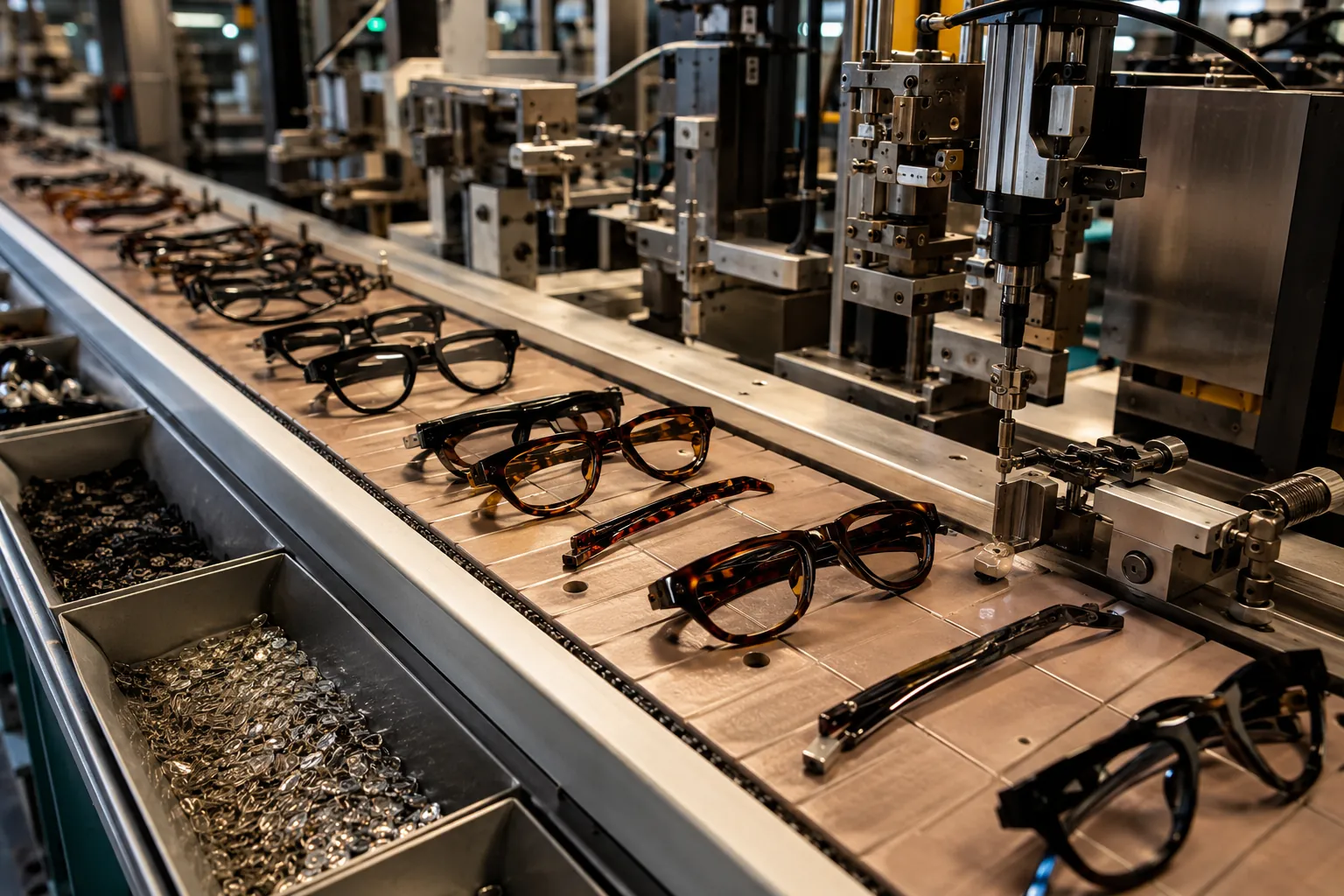
This guide is for brands, importers, distributors, and retail buyers preparing custom sunglasses orders at trial, small-batch, or bulk scale. The goal is simple: catch fit, lens, color, logo, packaging, and compliance problems before mass production starts. That takes physical samples, written specifications, agreed tolerances, and inspection checkpoints. Photos are not enough. Without clear controls, defects usually appear too late—at final inspection, during warehouse sorting, in retail handling, or after customer returns.
Start With a Defect Risk Map, Not a Pretty Sample
A sales sample can look excellent and still be a weak basis for bulk production. One polished frame does not prove repeatability across hundreds or thousands of pairs. Before approving mass production, list the likely failure points: frame shrinkage, loose hinges, lens tint drift, logo rubbing, temple print misalignment, nose bridge discomfort, packaging errors, wrong labels, and missing compliance documents.
Small parts cause big problems. A loose screw can trigger returns. A lens tint that looks fine indoors may look too light, too dark, or uneven in daylight. A pad-printed logo may look sharp in a photo, then fail after rubbing, pouch friction, or retail handling. These are process risks. Treat them that way.
If a supplier controls key processes in-house—such as injection molding, acetate cutting, CNC milling, lens tinting, laser engraving, pad printing, metal logo application, assembly, and QC—the correction loop can be faster. Fewer steps depend on outside vendors. Still, do not rely on verbal promises. The written specification is the working agreement between the buyer, sample room, production floor, QC team, and shipping team.
Build the risk map before deposit or tooling confirmation. If the order uses a new mold, new lens color, new decoration method, new packaging structure, or new market compliance requirement, treat it as higher risk. Require a pre-production sample, first article approval, and a line-check plan. If the order repeats a previously approved model, re-confirm the critical points anyway: material, lens category, logo method, packaging, labeling, and inspection criteria.
Blunt rule: do not approve bulk production from photos alone when the order involves a new mold, new lens color, new logo method, new packaging structure, or regulated market claim.
Separate the Golden Sample From the Control Sample
Many buyers say "sample approved" without defining which sample controls production. That creates room for argument. For custom sunglasses, use at least two physical references: a buyer-approved golden sample and a factory control sample. For larger or multi-SKU orders, keep a third retained QC sample.
- Golden sample: the buyer-approved reference for appearance, color, logo placement, lens tint, finishing, fit, and packaging.
- Factory control sample: the production reference kept on the factory floor for operators, line leaders, and in-process QC.
- QC retained sample: a reference held by the inspection or quality team for final inspection, shipment release, and dispute resolution.
Each sample should be labeled with project code, design number, frame material, lens material, lens category, logo method, packaging version, approval date, and revision number. "Black frame with grey lens" is too vague. Black ABS, black PC, black TR90, black acetate, and painted black over a base material can differ in surface hardness, flexibility, shrinkage, polishing result, and scratch behavior.
The approved sample should come from the intended production method whenever possible. A hand-polished prototype can hide mold flow marks, injection shrinkage, acetate lamination variation, hinge alignment limits, and decoration placement problems. If bulk production will use injection molding, request a pre-production sample from production tooling or confirmed pilot tooling before releasing a large run.
Seal the golden sample in a labeled bag or box and keep it clean. Keep a separate unsealed control sample available to the line leader. If the line later changes a temple curve, lens fit, logo position, screw type, pouch, case, or label, update the sample and approve it again. Do not ask operators to interpret an outdated sample on the production floor.
Define the Tolerances Buyers Often Miss
A sunglasses spec sheet should not rely only on drawings or renderings. It needs measurable tolerances and clear inspection methods. Phrases such as "good fit," "premium finish," or "same as sample" are weak. They sound clear until a defect appears.
| Item to control | Practical tolerance or check | Why it matters |
|---|---|---|
| Frame front width | Set a nominal size with an allowed deviation, commonly around +/-0.5 mm to +/-1.0 mm depending on material, construction, and price point | Affects fit, retail consistency, lens seating, and compatibility with cases or inserts |
| Temple length | Confirm left and right temple length match within the agreed tolerance, such as 0.5 mm where practical, and check fold symmetry | Uneven temples can cause rocking on a flat surface and poor wearing comfort |
| Hinge tension | Define smooth open-close movement, no obvious free play, and no screw loosening after an agreed cycling check | Loose or rough hinges are common return triggers even when the frame looks acceptable |
| Lens fitting gap | No visible gap, stress mark, or lens rattle after assembly; where measurable, define the maximum acceptable gap | Poor lens seating can lead to lens pop-out, cracking, rattling, or optical complaints |
| Logo position | Specify distance from hinge line, temple tip, or other datum point, plus left-right placement tolerance | Prevents inconsistent branding across units and cartons |
| Lens tint shade | Approve a physical tint chip or lens sample under consistent light, ideally D65 or controlled daylight-equivalent lighting | Grey, smoke, brown, green, gradient, and mirror lenses can vary between lots |
Plastic frames need special attention because dimensional movement is normal. Injection-molded materials cool and contract. Acetate changes during cutting, tumbling, polishing, heating, and adjustment. PC and TR90 can be stable when processed correctly, but shape still depends on tooling, temperature, cycle time, and handling. CNC-cut components may be more repeatable than loose manual trimming, but polishing can soften edges and change final dimensions by small amounts.
The tolerance should match the material, construction, and commercial level of the product. Do not demand watch-component tolerances on a low-cost promotional sunglass. Do define what matters to the consumer: fit, symmetry, lens stability, hinge feel, clean finish, and consistent branding.
Classify requirements as critical, major, and minor. Critical requirements affect safety, compliance, or fit, such as lens performance, sharp edges, and secure lens seating. Major requirements affect saleability, such as visible scratches, frame symmetry, logo location, hinge looseness, and wrong packaging. Minor variation may include small non-functional surface marks within an agreed limit. Put the classification in the spec pack before production starts.
Test Lens Performance Before Frame Color Debates
Lens issues create the greatest buyer exposure because they affect user experience, product claims, and market compliance. Decoration defects are usually visible. Lens defects may not be obvious until inspection, testing, or customer complaints.
Confirm the destination-market requirement before sampling. Common references include CE EN ISO 12312-1 for general-purpose sunglasses in many CE-marked markets, ANSI Z80.3 for non-prescription sunglasses in the United States, AS/NZS 1067 for Australia and New Zealand, and REACH for restricted substances in relevant markets. If the supplier has FDA registration, understand the limit: registration is not product approval. It does not replace confirmation of the correct U.S. requirements for the product. If the supplier also holds ISO 9001 or BSCI, treat those as supporting evidence of quality-management or social-compliance systems, not proof that a specific sunglass model meets lens-performance requirements.
Pre-production lens checks should include UV protection confirmation, visible light transmission category where required, lens color consistency, distortion check, surface scratch check, and impact-related requirements where applicable to the target market and product type. Polarized lenses need an additional check for polarization efficiency and axis alignment. A polarized lens that is rotated incorrectly may still look dark, but it will not perform as intended. For gradient lenses, check fade height and balance on both lenses after installation in the frame.
- Confirm lens material: PC, TAC polarized, nylon, acrylic, glass, or another agreed option.
- Approve lens color using a physical lens sample, not a screen image or rendering.
- Define whether lenses are solid tint, gradient, mirror coated, polarized, photochromic, or another construction.
- Request compliance documents tied to the exact product type, lens category, and destination market—not a generic certificate for a different model.
- Keep a retained lens sample for comparison during in-process QC and final inspection.
If the order uses a new tint, new coating, or new supplier batch, request a small pilot lens run before bulk assembly. This is especially useful for grey, smoke, brown, green, mirror, and gradient lenses, where dye time, coating thickness, base lens color, and process temperature can change the final appearance.
Also agree on lens protection after assembly. Some lenses scratch during dry wiping, pouch contact, or carton vibration. If the product uses mirror coating or a high-gloss finish, add a wipe check and packaging-friction check before approving final packing.
Prove Logo Durability Under Real Handling
Logo decoration is a common failure point because approval is often based on a clean close-up photo. Bulk sunglasses are not handled like photo samples. They go through assembly, wiping, curing, pouching, case loading, carton packing, customs checks, warehouse sorting, retail handling, and sometimes repacking.
Choose the logo method based on frame material, coating, order size, brand position, expected wear, and available flat or curved surface area. Laser engraving can be durable on suitable metals and some coated parts, but contrast depends on surface finish and laser settings. Pad printing is flexible and cost-effective, but ink adhesion must be tested on the exact frame material or coating. Metal logo plates can look premium, but they require accurate recess depth, adhesive selection, and placement control. Hot stamping and foil effects can work on suitable surfaces but are less forgiving on tight curves, textured temples, or flexible materials.
Before mass production, ask for practical handling checks: tape pull after curing, dry rub, wet rub, fingernail scratch, and packing-friction check. These are not substitutes for formal laboratory testing where required, but they are useful factory-level screens for weak adhesion. Confirm curing time too. Packing printed temples too soon can cause smudges, ghost marks, transfer marks, or sticking inside pouches.
For production orders, logo jigs and positioning references should be fixed before line start. Ask the supplier to provide first-off production pieces from the actual production line, not only a hand-finished pre-sample from the sample room. If the first pieces show logo drift, inconsistent ink density, tilted plates, or poor registration, stop and adjust the jig. Do it before bad output piles up.
A complete decoration approval also covers secondary branding: pouch printing, cleaning cloth artwork, case embossing or printing, retail box artwork, carton marks, barcode labels, and SKU stickers. A visually perfect frame with the wrong barcode, wrong market label, or mixed SKU carton can still create a receiving and distribution problem.
Use a Scale-Up Gate Before Larger Orders
MOQ and price breaks are useful, but they can push buyers to scale too fast. Do not let price lead the quality plan. Controls should become more formal as order size increases. If a supplier offers trial quantities, small-batch pricing, and bulk pricing, use each stage to remove risk rather than only to negotiate a lower unit price.
| Order stage | Main purpose | Recommended control before moving up |
|---|---|---|
| Trial order | Market test, influencer seeding, fit review, packaging review, small retail trial | Check fit, lens darkness, logo visibility, packaging reaction, basic lens approval, and customer feedback |
| Small commercial batch | First sellable production with controlled exposure | Freeze the spec sheet, confirm carton packing, inspect decoration adhesion, check size consistency, and verify labels |
| Standard production run | Repeatable commercial production | Approve a physical pre-production sample, set an AQL plan, verify product-specific compliance documents, and review first production output |
| Volume program | Higher output with stronger cost, schedule, and consistency pressure | Run a pilot lot where appropriate, confirm component supply, lock QC checkpoints, approve packaging strength, and verify carton markings |
Lead times should be confirmed for the specific product, not assumed from a previous order. Sampling time depends on material, tooling, lens type, decoration method, packaging, and artwork readiness. Bulk production time depends on the same factors plus component availability and inspection requirements.
Late changes cost time. If a buyer compresses the schedule after late artwork, lens, or packaging changes, the risk usually moves into production and inspection.
Use the trial or small-batch stage to find problems while they are still inexpensive to correct. Fit complaints, lens darkness, logo durability, pouch lint, case fit, barcode placement, and carton strength can all be adjusted before a larger run. By the time a program reaches volume production, the team should be controlling process variation—not still deciding the basic design.
Set QC Checkpoints Before Production Starts
Final inspection alone is late. It tells you what went wrong after most components have already been made, decorated, assembled, and packed. For custom sunglasses, set checkpoints before and during production.
- Incoming material check: confirm frame resin, acetate sheets, lenses, hinges, screws, logo parts, pouches, cases, cleaning cloths, labels, printed boxes, and cartons against the approved specification.
- First article check: inspect the first production pieces against the signed sample, drawings, lens specification, logo artwork, packaging layout, and inspection checklist.
- In-process QC: check lens fitting, hinge assembly, screw tightness, polishing marks, print position, color consistency, coating condition, and SKU separation while the line is running.
- Pre-packing check: catch fingerprints, loose screws, lens scratches, mixed colors, missing accessories, wrong pouches, wrong cases, and incorrect labels before cartons are sealed.
- Final random inspection: use agreed sampling, defect classification, and acceptance rules before shipment release.
Define defect categories in advance. Critical defects may include safety risks, wrong product, incorrect lens category, missing required warning or label, sharp edges, broken frame, or a compliance failure. Major defects may include visible lens scratches, poor logo placement, loose hinge, lens rattle, frame color mismatch, incorrect packaging, wrong barcode, mixed SKUs, or any defect that affects saleability. Minor defects may include small non-functional marks within a written and approved limit.
A practical AQL setup for sunglasses usually applies stricter acceptance to critical defects than to cosmetic defects. The exact AQL levels and sample sizes should be agreed in the purchase order or inspection plan. Do not wait until final inspection to argue about what counts as acceptable. If a buyer requires zero tolerance for critical defects, state it before production begins.
On-time shipment and quality approval are not the same thing. Avoid creating a conflict where the shipment date is fixed but the approval criteria are vague. Put inspection criteria, document requirements, packaging requirements, and rework rules in the purchase order or approved spec pack. Make sure the supplier acknowledges them before production starts.
Freeze the Spec Pack, Then Control Changes
The cleanest defect-prevention tool is a complete spec pack. Finish it before deposit or, at minimum, before pre-production sampling. Every later change should be written, dated, and reflected in the sample reference, order confirmation, and inspection checklist.
A practical sunglasses spec pack includes design drawings, dimensions and tolerances, frame material, lens material, lens category, lens color, UV and VLT requirements where applicable, logo artwork, decoration method, packaging layout, barcode and label placement, destination market, compliance references, inspection standard, carton marks, and shipping requirements. For multi-SKU orders, use a matrix that clearly separates frame color, lens color, logo color, packaging, barcode, and carton mark for each SKU. One wrong spreadsheet line can create hundreds of mixed or mislabeled units.
Artwork needs strict control. Vector logo files should state final size, color, placement, orientation, and whether the same logo appears on both temples, one temple, the lens, the pouch, the cloth, the case, the retail box, or the shipping carton. If the brand uses metal plates, confirm plate thickness, finish, recess depth, adhesive, and placement tolerance. If the logo is pad printed, confirm ink color, surface pretreatment if any, and curing requirement. If laser engraved, approve contrast on the actual production material or coating.
Change control is not paperwork for its own sake. It prevents expensive confusion. If a buyer changes from smoke lens to gradient smoke lens after sample approval, that may affect lens production, inspection, product labeling, photography, packaging copy, compliance review, and price. Write it down and request a revised approval sample if the change affects appearance, fit, lens performance, decoration, packaging structure, labeling, or market claims.
The same rule applies to packaging. Switching from a soft pouch to a hard case can change carton size, shipping density, product protection, and drop behavior. Changing a retail box can affect barcode placement and destination-market labeling. Treat packaging as part of the product, not an afterthought.
Have a custom sunglasses project in mind?
Send us your styles, target market and quantities and we will return a detailed quote with MOQ, lead time and a sample plan.
Get a QuoteWhy source this from Wenzhou with LumiShades
Wenzhou in Zhejiang Province is widely regarded as China’s eyewear manufacturing capital, producing a large share of the world’s sunglasses. That concentration matters to buyers: a deep local supply chain for acetate sheet, hinges, lens blanks, plating and packaging means shorter component lead times, easier color and material matching, and a workforce with decades of eyewear-specific skill. LumiShades has manufactured in this ecosystem since 2009, and our vertical integration — in-house injection molding, acetate cutting, CNC milling, lens tinting, decoration and quality control — means no part of your order is quietly subcontracted to a workshop you cannot audit.
For international buyers, that vertical control translates into accountability. When a single factory owns every step, defects are traced and fixed at source rather than bounced between vendors, and your specifications survive intact from first sample to bulk. We back this with 15+ years of experience, shipments to 60+ countries, more than 5 million pairs produced per year and a 98.5% on-time delivery rate. Our certifications — CE EN ISO 12312-1, FDA registration, ANSI Z80.3, AS/NZS 1067, REACH, ISO 9001 and BSCI audit — mean the compliance documentation your market requires already exists. Explore our manufacturing capabilities and quality control process to see how this works in practice.
Frequently asked questions
Should I approve mass production from a digital rendering? No. Use renderings for design discussion only. Approve mass production from physical samples that match the intended frame material, lens material, lens category, logo method, packaging, and label requirements. Keep one sealed golden sample and require the factory to keep a separate control sample on the production floor.
What is the minimum sample process before a bulk sunglasses order? At minimum, approve a physical pre-production sample, confirm lens material and lens category, verify destination-market requirements such as CE EN ISO 12312-1, ANSI Z80.3, AS/NZS 1067, or REACH where applicable, lock logo placement and decoration method, approve packaging and labels, and agree on QC criteria before production starts. If the order uses a new mold, new lens, new logo process, or new packaging, add a first article approval step before full production.
How early should I raise CE, ANSI, AS/NZS, REACH, FDA registration, ISO 9001, or BSCI requirements? Raise them before sampling. The supplier needs the destination market, product type, lens category, and any labeling or document requirements early enough to select the correct lens, materials, packaging copy, and test direction. CE EN ISO 12312-1, ANSI Z80.3, AS/NZS 1067, and REACH relate to product or market requirements. FDA registration, ISO 9001, and BSCI are supplier or system-related references and should not be treated as proof that a specific sunglass model is compliant.
Is a trial order useful if my real target is a large volume order? Yes, if you treat it as a risk test. Use the trial order to check real fit, lens darkness, frame comfort, logo durability, pouch or case quality, barcode placement, customer feedback, and carton handling. Before scaling up, update the spec pack, approve a production-representative sample, and define AQL, defect categories, and compliance documents for the larger order.
What defects should be considered major in sunglasses inspection? Common major defects include visible lens scratches, lens rattle, loose or rough hinges, poor logo adhesion, incorrect logo placement, visible frame marks, color mismatch, wrong lens color, wrong packaging, wrong barcode, missing accessories, mixed SKUs, and defects that affect saleability. Critical defects should be separated and may include unsafe sharp edges, broken frames, incorrect product, wrong lens category, missing required warnings, or compliance failures.
Can price pressure increase defect risk? Yes. Lower pricing can affect material selection, hinge quality, lens choice, polishing time, decoration method, curing time, packaging strength, and inspection coverage. A lower unit price is only useful if the product still meets the approved specification. Do not remove controls such as physical sample approval, lens verification, decoration adhesion checks, and final random inspection simply to hit a price target.
Ready to start?
Explore our sport wrap sunglasses or request a quote — our sales team replies within 12 hours.
Request a Quote