
How to Combine Sunglasses SKUs and Still Hit MOQ
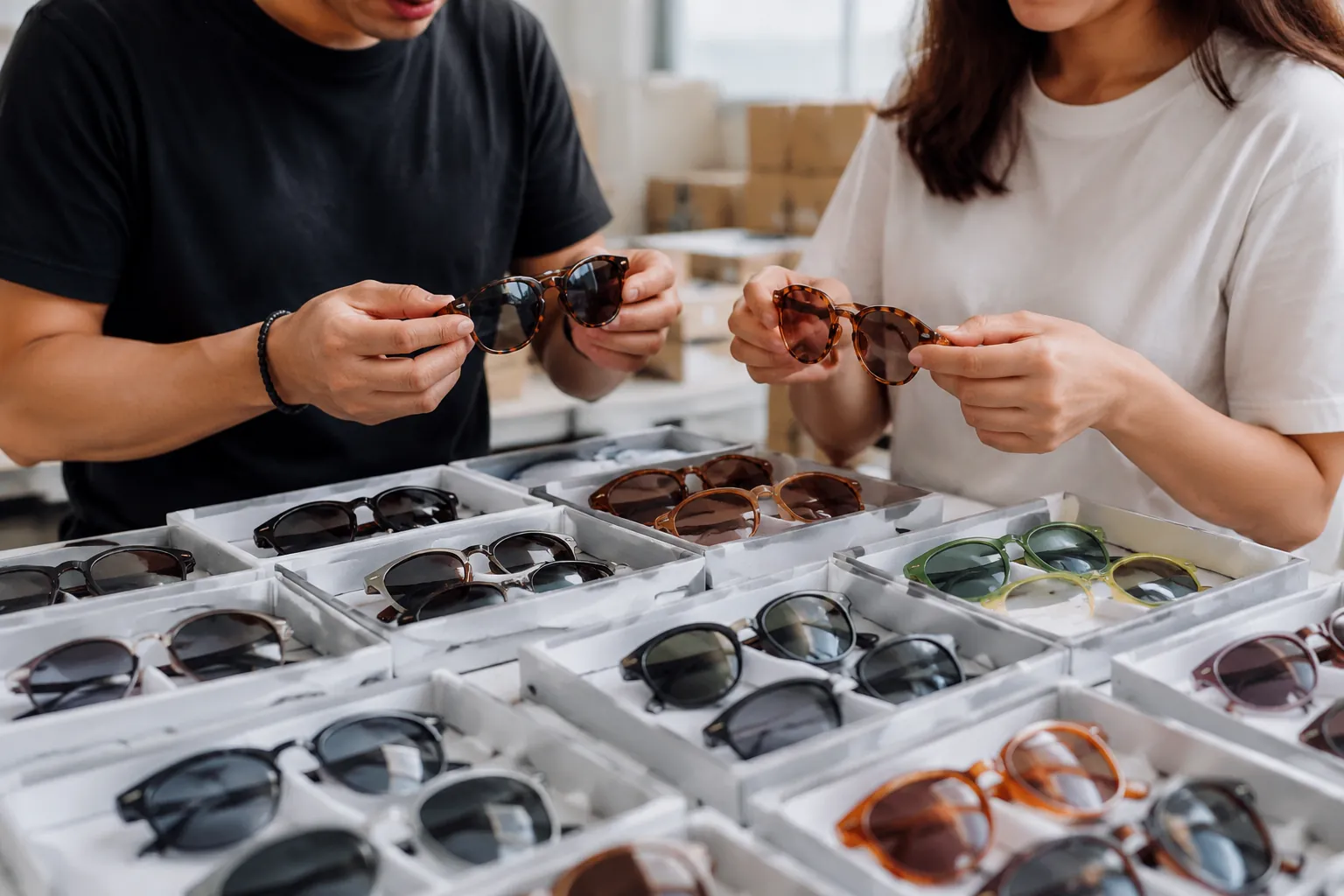
This guide is for buyers who want a wider sunglasses assortment without scattering volume across too many weak SKUs. The goal is simple: launch more looks while still meeting factory minimums, holding unit cost, and keeping the line buildable. In custom sunglasses production, MOQ is rarely just a finished-SKU number. It is usually set by tooling, machine changeovers, lens programs, decoration setups, and packaging splits. Build the range around shared fronts, temples, lenses, and branding methods, and a fragmented concept often becomes a workable production family. That means better cost control, faster approvals, fewer weak colorways, and fewer avoidable disruptions in production.
Start with the factory's real MOQ logic
Many buyers treat MOQ as one number, such as a minimum per style. That is not how production works. MOQ is usually a stack of minimums across parts and processes.
A supplier may quote a low starting MOQ for a repeat style. That number often changes once you add new molds, resin colors, acetate patterns, lens coatings, metal logos, or custom packaging. The headline number is not the whole story.
Ask the supplier to explain MOQ by production unit, not only by finished SKU. A low stated MOQ does not mean every variation is efficient to run. Small orders can still require setup time for lens cutting, decoration alignment, QC reference approval, and separate packing checks.
A buyer should ask the supplier to break MOQ into actual production units rather than only finished SKUs:
- Frame front MOQ by mold, CNC file, or acetate cutting pattern
- Temple MOQ by shape, core wire, hinge drill position, and hardware type
- Lens MOQ by base curve, material, thickness, tint, mirror, and cut size
- Decoration MOQ by pad print plate, laser program, foil stamp, or metal logo plate
- Packaging MOQ for boxes, pouches, cleaning cloths, barcode labels, and inserts
This matters. A collection of eight SKUs can run well if it shares one front mold, one hinge program, one lens blank specification, and one packaging set. The same eight SKUs become hard to manage if each one changes resin color, lens coating, trim, and barcode version. In practice, MOQ pressure usually comes from the number of separate setups, not the number of lines in the PO.
Build the range around shared components
The safest way to widen a collection is to treat each SKU as a modular combination, not a fully unique product. Shared components make a low-MOQ assortment possible.
A small launch might use one front shape, two temple options, several lens tints, and one or two branding methods. That still gives you real range. It also avoids forcing the factory to tool completely new parts for every variant.
If hinge spacing, temple fit, and lens groove geometry stay the same, the supplier can often run structural parts in larger batches and split later at the lensing or decoration stage. That is where you want variation. Later, not earlier.
For custom sunglasses, the biggest cost and timing drivers are usually front tooling, acetate cutting yield, lens sourcing, and metal trims. Decorative elements are often easier to vary than structural ones. Plan around that fact.
| Component | Good for sharing? | Typical MOQ impact | Lead-time effect |
|---|---|---|---|
| Front mold or frame shape | Very high | Usually the largest driver; a new tool often increases minimum commitment or adds tooling cost | High; tooling development and approval can extend the schedule |
| Temple shape and hinge drilling | High | Major driver; separate temple programs usually need cleaner volume allocation | Moderate; changes often add engineering and approval steps |
| Lens tint on same base curve and cut size | Moderate | More manageable if material and thickness stay constant | Low to moderate; depends on tinting or coating route |
| Pad print artwork | High | Usually lower impact; setup is mainly plate and alignment work | Low; often easier to add late than structural changes |
| Metal logo plate | Moderate | Can raise minimums on small runs because parts are custom-made | Moderate; plating, attachment, and approval add steps |
| Retail packaging | Low | Separate MOQ risk, especially for custom-printed boxes and inserts | High if artwork or approval is delayed |
Rule of thumb: keep the expensive structural parts common and vary the lower-risk elements later in the process. That is how you add width without wrecking build efficiency.
Use color splits that match real production flow
Color planning is where many launches lose MOQ efficiency. A style can look balanced on a line sheet while creating too many short runs on the floor. Nice on paper. Bad in production.
Frame colors and lens colors behave differently in manufacturing. In injection molding, every resin color change means cleaning, purging, restart checks, and extra inspection for contamination or color shift. In acetate, different sheet patterns can affect cutting yield, grain appearance, and polishing consistency. For lenses, the main control points are tint consistency, visible light transmission, coating performance, and left-right matching within a pair.
For a moderate-volume launch, a more workable split is usually:
- Put the largest share of volume into one core frame color.
- Put the next-largest share into one proven secondary color.
- Limit test colors to a small combined share of the order.
- Keep lens material, base curve, thickness, and cut size shared even when tint changes.
Instead of dividing a style evenly across many low-volume combinations, concentrate volume in one lead colorway, one secondary colorway, and only one or two test options. The visual range can still work commercially, but the supplier gets longer runs, fewer changeovers, and more consistent QC.
This also helps compliance control. If lens tint changes but lens material and construction stay the same, the factory has fewer variables to manage. If you add mirror coatings, polarization, or major transmission changes, recheck the applicable standard against the final bulk lens route, not only the development sample. Common references include CE EN ISO 12312-1, ANSI Z80.3, and AS/NZS 1067, depending on the target market.
Group SKUs by manufacturing route
Many assortment plans fail for one reason: the range is grouped by trend story, gender segment, or retail price instead of by manufacturing route. The factory does not schedule by story. It schedules by process.
If four SKUs use the same injection front, standard hinge construction, and the same lens cut, they can usually move through molding, trimming, lensing, decoration, and packing as one family. If another SKU needs acetate bevel changes, custom wire-core temples, and applied metal plates, plan it separately even if it sits in the same catalog story.
A buyer-friendly grouping method is:
- Injection family: same front mold, same temple fit, standard lens specification, color changes only
- Acetate family: same thickness, same cut plan, limited sheet variation, shared hinges
- Premium trim family: shared structure but with metal logos, hot foil, or special plated parts
- Fast-repeat family: proven body with only lens tint or print updates
This matters because each route behaves differently on lead time. Standard injection programs are usually easier to repeat than acetate programs with extra CNC and polishing control. Premium trims can also slow completion if outside parts such as logo plates or custom boxes are approved late. Group by route, then split one PO into realistic production families so simpler SKUs are not held back by slower ones.
Plan compliance and tolerances before freezing the range
Compliance is not paperwork you handle at the end. It affects what you can safely combine.
If two SKUs share the same frame material, lens material, lens category, and basic construction, they are easier to manage as one family. If one version adds a mirror coat, polarized lens, or different transmission level, it may need separate validation or at least a separate confirmation against the relevant standard.
Lock dimensional and cosmetic tolerances before bulk starts. In sunglasses production, common control points include overall size tolerance, lens fitting without visible edge stress, hinge alignment with smooth opening and closing, and repeatable logo placement. For lenses, the appearance standard should cover tint consistency, surface defects, and left-right matching within the same pair. Exact tolerances should be agreed with the supplier and written into the approved specification.
Before final approval, confirm these points in writing:
- Lens category and visible light transmission range by SKU
- UV performance for each lens route
- Frame and lens material declarations relevant to REACH or other required chemical controls
- Marking, warning text, and packaging differences by destination market
- Whether sample and bulk lenses use the same tinting, coating, and cutting process
The last point is critical. A development sample may use one lens route while bulk uses another for speed, yield, or sourcing reasons. If that changes transmission, color tone, polarization structure, or mirror adhesion, the sample is no longer a reliable production reference. Lock the route early, especially for mirrored, polarized, or gradient programs.
Use a production matrix to approve the right SKUs
Strong buyers do not approve collections one SKU at a time. They use a production matrix that shows which parts are shared, where MOQ pressure sits, and which combinations create work without enough commercial return.
Your matrix should track at least these fields: front, temple, hinge, lens material, lens color, logo method, packaging, destination market, forecast volume, and fallback substitution. Once you map the collection this way, weak combinations become obvious. You can see where tiny quantities are forcing a separate setup for little gain.
Here is a simple example for a 600-pair launch:
| SKU Family | Shared Parts | Planned SKUs | Total Pairs | Risk Level |
|---|---|---|---|---|
| Sport wrap injection | Same front, same temple, same lens cut and material | 3 colors | 300 | Low |
| Classic square acetate | Same temple, two acetate patterns, same hinge and lens spec | 2 colors | 180 | Moderate |
| Fashion oversize with metal plate | Shared front only; custom trim and logo plate | 2 colors | 120 | High |
This kind of matrix improves decisions fast. In the example above, the last family carries the highest setup burden per pair. A buyer might cut it from two colors to one, change the metal plate to pad print, or move it to a later phase. Better to simplify early than chase delays later.
Tie sample approval to bulk efficiency
Many MOQ problems start in sampling. Buyers approve too many variations because sampling feels cheaper than bulk. It is. But every approved sample can become a production obligation later, and every obligation adds setup, QC references, and delay risk.
Use sampling to remove options, not add them. Start with the structural base: fit, eye size, bridge, temple balance, hinge feel, and lens seating. Once that is fixed, sample only the colorways and branding methods that have a real chance of carrying volume.
A disciplined sample path usually looks like this:
- Approve one core size set and fit review for the main shape.
- Approve one frame material finish and one hinge construction.
- Approve two or three lead colorways only, not every possible tint split.
- Approve decoration by actual process, such as pad print, laser engraving, hot foil, or metal plate.
- Freeze the bill of materials before the final PO split.
This also makes QC easier. When the approved reference is controlled, inspectors can check dimensions, cosmetics, hinge alignment, lens fit, logo position, and packing against one stable standard. If sampling allows too many exceptions, bulk inspection gets slower and rejection risk usually rises.
Negotiate pricing by volume block, not by SKU
Factories price with more confidence when they can see the full production structure. If you negotiate every SKU on its own, low-volume variants usually stay expensive because the supplier has to cost each setup separately. If you present a combined build plan with shared materials and shared routing, the factory can often quote by family or by aggregate component volume.
When requesting a quote, ask for three pricing views:
- Price by exact SKU quantity
- Price by grouped family quantity
- Price by total collection quantity with shared components clearly marked
Then ask the most useful commercial question: what is the cheapest way to keep the same visual story with fewer setups? Sometimes the answer is dropping one frame color. Sometimes it is standardizing one lens specification across several styles. Sometimes it is changing an applied metal logo to pad print or laser marking. Those are not design failures. They are production decisions.
Broad collections can work at low MOQ, but only if the production plan comes first and the line sheet comes second. Ask the supplier to show the real cost drivers, confirm whether custom packaging has its own MOQ, and document every approved substitution before the PO is released.
Have a custom sunglasses project in mind?
Send us your styles, target market and quantities and we will return a detailed quote with MOQ, lead time and a sample plan.
Get a QuoteWhy source this from Wenzhou with LumiShades
Wenzhou in Zhejiang Province is widely regarded as China’s eyewear manufacturing capital, producing a large share of the world’s sunglasses. That concentration matters to buyers: a deep local supply chain for acetate sheet, hinges, lens blanks, plating and packaging means shorter component lead times, easier color and material matching, and a workforce with decades of eyewear-specific skill. LumiShades has manufactured in this ecosystem since 2009, and our vertical integration — in-house injection molding, acetate cutting, CNC milling, lens tinting, decoration and quality control — means no part of your order is quietly subcontracted to a workshop you cannot audit.
For international buyers, that vertical control translates into accountability. When a single factory owns every step, defects are traced and fixed at source rather than bounced between vendors, and your specifications survive intact from first sample to bulk. For procurement review, buyers can request process records, approved samples, quality checkpoints and project-specific compliance files before placing a bulk order. Required testing and documentation are confirmed against the destination market and product specification rather than assumed from a generic certificate list. Explore our manufacturing capabilities and quality control process to see how this works in practice.
Frequently asked questions
Can I combine several colorways to meet one MOQ? Often yes, but only if the supplier confirms which elements count as the shared production base. Ask for written confirmation on whether MOQ is calculated by front mold, temple program, lens specification, decoration setup, or full finished SKU. Before sampling and PO release, get a matrix that shows exactly which colorways share structure and which changes trigger a new minimum or added setup cost.
What is the safest number of colorways for a new style at 300 pairs? A conservative starting point is usually two core colorways and one test color, provided the structural parts stay the same. The real issue is not the number alone. It is whether each colorway carries enough volume to justify production and inspection. Ask the supplier what quantity per colorway still runs efficiently for that frame construction, then put most of the order into one lead color and one secondary color instead of spreading volume evenly across many small variants.
Does changing lens color affect compliance? It can. Different tints, mirror coatings, polarization structures, or visible light transmission levels may change lens category or test outcome. Confirm the final bulk lens specification against the relevant market standard, such as CE EN ISO 12312-1, ANSI Z80.3, or AS/NZS 1067. Do not rely only on the development sample if the bulk lens route, coating, or material source changes.
Should packaging be included in the same SKU consolidation plan? Yes. Packaging often has its own MOQ and approval path, and it can delay shipment even when the eyewear is finished. Include boxes, pouches, labels, barcode stickers, inserts, warning text, and market-specific markings in the same planning sheet as frames and lenses. Ask the supplier to identify which packaging items are custom, what their minimum order quantities are, and what approvals are required before production can start.
How do I stop one difficult SKU from delaying the whole order? Split the PO into production families and agree milestone dates by family before bulk starts. Identify which SKUs depend on slower steps such as acetate machining, custom metal trims, special lens routes, or custom packaging, and separate them from repeatable core programs. Also agree on fallback options in writing, such as changing a logo method or removing a late packaging element, so the easiest part of the order can ship without waiting for the highest-risk SKU.
Ready to start?
Explore our wayfarer sunglasses or request a quote — our sales team replies within 12 hours.
Request a Quote