
Compare Sunglasses Suppliers by Tooling Control
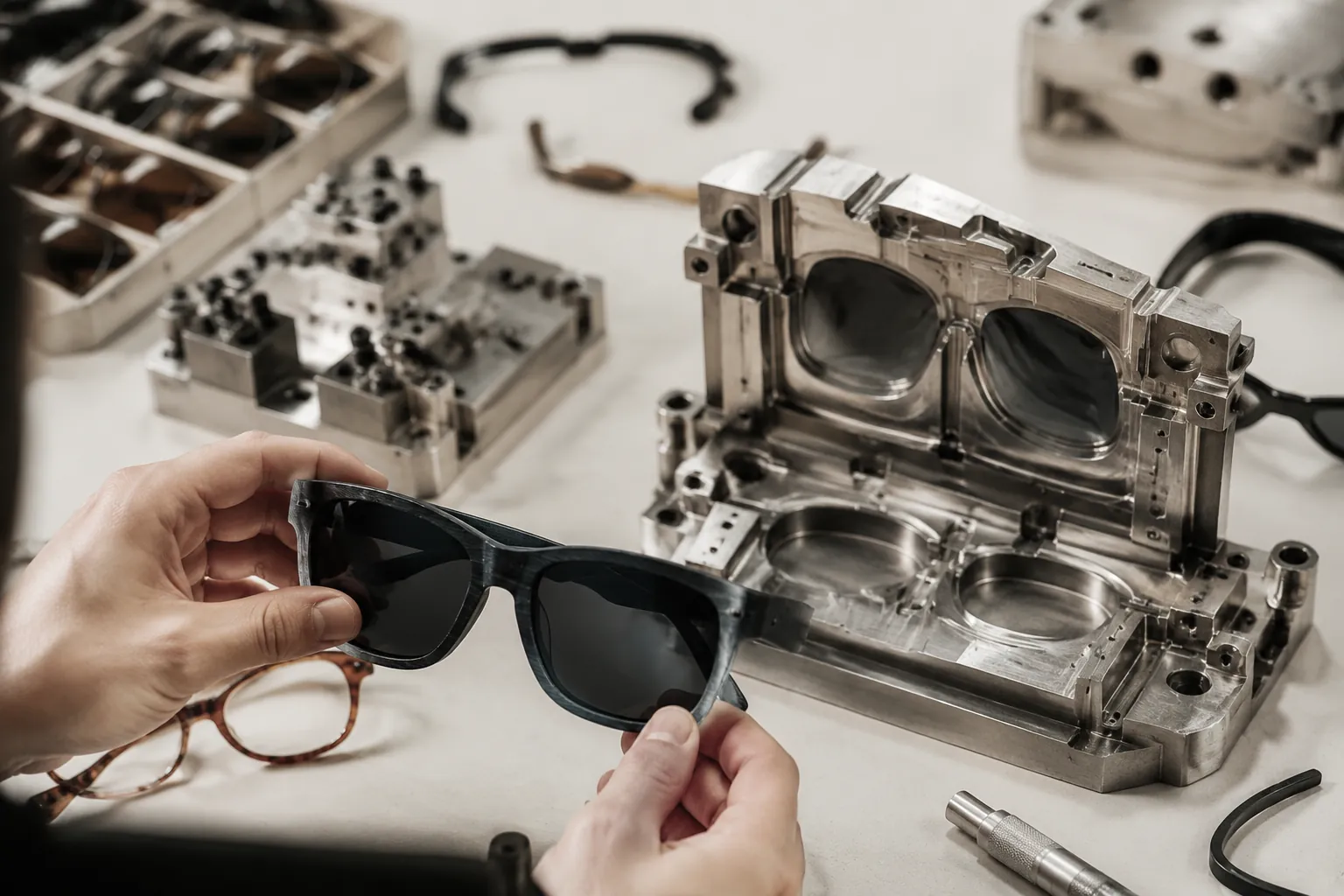
If you buy custom sunglasses for a brand, retail chain, importer, or distributor, unit price is only one line in the decision. Tooling control affects lead time, maintenance, repeat quality, and your ability to move or reorder a style. This guide shows how to compare suppliers by the risks that shape the full program, not just the quote sheet.
Why unit price is the wrong first filter
A low unit price can hide a weak process. If the supplier cannot explain who controls the mold, who repairs it, or which spare parts keep production running, the quote may look good while the order remains exposed to delay and rework.
In eyewear, tooling drives repeatability. Repeatability decides whether an approved sample can be made again at the same standard six months later. That is the real test.
Start with basic control questions. Who owns the tooling? Where is it stored? Who maintains it? Who can approve changes? If those answers are unclear, the supplier may be selling access to capacity rather than control of the process. That might work for a one-time trial. It is risky for a style you plan to reorder.
Tooling affects lead time, product consistency, reject rate, and landed cost. A worn mold can cause flash, poor fit, weak hinge alignment, or inconsistent lens seating. A missing insert or damaged cavity can stop production until the part is repaired or remade.
Buyers do not need to become mold technicians. They do need enough visibility to compare suppliers fairly. The sharper question is not "Who is cheapest?" It is "Which supplier can keep this style stable, traceable, and repeatable over the life of the program?"
Tooling ownership: what buyers should ask
Do not stop at "Can you make this?" Ask who paid for the mold, who physically holds it, and whether it is stored at the factory, with a tool shop, or with a buyer representative. Ask who approves modifications. Ask who pays for polishing, vent cleaning, welding repair, cavity replacement, or fixture updates.
If the supplier cannot answer these points clearly, control may be weaker than the sales pitch suggests.
- Ask for the mold number, cavity count, and tool revision history.
- Confirm the tool material or steel grade and whether hardened inserts are used.
- Request the maintenance log, including cleaning intervals and the last repair date.
- Check whether the supplier can release or ship the mold if production moves.
- Confirm whether the mold is dedicated to your SKU or shared across customers.
- Ask whether spare ejector pins, inserts, or polishing records are kept on file.
For sunglasses, tooling is not limited to frame injection molds. It can also include acetate cutting fixtures, lens tinting jigs, logo plate tooling, pad-print screens, ultrasonic welding fixtures, and assembly gauges. If a supplier controls these items in-house, changes are usually easier to trace and correct.
Material choice changes the tooling question. Injection materials need control of temperature, gate balance, and cooling time. Acetate depends on cutting accuracy, polishing, storage, and fixture stability. Metal parts bring bending, plating, laser marking, and CNC finishing requirements. The supplier should be able to explain how the tool system matches the material and process used for your style.
What in-house capability changes
In-house capability matters because it cuts handoffs. Fewer handoffs mean fewer delays and fewer blind spots. If one supplier handles injection molding, acetate cutting, CNC milling, lens tinting, decoration, assembly, and QC under one roof, it is usually easier to find where a defect started.
If a frame front needs a gate correction, draft adjustment, or shrinkage fix, an in-house team can inspect the tool, run a test shot, and check fit without waiting for another company. That does not guarantee speed. It does make the corrective path clearer.
The same applies to CNC work. Repeatable machining helps keep detail, bridge shape, hinge pockets, and fit points consistent across batches.
Acetate work has different risks. Sheets must be stored properly, handled carefully, and cut with fixtures that hold the intended outline. A weak fixture can create edge damage, poor symmetry, or excess waste. A capable supplier should explain how acetate and injection styles are controlled differently.
Decoration is another control point. Laser engraving, pad printing, heat transfer, and metal logo plates affect appearance and rejection risk. If decoration is outsourced, there is more room for color shift, print misalignment, cure problems, and inconsistent marking. In-house QC can catch those problems before packing, while rework is still possible.
Look for practical signs: faster sample feedback, clear ownership of corrections, and inspection records from incoming material to final packing. Ask where the first inspection happens, how sample changes are logged, and how a defect is tied back to the process step that created it.
Compare supplier types the right way
Most buyers meet four supplier models. The labels matter less than the control behind them. The model affects lead time, accountability, and your leverage if the product needs a change mid-program.
| Supplier model | Tooling control | Typical risk | Best fit |
|---|---|---|---|
| Factory owns and runs tools in-house | High | Lower handoff risk, faster corrective action, clearer traceability | Brand owners, repeat programs, private label lines, seasonal rollouts |
| Factory runs buyer-owned tools | Shared | Good control if records are clean; risk rises if mold history, storage, or maintenance are weak | Programs with long life, stable SKUs, and predictable reorder cycles |
| Trader or agent-managed production | Low | Limited visibility on maintenance, timing, and defect root cause | Small orders, trial runs, noncritical styles, market tests |
| Hybrid model with external tool shop support | Medium | Potential delay if repair work depends on outside capacity | Projects with moderate volume and occasional design changes |
A factory with visible internal steps is easier to evaluate because the production path can be inspected. That does not make every factory reliable. It means the buyer can review the process instead of guessing how many outside parties touched the work.
Score each supplier on control points: tool ownership, tool storage, maintenance records, in-process inspection, sample correction speed, and repeat output. If two suppliers quote similar prices, the one with stronger control often has the lower true cost. Scrap, sample churn, and remake risk are costs too.
How tooling ownership affects lead times
Lead time is not just a date on a quote. A schedule is credible only when the tooling status is known and the order has passed approval. If the mold needs correction, bulk production slips. If a spare insert is missing, the line waits. If decoration screens are wrong, semi-finished goods can pile up and create a hidden bottleneck.
Small orders may move quickly because the job is short and the tool is fresh. Larger runs expose weaknesses. A worn gate, damaged ejector pin, blocked vent, or unbalanced cavity can create batch-to-batch variation. The longer the run, the more expensive that variation becomes.
Ask for the production sequence: mold trial, first article inspection, color matching, mass run, final QC, and pack-out. Then ask what happens if the first trial misses spec. Does the supplier re-cut, re-polish, re-run, or charge for another round? How many iterations are included before extra costs apply?
A disciplined supplier should state whether a sample is a visual proof or a production-ready approval sample. Those are not the same.
Timing depends on design complexity, material availability, tool stability, and decoration. A sample can be faster when the design is close to existing tooling and the decoration is simple. Bulk can be faster when materials are on hand and no corrections are needed. Add time for new lenses, custom plating, difficult color matching, or a new mold cavity.
Mold health is part of lead-time control. Cooling channels need cleaning. Vents must stay open. Wear surfaces must stay aligned. Maintenance is not a side task. It protects the schedule.
Pricing should follow tooling, not hide it
Tooling control changes what the unit price means. One quote may exclude maintenance, repair, or future revisions. Another may include them and look higher on paper. Compare the full program, not only the first order.
If you compare only the first carton, you can miss the cost of reorders, revisions, repairs, downtime, and extra sample rounds.
- Ask whether tooling cost is included in the unit price or billed separately.
- Ask what happens if the frame needs a steel insert replacement or cavity polish.
- Ask whether decoration tooling, screens, plates, or fixtures are charged separately.
- Ask who pays for samples if the first mold trial misses spec.
- Ask how many production cycles the supplier expects before refurbishment is needed.
- Ask whether the quote changes if the order moves from a small trial to a larger repeat order.
Order size can improve pricing because setup cost is spread across more units and machine time is used more efficiently. But that benefit depends on a stable tool. If the mold needs repeated adjustment, the savings disappear.
Price should also reflect material and finishing requirements. A simple injection style is usually easier to run than a thick acetate frame with hand polishing and metal decoration. A matte surface may hide minor variation better than a high-gloss finish. The same tool can create different risk depending on the finish standard. Do not treat every pair of sunglasses as the same sourcing job.
Compliance and documentation still matter
Tooling control does not replace compliance. A supplier can control the mold and still ship a product that fails the destination market's requirements. Request the correct test and registration documents for the target market, and make sure the approved sample matches the shipment.
- CE EN ISO 12312-1 for sunglasses sold into applicable EU channels.
- ANSI Z80.3 for U.S. fashion sunglasses testing context.
- AS/NZS 1067 for Australia and New Zealand requirements.
- REACH for chemical restriction awareness on materials and finishes.
- FDA registration where applicable to the supplier and product pathway.
- ISO 9001 and BSCI as management and social compliance references, not product approval by themselves.
A clean tooling story should not distract from required test reports. Proper tooling does not guarantee correct lens tint, UV performance, impact behavior, labeling, or chemical compliance.
Tie sample approval to the intended standard, not only to appearance. For tinted lenses, ask whether tint consistency, coating, thickness, and transmission targets are recorded in the approval file.
Documentation should also support traceability. A strong supplier can link the production order to the mold revision, lens specification, decoration method, and final QC record. That matters when a retailer or distributor needs to isolate a problem batch. Better records make repeat orders easier to verify against the approved sample.
A practical supplier audit checklist
Before you place an order, ask for direct answers. Short answers are fine. Vague answers are not. The goal is to confirm whether the supplier can repeat the work, not whether they can talk around it.
| Audit item | What to request | Why it matters |
|---|---|---|
| Mold ownership | Purchase record or written control statement | Confirms who can move, repair, or reuse the tool |
| Maintenance history | Last repair date, parts replaced, and cleaning frequency | Shows whether the tool is production-ready |
| Sample path | Sample lead time and approval steps | Reveals whether the tool and line are actually ready |
| Bulk capacity | Daily output and bottleneck process | Shows whether the quoted lead time is realistic |
| QC checkpoints | Incoming, in-process, and final inspection points | Reduces defect leakage into shipment |
| Decoration control | Print method, cure time, and logo tolerance standard | Prevents cosmetic issues from appearing only at pack-out |
If the supplier is a real manufacturer, these questions should be routine. They should be able to support answers with records, photos, sample labels, or inspection forms where needed. If they cannot, you are not comparing factories. You are comparing claims.
A strong audit also checks practical tolerances. Confirm hinge symmetry, lens fit, temple alignment, bridge feel, and opening tension on a physical sample. A product can look right in a drawing and still fail in use if the arms sit unevenly or the lens fit is loose.
Use the same framework for every quote: tool ownership, tool health, process visibility, sample cycle, bulk repeatability, and documentation. Then price becomes easier to read. You can see what is included and what has been pushed into risk.
For a brand or importer, the best supplier is not always the cheapest on day one. It is the one that can repeat the approved product later without avoidable disruption. If you buy sunglasses regularly, tooling control is not an internal factory detail. It is part of your supply chain risk profile.
Have a custom sunglasses project in mind?
Send us your styles, target market and quantities and we will return a detailed quote with MOQ, lead time and a sample plan.
Get a QuoteWhy source this from Wenzhou with LumiShades
Wenzhou in Zhejiang Province is widely regarded as China’s eyewear manufacturing capital, producing a large share of the world’s sunglasses. That concentration matters to buyers: a deep local supply chain for acetate sheet, hinges, lens blanks, plating and packaging means shorter component lead times, easier color and material matching, and a workforce with decades of eyewear-specific skill. LumiShades has manufactured in this ecosystem since 2009, and our vertical integration — in-house injection molding, acetate cutting, CNC milling, lens tinting, decoration and quality control — means no part of your order is quietly subcontracted to a workshop you cannot audit.
For international buyers, that vertical control translates into accountability. When a single factory owns every step, defects are traced and fixed at source rather than bounced between vendors, and your specifications survive intact from first sample to bulk. We back this with 15+ years of experience, shipments to 60+ countries, more than 5 million pairs produced per year and a 98.5% on-time delivery rate. Our certifications — CE EN ISO 12312-1, FDA registration, ANSI Z80.3, AS/NZS 1067, REACH, ISO 9001 and BSCI audit — mean the compliance documentation your market requires already exists. Explore our manufacturing capabilities and quality control process to see how this works in practice.
Frequently asked questions
Should I buy my own sunglasses molds or let the factory own them? If the style is core to your brand and you expect repeat orders, buyer-owned molds usually give you more control over reorders, transferability, and long-term availability. If the style is a short run or trial design, factory-controlled tooling can be simpler. Ownership alone is not enough. Put storage, maintenance, revision approval, and release rights in writing.
What is the biggest hidden cost in cheap tooling? Repair and downtime. A mold that wears quickly can cause flash, poor fit, gate problems, slow cycles, and extra sampling rounds. Those delays often cost more than the initial savings, especially when a retail launch or reorder window is tight. Ask what maintenance is included and what is billed as repair.
How do I know if a supplier really controls the tooling? Ask for the mold number, storage location, maintenance log, cavity count, and change approval process. A supplier that controls the tool should have records that match the style, revision, and production history. If answers change from one contact to another, control may be weak.
Does in-house QC replace third-party testing? No. In-house QC helps catch defects early, but it does not replace test and registration requirements for the target market. Depending on the market, that may include CE EN ISO 12312-1, ANSI Z80.3, AS/NZS 1067, REACH-related checks, FDA registration where applicable, and management-system references such as ISO 9001 or BSCI. Internal inspection and external compliance testing solve different problems.
What lead time should I expect for custom sunglasses? Lead time depends on tool stability, material readiness, decoration, finishing, and approval speed. A simple sample may move faster than a complex one. Bulk may move faster when the tool is already approved and no corrections are needed. Add time if the supplier must fix the mold, rework decoration, source special lenses, or match difficult finishes.
What MOQ makes tooling ownership worth caring about? Care about tooling as soon as you expect a repeat order. Even at a small trial quantity, tooling control affects whether the second order matches the first. At higher volumes, it becomes a major factor in quality, scheduling, and total cost. Ask about tooling on every style you may reorder.
Ready to start?
Explore our sport wrap sunglasses or request a quote — our sales team replies within 12 hours.
Request a Quote