
Choosing Sunglass Frame Flex Without Losing Shape
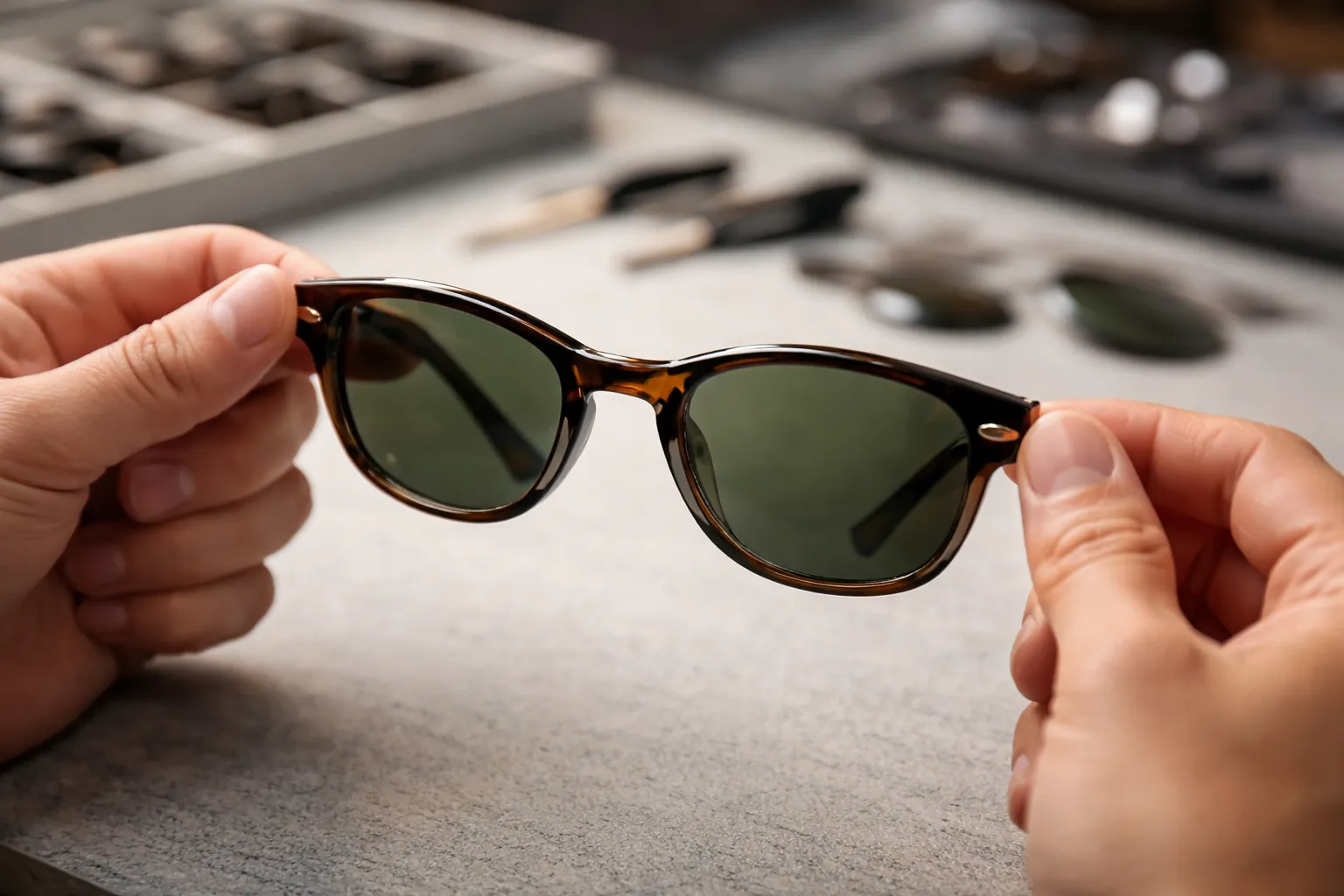
Buying frames for retail or private label is not just a style choice. Flexibility affects comfort, fit returns, breakage, and whether the frame still looks straight after heat, pressure, and shipping. For volume programs, the goal is controlled flex: enough give to improve comfort, enough structure to keep the frame aligned in packing, transport, and daily use.
What Flexibility Means in Sunglass Frames
Buyers often ask for a "flexible" frame. That phrase can mean three different things. First is initial bend: how easily the temples open and how much the front moves during handling. Second is recovery: whether the frame returns to its original position after stress is removed. Third is shape retention: whether the front keeps its geometry after storage, shipping, and wear.
Those are not the same thing. A frame can feel soft in hand and still drift out of alignment over time. Another can feel stiffer and still hold its front curve better. Simple as that.
For most B2B programs, the target is not maximum flexibility. It is controlled flex. You want enough give to reduce pressure at the hinge and temple tips, but not so much that the front twists, the bridge opens, or the lens groove loosens.
Material Behavior: Acetate, Injection, TR90, and Metal
Each material balances comfort, recovery, and geometry control differently. The wrong choice usually fails in a predictable way. Acetate can deliver a premium look and a strong finish, but thin geometry or weak hinge construction makes it more vulnerable to heat-related distortion. Injection-molded frames can be light and economical, but performance depends heavily on resin grade and wall design. TR90 and similar nylon-based materials are widely used for impact resistance and flexibility, but they still need careful tooling to avoid overly soft geometry. Metal frames can hold shape well, but their performance depends on gauge, bridge design, hinge design, and solder quality.
LumiShades works with injection molding, acetate cutting, CNC milling, lens tinting, and decoration in-house, so the frame choice can be matched to the build method. That matters. A flexible resin frame with poor gate placement or uneven wall thickness can still distort. A thicker acetate front with a weak hinge set can still fail at the temple joint.
| Material | Flex / Recovery | Shape Retention | Typical Buyer Use | Main Risk |
|---|---|---|---|---|
| Acetate | Moderate flex, good hand-feel | Good if thickness and milling are controlled | Fashion, mid- to premium-price programs | Heat warp, hinge pull-out, uneven polish stress |
| Injection plastic | Depends on resin grade and wall design | Good for stable molds, weaker if thin | Entry to mid-range volume programs | Creep, whitened stress marks, front twist |
| TR90 / nylon-based | High flex, strong recovery | Moderate to good with proper tooling | Sports, lightweight casual, travel sets | Too soft if over-thinned; finish limitations |
| Metal | Low to moderate flex | Very good if gauge and solder points are sound | Minimalist, optical-inspired, premium light frames | Permanent bend, hinge fatigue, plating wear |
The real question is not which material flexes most. It is which one keeps the frame aligned after repeated use and transport.
Where Frames Lose Shape in Real Use
Most shape problems do not start with the customer. They start earlier. Common failure points are temple hinges, bridge transitions, rim corners, and any area where wall thickness changes suddenly. If the front is too thin near the lens groove, the frame can ovalize. If the temple is long and narrow without enough section depth, it will keep bending at the same spot.
Heat is another issue. A dark acetate frame left in a hot parcel line or vehicle can soften enough to shift. Injection frames can creep if the resin choice is poor or the design is too slender. Metal frames usually resist heat-related softening better than plastics, but a bent wire temple does not recover on its own. It stays bent.
Good factories test shape loss by more than hand feel. They check temple opening cycles, bridge spread, front width after stress, and whether lens fit changes after load. Buyers should ask how the factory controls wall thickness, hinge insertion depth, and final symmetry inspection. Those controls matter more than broad claims about flexibility.
How Construction Changes Flex and Recovery
Two frames made from the same material can perform very differently. Construction is the reason. A thicker acetate front with balanced milling around the lens groove will resist distortion better than a thinner front with aggressive cut-outs. A molded plastic frame with reinforced hinge bosses will usually survive more cycles than a plain lightweight shell. A metal frame with spring hinges can improve comfort, but it also adds parts, assembly time, and cost.
For volume buyers, the most useful design questions are simple:
- Is the front one-piece, laminated, or multi-material?
- Where does the thickness drop off near the hinge and bridge?
- Are the temples straight, spring-loaded, or curved for grip?
- Does the frame need memory, or just enough give to avoid pressure points?
LumiShades uses CNC milling for acetate frames, which helps keep thickness and edge control consistent. Poor milling creates weak spots that may look fine in photos but distort during storage or transport. On injected parts, the mold must be designed for uniform fill and cooling. If the part cools unevenly, the frame may look aligned at packing and arrive slightly off at destination.
The Buyer Tradeoff: Comfort, Cost, and Return Rate
Comfort helps sell the first pair. Shape retention protects the repeat order. A frame that feels soft in hand may do well in a quick fitting, but if it spreads at the temples or warps around the lens area, the cost shows up later in returns, repacking, customer service, and margin loss.
For custom programs, MOQ and pricing also affect the frame choice. Simpler constructions usually cost less to produce and are easier to keep consistent. More complex builds can improve comfort or aesthetics, but they also add failure points and more variables in production. Buyers should avoid specifying spring hinges, metal inserts, or hybrid constructions unless the target market really needs them.
Use the least flexible structure that still passes comfort and fit requirements. Extra softness is not free. It usually costs you in shape retention.
What to Ask a Supplier Before You Order
Good sourcing questions are specific. Vague questions get vague samples. Before production, ask the factory to define what "flex" means in the context of your design. Then ask for the test point, not just the finished sample.
- What material grade is being used, and is it the same in samples and bulk?
- What wall thickness is held at the bridge, temple root, and rim?
- How is hinge pull-out prevented?
- What recovery should be expected after repeated bending?
- Will laser engraving, pad printing, or metal logo plates change any stress points?
- How does the factory verify symmetry before packing?
Also ask for a realistic sample timeline and bulk timeline. Sampling and production timing depend on design complexity, tooling, materials, and decoration. If a frame is too soft, you want to know before bulk units are booked.
Compliance and Testing
Flexibility claims should sit next to compliance, not replace it. For export programs, the relevant certifications and standards are the ones buyers can verify: CE EN ISO 12312-1, FDA registration, ANSI Z80.3, AS/NZS 1067, REACH, ISO 9001, and BSCI. Do not accept invented labels or unsupported claims.
Compliance does not tell you whether a frame keeps its shape. It does tell you whether the product platform is being managed in a disciplined way. REACH matters for substance control. ISO 9001 matters for process consistency. BSCI matters for supply chain expectations. If the factory cannot explain how the same design will be built consistently across repeat orders, frame flexibility is not the main issue.
For buyers selling into multiple markets, ask for the exact standard tied to each destination. A frame that works for one region may still need separate documentation for another. Build that into the program from the start.
A Practical Selection Guide by Channel
Different channels need different flex profiles. A retailer with high try-on volume usually wants a frame that feels comfortable and survives handling. A distributor may want a balanced design that ships well and covers a wider customer base. A brand building a fashion line may accept a slightly stiffer frame if the silhouette stays sharp. Sports and travel lines often need stronger recovery than fashion lines.
Use this rough guide:
- Fashion / lifestyle: acetate or well-controlled injected frames with stable geometry.
- Value volume: injection frames with reinforced hinge zones and simple construction.
- Active / travel: TR90 or similar memory-oriented materials.
- Premium light metal: metal frames with careful gauge control and hinge selection.
If you are unsure, start with two constructions for the same silhouette. One slightly softer, one slightly stiffer. Then test them for temple spread, front twist, and shelf presentation after packing. A serious supplier should be able to support both options without changing the design language.
Buy for recovery, not just bend. A frame that springs back once but drifts after shipping is not a good frame.
Have a custom sunglasses project in mind?
Send us your styles, target market and quantities and we will return a detailed quote with MOQ, lead time and a sample plan.
Get a QuoteWhy source this from Wenzhou with LumiShades
Wenzhou in Zhejiang Province is widely regarded as China’s eyewear manufacturing capital, producing a large share of the world’s sunglasses. That concentration matters to buyers: a deep local supply chain for acetate sheet, hinges, lens blanks, plating and packaging means shorter component lead times, easier color and material matching, and a workforce with decades of eyewear-specific skill. LumiShades has manufactured in this ecosystem since 2009, and our vertical integration — in-house injection molding, acetate cutting, CNC milling, lens tinting, decoration and quality control — means no part of your order is quietly subcontracted to a workshop you cannot audit.
For international buyers, that vertical control translates into accountability. When a single factory owns every step, defects are traced and fixed at source rather than bounced between vendors, and your specifications survive intact from first sample to bulk. For procurement review, buyers can request process records, approved samples, quality checkpoints and project-specific compliance files before placing a bulk order. Required testing and documentation are confirmed against the destination market and product specification rather than assumed from a generic certificate list. Explore our manufacturing capabilities and quality control process to see how this works in practice.
Frequently asked questions
Which material gives the best balance of flexibility and shape retention for custom sunglasses? There is no single best material for every program. TR90 and well-designed injection-molded frames usually offer strong recovery, acetate offers a premium look with good structure when thickness is controlled, and metal offers strong geometric stability when gauge and hinge design are correct. Choose based on channel, price point, and handling in distribution and retail.
Does a spring hinge solve shape retention problems? No. A spring hinge improves comfort and opening range, but it does not fix poor wall thickness, weak bridge design, or low heat resistance. Use it only when the frame needs extra movement at the temple; do not treat it as a substitute for good construction.
What should I ask a supplier before approving a flexible frame design? Ask what material grade is used, where the minimum wall thickness sits, how the hinge is secured, and how symmetry is checked before packing. Also ask for the sample and bulk build method to be the same, so you are not approving one construction and receiving another.
What should I test before approving a frame for bulk order? Check temple opening cycles, front width after stress, bridge spread, lens fit after handling, and whether the frame returns to spec after pressure is removed. Inspect hinge alignment and symmetry as well, because a frame can look fine in photos and still drift out of tolerance under use.
How long should sample and bulk lead times be for a custom frame project? Lead time depends on design complexity, tooling, materials, and decoration. Ask the supplier for a written sample timeline and bulk timeline before approval, and make sure those dates are tied to the exact build method you are ordering. If the design has custom tooling or complex decoration, expect longer timing than a simple stock-based project.
Which compliance documents matter for export sunglass programs? Use the standards required for your target market: CE EN ISO 12312-1, FDA registration, ANSI Z80.3, AS/NZS 1067, REACH, ISO 9001, and BSCI. Ask the supplier for current documentation that matches the product and destination market, and verify that the documents are not just generic claims in a catalog.
Ready to start?
Explore our sport wrap sunglasses or request a quote — our sales team replies within 12 hours.
Request a Quote