
Metal Sunglasses: Choosing the Right Nose Pad System
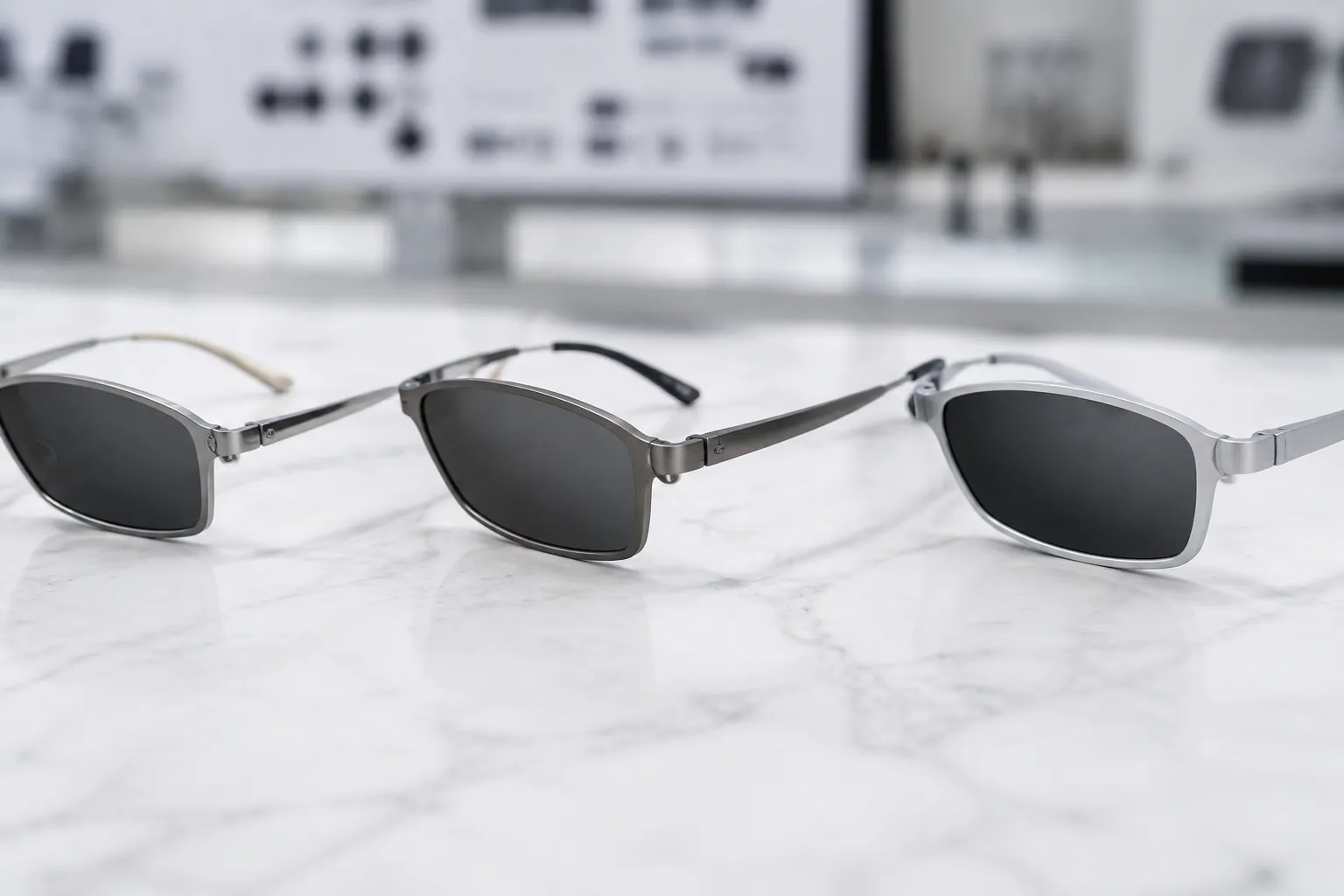
This guide is for brands, importers, distributors, and retailers sourcing metal sunglasses at volume. Nose pads are small, but they drive fit complaints, assembly consistency, post-sale service, and cosmetic acceptance. A showroom sample will not always expose weak pad-arm joints, poor screw retention, unstable pad material, or left-right asymmetry. Bulk production will. The decision should be made early, with clear specs and clear QC. This article covers pad type, pad-arm construction, material choice, cost and lead-time trade-offs, and the checks that matter before mass-production approval.
Start with failure modes, not the catalog page
Many buyers pick the nose pad system too late. They lock the front shape, temples, decoration, logo placement, and lens color first, then treat the pads as a minor trim detail. On metal sunglasses, that is a mistake. Nose pad problems usually appear after the sample room stage.
In production and post-sale, pad-system issues usually show up in four ways:
- Fit complaints: the frame slides down, sits too high, pinches the bridge, or feels uneven on the face.
- Assembly failures: screws loosen, push-fit pads do not hold, pad arms bend unevenly, or pads detach during handling or transit.
- Cosmetic rejects: clear pads discolor, weld or solder marks show near the bridge, left-right asymmetry is visible from top view, or the pad-arm area gets scratched during assembly.
- Material and compliance concerns: odor, inconsistent hardness, weak lot traceability, or uncertainty around chemical control for pad material and hardware.
So start with the real use case. If the frame will be sold in optical shops, department stores, or other staffed environments, adjustable pads usually make sense because trained staff can fine-tune fit. If it is a low-price fashion style sold mainly on appearance and quick turnover, fixed pads may be enough if the bridge fit is forgiving and the frame is light.
Review the pad system during sample development, not after branding approval. The fastest way to judge the trade-off is simple: build two samples on the same front, one with fixed pads and one with adjustable pads. Put them side by side. Differences in fit, appearance, and assembly risk become obvious fast.
Fixed pads vs adjustable pads: where each works
There is no default best option. The right system matches your channel, target FOB, service expectations, and fit requirements.
| Option | Best use case | Main advantages | Main risks | Typical cost effect |
|---|---|---|---|---|
| Fixed metal pads | Low-to-mid price fashion metal styles with limited service expectation | Fewer parts, simpler assembly, cleaner visual line, no pad screws to loosen | Very limited fit adjustment; higher risk of slide or pressure complaints across different bridge shapes | Usually the lowest-cost structure |
| Fixed molded saddle-style contact | Lightweight wire frames with a broad bridge target and low adjustment need | No pad screws, low maintenance, straightforward production flow | Less adaptable for narrow bridges or uneven fit needs | Low |
| Adjustable screw-in pads | Mid-to-premium sunglasses, aviators, and optical-retail channels | Largest fit window, replaceable pads, easier post-sale service | More parts, more assembly steps, risk of screw loosening if hardware control is weak | Higher than fixed-pad structures because of hardware and labor |
| Push-fit or snap-in pads | Programs that want replaceable pads with faster assembly than screw-in systems | Quicker installation, simpler field replacement if the interface is well designed | Retention depends heavily on stem and socket tolerance; weak fit can cause pop-outs during handling or transit | Moderate |
Fixed pads are easier to manage under aggressive cost targets. Fewer parts. Fewer assembly variables. Lower risk of loose hardware. But the fit window is narrower.
Adjustable systems cost more, but they can prevent downstream problems where fit matters. On aviators, double-bridge shapes, and thin metal constructions, small changes in pad angle or position can change comfort and weight distribution quickly. That is why adjustable pads are common in premium channels even with a higher ex-factory cost.
Pad arm construction decides reliability
Pad material gets attention. Pad-arm construction deserves more. It has a bigger effect on durability, fit stability, and cosmetic consistency than many buyers expect.
Three structural points matter most:
- Attachment to the frame front: soldered or welded joints should be centered, clean, and consistent. Too much heat can discolor stainless steel, disturb the surface finish, or leave visible marks around the bridge.
- Arm gauge and geometry: if the wire arm is too fine, it deforms too easily during fitting. If it is too stiff, store staff may force the bridge instead of adjusting the pads. The right gauge depends on the frame design, metal type, and intended adjustment range.
- Pad box or socket precision: screw holes, snap sockets, and push-fit stems need tight dimensional control. Poor matching causes wobble, stripped threads, weak retention, or pad loss.
Ask factories how they control left-right symmetry around the bridge area. A solid answer should describe a defined inspection method, not vague language like "100% checked." Useful controls include fixtures, mirrored jigs, and approved reference samples to verify pad-arm angle, height difference, and centerline alignment.
Finish matters too. On bright plating, polished surfaces, or decorative builds, slight asymmetry near the bridge is easy to see. If the frame is positioned as premium, write the cosmetic standard for the pad-arm area into the approval criteria.
One more warning: on thin stainless or alloy sunglasses with narrow rims, avoid very fine decorative pad arms unless repeated adjustment tests show the structure stays stable after normal handling. Thin looks good. Thin also fails fast if the design is weak.
Pad materials: comfort, aging, and compliance control
Pad material affects grip, skin feel, discoloration, dust pickup, and replacement frequency. Common options are silicone, PVC, and harder polymers. Metal contact pads exist, but they are usually a styling choice, not the comfort-first option.
Silicone pads are a common first choice when comfort and grip matter. They usually feel softer and create more friction against the skin than harder materials, which can help reduce slipping. The trade-off is clear: soft transparent silicone can attract lint, and weak formulations may yellow over time.
PVC pads are common in cost-sensitive programs because they are economical and can be dimensionally consistent in production. The trade-off is feel. They are usually less grippy and can feel harder on the nose than silicone.
Hard polymer pads hold shape well and support a crisp look, but they are less forgiving in extended wear. They fit appearance-led styles better than comfort-led styles.
Material control should go beyond touch and appearance. Ask for approved material specifications, supplier identification, and lot traceability for pads and hardware. For many export programs, pad materials are managed against chemical-control requirements such as REACH.
For finished sunglasses, the relevant market standard depends on the destination. Buyers commonly review alignment with CE EN ISO 12312-1, ANSI Z80.3, or AS/NZS 1067 as applicable. Those product standards do not replace pad-material control. They sit alongside it. If the importer or private-label owner is placing product on the U.S. market, confirm whether any FDA registration or listing obligation applies to the product category and the way it is marketed.
Check packaging too. Soft clear pads can mark lenses if the assembled frame is packed under pressure and the pads touch the lens surface during shipping. Test the packed frame, not just the loose parts.
Cost and lead-time trade-offs buyers can use
Nose pad decisions affect more than part cost. They change assembly time, yield risk, service burden, and repeat-order stability.
Fixed pads are usually the lowest-cost route because they remove hardware and reduce assembly steps. Adjustable screw-in systems add pad arms, boxes, screws, assembly labor, and retention checks. Push-fit systems can save time on the line, but only if the stem-and-socket fit is controlled well enough to avoid retention problems later.
- Sample lead time: depends on factory workload, whether tooling or special hardware is needed, and whether the frame front already exists. Confirm timing in writing.
- Bulk lead time: depends on material availability, plating schedule, lens production, decoration method, and final packaging, not just the pad structure.
- MOQ effect: on low-quantity programs, setup and handling costs can make upgraded pad systems feel disproportionately expensive.
- Volume effect: on larger runs, the relative cost increase from fixed to adjustable pads is often easier to absorb, especially if the channel expects better fit and serviceability.
If fit matters but the target cost is tight, simplify somewhere else first. Reduce colorways. Cut decoration complexity. Choose a less demanding finish. Those changes usually hurt wearability less than removing adjustability from the bridge area.
When asking for quotations, request at least two structural options on the same front shape. Compare more than unit price. Compare assembly risk, serviceability, replacement-part availability, and the supplier's ability to keep the same structure stable across repeat orders. If a factory works under a defined quality-management system such as ISO 9001, that will not fix a bad pad design, but it can support better documentation and change control. If social-compliance requirements matter in your sourcing program, ask separately about certifications or audit status such as BSCI.
QC checkpoints that catch nose pad problems before shipment
Good pad-system QC is specific. "100% inspected" means very little unless the supplier can explain what was checked, how it was checked, and what standard was used for acceptance.
- Incoming material check: verify pad material, color, transparency, stem dimensions, screw size, and hardware matching before line assembly.
- Weld or solder inspection: confirm pad-arm attachment position, cleanliness, and cosmetic quality before final finishing where possible.
- Assembly retention: for screw-in systems, verify that screws are fully seated and remain secure after handling; for push-fit systems, verify that the pad cannot be removed too easily under normal use conditions.
- Symmetry control: compare left and right pad height, opening angle, and spacing from the bridge center with a fixture or approved reference standard, not only by eye.
- Manual adjustment test: check that sample frames can be adjusted without cracking, finish damage, or hardware loosening in the pad area.
- Packing simulation: confirm that pads do not mark lenses, shift excessively, or detach after vibration or drop testing appropriate to the packaging format.
Then inspect the complete frame. Pad performance does not sit in isolation. It interacts with lens weight, bridge stiffness, temple opening force, and surface finish. A glossy plated frame will show slight asymmetry faster than a matte brushed frame, and a heavier lens can change how the front sits on the face.
For export programs, final documentation should match the destination market and the importer's file requirements before shipment booking. If compliance paperwork is required, confirm that test reports, declarations, labeling details, and shipment records are aligned before production is closed. Do not leave that check to the end.
Write the pad specification into the tech pack
If the tech pack says only "metal sunglasses with silicone nose pads," it is incomplete. Engineering, purchasing, and QC need a real specification.
A workable spec should include:
- Pad system: fixed, screw-in adjustable, or push-fit adjustable.
- Pad material: silicone, PVC, or hard polymer, plus color and transparency level.
- Pad shape and size: for example teardrop, oval, or D-shape, with dimensions or an approved sample reference.
- Arm construction: wire or stamped arm, target gauge if defined, attachment method, and surface finish.
- Hardware requirement: screw type or push-fit stem type, whether pads must be replaceable, and what service tool is required.
- Appearance standard: acceptable weld marks, finish continuity, and cosmetic criteria around the bridge and pad-arm base.
- QC criteria: symmetry standard, retention expectation, and post-adjustment appearance requirement.
If your team does not have internal engineering support, ask the factory for a marked drawing, component sheet, or pre-production sample report for approval. That document should identify the selected pad, the attachment method, any replacement limitation, and the approved appearance standard around the bridge.
Physical approval matters more than photo approval. Comfort, grip, and adjustability are hard to judge from images alone. If fit matters, approve the pad system by sample, by adjustment review, and by written specification.
A simple decision framework for buyers
Use this filter before requesting a final quotation or approving a pre-production sample.
- If price is the main driver and the frame is a simple fashion metal style with broad fit tolerance, start with fixed pads.
- If fit consistency matters across varied face shapes, move directly to adjustable pads.
- If the frame will be sold in optical, duty-free, or staffed retail, favor adjustable pads with replaceable hardware.
- If the bridge area is thin and decorative, avoid fragile pad arms unless repeated adjustment testing has passed.
- If comfort complaints are a known risk in your channel, specify silicone pads unless there is a strong cost or styling reason not to.
- If you need a very low unit cost at volume, simplify decoration or color count before removing a pad-system feature that affects wearability.
Practical rule: if you expect the consumer to wear the sunglasses for extended periods, treat the nose pad system as a structural decision, not a trim accessory.
Teams that get this right spend more time at sample stage and less time fixing avoidable issues after shipment. The part is small. Its impact is not.
Have a custom sunglasses project in mind?
Send us your styles, target market and quantities and we will return a detailed quote with MOQ, lead time and a sample plan.
Get a QuoteWhy source this from Wenzhou with LumiShades
Wenzhou in Zhejiang Province is widely regarded as China’s eyewear manufacturing capital, producing a large share of the world’s sunglasses. That concentration matters to buyers: a deep local supply chain for acetate sheet, hinges, lens blanks, plating and packaging means shorter component lead times, easier color and material matching, and a workforce with decades of eyewear-specific skill. LumiShades has manufactured in this ecosystem since 2009, and our vertical integration — in-house injection molding, acetate cutting, CNC milling, lens tinting, decoration and quality control — means no part of your order is quietly subcontracted to a workshop you cannot audit.
For international buyers, that vertical control translates into accountability. When a single factory owns every step, defects are traced and fixed at source rather than bounced between vendors, and your specifications survive intact from first sample to bulk. We back this with 15+ years of experience, shipments to 60+ countries, more than 5 million pairs produced per year and a 98.5% on-time delivery rate. Our certifications — CE EN ISO 12312-1, FDA registration, ANSI Z80.3, AS/NZS 1067, REACH, ISO 9001 and BSCI audit — mean the compliance documentation your market requires already exists. Explore our manufacturing capabilities and quality control process to see how this works in practice.
Frequently asked questions
Are adjustable nose pads always better for metal sunglasses? No. Adjustable pads are usually the better choice when the product will be sold across varied face shapes, in staffed retail, or in channels that expect post-sale fitting and replacement parts. Fixed pads can be the better commercial choice for low-price fashion styles if the frame is light, the bridge fit is forgiving, and the buyer accepts a narrower fit range. The clean way to decide is to ask the supplier for two samples on the same front shape, one fixed and one adjustable, then compare fit, appearance, serviceability, and assembly quality side by side.
Which nose pad material gets the fewest comfort complaints? Silicone is usually the first material to test when comfort and grip are priorities because it tends to feel softer and less slippery than PVC or harder polymers. But material alone does not decide comfort. Pad shape, size, frame weight, and bridge geometry all matter. Ask the factory to confirm the exact material, keep an approved sample, and maintain lot traceability. If clear silicone is selected, also review aging appearance and packaging contact risk, because discoloration and lens marking are common issues.
What should I ask a factory to test on pad assemblies before bulk production? Ask for documented checks in four areas: 1) left-right symmetry at the bridge, 2) pad retention for the chosen screw-in or push-fit system, 3) manual adjustment performance without cracking, finish damage, or loosening, and 4) packaging simulation to confirm pads do not mark lenses or detach in transit. Ask for photos or records of the inspection method, not just a verbal confirmation. For repeat orders, require the supplier to keep the approved pad and hardware specification unchanged unless written approval is given.
Do nose pads affect compliance for export markets? Yes, indirectly. Nose pads are one component, but their material and traceability form part of the product's overall compliance file. For many programs, buyers check chemical-control requirements such as REACH for materials and hardware. The finished sunglasses may also need to align with market standards such as CE EN ISO 12312-1, ANSI Z80.3, or AS/NZS 1067, depending on where they are sold. If the product is entering the U.S. market, also verify whether FDA registration or related obligations apply to the product category and marketing claim. The practical step is to confirm required documents with your importer, lab, or compliance advisor before bulk production starts.
How much do adjustable pads usually add to lead time? There is no universal number because the effect depends on the supplier's hardware stock, assembly method, workload, and whether the structure is specified early. In many cases, the bigger risk is not the pad itself but a late change to the bridge structure after sample approval. To control timing, confirm the pad system at sample stage, ask the factory whether the hardware is standard or custom, and lock the final approved pad specification before bulk materials are ordered.
Ready to start?
Explore our cat-eye sunglasses or request a quote — our sales team replies within 12 hours.
Request a Quote