
PC Injection vs Hand-Cut Acetate Sunglasses
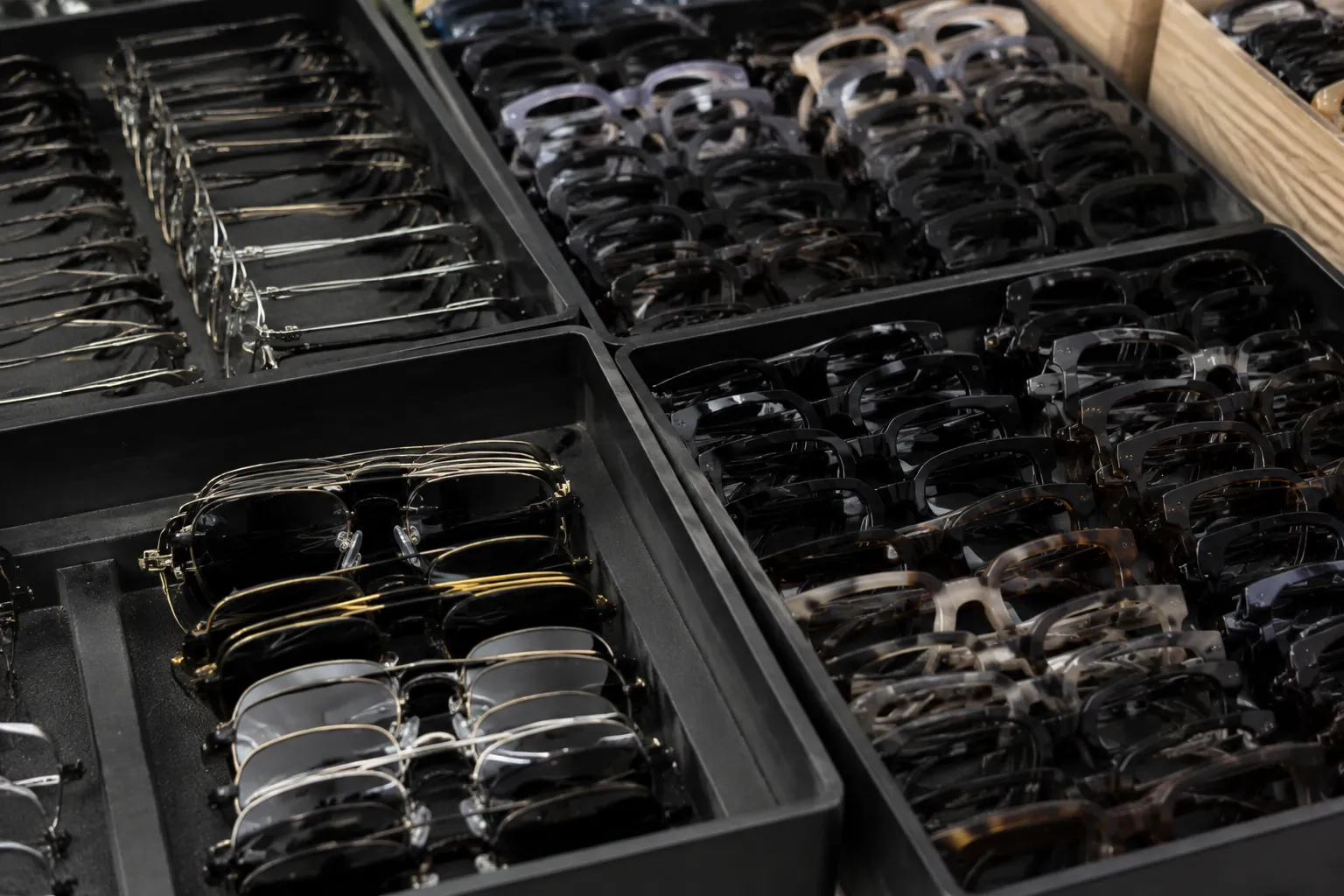
For private label sunglasses, frame material changes the business case, not just the look. It affects tooling, production flow, repeatability, finish expectations, retail positioning, and QC risk. PC injection and hand-cut acetate are both established manufacturing routes, but they solve different problems. PC injection usually fits cost-sensitive programs, repeatable higher-volume output, and lightweight designs. Hand-cut acetate is more often chosen for visible material depth, a heavier hand feel, and a stronger premium signal. Start with the commercial brief. Then choose the material that fits it.
Start With the Business Model, Not the Material
Many buyers start by asking which material is better. That is the wrong first question. Start with commercial fit: what does the program need to do on cost, retail price, reorder speed, and brand position?
A value-led chain program usually needs predictable unit economics, simple repeat orders, and broad price accessibility. A boutique, fashion, or premium DTC line usually cares more about perceived material value, finish quality, and shelf impact.
That is why PC injection and hand-cut acetate should not be treated as interchangeable. Similar shapes can sometimes be made in both. The manufacturing logic, finish profile, and price structure are still different. PC injection usually gives stronger consistency and lower unit cost at scale. Hand-cut acetate usually gives more visual depth and a more premium feel in hand.
Before you compare quotes, define the commercial frame first: target retail band, opening order size, likely reorder volume, branding method, and destination market. Those inputs decide whether the lower-cost process route or the higher-value finish route makes more sense.
- Choose PC injection when unit cost, repeatability, and replenishment speed matter most.
- Choose hand-cut acetate when material presentation and premium positioning matter more.
- Model total landed cost, not just ex-factory frame cost.
- Compare price by realistic order tier, not by one sample-order quote.
PC Injection Frames: Repeatability, Low Weight, Lower Cost
PC injection frames are made by melting polycarbonate resin and injecting it into a mold under controlled conditions. Once the mold and process settings are stable, repeat production is usually easier to standardize than in a more manual frame category.
That control matters for private label buyers. Front shape, bridge form, temple alignment, and lens seating can usually be reproduced with good consistency across repeat runs, especially after the design has been engineered and approved. This makes PC injection a practical option for programs that need reliable replenishment or multiple colorways built from the same base shape.
PC injection also tends to carry a lower unit cost than hand-cut acetate, particularly in value and mid-tier retail programs. It is common in lightweight sunglasses, sport-led styles, promotional runs, and high-volume assortments where comfort and cost discipline matter more than a premium material story.
There are limits. A fully custom injection design may require mold investment, and that cost has to be weighed against expected order volume and product life. Surface finish can be clean and commercially strong, but it will not mimic the layered look of acetate sheet. Do not judge PC as a substitute for acetate. Judge it on its own merits.
QC for PC injection should focus on dimensional consistency, hinge alignment, warpage, surface defects, and lens fit. On repeat orders, buyers should confirm that the supplier records key dimensional checkpoints and keeps an approved reference sample for comparison.
Hand-Cut Acetate: More Manual Work, Stronger Premium Signal
Hand-cut acetate frames move through more manual and semi-manual steps than injection-molded PC. The sheet is cut, milled, shaped, polished, assembled, adjusted, and checked through several finishing stages. The process is longer. Labor input is higher. The finish profile is different.
That is one reason acetate often supports a higher retail position. The material can show visible depth, especially in crystal, laminated, or patterned colorways. It also suits thicker profiles and polished edges that create a more substantial look and feel.
For private label buyers, acetate is often the better choice when tactile differentiation matters. If the brand story depends on premium presentation, stronger material identity, or a better shelf impression, acetate usually supports that position more naturally than an injected value frame.
That does not mean acetate is always right for a higher-ticket product. The case still depends on the full specification: hardware, lens quality, branding execution, packaging, and sales channel. Premium material alone is not enough.
QC priorities also shift. Buyers should watch temple symmetry, polish consistency, visible marks, hinge setting, and color consistency across the run. On premium-positioned products, small finish variation is easier for the end customer to spot.
Cost, MOQ, Tooling, and Margin Logic
Do not compare frame price in isolation. Compare the full cost stack. Private label sunglasses carry other cost layers: lenses, branding, packaging, testing, freight, duty, and reject allowance.
In many cases, PC injection comes in below hand-cut acetate on ex-factory cost, especially when the program is built for volume efficiency. Acetate can improve with scale too, but it usually stays on a higher cost base because the material and labor burden are heavier. That does not make acetate uneconomic. It means the retail margin structure has to carry it.
| Factor | PC Injection | Hand-Cut Acetate | Buyer Impact |
|---|---|---|---|
| MOQ entry point | Can be feasible at low opening quantities depending on supplier and design | Also possible at low opening quantities, but unit economics are often tighter | Both can support trial orders; compare real quotation tiers before deciding |
| Tooling logic | Custom molds may require upfront investment | No injection mold, but more labor-intensive frame production | PC usually rewards volume planning; acetate usually depends more on retail value support |
| Unit cost at 300-1000 pairs | Often scales down more efficiently | Can improve with volume, but usually stays higher | PC is often easier for price-led replenishment programs |
| Retail price support | Common in value and mid-tier programs | Often stronger in mid-premium and premium programs | Acetate may offer more pricing headroom when the channel recognizes the material difference |
| Damage and finish risk | Consistency still depends on good process control and inspection | Higher finish expectations can make rejects more commercially sensitive | Inspection standards matter regardless of material choice |
The real sourcing question is not which frame is cheaper on paper. It is which material still protects margin after decoration, compliance work, shipping, and markdown risk are built into the plan. Once that number is clear, the decision gets simpler.
Lead Time, Engineering Detail, and Launch Risk
Lead time is tied to specification control. In eyewear, delays often come from repeated revisions after sample approval, not from one dramatic production failure.
PC injection is usually easier to standardize once the design, mold, and branding details are locked. Acetate can also run on workable timelines, but changes to temple thickness, bevel treatment, polishing level, or laminate color tend to create more disruption because more manual steps are involved.
Freeze the technical package before bulk production starts. That means frame dimensions, lens specification, branding method, packaging requirements, labeling language, and destination market. Late changes to any of those items can shift timing and, in some cases, force updates to compliance documentation.
- Approve the frame silhouette and key dimensions first.
- Approve lens tint, category, and UV requirement second.
- Approve branding method and placement third.
- Freeze packaging, barcode, and carton details before bulk release.
If the launch window is tight, choose the route with fewer moving parts. Often that favors PC injection for first-run, cost-sensitive, or replenishment-led programs. For premium collections with longer planning cycles and stronger margin allowance, acetate may still be the better fit.
Decoration Methods, Material Behavior, and Retail Fit
Branding affects perceived value, but material changes how that branding reads. Both PC injection and acetate can support common decoration methods such as pad printing, laser engraving, and metal logo applications, depending on design and construction.
PC injection usually fits simple, cost-controlled branding in value retail, active styles, event merchandise, and large-volume programs. The result can look clean and commercially correct when the logo treatment matches the price point.
Acetate can support the same core methods, but the surrounding frame often carries more visual value on its own. Layered sheet color, polished surfaces, and thicker temple profiles can make the same logo treatment look more expensive.
Retail positioning should drive the choice. In entry-price programs, PC injection often matches the commercial model better. In higher-ticket assortments, acetate can support the price story more convincingly because consumers can usually see and feel the material difference.
- Use PC for value-led, promotional, active, and repeat-volume programs.
- Use acetate for boutique, fashion, and premium-positioned assortments.
- Keep decoration proportional to the margin structure.
- Do not expect branding alone to create a premium impression if the full product specification does not support it.
Compliance, QC, and What Buyers Should Request
Frame material does not determine compliance on its own. Market-entry requirements depend on the destination market, lens performance, labeling, and product claims. Buyers should ask for documents that match the actual market and product category, not vague statements that a product is simply "certified" or "approved."
Relevant standards and systems may include CE EN ISO 12312-1 for sunglasses sold into applicable CE-marked markets, ANSI Z80.3 for the United States, AS/NZS 1067 for Australia and New Zealand, REACH for applicable chemical compliance requirements, FDA registration where applicable to the company and product pathway, ISO 9001 for quality management systems, and BSCI for social compliance auditing. These are not interchangeable. Each covers a different issue.
Before production, confirm lens category, UV protection requirements, labeling content, packaging claims, and destination market. That reduces the risk of finding out too late that the test scope or documentation does not match the intended channel.
QC should also reflect the material. PC frames should be checked for warpage, hinge alignment, surface marks, and lens seating consistency. Acetate should be checked for polish quality, symmetry, edge finish, and color consistency. In both cases, the approved sample, written specification, and pre-shipment inspection criteria need to match.
Ask for the exact standard, report scope, issuing laboratory details, and destination-market fit before approving production.
A Practical Framework for First Orders
If the program is new, start with the retail target and margin requirement, then work backward into material, branding, and packaging. That keeps you from overbuilding the product before demand is proven.
For some buyers, a staged approach is the safer move. A PC injection version can test shape, fit, and sell-through with lower upfront risk. If the style works and the channel supports a higher price point, an acetate follow-up may make sense as a premium tier.
Before approving tooling or bulk production, apply a simple filter:
- If retail is price-led and replenishment speed matters, start with PC injection.
- If the line needs stronger material presence and premium presentation, start with acetate.
- If reorder visibility is weak, avoid locking in an unnecessarily heavy cost base.
- If custom tooling is required, calculate how many units are needed to absorb it responsibly.
- If compliance timing is tight, finalize destination-market requirements before branding and packaging approval.
The best material is the one that fits the channel, protects margin, and lowers launch risk. Nothing more complicated than that.
Have a custom sunglasses project in mind?
Send us your styles, target market and quantities and we will return a detailed quote with MOQ, lead time and a sample plan.
Get a QuoteWhy source this from Wenzhou with LumiShades
Wenzhou in Zhejiang Province is widely regarded as China’s eyewear manufacturing capital, producing a large share of the world’s sunglasses. That concentration matters to buyers: a deep local supply chain for acetate sheet, hinges, lens blanks, plating and packaging means shorter component lead times, easier color and material matching, and a workforce with decades of eyewear-specific skill. LumiShades has manufactured in this ecosystem since 2009, and our vertical integration — in-house injection molding, acetate cutting, CNC milling, lens tinting, decoration and quality control — means no part of your order is quietly subcontracted to a workshop you cannot audit.
For international buyers, that vertical control translates into accountability. When a single factory owns every step, defects are traced and fixed at source rather than bounced between vendors, and your specifications survive intact from first sample to bulk. We back this with 15+ years of experience, shipments to 60+ countries, more than 5 million pairs produced per year and a 98.5% on-time delivery rate. Our certifications — CE EN ISO 12312-1, FDA registration, ANSI Z80.3, AS/NZS 1067, REACH, ISO 9001 and BSCI audit — mean the compliance documentation your market requires already exists. Explore our manufacturing capabilities and quality control process to see how this works in practice.
Frequently asked questions
Which material is better for a first private label sunglasses launch? PC injection is often the safer first option when the priority is lower upfront risk, easier repeatability, and tighter cost control. Hand-cut acetate is usually the stronger choice when the collection depends on premium presentation and the target retail price can support a higher build cost. Compare both against the same brief: target retail price, expected order quantity, branding method, and destination-market compliance requirements.
Can you hit low MOQs for both materials? Often yes, but MOQ depends on the supplier, the frame design, and whether custom tooling or custom components are required. Ask for quotation tiers instead of one headline MOQ. A useful RFQ should request pricing at multiple volumes, note whether tooling is required, and separate frame cost from lenses, branding, packaging, and testing so you can see how the economics change by quantity.
What lead time should I plan for samples and bulk? Lead time depends on the supplier, design complexity, tooling status, decoration method, and testing requirements, so do not rely on a generic estimate. Ask for a stage-by-stage timeline covering sample making, revisions, approval, bulk production, and inspection. Also confirm what resets the schedule, such as dimension changes, logo-method changes, packaging revisions, or updated compliance requirements.
Which material is easier to decorate with logos? Both materials can support common logo applications such as pad printing, laser engraving, and metal logo details, but the better choice depends on price point and finish expectation. PC injection is usually more efficient for simple, cost-controlled branding. Acetate often makes the same logo treatment look more premium because the base material has more visible depth and mass. Request photos or physical samples of the exact logo method on the exact frame material before approving production.
What compliance documents should I ask for? Request documents that match the destination market and the actual product claim set. For sunglasses, that may include test reports to CE EN ISO 12312-1, ANSI Z80.3, or AS/NZS 1067, depending on where the product will be sold. If chemical compliance is relevant, ask about REACH. If you need supplier-system evidence, ask separately about ISO 9001 or BSCI. If U.S. regulatory questions arise, ask the supplier to clarify whether FDA registration is applicable to the product and business model. In every case, request the exact standard name, report scope, test date, product identification, and issuing laboratory details.
Ready to start?
Explore our rimless sunglasses or request a quote — our sales team replies within 12 hours.
Request a Quote