
Festival Sunglasses Specs to Freeze Before Production
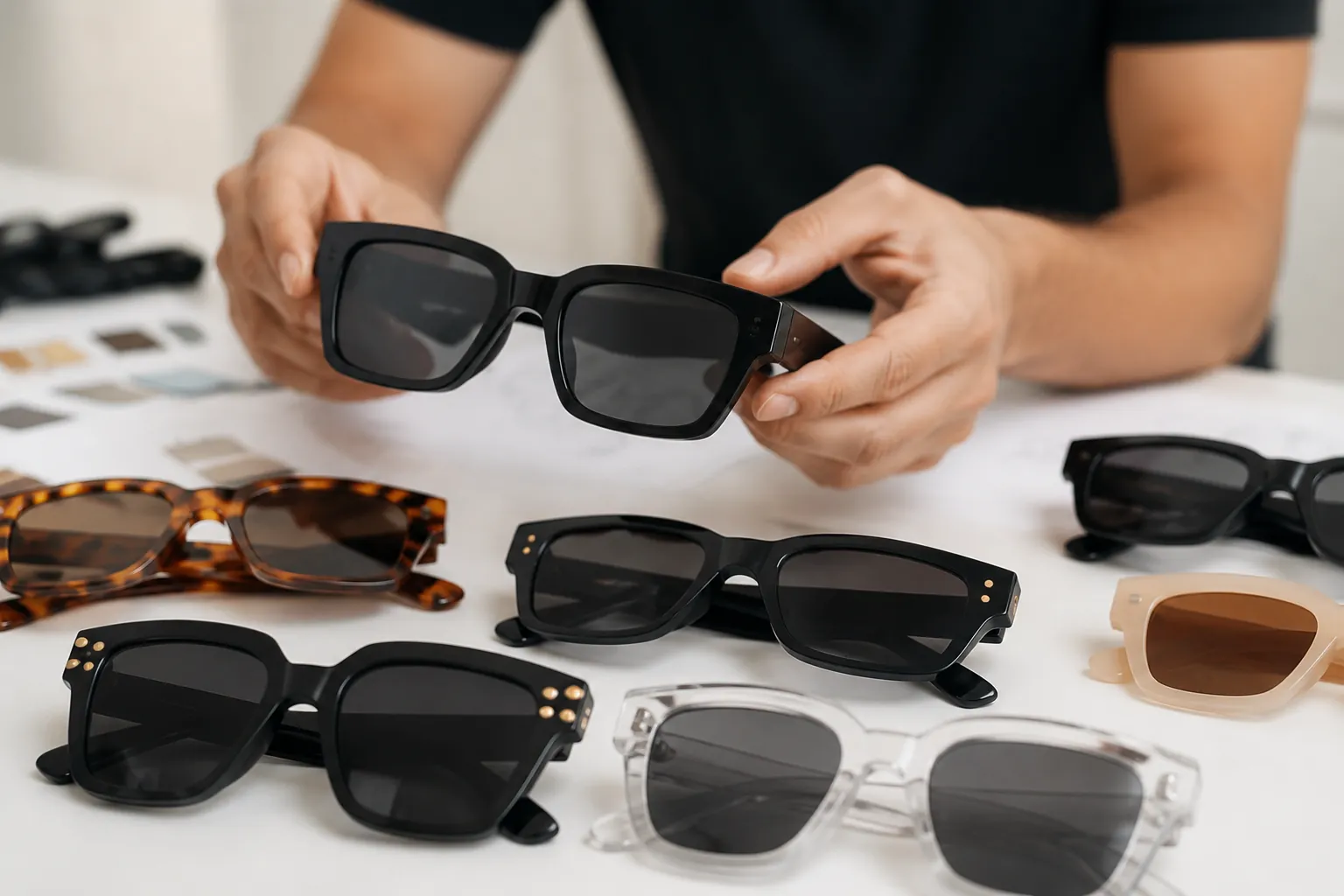
This guide is for brands, importers, distributors, retailers, agencies, and event buyers ordering custom sunglasses for music festivals, outdoor campaigns, sponsor activations, and merchandise drops. It shows which specifications to confirm before sampling so artwork, tooling, compliance, packing, cartons, and delivery plans do not crash into the event deadline. The goal is simple: fewer rejected samples, cleaner logo approvals, accurate compliance wording, tighter landed-cost control, and a production schedule with room for testing, inspection, freight, and receiving.
Start With the Event Use Case
Festival sunglasses are not handled like normal retail eyewear. They may be packed in bulk, carried in backpacks, worn in heat, exposed to sunscreen and sweat, and handed to people who did not choose them. That changes the brief. A frame can look good in a catalog and still fail if the temples feel sharp, the logo rubs off, the lenses do not match the stated category, or the carton plan wastes freight space.
Define the use case before asking for a quote: entry-gate giveaway, VIP merchandise, retail booth product, sponsor gift, staff uniform item, or influencer kit. A 50-pair influencer seeding order can carry higher unit cost, detailed decoration, and individual gift packing. A 20,000-pair gate giveaway needs repeatable molding, fast decoration, simple packing, clear inspection rules, and a defect threshold that keeps event staff from sorting sunglasses on-site.
For high-volume festival programs, freeze four items first: frame material, lens specification, logo method, and packing format. These drive mold choice, color matching, decoration setup, QC checks, carton quantity, and lead time. LumiShades in Wenzhou can support low-MOQ custom tests from 50 pairs per design. Larger runs usually price better because setup time, ink mixing, material preparation, production scheduling, and inspection labor are spread across more units. For simple high-volume programs, pricing may approach about $2.10 per pair, depending on frame, lens, logo, packing, quantity, and shipment terms.
Do not approve a sample just because the color looks fun. Check temple stiffness, hinge movement, lens fit, nose comfort, logo readability from 1 to 2 meters, and whether fingerprints or surface marks make the frame look dirty. Festival eyewear gets photographed. Small cosmetic flaws travel fast.
Choose Frame Materials for Real Handling
The safest festival frame is often an injection-molded style. It supports repeatable shapes, consistent output, and efficient decoration. PC and TR90 are common options for event sunglasses. Acetate can look more premium, but it requires sheet cutting, CNC shaping, tumbling, polishing, hinge setting, lens fitting, and more hand adjustment. Use it for VIP merchandise or retail-grade capsules, not rushed giveaway orders.
Material behavior matters. PC is rigid and cost-efficient, but a thin temple can feel sharp or brittle if the geometry is poor. TR90 has better bending recovery and wearer comfort, but resin cost is higher and color matching can need more sampling. Acetate has richer color depth and a heavier feel, but it can deform under heat or pressure if packing is too tight. Metal and combo frames can raise perceived value, but every screw, nose pad, plating surface, weld, and bridge alignment adds another QC point.
| Frame option | Best use | Buyer watch point | Typical production impact |
|---|---|---|---|
| PC injection frame | Large giveaways and low-cost event packs | Thin temples may feel stiff; poor shrinkage control can warp the front | Fast output, stable pricing, efficient for 1,000+ pairs |
| TR90 frame | Merchandise, staff eyewear, and comfort-focused designs | Higher resin cost and more careful color matching | Better flexibility and bending recovery |
| Acetate frame | VIP product, retail booths, fashion capsules | Longer cutting, polishing, and lens-fitting process | Premium feel but slower production and QC |
| Metal or combo frame | Sponsor merchandise and higher-value gifts | Plating, screws, welding, and alignment must be checked | Better perceived value but more assembly labor |
Ask the factory to confirm hinge type, screw length, temple opening angle, lens base curve, and expected dimensional tolerance. For many event sunglasses, a simple five-barrel hinge is more practical than a spring hinge. It costs less and removes one possible failure point. For molded frames, key control points include front flatness, temple spread, lens groove consistency, surface finish, and color tolerance against the approved sample.
Treat Lens Specs as Compliance Specs
Lens color is not just a design choice. It affects visible light transmission, UV protection claims, filter category, and labeling. Outdoor festival buyers often choose smoke, brown, green, mirror, or gradient lenses. Very dark lenses can look strong in photos, but they need the right category marking. Do not describe them as suitable for driving unless they meet the applicable requirement in the destination market.
Confirm the compliance target before packaging artwork is printed. Relevant eyewear and business documentation may include CE EN ISO 12312-1 for Europe, ANSI Z80.3 for non-prescription sunglasses in the United States, AS/NZS 1067 for Australia and New Zealand, REACH for EU chemical controls, FDA registration for the U.S. business context, ISO 9001 for quality management, and BSCI for social compliance. Do not ask a supplier to print a certification, logo, or standard reference that does not apply to the product, market, or test scope. Product labels, user information, customs documents, and test reports must match the actual sunglass specification.
- UV protection: Confirm UV400 or equivalent performance using the approved production lens material, tint, and coating.
- Lens category: Freeze the filter category before packaging, hangtags, warning text, or barcode labels are printed.
- Visible light transmission: Ask for the target VLT range when lens darkness affects compliance, wearer comfort, or brand appearance.
- Mirror coating: Approve color under daylight and indoor light; silver, blue, red, and green mirrors can shift by viewing angle.
- Impact expectation: ANSI Z80.3 applies to non-prescription sunglasses in the U.S.; it is not industrial safety eyewear.
- Chemical compliance: For EU programs, confirm REACH control for coatings, inks, plasticizers, metal parts, and packaging materials.
For bulk orders, request lens test confirmation from the final approved material and tint, not from a similar stock lens used on a previous order. Build testing into sample approval if the event date is fixed. Waiting until final inspection is risky. Failed lens claims can mean relabeling, rework, replacement, or a missed shipment.
Pick Logo Methods That Hold Up
A festival sponsor wants the logo visible in photos. The factory needs artwork it can apply repeatedly without high rejects. The decoration method is where those needs meet. The right choice depends on surface shape, logo size, color contrast, order quantity, and expected product life.
Pad printing is the common choice for temple logos because it is economical and fast. It works best on flat or gently curved areas with solid artwork. Fine lines, small legal text, and reversed lettering can fill in or break if the logo is too small. Laser engraving lasts longer because it is not surface ink, but it may be low contrast on black, translucent, or patterned plastics. Metal logo plates create a premium look, but they add parts, adhesive or mechanical fixing, plating checks, and alignment labor. Lens printing can work for short-term promotional photos, but placement must not disturb vision or conflict with product labeling and use requirements.
| Logo method | Good for | Limit | Approval detail |
|---|---|---|---|
| Pad printing | High-volume sponsor logos on temples | Small text and thin lines can fill or break | Approve ink color on the actual frame color |
| Laser engraving | Subtle branding and durable markings | Low contrast on some plastics | Check depth, edge quality, and readability after wiping |
| Metal logo plate | Premium event merchandise | Higher cost and more assembly labor | Confirm plate size, plating color, and bonding method |
| Lens logo print | Short-term promotional photos | May wear faster and affect appearance | Confirm location does not interfere with sightline |
LumiShades offers laser engraving, pad printing, and metal logo plate decoration, which can reduce sample revisions when the base frame and artwork are already clear. Buyers should provide vector artwork, Pantone references, minimum clear space, and a maximum logo size. A practical temple logo is easier to control when it stays inside a clean rectangular print area instead of wrapping too far around a curved surface.
Use Samples as Production Instructions
Samples are not souvenirs. They are production instructions. LumiShades usually prepares samples in 7 to 10 days, depending on whether the design uses an existing mold, custom color matching, special lenses, new artwork, or extra decoration. Sample review should be structured. Scattered chat comments from several departments waste days.
Use one approval sheet and mark each item pass, revise, or reject. If several sponsors share one sunglass design, assign one buyer-side decision maker. Factories lose time when brand, procurement, legal, and event teams send conflicting logo or label comments. For urgent campaigns, decide in advance which details can move and which cannot.
- Confirm frame model, material, color, surface finish, and Pantone or approved sample reference.
- Check lens color, darkness, mirror effect, lens fit, and visible scratches under bright light.
- Measure logo size and position on left and right temples, with a realistic tolerance such as about ±1 mm where the surface allows.
- Open and close hinges at least 20 times by hand and check screw tightness after cycling.
- Check packing: pouch, polybag, insert card, barcode, warning text, country marking, and carton marks.
- Confirm compliance wording for the destination market before any mass printing begins.
If the order is 5,000 pairs or more, request a pre-production sample after final artwork, lens, color, and packing details are frozen. This is the sample that should match bulk production. A first prototype may help with concept approval, but it is not enough for shipment approval unless it uses final materials and the final production file.
Blunt rule: if the buyer changes frame color, lens color, logo method, packing, or compliance wording after approval, the production clock may reset. Sometimes the delay is partial. A few lost days can still damage a seasonal campaign.
Read MOQ and Price Breaks Correctly
MOQ matters, but it is not the whole cost story. LumiShades can support 50 pairs per design, which helps for samples, influencer kits, and small test drops. For event buyers, the more useful price levels are usually 300, 1,000, and 5,000+ pairs because decoration setup, material preparation, machine scheduling, and QC labor spread across more units.
Cost moves for practical reasons. A stock injection mold with one-color pad printing is faster and cheaper than a new acetate shape with laminated color, custom lens tint, metal logo plates, and individual gift boxes. The difference is machine time, manual assembly, scrap risk, inspection time, and packing labor. Even a small packing change can matter. A simple polybag is fast. A microfiber pouch, printed card, barcode sticker, and gift box add handling steps to every unit.
- Lower-cost choices: existing injection mold, standard frame color, smoke lens, one-position pad print, and simple polybag packing.
- Mid-range choices: custom Pantone frame color, mirror lens, two-side printing, microfiber pouch, and printed insert card.
- Higher-cost choices: acetate cutting, CNC milling, metal trim, custom lens tinting, gift box, and multiple SKU labels.
- Hidden cost drivers: split shipments, many colorways, individual barcode rules, retail hangtags, extra test reports, and late artwork changes.
Ask for pricing by quantity tier, not one flat number. A clear RFQ might request 300, 1,000, 5,000, and 20,000 pairs with the same specs, packing, and delivery term. This shows where the real breakpoints are. On large, simple programs, unit price can move toward about $2.10 per pair, but only when the design supports efficient production and the packing plan is not overbuilt.
Build the Timeline Backward
Festival dates do not move because a logo plate arrived late. Work backward from the in-hands date, not the factory ship date. LumiShades bulk production is typically 25 to 35 days after sample approval and deposit, depending on order size, SKU count, material choice, decoration, lens specification, packing complexity, and inspection requirements. Add time for export handling, sea or air freight, customs clearance, inland delivery, and buyer-side receiving.
For a seasonal campaign, a safer planning window is usually 8 to 12 weeks from initial RFQ to warehouse arrival if sea freight is used. Air freight can rescue a late order, but it can erase savings on low-cost sunglasses. Use air for samples, urgent top-up orders, or VIP merchandise. Do not build the main plan around air unless the margin and event value can carry it.
| Stage | Typical time | Buyer action | Risk if late |
|---|---|---|---|
| Spec and quote | 2 to 5 days | Send artwork, quantity tiers, market, packing, and delivery target | Wrong price or missing compliance items |
| Sample making | 7 to 10 days | Approve frame, lens, logo, packing, and label wording | Production cannot start cleanly |
| Pre-production confirmation | 2 to 5 days | Freeze approved sample and production file | Bulk output may not match buyer expectation |
| Bulk production | 25 to 35 days | Monitor molding, decoration, assembly, and packing milestones | Partial shipments or rushed QC |
| Freight and customs | Varies by mode and destination | Confirm invoice, packing list, carton marks, and import requirements | Event stock arrives after activation |
Buyers still need buffer even when the factory schedule is clear. Weather, port congestion, customs checks, label changes, test timing, artwork approval delays, and late payment approvals sit outside the molding room. A timeline is only reliable when buyer and supplier both freeze the approved specification.
Control QC, Packing, and Cartons Early
For event sunglasses, QC must focus on repeatable defects: lens scratches, loose screws, frame warpage, poor logo adhesion, color mismatch, wrong labels, and packing errors. LumiShades has in-house processes covering injection molding, acetate cutting, CNC milling, lens tinting, decoration, and QC. That helps trace defects to a specific production step and correct them before shipment.
Set the inspection standard before production. Define acceptable color tolerance against the approved sample, logo position tolerance on the temple, lens scratch limits, hinge function, packing rules, and critical defects. A sunglasses order can look fine in cartons but fail at the event if pouches contain the wrong sponsor card or the wrong warning label. Packing is part of the product. Treat it that way.
- Frame QC: Check symmetry, hinge torque, screw tightness, temple spread, front warpage, and surface marks.
- Lens QC: Check UV performance, tint consistency, scratches, edge fit, coating defects, and left-right color match.
- Logo QC: Check position, color, rub resistance, registration, and left-right consistency.
- Packing QC: Check barcode, SKU, warning label, country marking, pouch, card, polybag, and carton mark.
- Carton planning: Confirm inner pack quantity, master carton quantity, gross weight, dimensions, and pallet preference early for freight quotes.
Ask for production photos at key stages: molded parts, lens tinting, decoration setup, assembled sunglasses, packed inner units, and sealed master cartons. Photos do not replace inspection, but they can catch obvious mistakes before goods are sealed. For high-volume festival orders, early visibility can prevent rework, delayed shipment, or emergency sorting at the venue.
Have a custom sunglasses project in mind?
Send us your styles, target market and quantities and we will return a detailed quote with MOQ, lead time and a sample plan.
Get a QuoteWhy source this from Wenzhou with LumiShades
Wenzhou in Zhejiang Province is widely regarded as China’s eyewear manufacturing capital, producing a large share of the world’s sunglasses. That concentration matters to buyers: a deep local supply chain for acetate sheet, hinges, lens blanks, plating and packaging means shorter component lead times, easier color and material matching, and a workforce with decades of eyewear-specific skill. LumiShades has manufactured in this ecosystem since 2009, and our vertical integration — in-house injection molding, acetate cutting, CNC milling, lens tinting, decoration and quality control — means no part of your order is quietly subcontracted to a workshop you cannot audit.
For international buyers, that vertical control translates into accountability. When a single factory owns every step, defects are traced and fixed at source rather than bounced between vendors, and your specifications survive intact from first sample to bulk. For procurement review, buyers can request process records, approved samples, quality checkpoints and project-specific compliance files before placing a bulk order. Required testing and documentation are confirmed against the destination market and product specification rather than assumed from a generic certificate list. Explore our manufacturing capabilities and quality control process to see how this works in practice.
Frequently asked questions
What is the minimum order for custom festival sunglasses? LumiShades can start from 50 pairs per design, which is useful for samples, influencer kits, and small test drops. For event buying, ask for tiered quotes at 300, 1,000, 5,000, and 20,000 pairs with the same specs so you can see where setup, material preparation, decoration, and QC costs spread out.
How early should we start before a music festival date? Start 8 to 12 weeks before the required warehouse arrival if sea freight is used. Build the schedule backward from the in-hands date: allow time for RFQ review, 7 to 10 days for samples, 2 to 5 days for pre-production confirmation, 25 to 35 days for bulk production after approval and deposit, plus freight, customs, inland delivery, and buyer-side receiving.
Which logo method is best for sponsor sunglasses? Pad printing is usually the most practical choice for high-volume temple logos because it is fast and cost-efficient. Use laser engraving when durability matters more than contrast, and use metal logo plates when the order supports higher cost, added assembly, plating checks, and alignment inspection. Approve the logo on the actual frame color before mass production.
Can the same sunglasses meet Europe, U.S., and Australia requirements? Often yes, but the lens specification, testing, labeling, and user information must be planned for each destination market. Confirm CE EN ISO 12312-1 for Europe, ANSI Z80.3 for U.S. non-prescription sunglasses, AS/NZS 1067 for Australia and New Zealand, REACH for EU chemical controls, and any FDA registration context required for the U.S. Do not print compliance wording until the product and test scope match.
What specs should be frozen before bulk production starts? Freeze the frame model, material, frame color, lens color, lens category, UV claim, logo method, artwork size, logo position, packing format, warning text, barcode rules, carton marks, and compliance wording. Treat the approved sample and production file as the control reference; changing these details after approval can delay production and may require a new sample.
How low can the unit price go on large orders? For simple high-volume designs using efficient molds, standard lenses, basic decoration, and simple packing, pricing can move toward about $2.10 per pair. Final cost depends on material, lens specification, decoration method, number of SKUs, packing, test requirements, quantity, and shipment terms, so request quantity-tier pricing with one fixed specification.
Ready to start?
Explore our square sunglasses or request a quote — our sales team replies within 12 hours.
Request a Quote