
Choosing Hinges and Temples to Cut Sunglass Returns
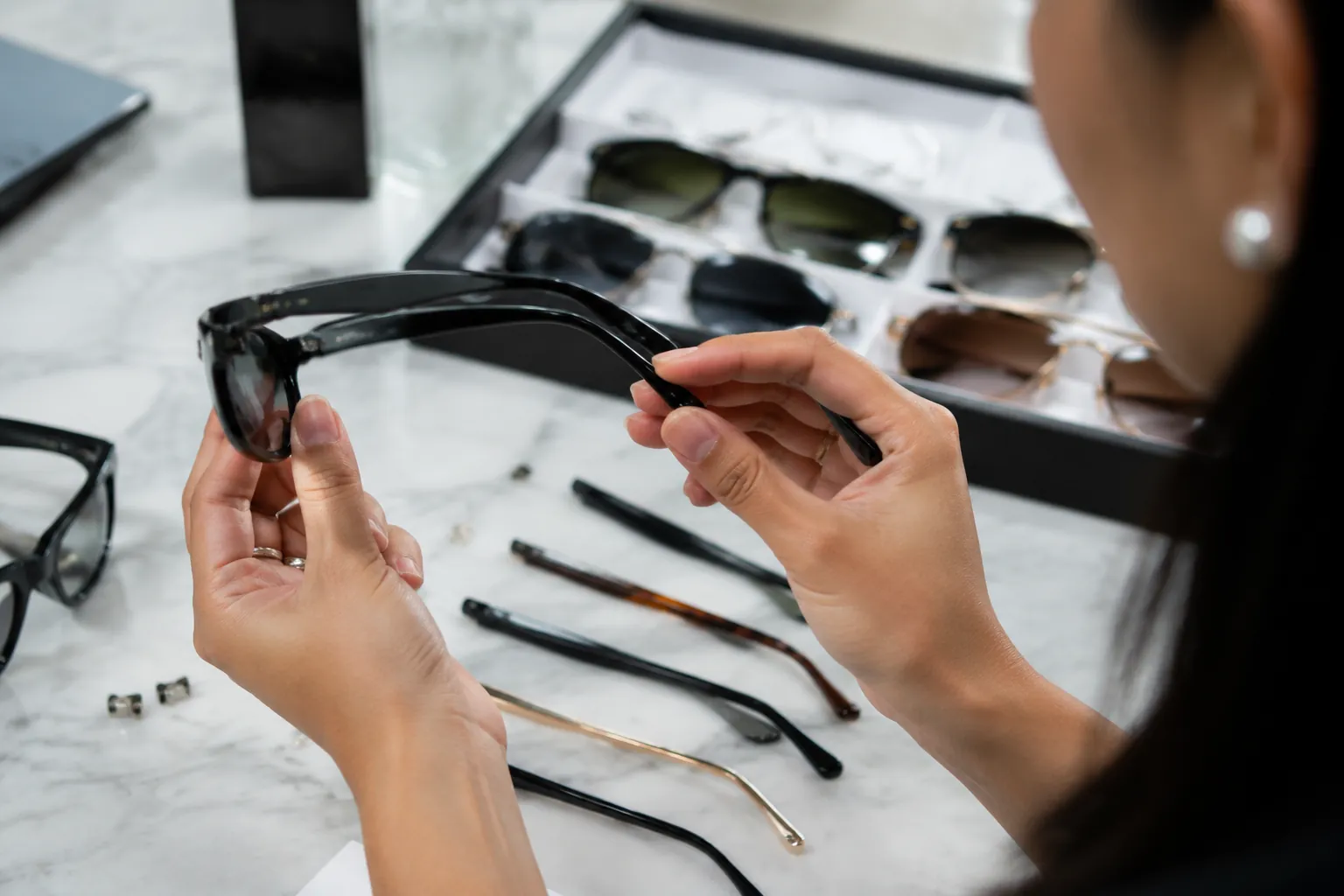
This guide is for brand owners, importers, distributors, and retail buyers specifying custom sunglasses in volume. The hinge and temple system is a small part of the frame cost, but it drives a lot of post-sale pain: loose arms, uneven opening, pinching, broken barrels, and poor fit. The job is simple. Choose a construction that fits the price point, order size, user profile, and return-risk tolerance before tooling, decoration, or samples are fixed.
The Failure Points Buyers Notice Too Late
Most sunglass returns do not sound technical. Customers say the arm feels loose, the frame sits crooked, the temple pinches behind the ear, or one side opens farther than the other. Those complaints usually trace back to a small set of causes: hinge type, screw retention, temple material behavior, barrel alignment, and final adjustment control.
The hinge area takes repeated stress every time the wearer opens, closes, removes, stores, or drops the frame. A lens can pass visual inspection and still reach the market without issue. A weak hinge, by contrast, may fail only after the product is already in use. That is why buyers should treat the hinge and temple system as a functional part, not a styling detail.
- Loose temples: usually caused by poor screw fit, soft hinge material, weak thread engagement, or inconsistent tightening.
- Temple splay: often appears when temples are too flexible, too thin near the hinge, or over-adjusted with heat.
- Broken hinge barrels: commonly linked to low-grade cast parts, poor riveting, or misaligned hinge seating.
- Uneven opening angle: usually comes from inconsistent hinge placement, warped fronts, or uneven final fitting.
- Comfort complaints: often come from temple curve, end-tip pressure, weight distribution, and temple length rather than frame width alone.
If the frame will be opened and closed many times a day, the hinge spec should be chosen for wear life, not just first-sample appearance. Set that decision before sample approval. Not after the first production batch starts generating complaints.
Head-to-Head: Common Hinge Choices
There is no single best hinge. The right choice depends on frame material, retail price, user behavior, and how much abuse the product will see in the field. A promotional PC frame and a mid-market acetate frame should not share the same hinge spec, and a sports frame should not be built like a giveaway item.
The practical target is a hinge system that holds torque, resists loosening after repeated movement, and stays aligned after normal packing and retail handling. The table below compares the common options buyers actually specify.
| Hinge type | Best use | Buyer advantage | Risk to control |
|---|---|---|---|
| Standard metal barrel hinge | PC, TR90, acetate, and metal-combination frames | Low cost, familiar repair method, widely available for volume production | Screws loosen if thread fit, barrel alignment, and tightening torque are not controlled |
| Spring hinge | Comfort-focused retail frames and wider fit ranges | Reduces pressure at the temples and helps fit more face shapes | Higher part cost and more failure points if the spring box is weak or under-pressed |
| Integrated plastic hinge | Low-cost injection frames and event merchandise | Fast production and fewer metal components | Limited durability; not ideal for higher-return-risk retail channels |
| Riveted hinge on acetate | Acetate fashion frames and thicker fronts | Strong mechanical hold when drilled and pressed correctly | Cracking around rivets if hole size, heat, or pressure is wrong |
| Flex or memory temple system | Sport, kids, travel, and active-use frames | Better resistance to bending and rough handling | Material cost, mold control, and hinge interface design matter; poor copies lose shape quickly |
A standard metal barrel hinge is often the safe middle choice. It is easy to source, easy to inspect, and easy to explain to buyers. Spring hinges are worth paying for when comfort matters, but they should not be specified just because they sound premium. A weak spring hinge is worse than a well-made standard hinge. It adds cost without reliably improving durability.
For many sunglasses, common barrel hinge sizes run from 3-barrel to 5-barrel construction. The exact choice depends on temple thickness and front design. The real question is not "Which hinge is best?" It is "Which hinge can hold the product's price, use case, and return target?"
Temple Materials Change the Complaint Profile
Temple material affects how the frame feels after 30 minutes of wear, not just how it looks in a product photo. Different materials behave differently under heat, bending, and repeated opening. That changes both comfort and complaint patterns.
PC temples keep cost low and support fast injection production. They fit promotional, entry-level retail, and simple fashion programs, but the design should avoid very thin sections near the hinge. That is where many breakages start, especially if the frame is stored hot or adjusted aggressively. TR90 offers better flex and memory, so it works well for active or comfort-driven frames. Acetate feels more substantial and can carry richer colors, but it needs cutting, tumbling, heating, bending, and careful hinge setting. Metal temples are slim and stable, though plating, solder joints, and temple balance must be controlled.
Temperature changes the picture too. PC and TR90 are more forgiving during adjustment, but excessive heat can still distort the temple curve or soften the hinge zone. Acetate needs tighter heat control. Too little heat and the bend may crack. Too much and the gloss or alignment can shift. Metal temples resist shape drift better, but they transfer pressure differently and can feel harsher behind the ear if the tip angle is wrong.
Temple systems may be made through injection molding, acetate cutting, CNC milling, lens tinting, and decoration in-house or through a mixed supply chain. That matters because temple fit is not only an assembly step. Mold shrinkage, acetate sheet thickness, CNC slot depth, hinge seat flatness, and final heating all affect whether the pair feels balanced. Control those steps together, and you get fewer "one side tight, one side loose" complaints after shipment.
If the user will put sunglasses on top of the head, drop them into bags, or pull them on and off all day, avoid the weakest hinge option. If the channel allows generous returns, it usually makes sense to spend more on hinge integrity and temple stability. That unit cost is often lower than the cost of replacement, freight, and customer service later.
The Spec Sheet Details That Prevent Loose Arms
Buyers often write "good hinge" on a tech pack. That is not a specification. A factory cannot inspect against an adjective, and the result is usually a sample that looks fine but behaves inconsistently in production. The hinge and temple section should include measurable requirements, especially before a 300-, 1,000-, or 5,000-pair order.
The spec does not need to be complicated. It does need to be concrete. The goal is a shared acceptance standard for the factory, QC team, and buyer. Define geometry, torque behavior, and fit behavior in the same document.
- Opening angle: define the target temple opening, commonly around 90 to 95 degrees unless the frame design requires more wrap or a sport fit.
- Screw retention: require screws to hold after repeated opening and closing, with no free spinning, visible lift, or back-out after handling.
- Temple alignment: both temple tips should sit level on a flat surface after adjustment, with no obvious twist.
- Hinge seating: hinge plates should sit flush, with no rocking or visible gap at normal viewing distance.
- Temple pressure: define the fit target using sample approval on head forms or agreed wearer measurements.
- Decoration clearance: confirm that laser engraving, pad printing, or metal logo plates do not weaken the hinge zone.
Specify tolerances where possible. A common production target is to keep left-right opening behavior visually matched, with no obvious asymmetry when the frame is opened on a flat surface. For temples, many buyers use a practical check rather than a technical one: the frame should open smoothly, close evenly, and remain balanced after normal adjustment. If the factory can provide a torque or cycle target, even better. A simple standard such as repeated open-close movement without loosening or thread damage gives the team something measurable to work against.
For acetate, call out hinge drill depth and rivet position on drawings. For injection frames, confirm the hinge boss thickness and metal insert placement. For spring hinges, ask for the spring box dimensions and a sample-cycle check. Small details. Big problems if they are missed.
Cost and MOQ Logic: Where to Spend
Hinge upgrades are not priced in isolation. The effect depends on material, tooling, labor, inspection time, and order quantity. For low-MOQ testing, avoid over-customizing the hinge unless the design truly needs it. Sampling a new temple structure, custom metal logo plate, and spring hinge at the same time creates cost and timing noise. It also makes it harder to see which change caused a problem.
At small quantities, keep the construction simple and use samples to separate fit issues from styling issues. At larger volumes, a stronger hinge or better temple material often pays for itself if the product is sold through retail or distributor channels, because fewer replacements and complaints offset the small increase in component cost.
Lead time matters too. Samples usually take 7 to 10 days when specifications are clear and tooling is not unusual. Bulk production typically runs 25 to 35 days. If a buyer changes from a standard hinge to a spring hinge after sample approval, time can slip because hinge seats, temple thickness, and final fit may need adjustment. A spring hinge may also require a different screw length, different barrel depth, or more careful assembly.
For budgeting, think in tiers. A basic hinge change may add a modest amount per pair, while a custom temple structure or logo-integrated hinge area can add tooling and labor overhead. The cheapest-looking option is not always the cheapest once returns, freight, and relabeling are counted. Compare the landed cost of the frame plus the expected cost of failure, not just the invoice price.
Blunt factory advice: approve the hinge system before approving color. A beautiful color on a weak temple still comes back.
QC Checks Buyers Should Ask For
Quality control for hinges should not stop at visual inspection. Visual checks catch scratches, dust, and crooked logos. They do not prove that the temple will survive use. For sunglasses shipped across borders, buyers should ask for hinge and temple checks in the QC plan before deposit, not after shipment problems begin.
The best QC programs combine simple fixture checks with practical handling tests. You do not need a laboratory to catch most failures. You need consistent movement, repeatable inspection, and a clear rule for what is acceptable.
- Open-close cycling: repeated manual or fixture-based movement to check loosening, noise, and uneven resistance.
- Screw torque check: controlled tightening so screws are firm but not stripping the hinge thread.
- Drop and flex observation: practical stress checks on finished frames, especially for PC and TR90 models.
- Flatness check: the frame sits evenly without one temple lifting after adjustment.
- Fit check after lens insertion: lens pressure can distort the front and change temple alignment.
- Packing check: temples should not be forced open or twisted inside pouches, boxes, or display packaging.
A useful request is a small pre-production stress sample, even if it is not a formal certification test. Ask the factory to inspect a set number of frames after repeated opening and closing, then check screw movement, temple symmetry, and hinge seat condition again. If the hinge fails early in a controlled test, it is better to learn that before mass production.
Mechanical problems often come from process variation rather than from the hinge part alone. If a temple problem appears, the team should trace whether it came from mold setting, hinge part quality, assembly pressure, or final adjustment. That traceability matters because many hinge defects are process defects, not just part defects.
Decoration and Compliance Should Not Weaken the Build
Decoration looks small on the drawing, but it can change the strength of the hinge and temple zone. Laser engraving, pad printing, hot stamping, and metal logo plates all interact differently with material thickness and movement. A decoration method that looks clean on a flat mockup may create friction, cracking, or wear marks after use.
Laser engraving is usually the safest choice near a hinge because it removes material in a controlled way and does not add bulk. Pad printing is light and efficient, but it should be placed away from high-flex areas whenever possible because rubbing from the temple fold and storage can wear it down. Hot stamping can look clean on acetate, but heat control matters. Heavy metal logo plates create a strong visual statement, yet they should not sit on a thin temple section or too close to a moving hinge zone. If the design calls for a plate, reinforce the area or move the decoration farther from the stress point.
Compliance is separate from durability, but it still matters. Sunglasses sold into different markets may need documentation such as CE EN ISO 12312-1, ANSI Z80.3, AS/NZS 1067, REACH, FDA registration, ISO 9001, or BSCI depending on buyer requirements and destination. CE EN ISO 12312-1, ANSI Z80.3, and AS/NZS 1067 address sunglass performance and safety requirements such as optical and transmittance criteria. REACH covers chemical restrictions. FDA registration matters for the U.S. regulatory context. ISO 9001 and BSCI speak to management system and social compliance expectations.
Those documents do not tell you that a screw will stay tight after a month of retail use. Use two layers of approval. Confirm compliance documentation for the market, then approve a mechanical QC checklist for the frame build. Do both. Do not let one stand in for the other.
A Practical Selection Framework for Buyers
Start with the selling channel. If the sunglasses are low-cost event goods, a simple injection frame with a standard hinge may be enough. Keep the temple thick enough near the hinge and do not treat it like a premium retail frame. If the sunglasses are for fashion retail, acetate or better TR90 with stable metal hinges usually gives a better balance of feel and durability. If the program targets sports, kids, travel, or rough handling, prioritize flex recovery and hinge protection over decorative extras.
Then use the order stage to control risk. At sample stage, request two versions if the decision is not obvious: one standard hinge and one upgraded hinge or temple material. That makes it easier to compare comfort, torque, and perceived quality. At low quantities, test customer feedback or distributor handling before scaling the spec. At higher volumes, lock the construction and tighten the QC limits. Review failure history before repeat production, and make small engineering changes only when they solve a real problem.
Match decoration to structure. Laser engraving near a hinge is usually safer than adding a heavy metal logo plate in a thin temple area. Pad printing is light, but placement still matters because temple bending and hinge movement can rub printed marks during use or packing. Pretty details should not sit where the frame needs strength. If the design team wants a visual upgrade, give them a safer surface area rather than forcing decoration into a stress point.
The best hinge choice is boring in the right way: it opens cleanly, holds adjustment, fits the target face, supports the required market documentation, and does not create avoidable returns.
Have a custom sunglasses project in mind?
Send us your styles, target market and quantities and we will return a detailed quote with MOQ, lead time and a sample plan.
Get a QuoteWhy source this from Wenzhou with LumiShades
Wenzhou in Zhejiang Province is widely regarded as China’s eyewear manufacturing capital, producing a large share of the world’s sunglasses. That concentration matters to buyers: a deep local supply chain for acetate sheet, hinges, lens blanks, plating and packaging means shorter component lead times, easier color and material matching, and a workforce with decades of eyewear-specific skill. LumiShades has manufactured in this ecosystem since 2009, and our vertical integration — in-house injection molding, acetate cutting, CNC milling, lens tinting, decoration and quality control — means no part of your order is quietly subcontracted to a workshop you cannot audit.
For international buyers, that vertical control translates into accountability. When a single factory owns every step, defects are traced and fixed at source rather than bounced between vendors, and your specifications survive intact from first sample to bulk. For procurement review, buyers can request process records, approved samples, quality checkpoints and project-specific compliance files before placing a bulk order. Required testing and documentation are confirmed against the destination market and product specification rather than assumed from a generic certificate list. Explore our manufacturing capabilities and quality control process to see how this works in practice.
Frequently asked questions
Should I choose spring hinges for all retail sunglasses? No. Use spring hinges when comfort, a wider fit range, or repeated handling matter, but only if the frame design can support the added mechanism. For simple fashion frames, a well-made standard metal hinge is often easier to source, easier to inspect, and less likely to create avoidable assembly variation.
What should I check in pre-production samples? Check opening angle, screw tightness, temple level on a flat surface, hinge seating, comfort behind the ear, and whether decoration weakens or rubs near the hinge area. Also check the frame after lens insertion, because lens pressure can change front alignment and expose hinge issues that were not visible earlier.
Can I test hinge options at low MOQ? Yes. Use a small pilot order to compare one standard hinge and one upgraded option under the same design and decoration conditions. Keep the rest of the spec stable so you can judge comfort, alignment, and handling without mixing in unrelated variables.
Do CE or ANSI documents prove the hinge is durable? No. CE EN ISO 12312-1, ANSI Z80.3, AS/NZS 1067, REACH, FDA registration, ISO 9001, and BSCI address compliance, safety, or management-system needs, but they do not prove long-term mechanical durability. Hinge durability still needs its own QC checks and acceptance criteria.
How much lead time should I allow for hinge changes? Samples usually take 7 to 10 days and bulk production 25 to 35 days when the spec is clear. If you change hinge type after sample approval, allow extra time for fit checks, screw selection, temple thickness, and any rework needed at the hinge seat or assembly stage.
Which temple material has the lowest return risk? There is no universal winner. TR90 is often strong for flex and active use, acetate is a solid choice for fashion retail, and PC can work well for entry-level programs if the hinge area is designed with enough thickness. The lowest return risk usually comes from matching the material to the channel and the expected handling pattern.
Ready to start?
Explore our wayfarer sunglasses or request a quote — our sales team replies within 12 hours.
Request a Quote