
Stainless Steel vs Titanium vs Aluminum Sunglass Frames
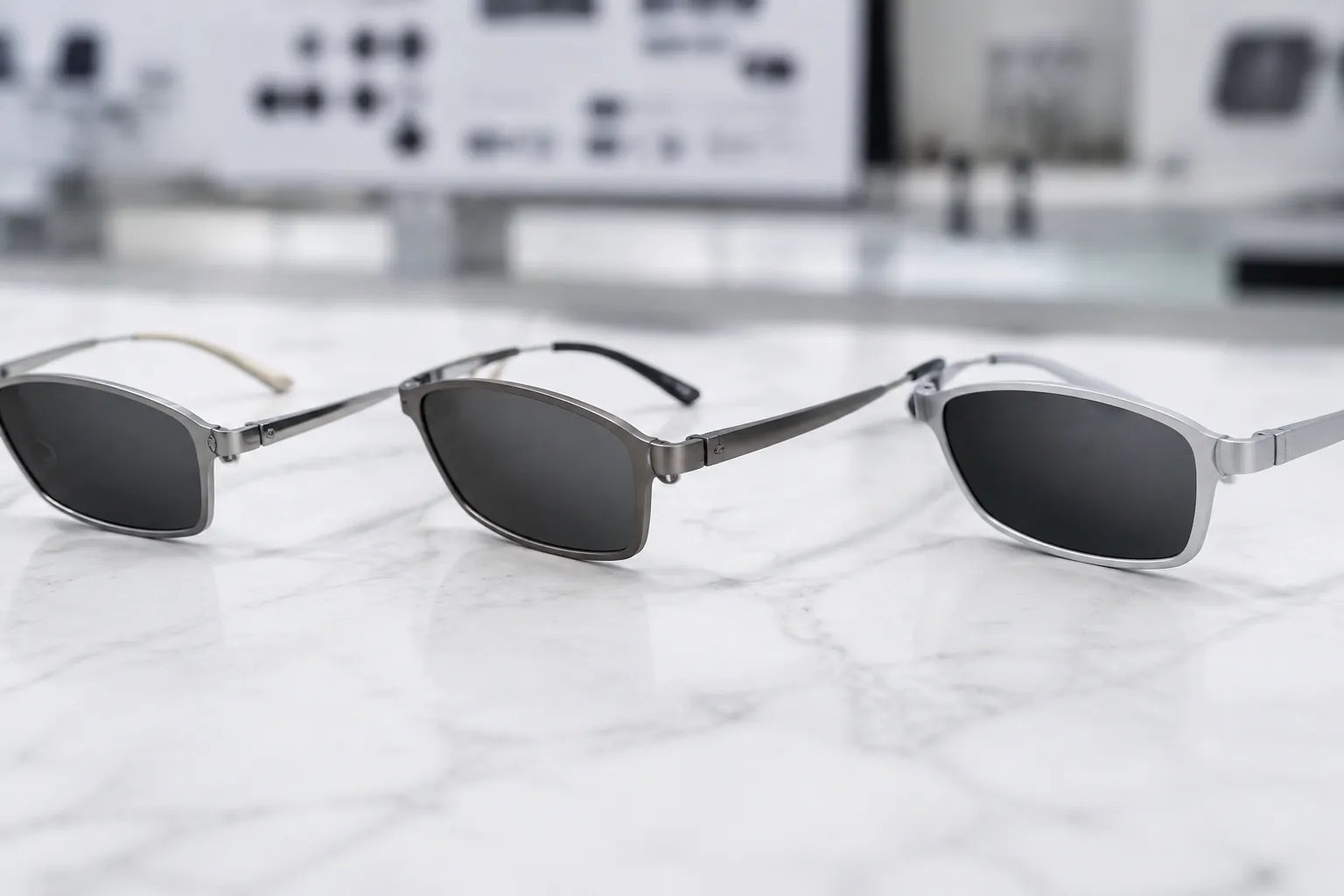
If you buy sunglasses for a brand, chain, or distribution business, frame metal affects margin, durability, and returns more than most spec sheets admit. Stainless steel, titanium, and aluminum behave differently in forming, finishing, repair rates, and shelf appeal. This guide breaks down the production trade-offs, commercial positioning, and sourcing questions that matter before you lock a design.
1) Start with the business case, not the alloy
The right question is not which metal is best. It is which metal fits your price band, durability target, and retail story. A frame can look premium on a spec sheet and still be a bad buy if it twists in transit, demands heavy hand-finishing, or lands above the shelf price your channel can support.
For B2B buyers, the decision usually comes down to three things: unit economics, process risk, and consumer perception. Stainless steel is the common workhorse because it is stable, widely available, and easier to control at scale. Titanium is the premium lightweight option, but it costs more to source and process. Aluminum can work for fashion-led programs, but it is less forgiving in daily wear and not every design justifies the extra finish control.
LumiShades runs metal-frame production in Wenzhou with in-house CNC milling, cutting, polishing, decoration, QC, and standard eyewear finishing steps. In metal eyewear, quality is won or lost in process control, not brochure language. Small deviations in temple alignment, bridge symmetry, or pad placement can create visible fit issues at retail and return issues later.
Set the target retail price first. Then work backward into frame metal, thickness, finish, and decoration. That order keeps you from buying material quality the channel will never recover in margin.
2) Material behavior in real production
Metal choice changes how the frame is cut, bent, polished, plated, anodized, and assembled. It also changes how many rejects you may see during sampling and bulk production. Those differences matter most once you move from concept to repeatable manufacturing.
| Material | Typical buyer position | Production behavior | Common risk | Best-fit retail lane |
|---|---|---|---|---|
| Stainless steel | Mainstream premium | Stable to stamp, laser cut, weld, plate, and polish; good shape retention for temples and bridges | Can feel ordinary if the design is too thin or too simple | Mass premium, optical-style, retail $30–$90 |
| Titanium | True premium | Lightweight and corrosion resistant, but more demanding in tooling, bending, and finishing; needs tighter process discipline | Higher scrap risk, higher material cost, and tighter alignment control | Higher-end fashion, optical crossover, premium sunglasses |
| Aluminum | Lightweight fashion niche | Very light and easy to theme, but surface finish, dent resistance, and coating adhesion need careful control | Denting, scuffing, and weaker perceived durability | Design-led collections, limited runs |
Stainless steel gives you the least drama in most standard programs. It tolerates normal eyewear forming, handles plating and PVD-style finishes well when the process is set up correctly, and gives a solid hand-feel without exotic fabrication. Titanium is better on weight and corrosion resistance, but it punishes poor bending, weak fixturing, and inconsistent weld control. Aluminum can look efficient on paper, but it usually needs more careful surface protection because cosmetic marks show quickly under retail lighting.
In production, the material also changes yield. A stainless steel program can often hold acceptable pass rates even when the design is moderately complex. Titanium usually needs cleaner drawings, more disciplined jigging, and more sample iterations before bulk approval. Aluminum can look simple to make, but the finish must be handled carefully because cosmetic defects are easier to see and harder to hide.
"Light" is not enough. Ask for spring tension, temple alignment, nose-pad stability, hinge feel, and whether the frame still sits square after shipping. Those are manufacturing outcomes. Not marketing claims.
3) Cost logic: where the money really goes
Buyers often focus on raw metal price. That is only one part of the cost stack. Landed cost also includes material, blank loss, forming labor, finishing labor, decoration, QC, packaging, and the yield hit from first-pass defects. A cheaper alloy can become the more expensive option if it creates more rejects or rework.
For OEM sunglasses, MOQ and pricing depend on the design, finish, and order volume. At LumiShades, MOQ starts at 50 pairs per design, and unit pricing usually improves as volume increases, commonly at higher breakpoints such as 300 pairs and above. Final cost depends on the construction, finish complexity, decoration method, and lens specification.
Use this commercial logic:
- Stainless steel: Usually the best total cost-to-performance ratio for premium mass-market programs.
- Titanium: Higher material and process cost, but supports higher retail pricing and a stronger comfort story.
- Aluminum: Can look economical at first, but cosmetic defects and lower abuse tolerance can reduce yield.
If your target retail is under $60, stainless steel usually gives the cleanest margin path. If your target retail is higher and the customer is paying for light weight and a premium feel, titanium can make sense. Aluminum needs a narrow design argument and controlled distribution. Otherwise it gets squeezed between lower-cost steel and more trusted titanium.
Decoration changes cost more than many buyers expect. Laser engraving is usually the cleanest option for a small logo on a metal temple because it is precise and durable, but it creates a bare-metal mark that may be subtle on dark finishes. Pad printing is more visible and often lower cost, but it is less durable in high-contact areas. Metal logo plates can create a stronger premium impression, but they add parts, assembly steps, and another QC point. The cheapest-looking program is not always the cheapest landed cost once rework and returns are included.
4) Durability, weight, and comfort in the field
Consumers do not ask about alloy names or modulus values. They talk about nose pressure, bent temples, hinge looseness, and frames that feel cheap after short wear. That is what shows up as complaints and returns.
Stainless steel is stiff enough to hold geometry and forgiving enough for regular use. It can take store handling and shipping better than many buyers expect. It is heavier than titanium, so the design has to distribute weight properly. Thin nose pads and poor temple balance can make a solid frame feel wrong. In most sunglasses builds, stainless steel works best when the front and temples are balanced to avoid front-heavy pressure on the bridge.
Titanium is usually the best answer when the selling point is all-day comfort. It is noticeably lighter, resists corrosion well, and supports premium lifestyle or travel assortments. The trade-off is simple: poor design is more expensive to correct. A titanium frame with weak hinge geometry or poor spring control may feel elegant in hand but unstable on the face.
Aluminum is light, but light does not equal durable. It can dent more easily and usually requires more careful handling in packing and transit. If your distribution chain is rough, or stores are careless with display handling, that matters. It is also less forgiving when customers repeatedly open and close the temples, because cosmetic damage can appear faster than on stainless steel.
Practical rule: if the frame will be tried on heavily, shipped in volume, and sold in a mid-price channel, stainless steel is the safest default. Titanium is a deliberate premium upgrade. Aluminum is a niche play.
Check samples at three points: off-face hinge action, on-face temple pressure, and after-pack alignment. A frame can look perfect in photos and still fail the feel test if temple torque is uneven. On metal sunglasses, small changes in bridge or pad placement can affect comfort materially.
5) Process details that decide pass or fail
Premium metal frames are not just cut and assembled. They go through forming, alignment, surface treatment, lens fitting, and QC checkpoints that determine whether you ship on time or absorb rework. Sourcing teams should treat those checkpoints as commercial risks, not as factory housekeeping.
- Specification review: confirm material grade, thickness, finish, lens tint target, and logo method before sampling. For most sunglass programs, that means confirming front thickness, temple dimensions, hinge type, nose-pad style, and finish family in writing.
- Prototype build: check bridge fit, temple swing, and pad symmetry. Small misalignments show immediately on metal frames, especially with mirrored lenses or flat temples.
- Tolerance check: lock the acceptable window for critical points such as hinge symmetry, temple opening angle, and lens seat depth. The exact tolerance should match the SKU's construction and target price.
- Surface treatment: verify polishing direction, plating adhesion, or anodized finish consistency depending on the metal. On dark finishes, inspect under bright directional light because micro-scratches become obvious quickly.
- Assembly test: inspect hinge action, screw retention, pad movement, and lens seat tolerance. Hinge torque should feel consistent across samples so the temples do not drift open in transit or feel stiff on first wear.
- QC and packing: check cosmetics under light, then confirm carton protection so frames do not arrive twisted. For metal sunglasses, sleeve fit, foam spacing, and tray pressure can matter as much as the frame itself.
For production timing, LumiShades quotes samples in 7 to 10 days and bulk in 25 to 35 days, depending on complexity and approval speed. That timeline only holds when the buyer gives fast feedback and does not keep changing finish, logo details, or lens tint after sampling starts.
If you need laser engraving, pad printing, or metal logo plates, schedule those early. Decoration is often where otherwise clean metal frames get delayed. Ask about lens tinting at the start, not after sample approval. Changing tint late can reset the schedule because lens sourcing, coating, and QC move together.
Ask whether the factory uses in-process checks and final inspection on critical features. A serious program should include incoming material checks, alignment checks during production, final cosmetic inspection, and a packing audit. That is the difference between a frame that ships and a frame that ships cleanly.
6) Compliance and export checks buyers should actually ask for
Do not buy a premium metal frame on looks alone. For overseas shipments, the compliance file matters as much as the sample. LumiShades holds certifications and registrations including CE EN ISO 12312-1, FDA registration, ANSI Z80.3, AS/NZS 1067, REACH, ISO 9001, and BSCI, but buyers should still verify which standard applies to the exact SKU and market.
What you should verify on each program:
- Lens and frame standard: confirm the target market standard before bulk approval, not after the sample is approved.
- Material content: ensure REACH-related material constraints are covered for the selected finish, coating, plating, and decoration method.
- Factory traceability: keep the approval sample, spec sheet, color chip, lens tint reference, and packing standard locked before order release.
- Test scope: ask which standard applies to the exact SKU, not just the product family.
Metal alone does not make a product compliant. The whole build does. A titanium frame still needs the same discipline on lens, assembly, and labeling as a stainless steel one. If the frame is sold as sunglasses in multiple regions, confirm whether the same lens tint and labeling can be used across destinations or whether regional packaging changes are needed.
For multi-market programs, the cleanest approach is one base platform with market-specific documentation. That usually means one frame construction, then adjusted labeling, lens specification, barcode, and carton language by destination. Rebuilding the frame for every market is slower, more expensive, and harder to scale.
7) Best-fit use cases by channel and price point
The right metal depends on the channel. A wholesale buyer for a supermarket chain does not need the same frame profile as a premium DTC brand, a travel retailer, or a fashion capsule built around limited drops.
| If you sell to... | Best material | Why | What to avoid |
|---|---|---|---|
| Mass premium retail | Stainless steel | Strong value signal, manageable landed cost, broad fit, and easier repeatability | Overengineering with titanium that hurts margin |
| Premium fashion or travel | Titanium | Light weight, higher perceived value, stronger comfort story, and better shelf differentiation | Thin designs with weak hinges or poor alignment |
| Design-led limited drops | Aluminum | Light feel and distinctive styling are possible when distribution is controlled | Rough handling, high return risk, and cosmetic damage |
| Optical crossover collections | Stainless steel or titanium | Better acceptance for daily wear and repeat purchase behavior | Novelty metal treatments that age badly |
If your retail price sits around $30 to $90, stainless steel usually gives the cleanest route to margin. If you want a more premium story and can support a higher ASP, titanium is the more credible upgrade. Aluminum only makes sense if the design itself is the selling point and your distribution is tightly controlled.
For brands building a range, a common structure is stainless steel as the core line, titanium as the premium tier, and aluminum only for selective fashion capsules. That keeps the supply chain simpler and the quality expectation more consistent across the range. It also makes merchandising easier because the customer can understand the pricing ladder quickly: good, better, best.
From a buying perspective, the best material is usually the one that protects sell-through. If the frame is a core item that must reorder smoothly, stainless steel is the safest. If it is a hero product built to justify a premium story, titanium earns its place. If it is a controlled-fashion experiment, aluminum can work, but it should be treated as a niche program, not a default.
8) Sourcing decision checklist for buyers
Before you place the order, lock the decision with numbers and requirements, not opinions. A good factory will ask the same questions because the answers determine yield, price, and delivery confidence.
- What is the target retail price and channel?
- How many pairs per design, and how many colorways?
- What is the acceptable frame weight range?
- Do you need laser engraving, pad printing, or a metal logo plate?
- Which market standards apply to this SKU?
- Is the order for a core program or a limited run?
- What tolerance window is acceptable for bridge symmetry, temple alignment, and lens seating?
Then confirm the commercial terms: MOQ, sample timing, bulk timing, and what changes trigger a new sample. At LumiShades, MOQ starts at 50 pairs per design. Pricing usually improves as volume increases, but the exact breakpoints depend on the spec, finish, and decoration. Move the bridge, change the finish, alter the temple length, or swap the lens tint, and the economics may change too.
The blunt answer: choose stainless steel if you need a dependable premium frame at scale, titanium if you need lighter weight and a stronger premium position, and aluminum only if you have a narrow design case and controlled handling. That is the buying logic.
If you are still deciding, ask the factory for three sample quotes side by side: one stainless steel build, one titanium build, and one aluminum build with the same visual silhouette. Comparing them on landed cost, sample lead time, and expected process risk is usually more useful than arguing over the alloy in the abstract.
Have a custom sunglasses project in mind?
Send us your styles, target market and quantities and we will return a detailed quote with MOQ, lead time and a sample plan.
Get a QuoteWhy source this from Wenzhou with LumiShades
Wenzhou in Zhejiang Province is widely regarded as China’s eyewear manufacturing capital, producing a large share of the world’s sunglasses. That concentration matters to buyers: a deep local supply chain for acetate sheet, hinges, lens blanks, plating and packaging means shorter component lead times, easier color and material matching, and a workforce with decades of eyewear-specific skill. LumiShades has manufactured in this ecosystem since 2009, and our vertical integration — in-house injection molding, acetate cutting, CNC milling, lens tinting, decoration and quality control — means no part of your order is quietly subcontracted to a workshop you cannot audit.
For international buyers, that vertical control translates into accountability. When a single factory owns every step, defects are traced and fixed at source rather than bounced between vendors, and your specifications survive intact from first sample to bulk. For procurement review, buyers can request process records, approved samples, quality checkpoints and project-specific compliance files before placing a bulk order. Required testing and documentation are confirmed against the destination market and product specification rather than assumed from a generic certificate list. Explore our manufacturing capabilities and quality control process to see how this works in practice.
Frequently asked questions
Which metal is safest for a first premium sunglasses order? Stainless steel is usually the safest starting point because it is easier to sample, scale, and price into a mid-premium channel. It also gives buyers a more forgiving path on alignment, finishing, and packing than titanium or aluminum.
Is titanium always worth the extra cost? No. Titanium makes sense when your retail price can support the added cost and your customer values light weight and premium feel. If your channel is price-sensitive, stainless steel is usually the better business choice.
Can aluminum work for sunglasses frames in bulk? Yes, but it is best for narrow use cases. Aluminum is more sensitive to dents and cosmetic damage, so it needs careful packing, controlled handling, and a channel that can protect the product through distribution.
What MOQ should I expect for custom metal frames? At LumiShades, MOQ starts at 50 pairs per design. The exact commercial terms depend on the frame construction, finish, and decoration method, so confirm the spec before you compare prices.
How long does sampling and bulk production take? Typical timing is 7 to 10 days for samples and 25 to 35 days for bulk, assuming the specification is clear and approvals are not delayed. Complex decoration, finish changes, or late lens updates can extend the schedule.
What compliance documents should I ask for? Ask for the standards that apply to your market and SKU, and verify the supporting paperwork for that exact style. Relevant documents may include CE EN ISO 12312-1, FDA registration, ANSI Z80.3, AS/NZS 1067, REACH, ISO 9001, and BSCI where applicable.
Ready to start?
Explore our sport wrap sunglasses or request a quote — our sales team replies within 12 hours.
Request a Quote