
Wholesale Sunglasses for Boutiques: Low-MOQ Guide
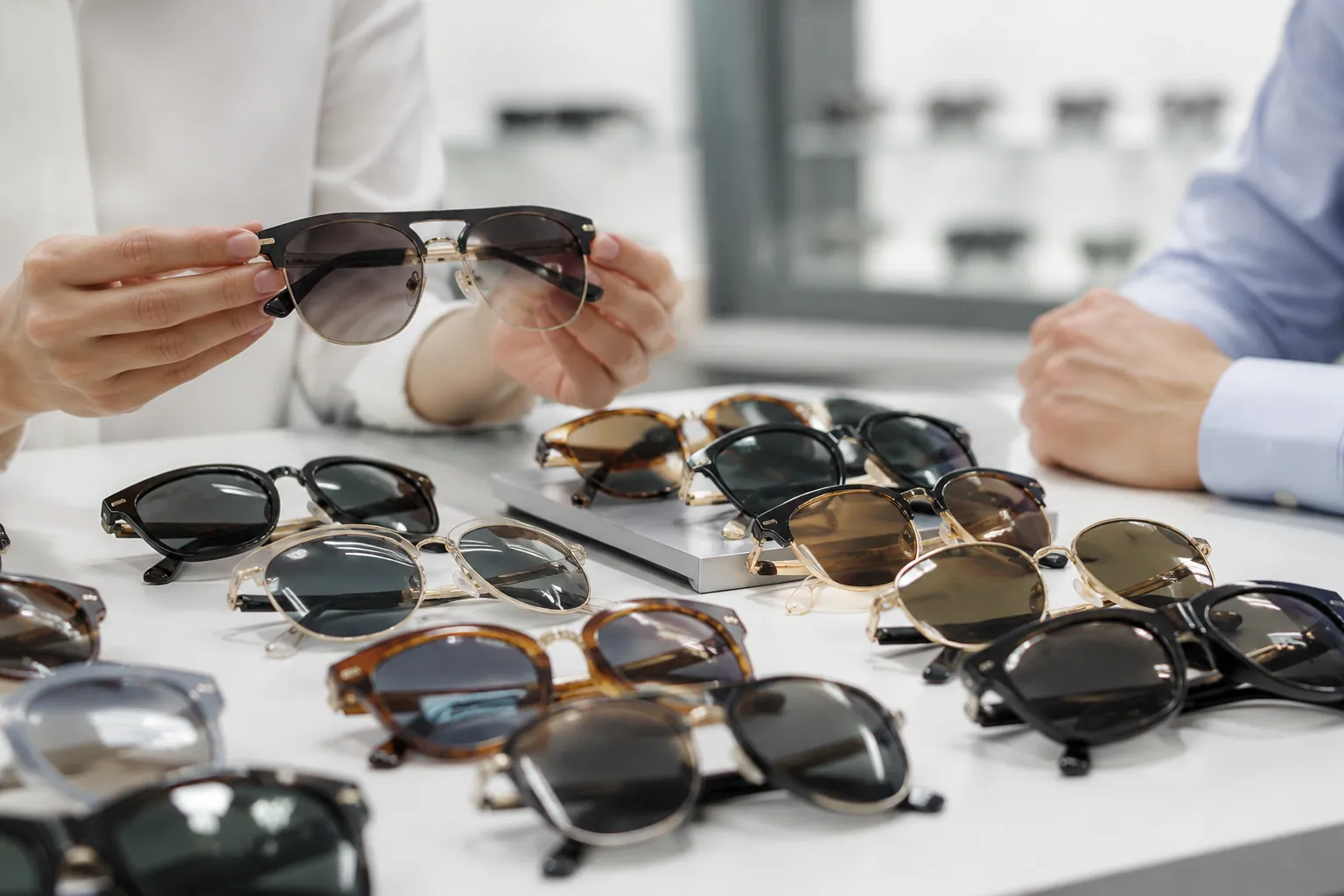
This guide is for boutique retailers, small chains, importers, and fashion brands that want premium-looking sunglasses without large quantities per style. It shows how to build a low-MOQ range, choose frame materials, specify lenses, control logo work, plan packaging, and write QC checks a factory can follow. The aim is simple: fewer weak SKUs, clearer specifications, better sell-through data, and a wholesale sunglasses program that can start small and reorder with less inventory risk.
Start With a Boutique-Size Buying Plan
A boutique sunglasses order should not copy a mass retailer's buying plan. Ten frame shapes, eight colors, and several lens options may look strong on a range sheet. In practice, they create too many SKUs and too little depth per SKU.
Weak depth causes problems. Setup work rises. Packing gets harder. Inspection points multiply. Sell-through data becomes less useful because each style has too few units to prove demand.
For a first wholesale run, keep the structure tight: 2 to 4 frame shapes, 2 to 3 colors per shape, and one lens category per colorway. If the supplier supports low-MOQ sunglasses, 50 pairs per design can be enough to test a focused capsule before increasing quantities. Larger orders may reduce unit cost, but price still depends on material, lens type, decoration, packaging, inspection needs, and shipment terms.
A practical first order might be 300 pairs total: 3 frame shapes, 2 colorways each, and 50 pairs per colorway. That gives enough stock to merchandise properly, place units in more than one location if needed, and measure sell-through without tying too much cash into slow colors. If a black smoke square frame sells out while a clear pink oval frame sits, that result is useful. A lower unit cost on a weak style is not.
- Keep the frame count tight: boutiques need a clear point of view, not a catalog wall.
- Use commercial colors first: black smoke, tortoise brown, champagne, clear grey, and dark green are easier to sell than novelty colors.
- Separate test and reorder logic: the first run proves demand; the reorder improves depth and margin.
- Hold one detail constant: using the same lens tint, logo size, or pouch style across SKUs reduces setup risk.
- Track by SKU: record sell-through by frame, color, lens, price, display position, and store location before reordering.
Choose Frame Materials by Price and Fit
Frame material affects appearance, weight, durability, comfort, processing time, and cost. Do not choose material from photos alone. Ask for sample weight, hinge type, temple stiffness, nose bridge finish, surface treatment, and fitting notes. A frame can look good in a rendering and still feel cheap if the temple flex is weak, the hinge screw loosens, or a mold line is visible on the front edge.
PC and TR90 are common for injection-molded fashion sunglasses. PC is cost-effective and works for trend frames, promotional styles, and entry retail price points. It is usually less flexible than TR90, so comfort depends on mold design, bridge shape, and temple geometry. TR90 costs more in many cases, but it can offer lighter wear and better recovery after bending. That makes it useful for daily wear, travel, and sport-inspired styles. For injection frames, check molded color consistency, sprue marks, sink marks near thick sections, and temple opening symmetry.
Acetate has a richer hand feel, better pattern depth, and a more premium boutique look, especially in tortoise, layered, translucent, and laminated colors. It also needs more processing: sheet cutting, CNC milling, tumbling, hand polishing, hinge installation, and adjustment. That adds cost and lead time. Metal and combination frames can look refined, but plating, soldering, bridge balance, and nose pad alignment need close control.
Ask suppliers which steps are handled in-house and which are outsourced. In-house injection molding, acetate cutting, CNC milling, polishing, decoration, or assembly can shorten feedback loops. Still, it does not replace written specifications, signed samples, or final inspection. Check the process. Do not rely on broad factory claims.
| Material | Best Use | Typical Buyer Trade-Off | QC Detail to Specify |
|---|---|---|---|
| PC injection | Trend frames and entry price points | Lower cost, less flexible than TR90 | Clean mold line, even color, no sink marks, secure hinge screw |
| TR90 injection | Lightweight daily wear and sport-inspired styles | Higher cost than PC, limited pattern depth | Consistent temple recovery, smooth bridge edges, balanced opening angle |
| Acetate | Premium boutique and fashion collections | Longer processing time and higher unit cost | Polished bevels, aligned pattern, no cloudy edges, clean hinge fit |
| Metal or combo | Thin profiles and optical-inspired fashion | Plating, soldering, and fitting are more sensitive | Stable bridge, clean plating, even nose pads, balanced temple pressure |
Use Colorways Instead of New Tooling
New molds are expensive and slow. For small wholesale sunglasses runs, be careful before asking for exclusive frame shapes. It is often smarter to use existing molds and focus on color, lens pairing, finish, and branding. A sharp colorway can make a standard mold look more considered than a rushed custom shape.
Do not approve color from a screen. Request physical color chips, sample frames, or acetate plate photos taken in daylight and indoor lighting. For acetate, confirm whether the plate is stock acetate or a custom sheet. Stock acetate is usually faster and better for low-MOQ programs. Custom sheet can look distinctive, but it may require higher material quantity, longer lead time, and more waste allowance.
For injection frames, clarify whether the color is molded-in, sprayed, rubber-coated, or painted. Molded-in color is generally more durable. Spray and coating can create softer fashion finishes, but they should pass adhesion and rub testing.
A practical boutique color rule is one commercial neutral, one warm fashion color, and one seasonal accent. For example: black frame with smoke lens, tortoise frame with brown lens, and champagne frame with green or gradient lens. Do not make every SKU unusual. Buyers may like unusual colors during range review. Retail customers often choose the color they can wear right away.
- Choose the frame shape first based on fit, face coverage, and target retail price.
- Select 2 or 3 colorways with clear roles in the collection.
- Match lens tint to frame color instead of copying trend images blindly.
- Approve physical samples under daylight and store lighting.
- Keep the winning color on reorder and replace only the weak colorway.
Specify Lenses Like a Technical Buyer
Lens color sells the first look. Lens quality drives complaints. A purchase order should not say only "black lens" or "UV400." That leaves too much room for interpretation.
Define lens material, lens category, UV claim, tint color, visible light transmission range, optical clarity, surface defect standard, and whether the lens is solid, gradient, mirrored, or polarized.
Common boutique options include solid smoke, brown, green, gradient smoke, gradient brown, and mirror lenses. Category 3 lenses are common for strong sunlight and mainstream sunglasses. Category 2 works for lighter fashion tints. Category 4 is very dark, is not suitable for driving, and requires clear user warnings where applicable.
Polarized lenses cost more and can support a higher retail price, but they need sharper inspection. Ask for a polarization test card. Check for stress marks, uneven darkness, rainbow distortion, and lens-to-lens color consistency.
Match compliance to the destination market. CE EN ISO 12312-1 is relevant for sunglasses sold in the EU. ANSI Z80.3 is relevant for non-prescription sunglasses in the U.S. AS/NZS 1067 applies to Australia and New Zealand. REACH matters for restricted substances in materials, coatings, and packaging components sold into the EU. FDA registration may be relevant for U.S. import handling, but it is not a product quality certification by itself. ISO 9001 and BSCI relate to management systems and social compliance. They do not replace product testing.
Put measurable checks on the approval sheet: UV400 claim confirmation, lens category, visible light transmission range, lens color reference, lens thickness, base curve, scratch allowance, and maximum visible defect size. For boutique orders, even a small lens scratch can cause a return because customers inspect sunglasses closely at retail.
Control Decoration So It Looks Premium
Branding is where many small runs fail. Oversized logos, weak foil stamping, crooked temple marks, and cheap pouch printing can make a decent frame look like a giveaway item. For boutiques, quieter decoration usually looks more expensive. A small temple logo, clean inside-arm mark, or restrained lens engraving often works better than a loud outside logo.
Common decoration methods include laser engraving, pad printing, metal logo plates, heat-transfer pouch printing, woven labels, and printed cleaning cloths. Each method has its own limits. Pad printing can be cost-effective for simple logos, but fine lines may fill in if the artwork is not adjusted. Laser engraving is clean on suitable surfaces, especially temples and some lens corners, but contrast depends on material color and coating. Metal logo plates can look premium, but they add assembly steps and must sit flush without sharp edges.
Send vector artwork, Pantone references where relevant, and a placement drawing with millimeter dimensions from the hinge, temple tip, lens edge, or centerline. "Put logo on side" is not a specification. It is a future complaint. For temple marks, a common boutique width is about 15 to 28 mm depending on temple height. For lens marks, keep placement subtle and confirm it does not interfere with vision, cleaning, or retail appearance.
- Pad print: confirm ink color, logo size, curing time, and abrasion resistance.
- Laser mark: approve contrast and depth on the actual production material.
- Metal plate: check recess depth, glue overflow, edge feel, and alignment.
- Inside temple print: include model code, lens category, and compliance marks only where required.
- Pouch logo: test print durability with rubbing because soft packaging is handled often.
Use Packaging to Improve Perceived Value
Packaging is often the fastest way to make a low-MOQ sunglasses run feel more serious. The frame may use an existing mold, but a better pouch, cleaning cloth, hangtag, barcode label, and carton plan can change how the product sits in a boutique display. Good packaging also prevents basic operating problems: wrong SKU labels, missing compliance marks, crushed cases, and mixed colorways.
Start with the retail environment. If sunglasses are sold from a countertop tray, a microfiber pouch and branded hangtag may be enough. If they are sold as gift items, a soft case or folding case can support a higher retail price. If the buyer needs shelf-ready stock, each pair may need a barcode sticker, model code, color code, lens category mark, country-of-origin label, importer information, and required market warnings.
Do not overpack a test order. Heavy rigid cases increase carton volume and freight cost quickly. A small boutique order with bulky cases can cost more to ship and store than expected. For many boutiques, a compact branded microfiber pouch plus a useful cleaning cloth gives a better balance of perceived value and logistics control.
| Packaging Option | Best For | Cost Impact | Watch Point |
|---|---|---|---|
| Polybag only | Internal handling or very low price items | Lowest | Looks weak at retail and offers little protection |
| Microfiber pouch | Boutique counter sales | Low to medium | Fabric color, seam strength, and print durability |
| Pouch plus cloth | Premium-looking small runs | Medium | Keep cloth size useful, not token-sized |
| Soft case | Giftable retail sets | Medium to high | Higher carton volume and compression risk |
| Rigid case | Higher price collections | High | Freight, storage, and display footprint |
Write Sampling, QC, and Lead Times Clearly
Sampling and production timelines vary by material, color, decoration, packaging, workload, and approval speed. Do not rely on a general promise. Ask the supplier to confirm sample lead time, bulk production lead time, artwork cut-off date, packaging approval date, inspection window, and planned ship date in writing.
If the buyer changes lens color after approving the frame, or changes pouch artwork after packing materials have started, the schedule should be recalculated. Small changes still affect production.
A proper sample approval should cover frame shape, material, color, lens tint, lens category, logo size, logo placement, hinge feel, packaging, labeling, and compliance documents for the destination market. Photograph the approved sample from the front, side, inside temple, lens close-up, logo close-up, and packaging view. If possible, keep one signed golden sample with the buyer and one production reference sample at the factory.
QC for sunglasses should be practical and measurable. Check lens scratches, frame warpage, hinge tightness, temple alignment, nose bridge finish, color difference, logo position, and packaging accuracy. Reject visible lens scratches, loose hinges, sharp edges, crooked logos, incorrect labels, and frames that sit unevenly. Temple tips should open symmetrically. Screws should not loosen after basic open-close testing. The frame should sit flat without obvious rocking.
Ask the supplier which inspection standard will be used, which defects are critical, major, or minor, and what sample size will be inspected. For small boutique runs, consider 100% inspection on lenses, logos, and packaging labels if the cost is acceptable. A few visible defects can affect a large share of the order. Written checkpoints matter even for low quantities: sample request date, sample approval date, material cut-off date, packaging approval date, inline inspection window, final inspection date, and planned ship date.
Build a Low-Risk Reorder Strategy
The first order is not only for sales. It is for data. Track sell-through by frame, color, lens, price, display position, and store location. If the tortoise square frame sells through faster than the clear grey oval frame, do not reorder both equally because the collection sheet looks balanced. Buy what moved.
Use the MOQ structure to step up carefully. Keep early tests narrow. Move winners into deeper quantities when sell-through is proven. At higher volumes, negotiate better unit pricing, but do not chase price breaks on colors that have not earned shelf space. Lower unit cost does not help if stock sits in the back room.
For seasonal boutiques, reorder timing matters. Place reorders before the peak selling month, not during it. Add up sample approval time, bulk production time, inspection time, freight booking, transit, customs clearance, and store allocation. For urgent replenishment, discuss air freight for bestsellers only. Air freight on slow colors is just expensive storage in motion.
Buying rule: test narrow, reorder deep, and change only one major variable at a time.
That is how small-run wholesale sunglasses can still look premium. Not by buying too many styles. By making fewer decisions, writing better specifications, and requiring every frame, color, lens, logo, and packaging choice to justify its place.
Have a custom sunglasses project in mind?
Send us your styles, target market and quantities and we will return a detailed quote with MOQ, lead time and a sample plan.
Get a QuoteWhy source this from Wenzhou with LumiShades
Wenzhou in Zhejiang Province is widely regarded as China’s eyewear manufacturing capital, producing a large share of the world’s sunglasses. That concentration matters to buyers: a deep local supply chain for acetate sheet, hinges, lens blanks, plating and packaging means shorter component lead times, easier color and material matching, and a workforce with decades of eyewear-specific skill. LumiShades has manufactured in this ecosystem since 2009, and our vertical integration — in-house injection molding, acetate cutting, CNC milling, lens tinting, decoration and quality control — means no part of your order is quietly subcontracted to a workshop you cannot audit.
For international buyers, that vertical control translates into accountability. When a single factory owns every step, defects are traced and fixed at source rather than bounced between vendors, and your specifications survive intact from first sample to bulk. We back this with 15+ years of experience, shipments to 60+ countries, more than 5 million pairs produced per year and a 98.5% on-time delivery rate. Our certifications — CE EN ISO 12312-1, FDA registration, ANSI Z80.3, AS/NZS 1067, REACH, ISO 9001 and BSCI audit — mean the compliance documentation your market requires already exists. Explore our manufacturing capabilities and quality control process to see how this works in practice.
Frequently asked questions
What is a realistic first order for a fashion boutique? A practical starting point is 200 to 400 pairs total, built from 2 to 4 frame shapes and about 50 pairs per design if the supplier supports that MOQ. Choose commercial colors first, assign each SKU a target retail price, and track sell-through by frame, color, lens, and store location before reordering.
Can I use my logo at 50 pairs per design? Often yes, but the right method depends on the frame material, surface area, artwork detail, and budget. Send vector artwork, confirm logo size in millimeters, approve a physical sample, and test durability for the chosen method, such as pad printing, laser engraving, metal plate application, or pouch printing.
How long should I allow from sample request to shipment? Ask the supplier to quote sample time, bulk production time, inspection time, and freight time separately. Add time for artwork revisions, lens or color changes, packaging approval, compliance document review, and final inspection. Do not set a launch date from production time alone.
Which certifications or compliance documents should I ask for by market? For the EU, ask about CE EN ISO 12312-1 and REACH. For the U.S., ask about ANSI Z80.3 and confirm whether FDA registration is relevant to the supplier or importer setup. For Australia and New Zealand, ask about AS/NZS 1067. ISO 9001 and BSCI can support supplier assessment, but they do not replace product testing for the sunglasses themselves.
Are polarized lenses worth it for boutique sunglasses? They can be worth it if your retail price supports the added cost and your customers value glare reduction. Approve samples with a polarization test card, check lens clarity and tint consistency, look for stress marks or rainbow distortion, and confirm the lens category and UV claim in writing.
How do I reduce the risk of dead inventory? Limit the first run to proven frame shapes, use 2 or 3 wearable colorways, test small quantities where possible, and reorder only styles with clear sell-through data. Change one major variable at a time, such as color or lens tint, so you know what caused the result.
Ready to start?
Explore our square sunglasses or request a quote — our sales team replies within 12 hours.
Request a Quote