
Best Sunglasses Frame Finish for Bulk Buyers
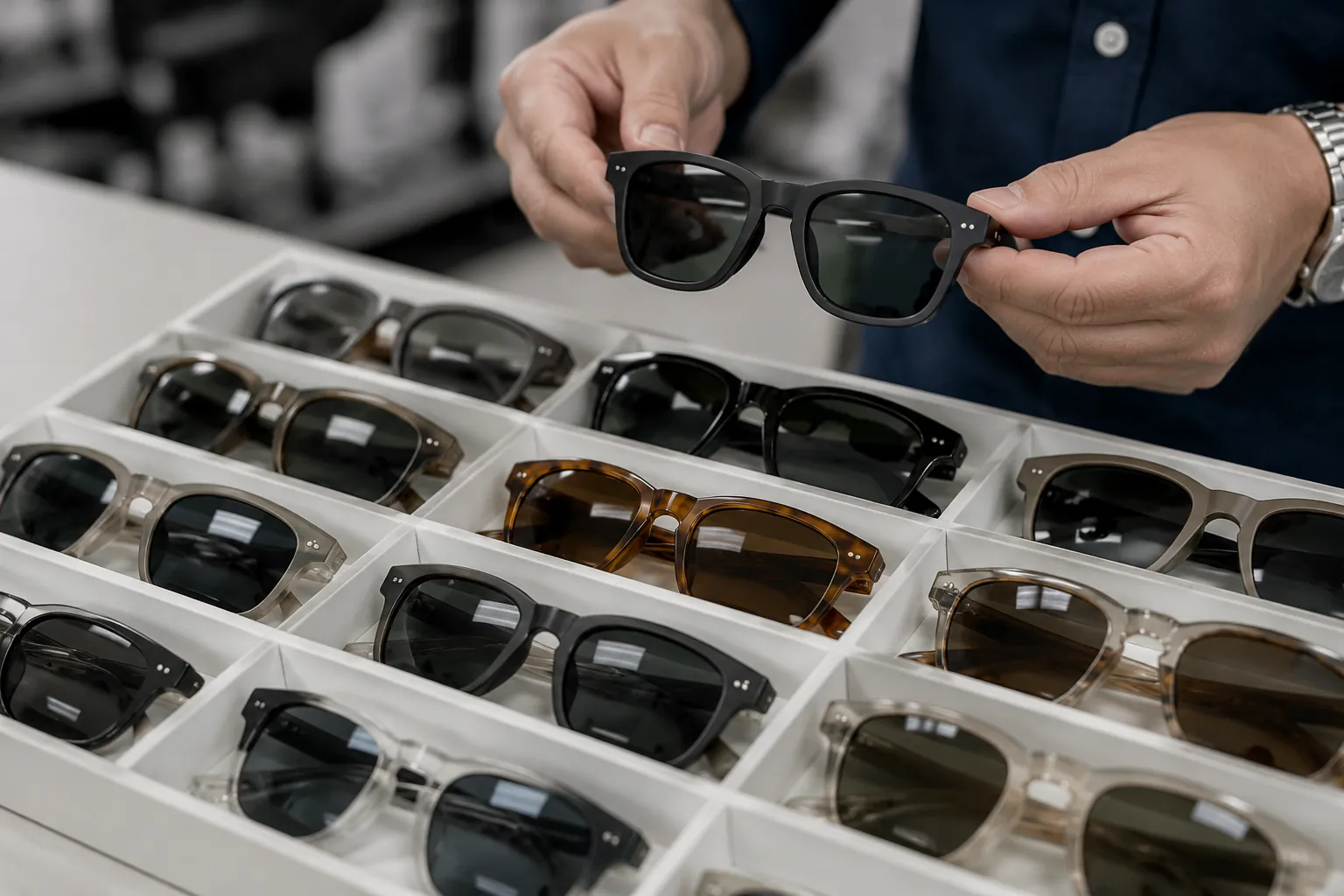
Frame finish is not only a style choice. For volume buyers, it affects perceived value, scratch visibility, hand feel, returns, inspection time, and retail positioning. This guide is for brands, importers, distributors, and retailers that need a finish they can reorder with confidence. The short answer: polished and sanded finishes are usually the safest high-volume choices. Rubberized and metalized finishes can sell well, but only when the channel, price point, and quality controls support the extra process risk.
What Each Finish Actually Means
Buyers often use finish terms loosely. Factories do not. A finish request becomes a surface requirement, and that requirement affects tooling, labor, inspection, and rejects.
Polished means the frame surface has a gloss level with visible reflection and depth. On acetate, this may involve tumbling, edge refinement, and hand polishing. On injected plastic, the result depends heavily on mold quality, resin choice, and any post-molding surface work.
Sanded means the surface is intentionally dulled or textured. The effect may come from mold texture, bead blasting on metal parts, or a controlled secondary step. The goal is a low-gloss surface that reduces glare and hides light handling marks.
Rubberized usually means a soft-touch coating over a base frame, most often injected plastic or another treated substrate. It gives grip and a warmer hand feel. Metalized means a metallic-looking decorative finish, such as vacuum metallization, plating, or a similar coating system. It is not the same as a full metal frame.
- Polished: glossy, reflective, and visually rich.
- Sanded: matte, low-glare, and forgiving in display handling.
- Rubberized: soft-touch and grippy, but more sensitive to wear if the coating system is weak.
- Metalized: high-impact and decorative, but more dependent on coating adhesion and edge quality.
The finish has to match the material. A surface that looks premium on acetate may look flat on polycarbonate or too dry on TR90. Always review samples on the actual production material, not on a lookalike sample from another program.
How Finish Interacts With Material
The same finish behaves differently on acetate, TR90, polycarbonate, and metal. That is why the finish specification should never stand alone.
Acetate is often the easiest material to polish well. It can be cut, refined, tumbled, and buffed to a deep gloss. It also exposes poor prep fast. Burned edges, uneven sanding, and weak polishing are easy to see.
TR90 and other injected nylons are common for matte and sport-oriented frames because the mold can carry texture directly. That reduces secondary labor. It can also make consistency easier if the mold is well maintained.
Polycarbonate is common in mass-market frames, but the finish depends heavily on mold condition and process control. It is less forgiving than a well-finished acetate program. Metal frames rely on coating, brushing, plating, anodizing effects, or combinations of those processes. Edges matter. Sharp corners and hinge areas show defects before broad flat surfaces do.
Finish also changes how a frame ages. Acetate can develop shine at temples and contact points after repeated wear. TR90 usually handles impact well, but an overly coarse texture can look cheap. Soft-touch coatings can feel strong at first, then show shine, tackiness, or wear after contact with skin oils, sunscreen, and cleaning chemicals. Metalized finishes are most vulnerable at corners, logo cuts, and hinge junctions.
Do not approve by color alone. Check texture, reflection, hand feel, and edge quality on the real production material.
What Happens In Production
Finish selection changes tooling needs, cycle time, inspection points, and handwork. It also changes where defects appear.
Polished acetate usually requires cutting, edge refinement, tumbling, and buffing. If the cut line is poor, polishing can make the defect more visible. It does not hide bad geometry. Sanded surfaces are less sensitive to shine defects, but they can reveal uneven texture depth, patchy grain, or inconsistent direction.
Rubberized coatings add prep, application, curing, and extra handling. Metalized effects may require vacuum metallization, a conductive base coat, a topcoat, and adhesion checks. The finish is not usually the first failure point. Surface preparation is. Dust, oil, mold release, and uncured compound can ruin an otherwise workable finish.
A practical approval flow looks like this:
- Inspect the base frame for flash, sink marks, burn marks, and seam lines.
- Confirm the surface preparation method before polishing or coating.
- Review first articles under normal light and side light.
- Test a small batch for adhesion, color consistency, and finish uniformity.
- Lock the approved sample and photo reference before bulk production.
For repeat programs, approve the finish together with the base material, decoration method, and packing method. A good surface can still fail if pad printing, engraving, logo assembly, or packaging scratches it later.
Durability And Failure Modes
Durability is where catalog language often becomes too vague. Be specific. Each finish fails in a different way.
Polished frames show scratches sooner because reflection makes fine wear more visible, especially on black, crystal, and dark tortoise colors. That does not mean the frame is weaker. It means it looks handled sooner.
Sanded finishes hide fingerprints and small scratches better. They can still develop shiny spots at temples, bridge areas, and ear contact zones after repeated handling. If the texture is uneven, the frame looks low-cost fast.
Rubberized finishes can create a strong first impression. The common problems are tackiness, peeling at edges, whitening, and local wear where hands touch the frame most. Metalized finishes give strong shelf impact, but they can chip at corners or hinge bosses if the coating stack and substrate are not matched well.
The real buying question is simple: where will the sunglasses be used and handled? A beach account sees sunscreen, salt, sand, and heat. A fashion chain sees constant try-ons and display friction. An outdoor account usually values grip and low glare more than shine.
| Finish | Best Visual Effect | Main Failure Mode | Retail Risk | Typical Fit |
|---|---|---|---|---|
| Polished | High gloss, rich color depth | Scratches and fingerprint visibility | Can look handled quickly if display care is poor | Fashion, gift, mass market |
| Sanded | Matte, restrained, technical | Uneven texture or shiny wear spots | Can look cheap if texture is inconsistent | Sport, utility, muted fashion |
| Rubberized | Soft-touch, grip, premium feel | Peeling, tackiness, edge wear | Returns increase if coating feels sticky or weak | Activewear, outdoor, kids |
| Metalized | Metal look, strong shelf impact | Chipping, color shift, adhesion loss | Harder to keep pristine during handling | Fashion-forward, seasonal drops |
For most bulk programs, polished and sanded finishes are easier to keep stable. Rubberized and metalized finishes can work, but they need tighter process control and stricter inspection.
Cost, MOQ, And Lead Time
Finish choice changes cost. At volume, small process differences matter.
Polished work can be efficient when the base material and tooling are stable. The process is familiar, and many factories know how to control it. Sanded surfaces can also be economical if the texture comes from the mold or a simple secondary step.
Rubberized finishes usually cost more because they add coating, curing, handling, and inspection. Metalized effects can cost more again if they require vacuum metallization, multiple coats, color matching, or a plated decorative layer.
MOQ depends on the factory, material, color, and decoration complexity. Finish alone is not the full answer. Still, simple polished or sanded frames are often easier to run at lower quantities than rubberized or metalized styles. Complex finishes make more sense when the order size can absorb setup time and rejection risk.
Lead time follows the same pattern. Samples take longer if a new finish stack is needed. Bulk production takes longer when the finish needs extra coating passes, curing time, or tighter color control. Rushing finish work is risky. It leads to dust nibs, uneven texture, sticky surfaces, gloss variation, and higher rejects.
- Lowest process complexity: polished and basic sanded finishes.
- Medium complexity: controlled matte textures and mixed-finish designs.
- Higher complexity: rubberized and metalized finishes.
- Highest risk on tight deadlines: finishes requiring coating cure plus decoration.
Do not ask for a finish in isolation. Ask how it affects tooling, yield, inspection time, packing protection, and replacement risk.
Which Finish Sells Best By Channel
There is no single winner. Channel decides more than finish name.
In supermarkets, drug chains, and broad marketplace channels, polished black, crystal, tortoise, and simple matte colors usually sell well. They are easy to read on shelf and easy to photograph online. No explanation needed.
In outdoor and sport channels, sanded and rubberized finishes can perform better because buyers connect them with grip, low glare, and utility. The finish has to support the story. Fake performance language does not help if the frame feels slippery or the coating wears fast.
In fashion-led accounts, metalized effects can make a small capsule stand out. Keep the color story tight. Inspect hard. A chipped metallic frame looks damaged, not premium.
Across the widest range of markets, polished is still the safest default. It is familiar, it signals value, and it can make an inexpensive frame look better than its cost. Sanded is the next safest option when the buyer wants matte and modern. Rubberized sells best when grip is a real benefit. Metalized works when shelf impact matters and the buyer accepts more finish risk.
For private label programs, the strongest approach is usually to split the line instead of forcing one finish across every SKU.
- Use polished as the core volume SKU.
- Add sanded for a matte variant and lower visual glare.
- Use rubberized only where grip or soft-touch is a genuine selling point.
- Reserve metalized finishes for limited colorways or fashion capsules.
This keeps replenishment simpler and reduces overcommitment to a finish that only works in a narrow channel.
How To Specify The Right Finish In Your PO
Do not write only polished, matte, or soft-touch on the purchase order. That is not enough. The factory needs a testable surface requirement.
Specify the finish type, gloss or texture target, affected areas, decoration method, and inspection standard. If the finish is partial, say exactly where it starts and stops. If the temples differ from the front, state it clearly. If you want matte, define whether it should be molded texture, post-sand, or coated matte.
Good finish control is measurable. Define acceptance by gloss level, texture consistency, visible defect limits, and critical areas. Hinge junctions, bridge transitions, logo zones, and temple tips need special attention. These areas fail first.
If the order is a reorder, use the approved production sample as the control sample. A showroom sample is not enough. If the frame also uses pad printing, laser engraving, or a metal logo plate, approve the decoration together with the finish. One process can damage the other.
A practical decision order is:
- Choose the channel and price point first.
- Select the finish that fits the channel, not the trend.
- Confirm the finish can withstand handling, cleaning, and climate conditions.
- Review a production sample and, if possible, a pilot batch.
- Lock the approved finish with photos and written tolerances for reorders.
If you need a simple default, use polished for broad retail, sanded for low-glare or sport-leaning lines, rubberized for grip-driven niches, and metalized only where visual impact justifies the extra risk.
Compliance And Decoration Should Be Checked Together
Finish does not replace compliance. Sunglasses still need to meet the rules of the target market, such as CE EN ISO 12312-1 for the EU, ANSI Z80.3 for the U.S., AS/NZS 1067 for Australia and New Zealand, and REACH restrictions where applicable. Some U.S. importers also manage FDA registration requirements where relevant to their supply chain.
The finish chemistry matters. Coatings, inks, adhesives, and plated layers should not introduce restricted substances, unstable surfaces, strong odor, or unsafe edges.
Buyers should also ask for supplier quality and social-compliance documents where required, such as ISO 9001 and BSCI. These documents do not replace product testing. They do help show whether the supplier has process discipline.
QC on finish work should be practical. Check for coating transfer, odor, sticky feel, sharp edges after finishing, and left-right mismatch on temples or the front frame. Inspect hinge junctions, nose bridge transitions, and logo or engraving areas. These are common failure points.
If the frame uses pad printing, the ink should withstand rubbing and normal cleaning. If it uses laser engraving, the cut should not expose a rough substrate edge. If it uses a metal logo plate, the attachment should not create a pressure point.
Finish and decoration should be approved together. A clean surface can still fail if branding damages it later in production.
For bulk buying, specify finish as a testable surface condition, not a vague style word. State what it is, where it is applied, what texture or gloss you expect, and which defects are not acceptable.
Have a custom sunglasses project in mind?
Send us your styles, target market and quantities and we will return a detailed quote with MOQ, lead time and a sample plan.
Get a QuoteWhy source this from Wenzhou with LumiShades
Wenzhou in Zhejiang Province is widely regarded as China’s eyewear manufacturing capital, producing a large share of the world’s sunglasses. That concentration matters to buyers: a deep local supply chain for acetate sheet, hinges, lens blanks, plating and packaging means shorter component lead times, easier color and material matching, and a workforce with decades of eyewear-specific skill. LumiShades has manufactured in this ecosystem since 2009, and our vertical integration — in-house injection molding, acetate cutting, CNC milling, lens tinting, decoration and quality control — means no part of your order is quietly subcontracted to a workshop you cannot audit.
For international buyers, that vertical control translates into accountability. When a single factory owns every step, defects are traced and fixed at source rather than bounced between vendors, and your specifications survive intact from first sample to bulk. For procurement review, buyers can request process records, approved samples, quality checkpoints and project-specific compliance files before placing a bulk order. Required testing and documentation are confirmed against the destination market and product specification rather than assumed from a generic certificate list. Explore our manufacturing capabilities and quality control process to see how this works in practice.
Frequently asked questions
Which finish has the lowest return risk? In most programs, polished or sanded finishes have the lowest return risk because they are simpler to control than rubberized or metalized coatings. Polished is usually safer for broad retail. Sanded is often better when buyers want a matte look with fewer visible handling marks. Always review a production sample under normal retail lighting before placing the bulk order.
Does a rubberized finish cost much more? Usually yes. Rubberized finishes add coating, curing, handling, and inspection steps, so they generally cost more than a simple polished or sanded surface. The exact difference depends on the base material, color, decoration method, and order quantity. Ask the factory to quote the finish stack separately so you can see where the added cost comes from.
Can metalized frames pass compliance tests? Yes, if the frame materials, coating chemistry, and workmanship meet the rules of the target market. The finish itself is not the only issue; the full material system matters. Before volume production, confirm testing to the correct destination standard, such as CE EN ISO 12312-1, ANSI Z80.3, or AS/NZS 1067, and check that the coating does not create safety or durability defects.
What finish works best for mass retail? Polished is usually the safest mass-retail choice because it is familiar, easy to understand on shelf, and easier to replenish consistently. If the target customer wants a matte look or low-glare styling, sanded is often the next best option. For mass retail, choose the finish that can be repeated cleanly, not the one that looks most dramatic in a sample photo.
How should I brief the factory on finish? Give the factory the finish type, the exact parts that receive it, the gloss or texture target, acceptable defect limits, decoration method, and control sample. If you want matte, say whether it should be molded texture, post-sand, or coated matte. For reorders, require the approved production sample and written tolerances so the finish can be matched across future runs.
Ready to start?
Explore our sport wrap sunglasses or request a quote — our sales team replies within 12 hours.
Request a Quote