
Monel vs Stainless Steel vs Titanium Sunglasses
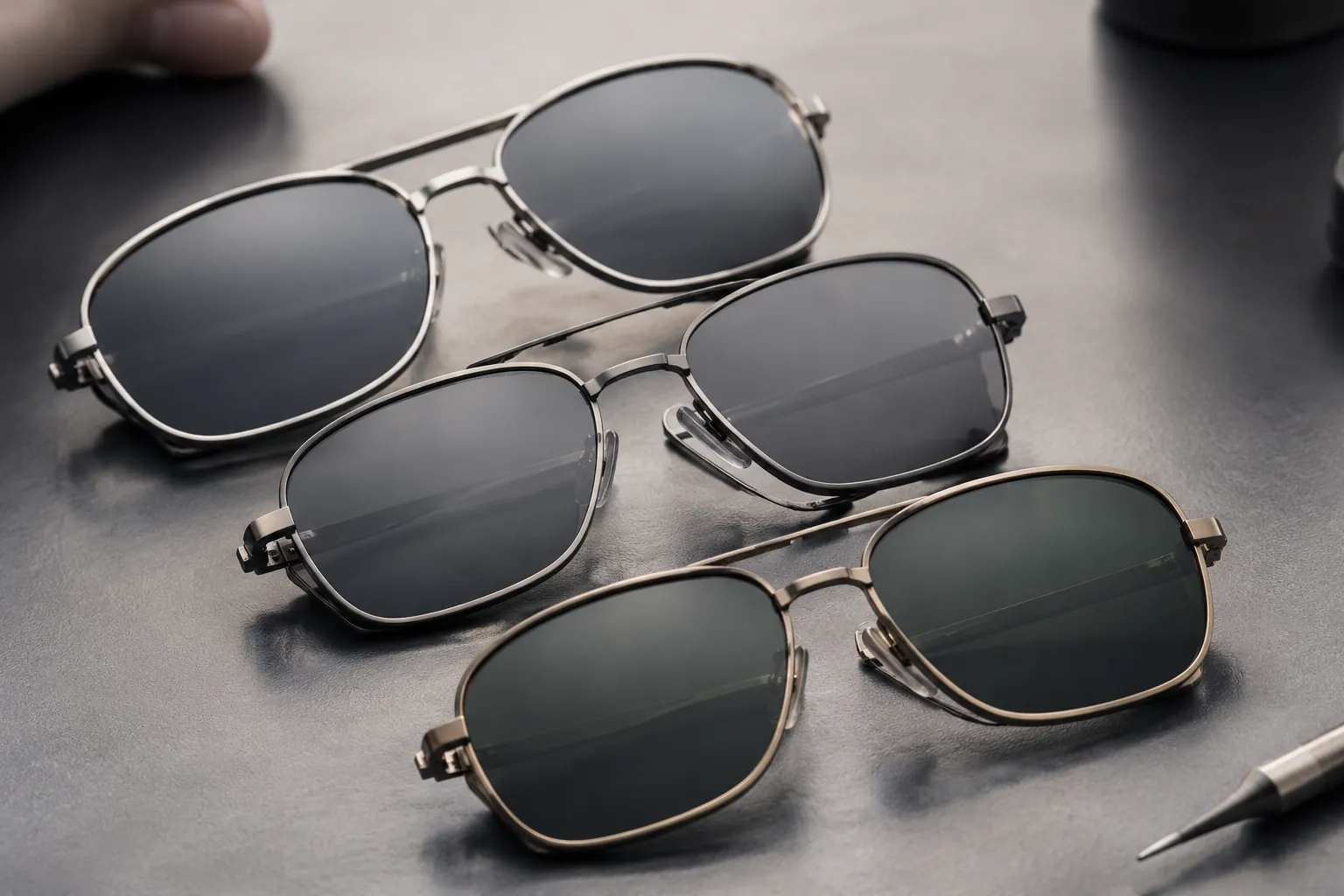
If you buy sunglasses for a brand, importer, distributor, or retail chain, material choice affects more than appearance. It changes landed cost, hinge stability, corrosion resistance, weight, yield, and where the product sits in your assortment. This guide compares monel, stainless steel, and titanium in practical OEM terms: tooling, forming behavior, decoration, plating, QC, lead time, and compliance. The goal is simple: choose the right metal for the right price band without paying for features your customer will not notice.
What each metal does best
Monel, stainless steel, and titanium all show up in premium OEM sunglasses. They are not interchangeable. Buyers often treat them as one bucket, then run into trouble with weight, plating, spring-back, or pricing. That is a sourcing issue, not a materials issue.
Monel is a nickel-copper alloy known in eyewear for formability, stability, and plating performance. It suits classic silhouettes because it holds shape well and takes decorative finishes cleanly, provided surface prep is controlled. Stainless steel is the workhorse. It fits slim, modern designs and is usually easier to scale. Titanium sits at the top end. It is very light and highly corrosion resistant, but it costs more and is less forgiving in welding, polishing, and decoration.
The factory tells the real story. Monel bends predictably, but plating prep matters. Stainless steel scales well, but the design must account for spring-back and forming stress. Titanium can produce an excellent frame, but the process window is tighter. Surface finishing takes discipline. If the brief is a classic premium look, monel belongs in the discussion. If the brief is strong cost-to-performance, stainless steel often wins. If the brief is low weight first, titanium leads.
The better question is not "Which metal is best?" It is "Which metal fits the design, the retail price, the target market, and the supplier's actual process capability?" That is what protects margin and cuts rework.
Cost, weight, and tiering
Metal choice should follow the commercial tier of the line. A frame that looks expensive but feels heavy can disappoint. A titanium frame sold into a monel price band will squeeze margin fast. This is a sourcing decision as much as a design one.
| Material | Typical cost position | Weight feel | Corrosion resistance | Best use case |
|---|---|---|---|---|
| Monel | Mid | Medium | Good with proper plating | Classic premium styles, fashion-led collections, decorative finishes |
| Stainless steel | Lower to mid | Medium to light | Good | Volume styles, sharp retail price points, slim and modern designs |
| Titanium | High | Very light | Excellent | Top-tier collections, comfort-led frames, higher ASP programs |
At OEM level, raw material is only part of the cost. Think in process cost per pair: cutting, stamping, CNC work, laser work, welding or soldering, polishing, plating or anodizing where applicable, scrap, rework, and the number of pieces that pass QC first time. Titanium usually needs tighter control and more experienced operators. Monel often needs careful attention to plating consistency and anti-tarnish protection. Stainless steel is usually the easiest to scale, especially if the design avoids ultra-thin sections that distort during forming or finishing.
A practical ladder often looks like this: stainless steel for entry premium, monel for classic fashion premium, titanium for the flagship tier. That structure makes sense in the market and on the line.
How production differs by metal
Specs matter less than how the frame behaves in production. A design that looks clean in CAD can turn into scrap if the metal does not suit the process. Lock the metal early. Before artwork. Before tooling.
- Monel: good formability and strong plating behavior, but the surface must be clean; contamination or poor pretreatment shows fast after finishing.
- Stainless steel: suitable for precision shapes, bridge structures, and slim temples; plan for spring-back in bending and stamping.
- Titanium: strong and light, but welding, polishing, and decoration need more care, more time, and more experienced operators.
Common metal-frame steps include laser cutting for fronts and temples, CNC machining for detailed parts, stamping or etching for logos, welding or soldering at joints, barrel hinge assembly, polishing, plating where specified, and final QC. Tolerances matter at every stage. A temple can be visibly off if a part is only slightly out of position. Ask the supplier for the acceptable tolerance on the specific design. Do not assume one number fits every frame.
Mixed-material programs add another layer. Many premium sunglasses combine a metal front with acetate temples, or a titanium front with injected parts and coated lenses. In-house control reduces handoff errors like hole misalignment, hinge-axis mismatch, uneven plate placement, and finish mismatch. Before bulk, the supplier should confirm hinge geometry, lens seating depth, and temple clearance on a pre-production sample. Find the problem there, not after production starts.
The sample should do more than look good. It should show finish consistency, decoration placement, pad alignment, and how the metal behaves after repeated opening and closing. That is where hidden defects appear.
Durability and wear complaints
Most returns on metal sunglasses are quiet complaints. The frame feels heavy. The temples feel stiff. The finish dulls too fast. The nose pads hurt. The coating chips at an edge. Those small issues decide repeat orders.
Monel wears well in daily use when the plating system is right. The trade-off is perceived weight, especially on larger lens shapes or thicker fronts. Stainless steel usually gives a solid price-to-weight balance for broad distribution. It can look polished and refined without pushing cost too high. Titanium is the comfort winner. It stays light and resists corrosion very well, especially in humid or coastal markets. It also fits long-wear styles, where the frame stays on for most of the day.
Still, titanium is not automatically better. If the frame is too thin, too minimal, or poorly proportioned, the ultra-light feel can make it seem less substantial in hand. Some retail buyers want more hand-feel because it reads as premium at the counter. Others care more about comfort once the product is worn. The right answer depends on the brand story and selling channel.
In wear testing, ask about repeated flexing, hinge fatigue, and finish retention after simulated perspiration or humidity exposure. A good OEM partner should explain which polish, base coat, or top coat reduces edge chipping and which temple shape eases ear pressure. Small details matter more than the alloy name on the spec sheet.
Rule of thumb: if buyers complain about weight and skin comfort, look at titanium. If they complain about margin, look at stainless steel. If they want a classic premium look without moving to the highest cost tier, monel still has a place.
Compliance and buyer checks
Material choice does not replace compliance. For overseas buyers, the frame program still has to fit the right standard set for the destination market. Supplier claims should be current and verifiable. The relevant references here are CE EN ISO 12312-1, ANSI Z80.3, AS/NZS 1067, REACH, FDA registration, ISO 9001, and BSCI.
For sunglasses, compliance usually covers lens transmittance, impact performance, labeling, restricted substances, and factory process control. REACH matters for chemical limits and restricted coatings. FDA registration matters for U.S. market readiness, but it is not a stand-alone proof of product compliance. ANSI Z80.3 and AS/NZS 1067 apply to those specific markets. CE EN ISO 12312-1 is the common reference for sunglasses sold into Europe.
Ask for the test route before artwork approval, because material can affect compliance indirectly through coatings, tint density, and assembly details. A metal frame with dark lenses and decorative plating may need tighter control of edge finish, coating thickness, and surface uniformity. The supplier should explain how the construction fits the target standard, what test samples will be submitted, and whether any decorative feature could affect the results.
A practical request list should include lens category, target market, coating type, plating system, logo method, and whether the product is fashion-only or sun-protective. If the supplier cannot connect those points, the program is not ready for bulk.
Decoration, finish, and tooling
Decoration is where many metal sunglasses either look expensive or fall flat. The base alloy matters, but the finish system and decoration method often decide the result. Ask early which methods are actually available on the chosen metal. Not every effect works equally well on monel, stainless steel, and titanium.
Common decoration methods include laser engraving, pad printing, embossing, etching, hot stamping, metal logo plates, enamel fill, anodized color on titanium, and vacuum plating for specific shine effects. Monel usually works well with plating and small decorative inserts, as long as the base prep is consistent. Stainless steel is good for laser-marked branding and precise modern detailing, especially in clean-lined designs. Titanium is often chosen for premium matte or brushed finishes and can support anodized color, but the process window is narrower and color consistency needs tighter control.
Tooling choices affect yield too. A slightly oversized temple logo, a poorly placed hinge plate, or a bridge contour that is too aggressive can create rework or visual mismatch across the batch. Ask for a first-off sample, a finish board, and a decoration mock-up before bulk approval. If the style uses mixed materials, check the color match between metal and acetate or injected parts under daylight and retail lighting. Mismatch shows up fast in store.
For premium OEM programs, keep one rule in mind: the more visible the metal surface, the tighter the finish control should be. A brushed titanium frame hides small differences better than a mirror-polished monel frame. A black-plated stainless steel frame will show edge defects quickly if polishing is weak. Finish selection matters as much as frame geometry.
Pricing logic, MOQ, and lead time
MOQ, unit price, and lead time belong together. A program can be technically workable and still fail commercially if the build is too complex for the target price or too slow for the launch calendar.
For custom sunglasses, a common OEM structure starts with a low MOQ for sampling or pilot orders and improves pricing as volume rises. The real breakpoint depends on the factory, the construction, and the decoration method. Ask for pricing at several volume levels so you can see how unit cost changes as the order grows. Titanium, mixed-material builds, and complex finishes usually cost more than straightforward stainless steel styles.
Sample lead time and bulk lead time also depend on complexity. Simple metal frames with standard hardware move faster than styles that need custom tooling, special temple tips, unusual mixed-material joints, or multi-step finishes. Price those in at the start. Do not negotiate them later.
- Confirm the target market and compliance standard.
- Lock frame material, finish, and decoration method before sample approval.
- Check hinge fit, plating color, weight feel, and nose pad comfort on samples.
- Approve pre-production only after test reports and the visual sample match.
- Plan bulk around the agreed production window, then add shipping time and customs buffer.
If the program needs speed, stainless steel is often easiest to scale because it supports efficient forming and predictable repeatability. If the program needs a premium look at a mid-tier cost, monel stays competitive. If the program needs low weight and stronger top-end positioning, titanium can justify the extra cost, but only if the retail price supports it and the supplier has the right control.
Ask how the supplier handles yield loss. A frame that looks cheap on paper can become costly if polishing rejects, plating rework, or alignment issues are high. MOQ is only half the equation. Stable output matters just as much.
How to choose for your line
There is no universal winner. There is only the right metal for the right collection and customer. For a fashion line with retro shapes, monel gives strong finish options and a solid premium feel. For a value-premium line with broad distribution, stainless steel offers better cost control and easier scaling. For a comfort-led line with a higher ASP, titanium is the strongest option.
For most overseas buyers, the decision comes down to four questions. Can the target price support the material? Does the market care more about weight or hand-feel? Is the design simple enough to manufacture at yield? And does the compliance path fit the intended destination? If the answer is unclear, you need a sample run, not a guess.
One practical split works well: use stainless steel for entry premium, monel for middle premium, and titanium for the flagship model. That gives you a price ladder that makes sense to distributors and retail buyers. It also helps the supplier keep process control tighter because each material is used where it performs best.
Ask for the right sample, not the fanciest one. A good OEM partner should show how the frame will be built, finished, tested, decorated, and packed before bulk starts. That is where margin is won or lost.
Have a custom sunglasses project in mind?
Send us your styles, target market and quantities and we will return a detailed quote with MOQ, lead time and a sample plan.
Get a QuoteWhy source this from Wenzhou with LumiShades
Wenzhou in Zhejiang Province is widely regarded as China’s eyewear manufacturing capital, producing a large share of the world’s sunglasses. That concentration matters to buyers: a deep local supply chain for acetate sheet, hinges, lens blanks, plating and packaging means shorter component lead times, easier color and material matching, and a workforce with decades of eyewear-specific skill. LumiShades has manufactured in this ecosystem since 2009, and our vertical integration — in-house injection molding, acetate cutting, CNC milling, lens tinting, decoration and quality control — means no part of your order is quietly subcontracted to a workshop you cannot audit.
For international buyers, that vertical control translates into accountability. When a single factory owns every step, defects are traced and fixed at source rather than bounced between vendors, and your specifications survive intact from first sample to bulk. For procurement review, buyers can request process records, approved samples, quality checkpoints and project-specific compliance files before placing a bulk order. Required testing and documentation are confirmed against the destination market and product specification rather than assumed from a generic certificate list. Explore our manufacturing capabilities and quality control process to see how this works in practice.
Frequently asked questions
Which material is best for a premium sunglasses line with a controlled budget? Stainless steel is usually the safest starting point for a controlled budget. It keeps weight reasonable, is widely used in OEM production, and is generally easier to scale than titanium. If your brand wants a warmer, more classic premium feel and can support a slightly higher cost, monel is the next material to evaluate. The right choice depends on your target retail price, desired weight, and the supplier's finish quality.
Is titanium always worth the higher price? No. Titanium is worth the higher price when low weight, comfort, and corrosion resistance are part of the selling point. If the product is price-led, the extra material and processing cost may be better spent on lens quality, finish consistency, packaging, or a stronger frame design. Ask for an A/B sample comparison before you commit, because the difference is easiest to judge in hand and on face.
Can monel and stainless steel both pass compliance for export markets? Yes, but compliance depends on the full product build, not just the frame metal. Lens category, coatings, plating chemistry, labeling, and factory controls all matter. Ask the supplier which standard applies to your market, such as CE EN ISO 12312-1, ANSI Z80.3, AS/NZS 1067, REACH, or FDA-related requirements where applicable, and request the test route before artwork is approved.
What should I check on samples before placing bulk? Check weight feel, hinge alignment, temple opening, nose pad comfort, plating consistency, edge finish, and decoration placement. Also verify that the sample matches the approved reference in daylight and under retail lighting, because color and surface gloss can read differently in store conditions. If the design uses mixed materials, confirm that the metal and non-metal parts align cleanly and that there is no visible finish mismatch.
How should I decide between monel, stainless steel, and titanium for one collection? Use the product role in your line as the guide. Stainless steel works well for entry premium and volume styles. Monel is a strong fit for classic fashion-premium frames where finish and hand-feel matter. Titanium is best for top-tier or comfort-led models where low weight and corrosion resistance justify the cost. If you are unsure, ask the factory for the same design in two materials so you can compare cost, feel, and finish side by side.
Ready to start?
Explore our cat-eye sunglasses or request a quote — our sales team replies within 12 hours.
Request a Quote