
Handmade Acetate vs Molded Eyewear Frames
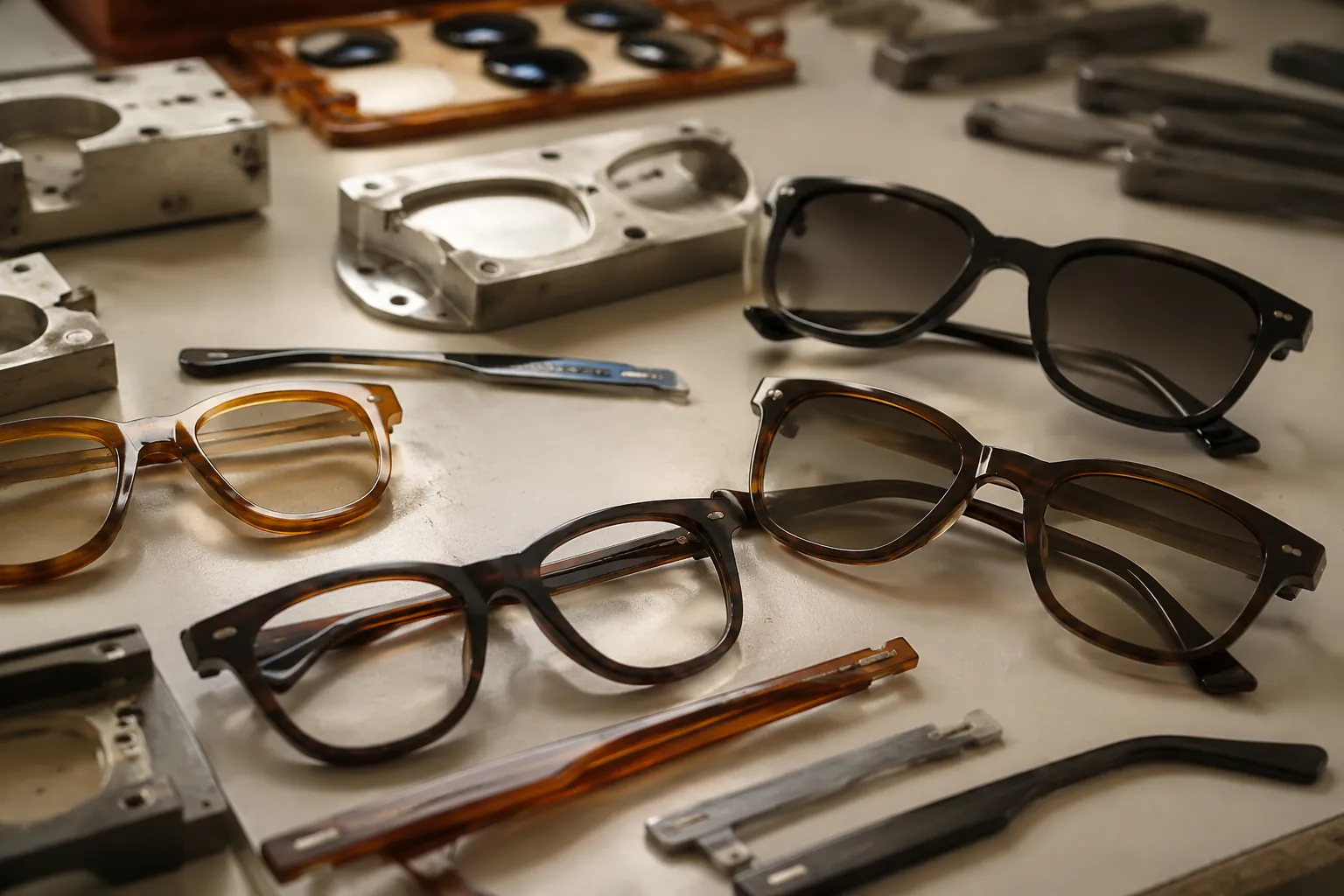
This article is for brand owners, importers, distributors, and retailers choosing a premium frame path for custom sunglasses or optical collections. The real question is not which material looks better. It is which construction gives you the finish, price band, tolerance control, and margin you need at your target volume. Acetate and molded frames behave very differently in tooling, labor, repairability, decoration, and perceived value. In volume, those differences show up in cash tied up, rejection rate, and gross margin.
What each frame type is
Handmade acetate frames start as cellulose acetate sheet. The sheet is layered, cut into fronts and temples, milled to shape, tumbled, hand-finished, polished, drilled, and assembled with hinges and hardware. Machines do the heavy work. People handle the finish. That is why acetate can look premium and still show small natural variation.
Molded frames are formed in an injection mold, usually from TR90, Grilamid, or polyamide. Shape comes from tooling, melt temperature, injection pressure, cooling time, and ejection design. Not from sanding and hand polishing. A stable process can produce very repeatable parts, but cosmetic quality still depends on tool condition, process control, and post-mold finishing.
The commercial split is simple. Acetate gives more surface richness and more room for premium finishing. Molded frames give faster repetition, lower unit labor, and better scalability once the design is locked. They are different tools. Use them for different jobs.
At LumiShades, both routes can be supported in-house, including acetate cutting, injection molding, CNC milling, lens tinting, and decoration such as laser engraving, pad printing, hot stamping, and metal logo plates. Fewer handoffs usually means fewer surprises.
Where acetate wins and where it does not
Acetate wins on visual depth and tactile quality. It can be layered, translucent, marbled, frosted, or solid. It also takes a deep polish that reads as premium in hand and on camera. On a retail shelf, that matters. The edge catches light differently. The color looks richer than many molded alternatives.
It also gives room to adjust the finish. A supplier can change bevel depth, temple taper, front thickness, and surface sheen without remaking a mold. That makes acetate useful for boutique programs, fashion-led drops, and styles where small visual changes affect sell-through.
But acetate has limits. It is denser than many molded plastics, so the frame can feel heavy if the front is overbuilt or the temple balance is poor. It also needs more manual labor. That affects cost, lead time, and reject risk. If cutting paths are rough, sanding is uneven, or polishing is rushed, the defects show fast: seam visibility, haze, uneven gloss, and hinge misalignment.
Acetate can absorb some rework. Not unlimited rework. A color adjustment may be manageable. A shape change often means new cutting programs, extra sanding, and possible temple rebalancing. That is why acetate works best in collections where the customer will pay for finish.
- Best fit: premium sunglasses, fashion-driven drops, boutique optical programs, high-image hero SKUs.
- Weak fit: ultra-tight promotional pricing, very large volume basics, extreme rush programs, price-led replenishment.
- Buyer risk: overpaying for finish if the market will not support the margin, or specifying a heavy front that hurts comfort.
Where molded frames win and where they do not
Molded frames win on consistency and speed. Once the mold is correct and the process is stable, parts come out very consistently pair to pair. That reduces variation in bridge fit, temple symmetry, and lens seating. For buyers who need repeat orders, that repeatability is often more valuable than hand-finished character.
They also support tighter price points because much of the cost sits in tooling instead of per-pair labor. That makes molded programs more attractive when the buyer has a stable design, a forecast, and a real reorder expectation. On a one-off test run, tooling can dominate the economics. That is the trap.
Molded frames are not automatically low quality. Good tooling, gate placement, cooling control, and post-mold finishing still matter. A well-made molded frame can have clean parting lines, stable temple behavior, and good lens fit. But the material usually does not match acetate for color depth or surface luxury. If the brand story depends on close-up premium presentation, molded frames often need support from texture, coating, or decoration.
They are strongest where the selling model rewards velocity: core carryover styles, promotional programs, distributor replenishment, and long-run colorways. They are weaker when the goal is an artisanal feel or when the frame itself must carry a higher ticket.
Cost structure by volume
The cost logic is different for each route, and buyers often compare the wrong numbers. Acetate is more labor-sensitive. Molded frames are more tooling-sensitive at the start and more volume-sensitive later. The right comparison is not the first quote. It is the fully loaded landed cost after sampling, yield loss, decoration, freight, duty, and rejects.
On acetate, the biggest cost drivers are sheet grade, hinge choice, manual polishing time, and how much shaping is needed to hit the final profile. On molded frames, the biggest drivers are mold complexity, cavity count, cycle time, resin selection, and post-mold decoration. Single-cavity tooling can work for prototypes or niche styles. Multi-cavity tools usually win once you need scale.
| Factor | Handmade acetate | Molded frame |
|---|---|---|
| Upfront cost | Lower tooling burden; higher labor content per pair | Higher mold cost; lower unit labor after launch |
| MOQ behavior | Often workable from 50 pairs/design, with better economics from 300+ | Usually more efficient once the design is stable and volume is predictable |
| Price at scale | Improves at 300, 1000, and 5000+ pairs, but polishing and assembly still matter | Drops as tooling is amortized and cycle time is optimized |
| Typical sweet spot | Premium collections, color-driven SKUs, and styles with strong visual differentiation | Core repeat programs, price-led lines, and reorder-heavy commercial styles |
| Best risk profile | When style value matters more than lowest unit cost | When volume certainty matters more than surface depth |
For LumiShades, MOQ starts at 50 pairs per design, and pricing improves at 300, 1000, and 5000+ pairs. Volume pricing can move lower on suitable molded programs, but the final number depends on design complexity, mold efficiency, resin choice, decoration method, and order volume. Treat each quote as program-specific.
Build in scrap and rework. Always. A low quote does not help if correction or replacement wipes out the savings. Real margin lives in yield, not only in the line item price.
Finish quality and what buyers should inspect
Acetate and molded frames fail in different ways, so the inspection checklist should match the process. With acetate, look for polishing marks, visible glue joints, hinge seat cleanliness, temple balance, and color consistency across the batch. With molded frames, focus on gate marks, parting lines, sink, warpage, lens groove accuracy, and whether the texture or coating is even across both sides of the frame.
Do not approve by photo only. Ask for a physical pre-production sample and measure the features that matter to fit and retail appearance. Verify bridge width, lens opening symmetry, temple opening force, and hinge rebound. Those issues often drive fit complaints and returns.
A simple check helps. Compare the sample against the master under daylight and white light, then again after a short wear test. Small asymmetry is easier to see after the frame has been opened, closed, and placed on a flat surface. Fresh out of the box can hide it.
If your collection uses metal logo plates, laser engraving, pad printing, or hot stamping, inspect after all decoration is complete. Decoration can hide defects or create new ones. Pad printing can cover a faint surface flaw, but it will not fix it. A logo plate can create a bump if adhesive thickness is uneven.
- Check front symmetry, especially around the bridge and lens rim.
- Measure temple opening force and hinge return consistency.
- Confirm lens seating depth and edge contact around the full rim.
- Inspect logo placement after polishing, coating, or printing.
- Compare color against the master sample under multiple light sources.
Lead time, sampling, and change control
Sampling and bulk timing show which route fits your buying calendar. With LumiShades, samples are typically ready in 7 to 10 days, and bulk production runs 25 to 35 days, assuming the spec is frozen and artwork is approved. That works for seasonal programs. It does not work if the buyer keeps changing the brief.
Acetate changes are usually easier to make at the visual level, but they still take time at the finishing stage. A small color tweak may be straightforward. A shape tweak can require reprogramming the cutting path, adjusting sanding stages, rebalancing the temples, and rechecking hinge alignment. Molded frames are the reverse: color and finish can often be standardized, but shape changes may require tooling modification or a new mold. That affects both schedule and cost.
Before PO release, lock these items: frame material, hinge type, lens category, logo method, temple length, and packaging specification. If the temple length shifts after sampling, balance and fit can change. If lens category changes late, the lens package may need a new check for tint, UV behavior, or impact performance.
Use one rule. Once the pre-production sample is approved, freeze the critical dimensions. If a change cannot be avoided, classify it as cosmetic or structural before asking for a re-quote. Cosmetic changes are usually easier. Structural changes almost always affect tooling, labor, or compliance.
Compliance and market access
Do not buy frame material in a vacuum. Your destination market controls part of the decision. A premium frame is only useful if it clears the compliance requirements of the region where it will be sold. The material alone does not guarantee that.
Use only the standards and registrations that apply to your market and product type. Common references include CE EN ISO 12312-1 for sunglass safety in applicable markets, ANSI Z80.3 for the U.S. sunglass standard, AS/NZS 1067 for Australia and New Zealand, REACH for chemical restrictions, FDA registration for U.S. facility-related requirements, ISO 9001 for quality management, and BSCI for social compliance audits. Ask the supplier for current documents, not general claims.
Material choice can affect test outcomes indirectly. Coatings, tint uniformity, UV performance, lens fit, surface finish, and print durability can all influence whether the final product passes internal or external QA. A frame can look right and still fail if the lens or coating package is off.
If you are building one frame for multiple markets, confirm the compliance path before approving packaging or printed claims. A claim that is acceptable in one region may need different wording, labeling, or documentation elsewhere. That matters even more when premium decoration is used, because those finishes can change how the product ages in testing.
Which path protects margin
Margin is not just unit cost. It is the price you can sustain after rejects, freight, duty, storage, and reorders. Acetate usually supports a stronger shelf story and a higher perceived-value ladder. Molded frames usually protect cost and inventory risk better. The right choice depends on where the margin has to come from.
If your buyer is retailer-led and expects visual richness, acetate can justify a stronger wholesale price because the frame helps sell the story. If the program is distributor-led and needs repeat velocity, molded frames often win because they are easier to replenish and cheaper to scale. If you need both, split the line. Do not force one material to carry every job.
A practical structure is to use acetate for hero SKUs, content-heavy styles, and frames sold above the middle of the market; then use molded frames for core commercial colors, carryover shapes, and reorder-heavy items. That keeps the premium look where it matters and protects cash where volume matters.
Decoration also affects economics. Laser engraving is precise and usually low waste, but it may add setup time. Pad printing is flexible for logos and color, but it adds a curing step. Metal logo plates increase perceived value, yet they also add parts, labor, and defect points. The best margin choice is not always the most dramatic one.
Buyer rule: do not pick the material first. Pick the selling price, target margin, and reorder pattern first. The frame material follows those numbers.
Have a custom sunglasses project in mind?
Send us your styles, target market and quantities and we will return a detailed quote with MOQ, lead time and a sample plan.
Get a QuoteWhy source this from Wenzhou with LumiShades
Wenzhou in Zhejiang Province is widely regarded as China’s eyewear manufacturing capital, producing a large share of the world’s sunglasses. That concentration matters to buyers: a deep local supply chain for acetate sheet, hinges, lens blanks, plating and packaging means shorter component lead times, easier color and material matching, and a workforce with decades of eyewear-specific skill. LumiShades has manufactured in this ecosystem since 2009, and our vertical integration — in-house injection molding, acetate cutting, CNC milling, lens tinting, decoration and quality control — means no part of your order is quietly subcontracted to a workshop you cannot audit.
For international buyers, that vertical control translates into accountability. When a single factory owns every step, defects are traced and fixed at source rather than bounced between vendors, and your specifications survive intact from first sample to bulk. For procurement review, buyers can request process records, approved samples, quality checkpoints and project-specific compliance files before placing a bulk order. Required testing and documentation are confirmed against the destination market and product specification rather than assumed from a generic certificate list. Explore our manufacturing capabilities and quality control process to see how this works in practice.
Frequently asked questions
What MOQ should I expect for custom acetate or molded sunglasses? A practical starting point is 50 pairs per design for sampling or very small programs, but the economics improve as volume rises. Ask for pricing at 50, 300, 1000, and 5000+ pairs so you can see the real cost curve before you commit.
Which option usually has better perceived value at retail? Handmade acetate usually reads as more premium because of its color depth, polish, and material feel. Molded frames can still sell well, but they usually need stronger texture, coating, or decoration to create the same close-up premium impression.
Can molded frames reach a lower landed cost than acetate? Yes, especially when the design is stable and the order volume is high enough to spread tooling cost. To compare fairly, ask for landed cost that includes sampling, decoration, packaging, freight, and an allowance for rework or rejects.
How fast can I get samples and bulk production? If the specification is final, sample timing is often measured in days, not weeks, and bulk production is usually several weeks. In this program, the reference is 7 to 10 days for samples and 25 to 35 days for bulk, but late artwork or structural changes can extend both.
What compliance should I request for export orders? Request the standard that matches your target market and product type, such as CE EN ISO 12312-1, ANSI Z80.3, or AS/NZS 1067. For supplier due diligence, also ask for current REACH documentation, FDA registration where relevant, ISO 9001, and BSCI if social audit coverage is part of your requirement.
How should I choose between the two for a new collection? Start with the selling model. Use acetate for hero styles that need a premium look and stronger perceived value; use molded frames for core carryover styles, repeat orders, and tighter cost control. If the collection has both roles, split the program so each material serves the right price tier.
Ready to start?
Explore our sport wrap sunglasses or request a quote — our sales team replies within 12 hours.
Request a Quote