
Acetate Lamination, Marbling, and Layered Color Effects
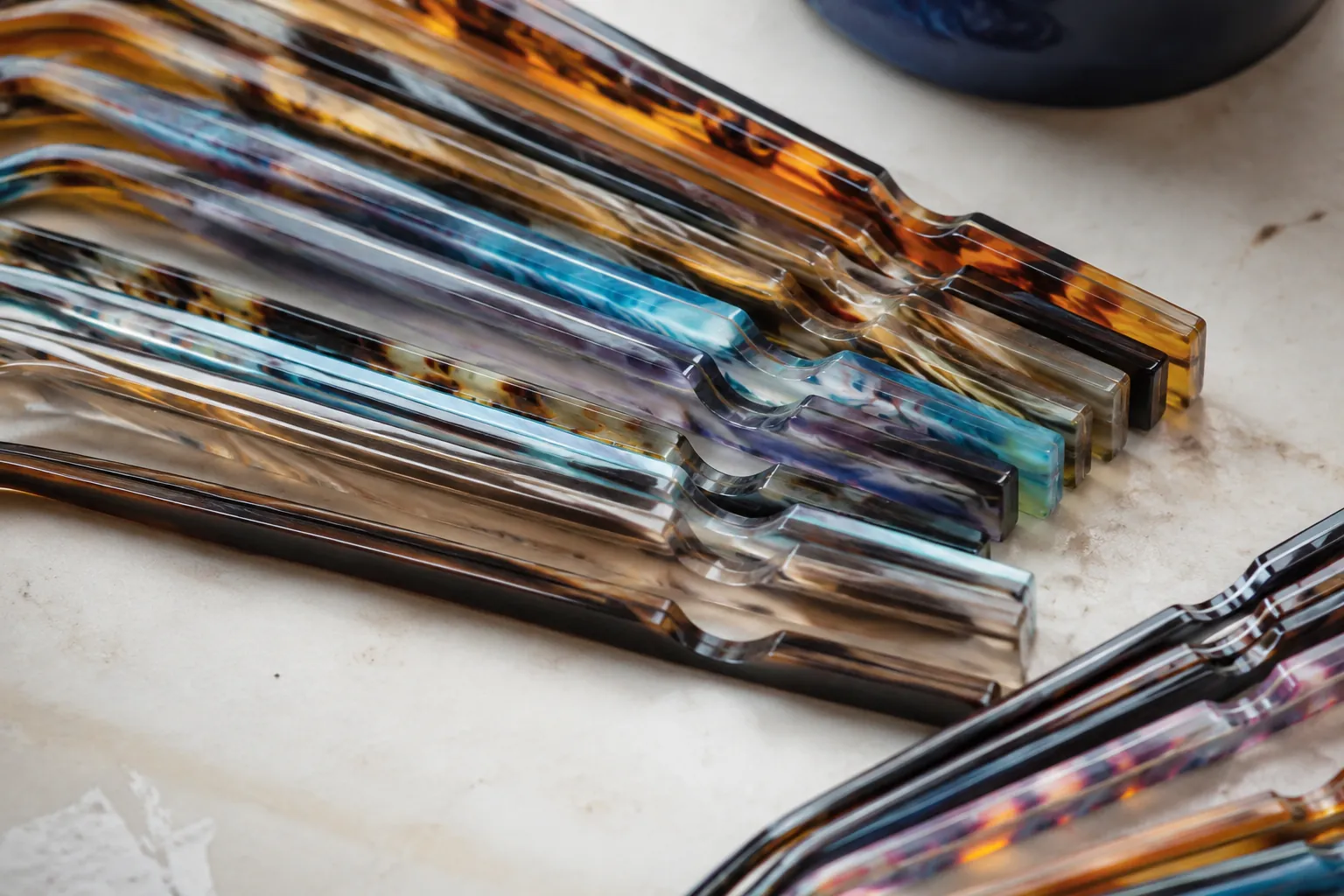
If you buy custom sunglasses for a brand, import business, or retail chain, acetate color work is one of the quickest ways to make a frame line stand out from plain stock. But not every effect is cheap, stable, or easy to repeat at scale. This guide explains how lamination, marbling, and layered color effects are made, where the cost comes from, and how to specify them so sampling and bulk orders stay on track.
What these acetate effects are
Acetate color effects are not paint sprayed on a finished frame. They start at the sheet level, then get cut, milled, polished, and assembled. That matters. The pattern is built into the material, not added later.
Lamination means bonding two or more acetate sheets together before frame cutting. Each layer can carry a different color, opacity, or pattern. Marbling is mixed into the sheet structure, so the color movement runs through the thickness of the frame. Layered color effects can combine clear outer layers with solid cores, translucent caps, or contrasting laminates at the front, temple, or rim.
The rule is simple. The more controlled the pattern, the easier it is to repeat. The more random the pattern, the more variation you should expect pair to pair. Some variation is normal. Too much variation looks cheap.
How lamination is built in production
At an acetate factory, lamination starts with selecting sheet stock by color, transparency, and thickness. Sheets are stacked in a planned order, then bonded under heat and pressure. After curing, the laminated block is cut into frame blanks. Those blanks go through CNC milling or manual shaping, depending on the model.
Good lamination depends on three things: bond strength, layer alignment, and sheet consistency. If thickness drifts, the final pattern shifts. If the bond is weak, edges can separate during polishing or after heat exposure in transit. If the layers are not aligned before cutting, the front view and the temple view will not match the approved sample.
Most factories build a color board first. That board should show the exact layer order, gloss level, and expected pattern spread. For a buyer, that board is more useful than a polished render. It gives the production team a target they can actually follow.
- Use layered acetate when you want a clear front view with depth from the side.
- Use full lamination when the pattern must continue across the entire frame.
- Use contrast temple laminates to add detail without raising waste on the front frame.
Marbling, stripe work, and pattern control
Marbled acetate is made by combining colored acetate granules or sheets before the block is pressed. The material is then stretched, compressed, or folded to create flowing color movement. Stripe effects use more directional layering, so the visual lines stay cleaner and more structured.
Here is the hard part: marbling is never fully identical from frame to frame. If a supplier promises perfect repeatability on a wild marble pattern, be careful. A good factory can control the color family, contrast, density, and overall mood. It cannot make random swirls behave like printed graphics.
Buyers should approve pattern range, not one magic sample. Ask for a reference set of 6 to 10 front pieces, then define what is acceptable. If you want low risk, stay with tighter patterns, smaller contrast jumps, and moderate translucency. Big contrast marble looks good, but it also exposes every process flaw.
| Effect type | Visual behavior | Repeatability | Typical buyer risk |
|---|---|---|---|
| Solid acetate | Uniform color, low variation | High | Low mismatch risk |
| Laminated color block | Layered front and side view | Medium to high | Edge alignment and layer shift |
| Marbled acetate | Random flow, natural variation | Medium to low | Pair-to-pair variation |
| High-contrast stripe | Clean directional bands | Medium | Visible miscut if tooling is off |
What drives cost in custom acetate color work
Color effects add cost in specific places. Extra sheet layers mean more raw material and more waste at the cutting stage. Complex patterns increase scrap because not every cut lands on an attractive part of the block. Polishing time also rises when the edges must stay clean across multiple colors.
At LumiShades, MOQ starts at 50 pairs per design. That is enough for a small brand test, but not enough to make complicated color structures cheap. Pricing improves at 300, 1000, and 5000+ pairs. On volume, cost can move down to around $2.10 per pair depending on frame design, material mix, decoration, and lens spec. Fancy acetate work still follows the same rule. More labor. More waste. More cost.
If a frame uses multiple acetate colors, a metal logo plate, laser engraving, and special lens tinting all at once, the labor stack gets heavy. Each added process needs setup, inspection, and a rejection route. The cheapest-looking sample is not always the cheapest bulk order if the yield is poor.
- Lowest cost: solid color acetate with simple polishing.
- Mid cost: two-layer laminate or controlled stripe effect.
- Higher cost: random marbling, multi-step temple builds, mixed decoration, or heavy color matching.
Lead time, sampling, and schedule risk
For custom acetate color work, sample timing is usually 7 to 10 days if the base model already exists and only the color structure changes. Bulk production typically runs 25 to 35 days after sample approval. That window assumes the material is available and the decoration plan is already locked.
Lead time slips for a few predictable reasons. New laminate combinations may need a fresh color board or material trial. Tight color matching can take multiple sample rounds. If you combine acetate effects with lens tint changes, pad printing, laser engraving, and metal logo plates, each item adds a handoff and a QC check.
Ask one practical question before placing the order: which parts are off-the-shelf, and which parts need development? If the answer is unclear, the schedule will drift. Good factories separate pattern approval, frame approval, and packaging approval. That keeps the job moving.
- Confirm frame shape and size first.
- Approve the acetate effect board or reference set.
- Lock lens tint and decoration.
- Confirm bulk order quantity by color.
- Start production only after final sample sign-off.
How to spec the effect so the factory can hit it
A useful spec sheet does not say "make it look premium." It lists what can be measured or judged. Give the factory a Pantone or physical color reference if you have one. State whether the effect must be identical across both temples, or whether random variation is acceptable. Define gloss level, translucency, and where the pattern must be most visible.
For acetate lamination, specify the layer order. For example: clear outer / tortoise center / solid core. For marbling, state the dominant color, secondary color, and acceptable contrast range. If you do not want heavy randomness, say so directly. If you do want it, say that too.
Ask for these items before bulk:
- Front and temple approved samples.
- Color board or sheet reference.
- Photo set under daylight and warm light.
- Target tolerance on color shift and pattern spread.
- Clear rejection rules for visible defects, bubbles, edge pull, and layer separation.
Most disputes start because the buyer expected art and the factory quoted material. Put the pattern rules in writing.
QC points that matter on laminated acetate
Visual effects can hide small defects, but they can also expose them. QC should check the block before cutting, the milled frame before polishing, and the finished frame before packing. In laminated or marbled acetate, the usual failure points are bubbles, delamination, color shift, burned edges from poor milling, and uneven polish at the layer line.
LumiShades handles in-house QC, along with injection molding, acetate cutting, CNC milling, lens tinting, laser engraving, pad printing, and metal logo plate decoration. That matters because defects are easier to catch when the work stays under one roof. A supplier that outsources every step has less control over layer alignment and finishing consistency.
For compliance, custom visual effects do not change the basic eyewear requirements. If the product is sold as sunglasses, the frame and finished product still need to meet the relevant standard for the destination market. LumiShades lists real certifications including CE EN ISO 12312-1, FDA registration, ANSI Z80.3, AS/NZS 1067, REACH, ISO 9001, and BSCI. Buyers should match the target market to the right test set before shipment, not after.
How brands use these effects without overcomplicating the line
The best use of acetate color effects is focused, not loud. A brand does not need ten random patterns. It needs two or three clear visuals that can be reordered. That keeps inventory sane and helps retailers explain the product difference.
A practical structure is to split the assortment into a core seller, a seasonal color, and one higher-contrast statement frame. Use solid or lightly laminated colors for the repeat order. Reserve marbling or strong layering for limited runs or capsule drops. That way, the high-variation styles do not dominate your production calendar.
If you are buying for distribution or retail, ask your supplier to quote the same frame in three color structures side by side. You will see the real cost difference fast. In many cases the visual gain is worth it only on a small part of the range. That is normal. Good merchandising is not about making every SKU complicated.
Rule of thumb: if the color effect needs a long explanation to sell, it probably needs better positioning or a simpler pattern.
Have a custom sunglasses project in mind?
Send us your styles, target market and quantities and we will return a detailed quote with MOQ, lead time and a sample plan.
Get a QuoteWhy source this from Wenzhou with LumiShades
Wenzhou in Zhejiang Province is widely regarded as China’s eyewear manufacturing capital, producing a large share of the world’s sunglasses. That concentration matters to buyers: a deep local supply chain for acetate sheet, hinges, lens blanks, plating and packaging means shorter component lead times, easier color and material matching, and a workforce with decades of eyewear-specific skill. LumiShades has manufactured in this ecosystem since 2009, and our vertical integration — in-house injection molding, acetate cutting, CNC milling, lens tinting, decoration and quality control — means no part of your order is quietly subcontracted to a workshop you cannot audit.
For international buyers, that vertical control translates into accountability. When a single factory owns every step, defects are traced and fixed at source rather than bounced between vendors, and your specifications survive intact from first sample to bulk. For procurement review, buyers can request process records, approved samples, quality checkpoints and project-specific compliance files before placing a bulk order. Required testing and documentation are confirmed against the destination market and product specification rather than assumed from a generic certificate list. Explore our manufacturing capabilities and quality control process to see how this works in practice.
Frequently asked questions
What is the difference between laminated acetate and marbled acetate? Laminated acetate bonds separate layers together in a planned order. Marbled acetate mixes colors inside the material to create flowing, less predictable pattern movement.
Does marbling always mean higher cost? Usually yes, because yield is lower and pattern rejection rises. The exact cost depends on the contrast level, waste rate, and whether the design needs matching across both temples.
What MOQ should I expect for custom acetate color effects? At LumiShades, MOQ starts at 50 pairs per design. More complex structures are easier to price and control at 300, 1000, and 5000+ pairs.
How long should sample and bulk production take? Samples are typically 7 to 10 days. Bulk production is usually 25 to 35 days after sample approval, assuming the material and decoration plan are already confirmed.
What should I ask for before approving bulk? Ask for a color board or reference set, front and temple samples, daylight photos, and clear rejection rules for bubbles, delamination, color shift, and edge defects.
Do special acetate effects change compliance requirements? No. The frame still has to meet the market standard and material rules. For sunglasses, relevant certifications and tests include CE EN ISO 12312-1, FDA registration, ANSI Z80.3, AS/NZS 1067, and REACH where applicable.
Ready to start?
Explore our shield & oversized sunglasses or request a quote — our sales team replies within 12 hours.
Request a Quote