
TR90 vs PC vs Nylon for Sport Sunglass Frames
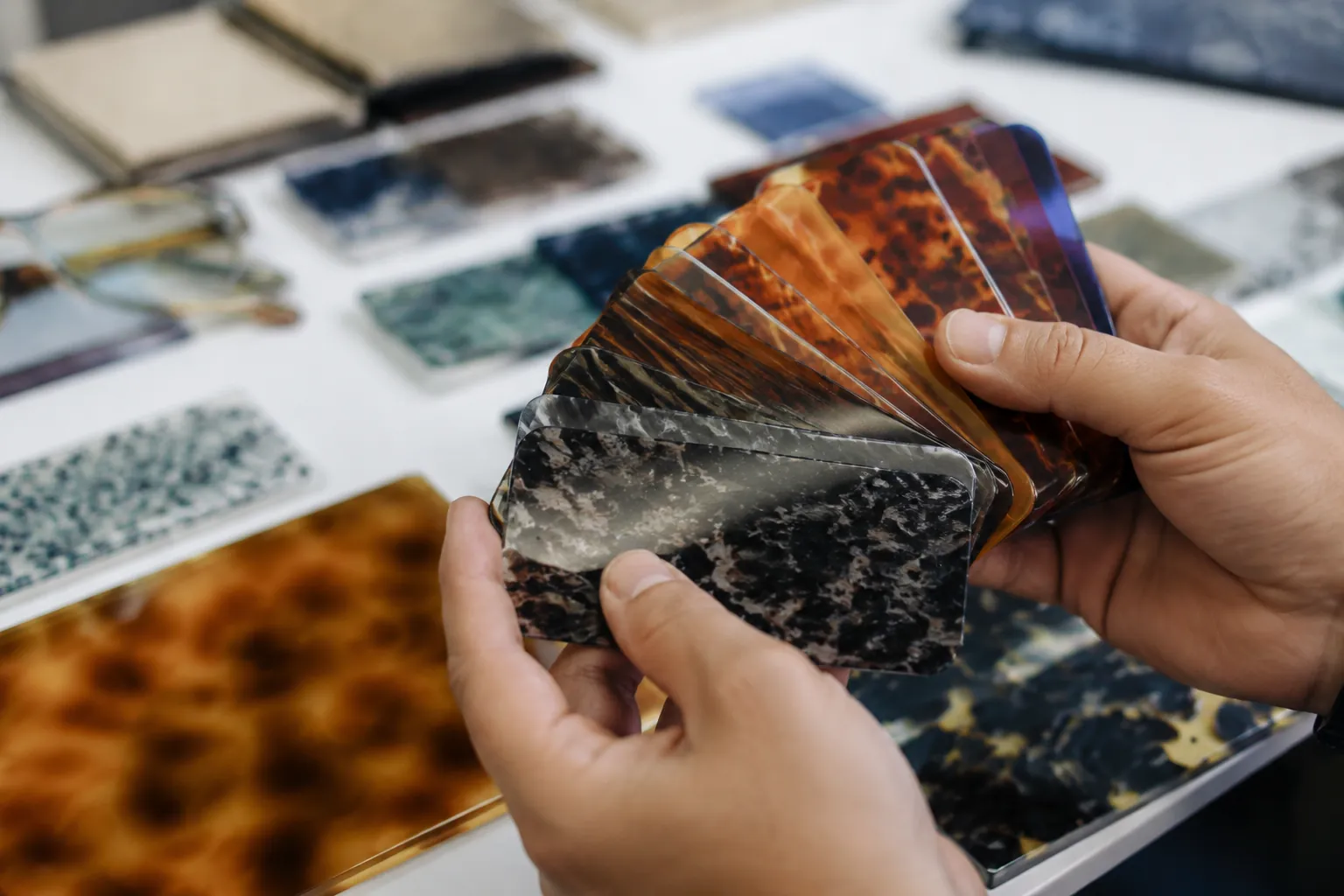
This guide is for brands, importers, distributors, and retailers sourcing custom sports sunglasses and choosing between TR90, polycarbonate (PC), and nylon frame materials. The aim is simple: pick a frame material that fits the product brief, expected use, finish requirements, and production risk before tooling and bulk orders begin. Get this wrong and the problems show up later—warped fronts, hinge stress, poor lens fit, decoration failure, and higher returns. Get it right and development gets easier. Start with the checks that matter early: expected abuse, likely heat exposure in storage and transit, wall-thickness control, decoration method, MOQ economics, and target sales channel.
Start with failure risk, not brochure claims
Most material comparisons are too vague to help with a real sourcing decision. Words like flexible, durable, and premium sound useful. They are not enough. Buyers need to know how a frame behaves after repeated opening and closing, lens insertion, heat exposure, and rough handling.
For a commercial purchase, start with likely failure points and work backward to the material and frame design.
For sport sunglass frames, five questions matter most:
- What level of abuse is realistic? Casual running is one thing. Youth team use, fishing, mountain biking, tactical work, and rental programs are another.
- How much heat exposure is likely? Frames may sit in hot cars, retail windows, vans, or containers. Material matters. Section design matters too.
- How important is long-term fit retention? Initial flexibility is not enough. A frame that slowly spreads or loses recovery becomes a returns issue.
- What finish and branding are required? Molded matte textures, translucent effects, pad printing, painted surfaces, laser marks, and logo inserts do not perform the same across TR90, PC, and nylon.
- What price band and sales channel is this for? Entry-price chain retail, optical distribution, and premium outdoor specialty all carry different cost limits and field-risk tolerance.
This filters the options fast. It also keeps design, tooling, decoration, compliance, and channel expectations aligned earlier in development.
TR90 vs PC vs nylon in actual sport use
| Material | Typical density / hand feel | Flex and recovery | Heat and shape retention | Decoration range | Best-fit channels |
|---|---|---|---|---|---|
| TR90 | Lightweight feel commonly associated with sport frames | Generally offers good flexibility and recovery when the hinge root and temple sections are designed correctly | Usually suitable for active-use frames, but shape stability still depends on wall thickness, mold design, and process control | Solid colors, translucent effects, molded matte textures, selective painting, laser marks | Running, cycling, mid-range sport private label, active outdoor crossover lines |
| PC | Typically feels slightly more rigid and can support cost-sensitive molded programs | Moderate flex; thin corners, sharp transitions, and screw areas need careful design to reduce stress whitening or cracking | Can be more sensitive to deformation if the frame is thin, packed under load, or exposed to sustained heat | Wide color range, glossy molded finishes, spray paint, pad print, logo inserts | Promotional, tourist retail, entry-price chain programs, large seasonal buys |
| Nylon | Technical, resilient hand feel often used in performance-oriented frames | Generally strong resilience and good fatigue resistance under repeated flex cycles | Commonly selected for demanding outdoor use where dimensional stability and durability matter | Best suited to technical matte or understated finishes; decorative processes may require more validation | Outdoor specialty, fishing, trail, tactical, premium technical sport |
TR90 is often the middle-ground choice. It combines low weight, sport-friendly flexibility, and broad market acceptance. For many mid-range sport styles, that balance works.
PC still matters. A lot of programs are built around aggressive opening-price targets. If the design is simple, the expected use is moderate, and the channel is price sensitive, PC can be the right call. But keep the brief realistic. Do not load a low-cost PC frame with hard-use expectations, thin risky geometry, and demanding decoration at the same time.
Nylon is often the better fit for technical applications where repeated flexing, rough handling, and long service life matter more than first-cost savings. It is widely used in fishing, trail, marine, and performance-led categories. The trade-off is cosmetic freedom. Some fashion-led finishes and heavy decoration need more validation.
Where sport frames really fail
Many so-called material failures are actually design or process failures. A stronger resin will not fix a weak hinge root, an over-tight lens groove, uneven wall thickness, or poor cooling control after molding.
- Hinge root cracking: Often tied to thin temple roots, sharp geometry changes, screw bosses too close to the edge, or high opening force during fitting and use.
- Lens groove stress: Wrap sunglasses need controlled groove width and depth. Too tight and lens insertion distorts the front. Too loose and retention drops after wear and temperature change.
- Bridge and brow distortion: Wide or high-wrap fronts can twist or sink if wall thickness is not balanced.
- Temple memory loss: Flexible material alone is not enough. Poor section design can still cause the frame to spread over time.
- Decoration failure: Weak surface prep, wrong primer systems, or bad logo placement can cause print lift, chipping, or edge failure after sweat and abrasion exposure.
Buyers should not approve a frame on renderings and a resin label alone. Review hinge-zone design, lens insertion method, wall-thickness logic, and critical tolerances before final sample sign-off.
In sport frames, small dimensional errors can create big problems. Lens fit changes. Front symmetry shifts. Shape retention drops.
Useful production checks include groove consistency, left-right temple symmetry, front-curve alignment, hinge opening resistance, and visual inspection after lens insertion. These checks do not remove all risk. They do catch more than broad claims that one material is simply stronger than another.
Heat, sweat, sunscreen, and storage risk
Frames do not fail only on the customer's face. They fail in containers, vans, warehouses, retail displays, and car interiors. Heat is often underestimated. That mistake is expensive.
Of these three materials, PC usually needs the most caution in thin designs or frames stored under load for long periods. TR90 often handles active-use demands better and can be more forgiving, but it is not immune to distortion if the frame design or molding process is weak. Nylon is commonly favored for harder outdoor use because of its strong reputation for resilience and field durability.
Sweat and sunscreen matter too, especially on matte black or dark sport frames. In many claims cases, the frame substrate stays intact while the decorative layer fails first. That is why molded texture is often lower risk than heavy paint systems on hard-use products.
If the brief includes rubber-touch coatings, metallic logos, or multicolor pad printing, test those features on the exact material and final color during sampling. Do not approve them from artwork, chips, or lab samples on another substrate.
For regulated markets, frame and lens planning should match the intended compliance path early. Depending on market and product scope, buyers may need to prepare for CE EN ISO 12312-1, ANSI Z80.3, AS/NZS 1067, REACH, and FDA-related requirements where applicable. Factory-management credentials such as ISO 9001 and social-compliance audits such as BSCI may also matter at supplier-selection stage, but they do not replace product testing.
Finish and branding: what works well, what needs caution
Mechanical performance is only half the decision. The other half is whether the material can support the visual brief without driving scrap, rework, or post-delivery claims.
| Branding / finish requirement | TR90 | PC | Nylon |
|---|---|---|---|
| Technical matte molded look | Good | Good | Very good |
| Bright glossy molded or painted color | Good | Very good | Moderate |
| Translucent crystal or smoke effects | Good | Very good | Limited by style and program |
| Pad printing for side logos | Usable with adhesion testing | Common and flexible | Possible, but should be validated carefully |
| Laser engraving | Good on stable surface areas | Good | Good, though visual contrast can vary |
| Metal logo plates / inserts | Possible with tooling planning | Possible | Possible, but less common on purely technical styles |
PC usually gives the widest cosmetic range, especially for glossy colors and visually driven retail programs. TR90 also supports a broad finish range, especially in sport-led matte and semi-translucent styles. Nylon suits technical, performance-oriented looks well, but some decorative effects need more process validation.
For custom branding, define the method early:
- Pad printing: common and efficient, but it should be tested for abrasion, sweat, and sunscreen resistance.
- Laser marking: often a stable choice for technical branding, especially on matte surfaces.
- Screen or heat-transfer decoration: possible on selected styles, but placement and durability should be checked on curved areas.
- Metal logo plates: can improve perceived value, but require recess planning and tighter assembly control.
Test decoration during sampling. If the logo method, coating, or color stack-up is not validated on the final substrate, the project is carrying avoidable risk into production.
Cost, MOQ, tooling, and lead time
Resin cost alone does not decide the best frame option. The real decision is shaped by molding behavior, scrap risk, decoration complexity, tooling changes, and how tightly the project must hit a target retail price.
In broad terms:
- PC is often the practical route for cost-sensitive, high-volume programs with simple geometry and straightforward decoration.
- TR90 is often the balanced choice when the buyer wants lighter hand feel, sport positioning, and controlled cost.
- Nylon usually makes more sense when field durability, warranty control, and performance positioning matter more than lowest first cost.
MOQ and lead time vary by supplier, model complexity, tooling status, lens type, and decoration plan, so buyers should confirm those points directly with the factory rather than rely on generic benchmarks.
Still, material choice changes the economics in predictable ways. The more technical the finish, fit requirement, and durability target, the more process stability matters. That can affect scrap, rework, and approval time more than resin price does.
Tooling is another cost trap. If a frame has to be re-cut because the chosen material does not suit the intended use case or geometry, early savings disappear fast. Compare more than the quoted unit price. Compare revision risk, decoration validation needs, and likely warranty exposure by channel.
Channel fit and a pre-production checklist
There is no universal winner between TR90, PC, and nylon. The right choice depends on who will sell the product, how the user will treat it, and how much return or warranty risk the business can absorb.
Choose PC if the program is for promotional campaigns, tourist retail, entry-price chain programs, or large seasonal buys where cost control leads and the design stays simple.
Choose TR90 if the line targets running, cycling, active outdoor use, or sport-fashion crossover retail. For many private-label buyers, it is the most practical middle option.
Choose nylon if the line is aimed at fishing, trail, tactical, marine, or premium specialty channels where rough handling and long-term durability matter more than squeezing the last point of factory margin.
A simple rule: if the brief is driven by opening price, start with PC. If it is driven by balanced sport performance, start with TR90. If it is driven by hard-use durability, start with nylon.
That rule will not replace sample testing. It does help shorten early decisions.
Before bulk approval, lock down the points that most affect claims risk, approval speed, and margin:
- Confirm the exact material grade for the approved frame, not just the material family on the quote.
- Review section thickness at the hinge root, bridge, brow, and lens groove where stress is concentrated.
- Approve the lens insertion method for wrap geometry and repeated assembly handling.
- Validate decoration on the final color and final substrate, including pad print, laser mark, painted parts, or logo plate attachment.
- Check heat and storage tolerance using realistic transport and retail scenarios, not only room-temperature inspection.
- Match compliance documents to destination-market requirements such as CE EN ISO 12312-1, ANSI Z80.3, AS/NZS 1067, REACH, and FDA-related requirements where applicable.
- Verify factory-management and audit documents where relevant, such as ISO 9001 and BSCI, while remembering that these do not replace product-specific test reports.
- Freeze the bulk specification clearly so material, finish, logo method, lens fit, and packaging do not drift after sample approval.
Clear briefs cut assumptions. If the buyer defines use case, abuse level, finish limits, compliance market, launch quantity, and target channel at the start, material selection gets more accurate and production gets more predictable.
Have a custom sunglasses project in mind?
Send us your styles, target market and quantities and we will return a detailed quote with MOQ, lead time and a sample plan.
Get a QuoteWhy source this from Wenzhou with LumiShades
Wenzhou in Zhejiang Province is widely regarded as China’s eyewear manufacturing capital, producing a large share of the world’s sunglasses. That concentration matters to buyers: a deep local supply chain for acetate sheet, hinges, lens blanks, plating and packaging means shorter component lead times, easier color and material matching, and a workforce with decades of eyewear-specific skill. LumiShades has manufactured in this ecosystem since 2009, and our vertical integration — in-house injection molding, acetate cutting, CNC milling, lens tinting, decoration and quality control — means no part of your order is quietly subcontracted to a workshop you cannot audit.
For international buyers, that vertical control translates into accountability. When a single factory owns every step, defects are traced and fixed at source rather than bounced between vendors, and your specifications survive intact from first sample to bulk. We back this with 15+ years of experience, shipments to 60+ countries, more than 5 million pairs produced per year and a 98.5% on-time delivery rate. Our certifications — CE EN ISO 12312-1, FDA registration, ANSI Z80.3, AS/NZS 1067, REACH, ISO 9001 and BSCI audit — mean the compliance documentation your market requires already exists. Explore our manufacturing capabilities and quality control process to see how this works in practice.
Frequently asked questions
Is TR90 always better than PC for sports sunglasses? No. TR90 is not automatically better. It is often better suited to lightweight sport frames that need more flexibility and a sport-oriented hand feel. PC can still be the better commercial choice for simple, high-volume, price-driven programs. Compare the use case, frame geometry, heat exposure risk, decoration plan, and acceptable return rate. Then ask the supplier for samples in the proposed material and review hinge stress, lens fit, and shape retention before approving tooling or bulk production.
Which material performs best in hot climates and car interiors? Nylon is commonly favored for more demanding outdoor applications where heat exposure and rough handling are part of the use case. TR90 is also widely used in sport frames and can perform well when design and molding are controlled properly. PC needs more caution in thin or highly stressed designs because shape distortion risk can rise under heat and load. If the product may sit in vehicles, containers, or non-climate-controlled storage, ask for heat-exposure evaluation on the finished frame, not just a resin description.
What is the safest starting material for a mid-range private-label sports line? TR90 is often the safest starting point for a mid-range sport line because it usually offers a workable balance of light weight, flexibility, sport positioning, and cost. It suits many running, cycling, and general outdoor programs without forcing the project into a more technical cost structure. Buyers should still confirm that the chosen design, hinge construction, lens geometry, and branding method all fit the exact TR90 grade proposed by the supplier.
When should decoration like pad printing or metal logo plates be tested? During sampling, before bulk approval. Test decoration on the exact frame material, color, texture, and logo position planned for production. For pad printing, ask for adhesion and abrasion checks. For metal logo plates, confirm recess design, attachment method, and cosmetic consistency after assembly. Do not approve decoration from artwork alone or from tests done on a different substrate.
Can a low MOQ still make sense for technical sports frames? Yes, mainly for validation rather than long-term cost efficiency. A low MOQ can make sense for market testing, sales samples, photography, or trialing multiple colorways with less risk. For technical sport frames, use a low-MOQ run to confirm fit, finish, decoration performance, and channel response before scaling. Decide in advance what the pilot run must prove—sell-through, return rate, finish durability, or something else—so the small order produces useful buying data.
Ready to start?
Explore our cat-eye sunglasses or request a quote — our sales team replies within 12 hours.
Request a Quote