
Sunglasses Sample Approval Plan for Custom Orders
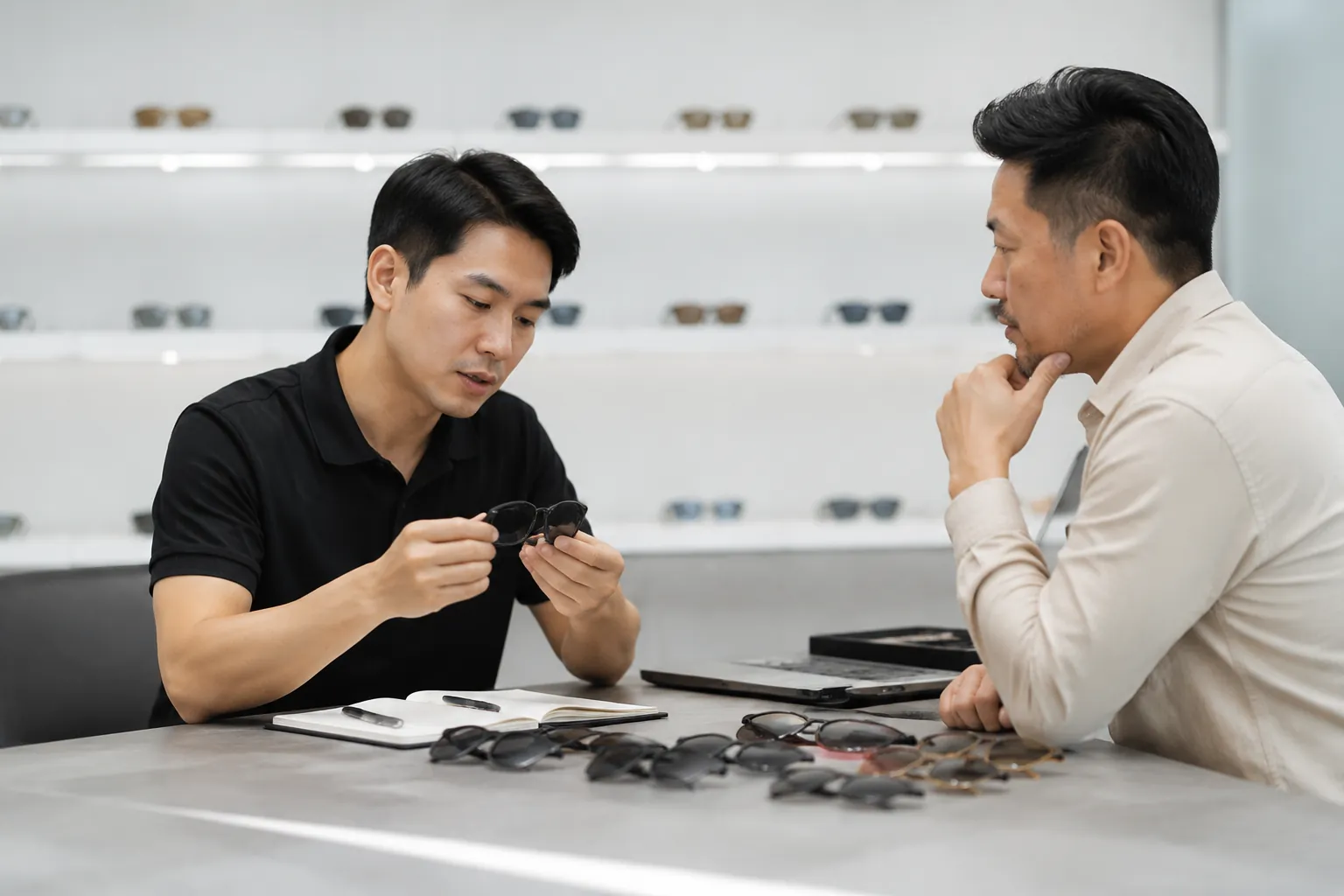
This guide is for brand owners, importers, distributors, and retail buyers who need to approve custom sunglasses with speed and control. The goal is not to collect extra samples. It is to collect the right evidence, in the right order, so you can place a bulk order with clear specifications and lower production risk. A solid sampling plan defines what is being approved at each stage, how many prototype rounds the project actually needs, which details can be screened with chips instead of full assemblies, and which measurements and appearance standards must be frozen before mass production. Do that well and decisions move faster. Costs stay tighter. Disputes drop after production starts.
Start with the approval decision, not the sample count
Many delays start with a vague request like "send a few options." That sounds harmless, but it creates confusion fast. The buyer and factory often end up judging different things at the same time. A better approach is to define the approval path before the first sample is made: structure approval, fit approval, color approval, decoration approval, then pre-production sign-off.
For custom sunglasses, those decisions should stay separate wherever possible. Frame width, temple opening feel, lens base curve, bridge shape, hinge alignment, and logo position all affect the final product. But they should not all be revised in the same round unless you accept a slower process. If fit, lens tint, logo finish, and packaging artwork all change at once, it becomes difficult to tell which revision fixed which problem.
A practical rule for many B2B projects is simple: lock structure first, appearance second, packaging third. The first prototype should answer basic questions. Is the shape commercially right? Does the bridge sit correctly? Is the temple length workable? Does the frame wrap too much or too little? Once those points are stable, move to exact lens tint, logo finish, pouch print, barcode label, and carton details.
This order matters because different constructions revise at different speeds. Injection-molded frames can be adjusted quickly when changes are minor, but tooling-related corrections add time. Acetate samples can be hand-finished for review, yet geometry changes may still require recutting and repolishing. CNC-machined parts can hold tight dimensions, but revision timing still depends on programming, machining, and finishing capacity. The point is straightforward: a clear approval sequence works better than loosely defined sample rounds.
How many samples you actually need by project type
Prototype count should follow project risk, not buyer nerves. A logo-only run on an existing mold is usually lower risk because the base shape and construction are already known. A new acetate style with custom laminated temples, gradient lenses, and plated logos carries more variables. It usually needs more validation.
| Project type | Recommended prototypes | Color chips | Fit revisions | Typical use |
|---|---|---|---|---|
| Logo-only on existing mold | 1 to 2 | 1 to 2 | 0 to 1 | Private label runs based on proven construction |
| Existing shape with custom colors | 2 to 3 | 3 to 5 | 0 to 1 | Seasonal collections where appearance risk is higher than fit risk |
| New fit on existing construction | 2 to 4 | 2 to 4 | 1 to 2 | Bridge, temple, or face-curve adjustments for a defined target user |
| New custom style from scratch | 3 to 5 | 4 to 6 | 1 to 3 | Core collection launches where tooling, fit, and branding all need validation |
For many overseas projects, three checkpoints are enough. Sample 1 confirms shape and basic construction. Sample 2 confirms corrected fit, target color, and logo method. Sample 3, if needed, becomes the pre-production sample that sets the bulk standard.
Order size should also affect discipline. A small trial order does not always justify repeated prototype rounds, especially if the style will not be repeated. Larger orders justify tighter control because the cost of a bulk mistake is usually higher than the cost of an extra sample round. The threshold varies by unit value, freight method, retail commitments, and the cost of replacement or delay. Decide sample depth based on total business exposure, not MOQ alone.
Use color chips before full samples
Color chips are one of the most useful control tools in eyewear sourcing, yet many buyers skip them and go straight to assembled samples. That wastes time. It also raises cost. If the project includes translucent injection colors, laminated acetate, lens gradients, mirror coatings, plated trims, or printed logos on dark surfaces, chips can eliminate bad options before assembly and courier time are spent.
Frame color can shift under different lighting, especially with transparent or translucent tones such as gray, tea, olive, sand, or champagne. Acetate pattern distribution can vary across a sheet, so a photo or even one assembled sample may not show what the material will look like in production. Lens appearance adds another layer because a gradient or mirror finish often looks different in hand than it does on screen.
- Injection frame colors: Request chips made from the actual resin formula and review them under at least daylight and indoor light.
- Acetate patterns: Ask for cut chips from the actual sheet or sheet reference whenever possible, because pattern density, stripe direction, and transparency can vary.
- Lens tints: Approve both the visual shade and the intended market specification, especially if the product will be evaluated against CE EN ISO 12312-1, ANSI Z80.3, or AS/NZS 1067.
- Metal finishes: Review finish samples for polished, brushed, matte, or plated parts before requesting full assembled pieces.
- Print colors: For pad print or screen print logos, ask for strike-offs or print references on the real substrate, especially on textured or rubberized surfaces.
A rejected chip usually costs far less time and money than a rejected complete prototype. The rule is blunt: approve colors and finishes in the cheapest reliable form first. Then request full samples only for options that already pass visual review.
Fit revisions: where projects usually stall
Fit is where many projects lose time because comments stay subjective. A sample may look right on the table and still fail when worn. Common problems include bridge pressure, temples gripping too tightly, lens height sitting too low on the face, or a wrap angle that does not suit the intended customer.
Most projects should allow one formal fit revision. Two is reasonable for a new style or a narrow target profile, such as petite frames, oversized acetate, or sport shapes with stronger wrap. More than two is a warning sign. It often means the original brief did not define the target fit clearly enough.
| Fit checkpoint | What to measure | Typical tolerance | Common failure |
|---|---|---|---|
| Front width | Hinge-to-hinge or temple spread reference | Project-specific, often within ±1.0 mm | Frame feels too narrow or too wide on the face |
| Bridge fit | Bridge opening, saddle contact, nose position | Project-specific, often within about ±0.5 to 1.0 mm | Pinching, sliding, or sitting too high |
| Temple length | Functional length to ear bend | Project-specific, often within ±1.0 mm | Pressure behind ear or insecure hold |
| Lens alignment | Left-right symmetry and visual height | Within agreed QC standard | Uneven appearance when worn |
- Lock target dimensions early: define eye size, bridge, temple length, front width, lens base curve, and any required wearing angle before sampling starts.
- Test on several wearers: do not approve fit from one person alone if the style is meant for a broad consumer group.
- Separate fit fixes from design changes: changing bridge height is a different decision from redrawing the lens shape.
- Record measurable comments: feedback such as "bridge sits about 1 mm high" or "left temple tension is too loose" is more actionable than "fit feels off."
Revision timing also depends on construction. Acetate can be heat-adjusted for review, but true geometry changes may still require cutting and polishing work. Injection samples may be reworked for reference, but mold-related corrections can take longer. Treat each fit round as a controlled engineering step, not a styling discussion.
Use an approval path that fits risk, speed, and MOQ
The best approval path balances technical risk against commercial value. Existing-mold projects usually move faster because the base shape and fit are already known. New styles need more control because more unknowns are being tested at once.
| Approval stage | What to review | Typical lead time | Approve or reject on |
|---|---|---|---|
| Stage 1: Visual concept sample | Shape, proportions, broad material direction | Often about 7 to 10 days, depending on construction | Front profile, lens shape, temple design, basic construction |
| Stage 2: Corrected prototype | Fit updates, target colors, logo method | Often about 7 to 10 days after comments, depending on revisions | Wear test, hinge feel, bridge comfort, color match, decoration placement |
| Stage 3: Pre-production sample | Bulk standard before mass production | Typically aligned with production planning | Bill of materials, packaging, labeling, QC checkpoints |
For a low-risk logo-only order, Stage 1 and Stage 2 may be enough. For a new style, all three stages are usually justified. Be careful with approval by photo unless the frame is already proven and only a minor branding change is involved. Photos help with interim communication. They do not reliably confirm hinge feel, lens tint behavior, print sharpness, plating consistency, or packaging execution.
MOQ and pricing matter, but they should not overrule control on high-risk points. A low unit price does not cancel out the cost of a bulk error if the shipment misses a launch window, fails buyer expectations, or needs replacement. Ask the hard question early: what does an incomplete approval standard really cost?
What the pre-production sample must prove
A pre-production sample is not just a good-looking prototype. It is proof that the factory can repeat the approved result using the intended bill of materials, decoration method, and packaging specification. If any of those points remain open, the product is not ready for bulk approval.
- Material match: confirm the intended frame material, lens material, and any mixed-material components used in the approved build.
- Decoration match: verify logo method, spelling, position, adhesion, orientation, and finish against the approved artwork and sample reference.
- Assembly consistency: review hinge action, screw seating, left-right symmetry, lens seating, and frame alignment.
- QC tolerances: freeze acceptable standards for color variation, logo position, cosmetic defects, lens cleanliness, and temple alignment.
- Packaging details: verify barcode, country-of-origin marking, warning text, case or pouch style, inner pack method, and carton pack count.
This stage should also produce a written approval record. The approved sample should be linked to the purchase order, with one reference kept by the factory and one by the buyer where practical. That record should include the approval date, revision number, key measurements, approved colors, decoration reference, packaging files, and any agreed exceptions. Good records remove guesswork later. They turn disputes into document checks instead of opinion fights.
Where compliance and sampling meet
Compliance should be built into the sample process, not left to the end. In sunglasses, the approved sample should reflect the product that will actually ship. If lens tint, mirror coating, lens material, paint, or plating changes after approval, the basis for compliance review may change too.
Depending on the target market and product specification, buyers may need to evaluate the product against standards or controls such as CE EN ISO 12312-1, ANSI Z80.3, AS/NZS 1067, or restricted-substance expectations under REACH. Factory management and social compliance credentials such as ISO 9001 or BSCI may also support supplier approval, but they do not replace product-specific sample review. If the product is sold in a category or channel where FDA registration is relevant, confirm that status separately and in writing.
Short version: if the change affects lens performance, coating, paint, plating, material composition, labeling, or market claims, treat it as a new control point and document it before production proceeds.
This is another reason the chip-and-sample sequence works. It is faster to reject an unsuitable lens tint, coating, or decorative finish before the factory prepares bulk components. Sampling is not only about appearance. It connects design intent, repeatable production, and market-readiness checks.
A buyer checklist to keep sample rounds under control
If you want speed without losing control, manage sampling with one checklist and one version of truth. Most delays come from scattered comments, late additions, or parallel approvals on different revisions. Keep the process tight.
- Issue one complete brief: include drawings, target dimensions, fit intent, logo method, color direction, packaging requirements, and the compliance standards or documents you need reviewed.
- Name the sample stage clearly: use labels such as concept sample, corrected prototype, and pre-production sample instead of calling every item simply "sample."
- Use one comment sheet: keep one file, one revision number, one owner, and one deadline for consolidated feedback.
- Limit revision scope per round: avoid changing fit, color family, branding concept, and packaging at the same time unless extra calendar time is acceptable.
- Approve chips before full color samples: this is especially useful for acetate patterns, translucent injection colors, lens gradients, and plated trims.
- Freeze the final standard: attach approved sample references, measurements, comments, packaging files, and QC notes to the purchase order and supplier confirmation.
Sample lead times and bulk timing vary by construction, decoration, workload, and shipping method, so confirm current timing case by case instead of relying on generic promises. A disciplined process can still move fast. A loose process usually creates extra rounds, conflicting instructions, and rework that becomes more expensive once production starts.
Have a custom sunglasses project in mind?
Send us your styles, target market and quantities and we will return a detailed quote with MOQ, lead time and a sample plan.
Get a QuoteWhy source this from Wenzhou with LumiShades
Wenzhou in Zhejiang Province is widely regarded as China’s eyewear manufacturing capital, producing a large share of the world’s sunglasses. That concentration matters to buyers: a deep local supply chain for acetate sheet, hinges, lens blanks, plating and packaging means shorter component lead times, easier color and material matching, and a workforce with decades of eyewear-specific skill. LumiShades has manufactured in this ecosystem since 2009, and our vertical integration — in-house injection molding, acetate cutting, CNC milling, lens tinting, decoration and quality control — means no part of your order is quietly subcontracted to a workshop you cannot audit.
For international buyers, that vertical control translates into accountability. When a single factory owns every step, defects are traced and fixed at source rather than bounced between vendors, and your specifications survive intact from first sample to bulk. We back this with 15+ years of experience, shipments to 60+ countries, more than 5 million pairs produced per year and a 98.5% on-time delivery rate. Our certifications — CE EN ISO 12312-1, FDA registration, ANSI Z80.3, AS/NZS 1067, REACH, ISO 9001 and BSCI audit — mean the compliance documentation your market requires already exists. Explore our manufacturing capabilities and quality control process to see how this works in practice.
Frequently asked questions
For a new custom sunglasses style, how many prototype rounds are usually enough? In many projects, two to three rounds are enough if the brief is complete. Use the first round to confirm shape and construction, the second to confirm fit corrections, color, and branding, and a third only if needed for pre-production approval or a more complex correction. Before approving any round, issue written comments with revision numbers and keep fit changes separate from cosmetic changes so the factory can respond clearly.
Should I approve color from photos or insist on physical chips? Use physical chips whenever color, transparency, pattern, plating, or lens appearance matters to the sale. Photos help with early discussion, but they are not a reliable final approval tool for translucent frame colors, acetate patterns, gradients, mirror coatings, or metallic finishes. Ask for chips made from the actual material reference, review them under more than one lighting condition, and keep the approved chip tied to the sample record.
At what order size should I require a pre-production sample before bulk starts? Require a pre-production sample for any new style, major fit revision, or project with multiple custom components, even if the order quantity is modest. For repeat styles on proven construction, the decision can depend on business exposure, retailer requirements, and the cost of a bulk mistake. As a practical rule, require pre-production approval whenever the shipment value, launch deadline, or compliance sensitivity is high enough that replacing or delaying stock would be difficult.
Can I change lens tint after sample approval without affecting compliance? Do not assume so. A lens tint or coating change can alter product characteristics that may be reviewed against CE EN ISO 12312-1, ANSI Z80.3, or AS/NZS 1067. If you change tint, mirror coating, or lens material after approval, stop and document the change, ask the supplier which specifications are affected, and confirm whether new testing, new sample approval, or updated technical records are needed before production continues.
How do I keep fit revisions from dragging on for weeks? Start with a measurable fit brief, including target eye size, bridge, temple length, front width, and intended wearer profile. Test samples on more than one person, record comments in millimeters where possible, and avoid mixing fit corrections with unrelated styling changes in the same review. If the project still needs repeated fit corrections after two formal rounds, pause and recheck the original dimensions, face-fit target, and whether the chosen base construction is suitable for the design.
Ready to start?
Explore our square sunglasses or request a quote — our sales team replies within 12 hours.
Request a Quote