
Stainless Steel vs Aluminum Eyewear Frames
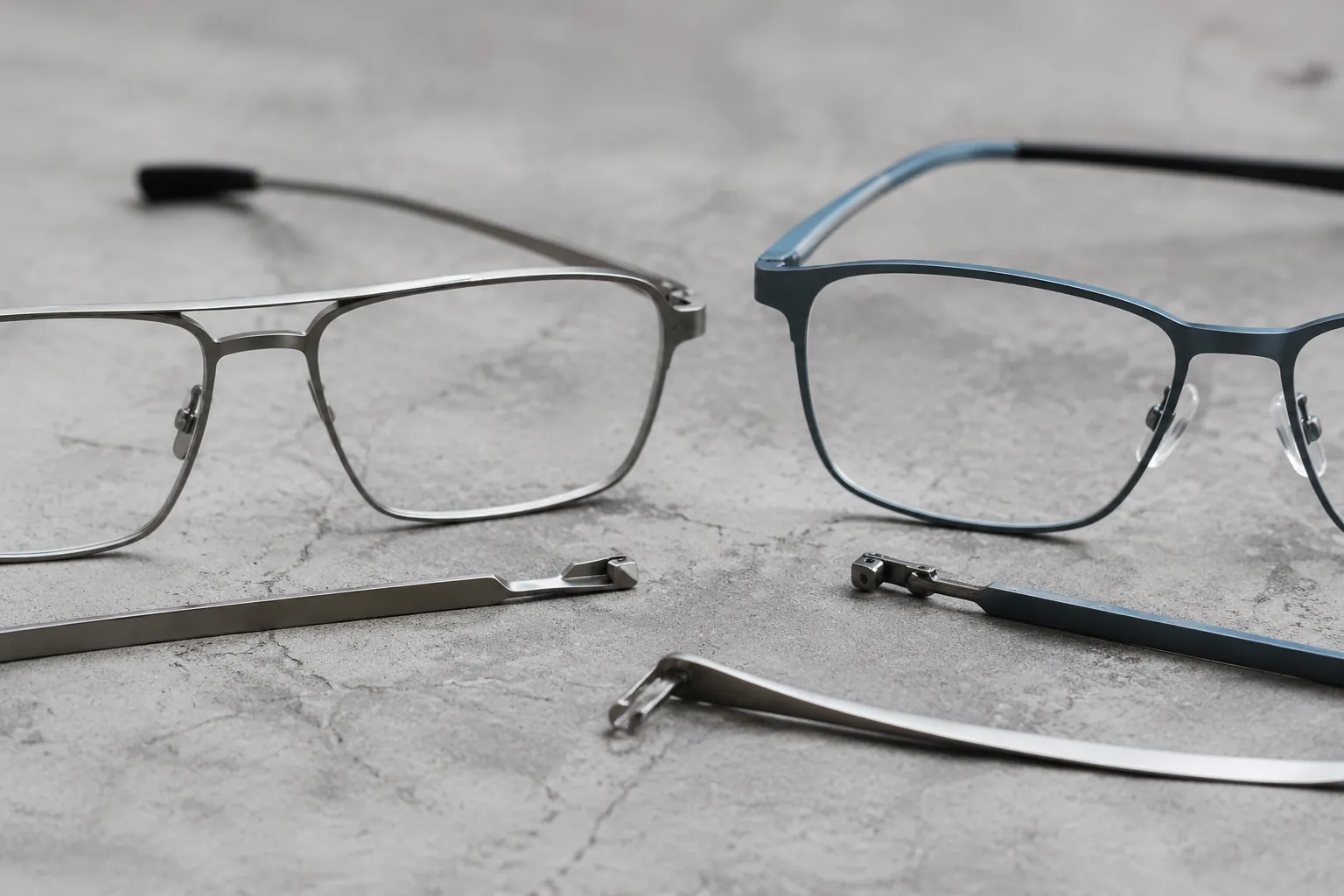
If you buy sunglasses or optical frames in volume, the metal you choose affects weight, durability, finish quality, lead time, and retail positioning. Stainless steel and aluminum can both work, but they behave differently in forming, finishing, assembly, and everyday wear. This guide compares them from a buyer's perspective: weight, corrosion resistance, tooling, decoration, compliance, and how quantity can affect pricing.
What volume buyers are choosing
Stainless steel and aluminum are not interchangeable, even if two frames look similar in a render. Stainless steel usually gives more stiffness and a wider process window during forming and assembly. Aluminum is lighter. That can make a frame feel easier to wear, if the profile, edges, and coating system are controlled well.
For volume orders, the real question is not which metal is stronger in the abstract. It is which one fits the target retail price, acceptable defect rate, and use case. A chain buyer selling everyday optical frames usually wants stable hinge action, straight temples, and a low complaint rate. A fashion brand selling oversized sunglasses may care more about weight, comfort, and how the frame feels after hours of wear.
Material choice should also match the production plan. Tooling, fixture setup, sample approval, and scrap are front-loaded costs. The same design can behave very differently at 50 pairs and at 5,000 pairs. A frame that is easy to make at scale may be too sensitive for a small pilot run.
Stainless steel is often the safer default when repeatability matters. Aluminum makes more sense when low weight is the selling point and the supplier can control forming, surface treatment, and edge finishing. Think of the frame as a system. Base metal, hinge type, coating, decoration method, lens fit, and packaging all matter.
Weight, stiffness, and comfort
Weight is usually the first question. Aluminum is lighter than stainless steel, so it can reduce the felt weight of larger sunglasses and comfort-led fashion frames. That matters for wearers who feel pressure on the nose or ears.
Comfort is not only about weight. Stiffness and balance matter too. Stainless steel generally holds shape better in thin sections, especially at the bridge and temple areas. That helps when the design uses narrow profiles, longer temples, or precise lens alignment. Aluminum can work, but it often needs more section depth or other design support to stay rigid.
Stainless steel is usually more forgiving if the frame is handled roughly during assembly, transport, or packing. Aluminum can deform more easily if the design is underbuilt or if handling is weak. The short version: if the product must feel light, aluminum may help. If it must keep its shape with less variation, stainless steel is often the steadier choice.
| Factor | Stainless Steel | Aluminum |
|---|---|---|
| Relative weight | Heavier | Lighter |
| Shape retention | Strong in thin sections | More design-dependent |
| Comfort profile | Stable, solid feel | Light, low-pressure feel |
| Risk in thin sections | Lower | Higher if underbuilt |
| Typical use case | Core optical frames, durable metal sunglasses | Lightweight fashion, comfort-led sunglasses |
If your market complains about nose pressure, aluminum can help. If it complains about bent frames, loose temples, or a flimsy feel on shelf, stainless steel usually causes fewer problems.
Corrosion, sweat, and long-term wear
Corrosion resistance should be judged by the full build, not by a generic promise. Stainless steel performs well in everyday use because it resists sweat, humidity, and normal handling without leaning heavily on a fragile surface system. That is one reason it is common in optical frames and everyday sunglasses.
Aluminum also resists corrosion, but it depends more on surface treatment. Anodizing, powder coating, and paint systems can work well, but results depend on process control. If the coating is thin, if sharp edges are not handled correctly, or if dissimilar metals are used in a poor hinge stack, wear can show up sooner. In humid or coastal markets, aluminum needs more finish scrutiny.
For outdoor-heavy use, stainless steel is often the safer default. Sweat, sunscreen, repeated wipe-downs, and temperature swings make finish durability more important. Aluminum can still work, but it should be backed by coating-thickness targets, adhesion checks, and salt-spray or sweat-simulation testing where appropriate. Screws, rivets, hinges, and decorative parts should also match the main metal.
For export programs, compliance is not optional. Common requirements include CE EN ISO 12312-1, ANSI Z80.3, AS/NZS 1067, REACH, FDA registration, ISO 9001, and BSCI. Material choice matters, but compliance is decided by the finished product, including the lens package, coatings, inks, adhesives, and final construction.
When reviewing samples, ask for a simple wear check: hinge cycles, cloth wipe tests, and visual inspection under bright light after handling. A short evaluation can reveal whether the coating is too soft, the edges are too sharp, or the metal clashes with the decoration method.
Tooling, fabrication, and factory reality
Metal frame production is a sequence of operations, not just a drawing. The chosen material affects cutting, bending, joining, polishing, coating, hinge insertion, and final QC. Stainless steel is commonly used for stamping, forming, joining, polishing, and electroplating or PVD-style finishing, depending on the style. Aluminum often needs tighter control during cutting and bending because it can mark more easily and is less forgiving in slim sections.
The biggest hidden cost is inconsistency. A supplier may produce a strong first sample, but if the profile is too thin, if spring-back varies, or if the coating stack is unstable, production yield drops quickly. For metal eyewear, hinge alignment and symmetry must stay within the approved tolerance range, and temple opening force must remain consistent enough that the buyer does not feel a difference from pair to pair.
Practical controls on metal frames focus on measurable geometry and finish quality: bridge symmetry, temple parallelism, hinge position, and surface uniformity. If the bridge is off by even a small amount, the frame can sit crooked on face. If the temple angle drifts, the lot feels inconsistent in wear.
Typical production checkpoints are straightforward but important:
- Confirm incoming metal thickness and surface finish against the approved sample.
- Verify hinge position and rivet alignment before final assembly.
- Measure temple opening angle and closing resistance on a lot basis.
- Check lens seating depth and rim symmetry under fixture.
- Inspect coating, polish, and engraving under standard lighting before packing.
Smaller profiles usually need tighter tooling and better process discipline. A frame can look elegant on screen and still become expensive if it warps during finishing or if the surface treatment fails after a few handling cycles. Ask for pre-production samples. Not just a quote.
Decoration, finishing, and brand presentation
Decoration is not an afterthought on metal eyewear. It affects perceived quality and can affect durability too. Common methods include laser engraving, pad printing, hot stamping, PVD accents, and metal logo plates. Each behaves differently on stainless steel and aluminum.
Laser engraving is often the cleanest option for stainless steel because the mark can be crisp and repeatable. On aluminum, laser work can also look good, but the coating or anodized layer must be compatible or the mark may come out too light, too dark, or too shallow. Pad printing can work on both metals when the surface is prepared correctly, but it is more exposed to abrasion and cleaning wear. Metal logo plates can create a premium look, though they add parts, adhesive control, and another inspection step.
Finish quality matters more than the decoration itself. Ask for clear gloss or sheen targets, edge-break expectations, and sample photos under both direct white light and diffuse light. On aluminum, a slightly sharp edge or uneven coating across bends is noticed quickly. Stainless steel is more forgiving of small handling marks, but it still needs polished edges and clean transitions around the hinge and nose bridge.
A practical sample review should include a visual check for coating or plating defects, a wipe test, and a close look at corner transitions where decoration often breaks down. If the logo sits on the temple tip or outer temple face, confirm that it remains legible after repeated opening and closing. For private label programs, decoration durability is part of the spec, not just branding.
Also specify whether the product is matte, brushed, polished, or mixed-finish. A brushed stainless steel frame and a matte aluminum frame can both look premium, but the supplier needs clear instructions because texture hides or reveals defects differently. The wrong finish can make the same frame look cheaper than intended.
Cost logic from MOQ to 5000+ pairs
Price is not a single number. It changes with quantity, structure, finish, decoration, packaging, and defect risk. Small-run cost is usually higher because setup, sampling, and packing are spread across fewer units. As quantity rises, the unit price usually improves because those fixed costs are distributed across more pairs.
As a general sourcing rule, simpler stainless steel frames are often easier to price at lower quantities because the process is familiar and yield is usually stable. Aluminum can also be cost-effective, but if the design needs extra coating care, careful handling, or tighter reject control, the finished cost may not be lower than stainless steel. Lower material weight does not automatically mean lower finished cost.
At low quantity, the order is often a test of fit rather than a true cost benchmark. Around 300 pairs, setup and packing costs start to spread more evenly. At 1,000 pairs, production planning becomes more efficient. At 5,000 pairs and above, tooling efficiency and stable workflow usually create the best unit economics, especially for repeat SKUs.
| Order level | Buying impact | Typical decision point |
|---|---|---|
| 50 pairs | Highest unit cost; quickest way to test design | Pilot launch, showroom, or early sell-through test |
| 300 pairs | Better spread on setup and packing | First meaningful retail run |
| 1000 pairs | Better price leverage and more stable planning | Regional distribution or multi-store rollout |
| 5000+ pairs | Lowest unit cost and best tooling efficiency | Core SKUs with repeat demand |
Simple stainless steel models can sometimes be priced at a low per-pair level at scale, but that depends on structure, finish, decoration, and packing. Ask suppliers to separate pricing by material, finish, quantity tier, and decoration. Compare like with like.
Retail value and buyer perception
Retail value is not only about material cost. It is about how the frame feels in hand, how well it holds up, and whether the finish looks credible on shelf. Stainless steel often reads as practical, durable, and dependable. That makes it a strong fit for core collections, office-wear shapes, and price-sensitive chains that still want a metal-frame story.
Aluminum can support a lighter, more modern assortment. It often fits fashion-led sunglasses where comfort and visual lightness matter as much as durability. But the design has to look intentional. If the finish is uneven, the edges are too sharp, or the surface feels fragile, customers notice quickly. Aluminum is less forgiving of weak surface prep and inconsistent edge treatment.
For private label buyers, the decoration method also affects perceived value. Laser engraving, pad printing, and metal logo plates each create a different retail impression. On stainless steel, laser marks tend to stay crisp and understated. On aluminum, decoration can work well too, but the coating stack must be tested so the logo does not wear too quickly after cleaning or friction.
Positioning matters. Stainless steel supports a durable-value message: reliable, repeatable, easy to replenish. Aluminum supports a lightweight-premium message: sleek, easy on the face, designed for comfort. The right choice depends on the story your store, distributor, or ecommerce listing needs to tell.
Buyer rule: choose stainless steel if the program is built around durability, repeatable production, and lower complaint risk; choose aluminum if low weight is a key selling point and the design control is tight.
How to specify the right frame in your RFQ
A good RFQ saves time. A vague one usually creates revisions. If you want a supplier to quote stainless steel and aluminum correctly, give exact specifications up front. Frame shape, target weight, hinge type, lens size, temple length, finish, logo method, packing requirements, and compliance market should all be included in the first brief. If possible, provide a reference sample and a target feel description, not only a sketch.
Use a simple checklist:
- Frame metal: stainless steel or aluminum, with alloy or finish requirement if known
- Target market: EU, US, Australia, or mixed export
- Compliance: CE EN ISO 12312-1, ANSI Z80.3, AS/NZS 1067, REACH, FDA registration, ISO 9001, and BSCI as applicable
- Quantity tiers: 50, 300, 1000, 5000+
- Sampling target: 7-10 days for a clear design
- Bulk target: 25-35 days after sample approval
- Decoration: laser engraving, pad printing, or metal logo plate
- Tolerance priorities: bridge symmetry, temple alignment, hinge feel, and lens seating
Ask for a sample approval process before mass production starts. A serious factory should show hinge function, finish under light, and packaging details before the bulk run. For metal frames, the signed sample is the production reference that controls the whole lot, especially when the order spans multiple sizes or colorways.
If you are comparing suppliers, ask them to quote the same frame in both metals using the same visual specification. That makes it easier to see where aluminum genuinely saves money and where extra finishing work closes the gap. It also shows which factory understands process control instead of just quoting the lowest number.
Have a custom sunglasses project in mind?
Send us your styles, target market and quantities and we will return a detailed quote with MOQ, lead time and a sample plan.
Get a QuoteWhy source this from Wenzhou with LumiShades
Wenzhou in Zhejiang Province is widely regarded as China’s eyewear manufacturing capital, producing a large share of the world’s sunglasses. That concentration matters to buyers: a deep local supply chain for acetate sheet, hinges, lens blanks, plating and packaging means shorter component lead times, easier color and material matching, and a workforce with decades of eyewear-specific skill. LumiShades has manufactured in this ecosystem since 2009, and our vertical integration — in-house injection molding, acetate cutting, CNC milling, lens tinting, decoration and quality control — means no part of your order is quietly subcontracted to a workshop you cannot audit.
For international buyers, that vertical control translates into accountability. When a single factory owns every step, defects are traced and fixed at source rather than bounced between vendors, and your specifications survive intact from first sample to bulk. For procurement review, buyers can request process records, approved samples, quality checkpoints and project-specific compliance files before placing a bulk order. Required testing and documentation are confirmed against the destination market and product specification rather than assumed from a generic certificate list. Explore our manufacturing capabilities and quality control process to see how this works in practice.
Frequently asked questions
For a first volume order, should I start with stainless steel or aluminum? Start with stainless steel if your priority is lower production risk, easier fit control, and more predictable mass production. Choose aluminum only if low weight is a clear selling point and the design has already been proven through sampling.
Which frame material is better for humid or coastal markets? Stainless steel is usually the safer choice because it handles sweat and humidity well in everyday use. Aluminum can work too, but it depends more on coating quality, edge treatment, and process control.
Can both materials meet CE EN ISO 12312-1 and ANSI Z80.3 requirements? Yes. Compliance depends on the finished product, not the metal alone. The lens, assembly quality, finish system, labeling, and overall construction all need to meet the relevant standard.
What should I ask for in a sample before approving bulk production? Check hinge feel, temple alignment, bridge symmetry, coating quality, lens fit, and logo durability. Review the sample under direct light and, if possible, after repeated open-close cycles and wipe tests.
How do quantities affect pricing on metal frames? At 50 pairs, unit cost is usually highest because setup is spread across a small run. Pricing generally improves at 300, 1000, and 5000+ pairs as setup, batching, and packing costs are diluted.
How fast can samples and bulk orders move? A reasonable target is 7-10 days for samples and 25-35 days for bulk after approval, assuming the design is clear and the specs do not change during development.
Ready to start?
Explore our square sunglasses or request a quote — our sales team replies within 12 hours.
Request a Quote