
Stainless Steel Hinge Specs for Durable Sunglasses
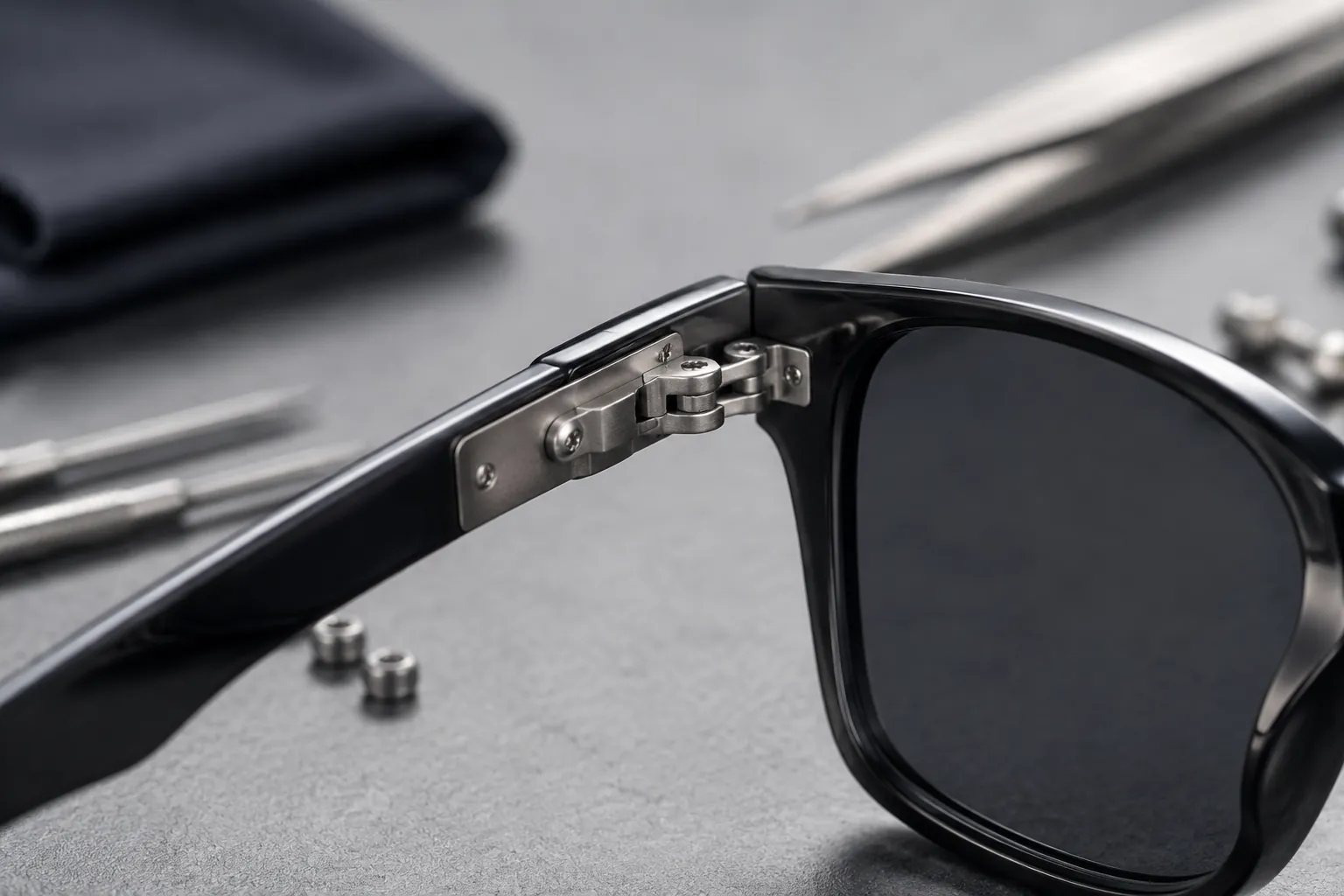
For brands, importers, distributors, and retailers buying sunglasses in volume, hinge failures become returns, replacements, and complaints fast. This guide covers the dimensions, tolerances, reinforcement details, and factory checks that matter if you want fewer breakages in mass-market programs.
What usually breaks first
In high-volume sunglasses, the hinge rarely fails because the metal itself is weak. More often, the problem starts around it: a loose screw, a thin temple pocket, a warped front, or a hinge forced into a mount that was never built for the load.
Three failure modes show up early. The screw hole elongates. The barrel bends or opens. The temple mount cracks around the pocket. Simple. Costly too.
That is why the hinge must survive more than showroom handling. Mass-market sunglasses face repeated opening and closing, carton pressure in shipping, heat in transit, store try-ons, and daily consumer use. A sample can look fine and still fail in repeat use if the barrel wall is too thin or the mount flexes too much.
For B2B buyers, the first question should not be, "Is it stainless steel?" It should be, "What is the full hinge system?" That means barrel diameter, barrel wall thickness, leaf thickness, screw size, reinforcement method, assembly torque, and the fit tolerance between the hinge and the temple pocket. If the factory cannot answer those points clearly, the program is not defined well enough.
At LumiShades, hinge selection is tied to frame material, temple width, and target price. A low-cost FOB pair does not use the same hinge thickness or reinforcement detail as a premium acetate frame. The metal part is only one piece. The mount decides whether the joint lasts.
Key hinge dimensions to specify
Buyers often ask only for barrel count, but barrel count does not tell you whether the hinge is durable. The dimensions that drive strength and service life are barrel outer diameter, wall thickness, hinge leaf thickness, pin or screw diameter, and the amount of material supporting the pocket. If one of those is undersized, the hinge can loosen or deform before the product reaches the end user.
| Spec item | Typical buyer target | Practical tolerance target | Why it matters | Common failure if too weak |
|---|---|---|---|---|
| Barrel outer diameter | About 2.0–3.0 mm on light fashion frames; larger on heavier temples | Hold within ±0.10 mm on the critical mating section | Controls load spread and pin support | Ovalization, loose action, visible wobble |
| Barrel wall thickness | Keep it uniform through the knuckle area | Avoid local thinning below the drawing callout | Helps prevent bending and crack initiation | Collapse after repeated wear or rough handling |
| Hinge leaf / plate thickness | Enough metal to resist pull-out under temple torque | Keep thickness variation tight across left and right pairs | Helps the hinge stay seated in acetate or injected plastic | Plate pull-out, stress whitening, mount cracking |
| Screw diameter | Match hinge size; do not downsize blindly | Use one controlled screw spec with consistent thread engagement | Affects thread grip and service life | Back-out, stripped threads, loose temples |
| Temple pocket depth | Deep enough to capture the leaf without overcutting | Keep pocket depth consistent within the mold or cut program | Protects the joint from shear and side load | Early pull-out or temple misalignment |
For acetate frames, the hinge leaf needs enough surrounding material to resist torque. For injected frames, the molded boss or insert pocket must be strong enough to accept the hinge without sink, warp, or cracking. A strong hinge on a weak mounting zone still breaks. The metal part and the host frame must be approved together.
If the hinge spec changes and the temple pocket drawing does not, the program is not ready. The load path has to work as one system.
Tolerance control decides the outcome
Tolerance control matters because small variation quickly becomes assembly trouble. If the left and right temples do not close to the same stop position, workers may force the fit. That creates torsion in the barrels, makes the screw threads bite unevenly, and often leads to early loosening. "Close enough" turns into rejects.
For a normal mass-market sunglass program, ask the factory to define tolerance targets on the drawing, not only in QC notes. Useful checks include hinge barrel alignment within the pair, temple opening angle consistency, screw hole position, and the gap between hinge leaf and frame mount. The hinge should assemble without force, without visible twist, and without rework at final inspection.
- Barrel centerlines should align so the pin or screw runs straight through the pair.
- Temple opening angle should be consistent left to right so the frame sits square on the face.
- Screw holes should be positioned to avoid driver slip and thread damage during assembly.
- Mount gap should be controlled so the hinge is not preloaded before the product is used.
- Closed temples should show no visible offset or rubbing at the hinge area.
At the line level, common causes of tolerance failure are worn tools, inconsistent heat during assembly, and weak checking between incoming parts and final pack-out. If a factory says it is doing "100% inspection," ask what it is inspecting, at what stage, and against what measurable standard. A visual pass is not a fit check.
For high-volume eyewear, hinge fit should be part of final inspection because a good hinge that is badly seated is still a defect. Ask how many checkpoints exist between raw part receipt, temple insertion, screw setting, and carton pack-out. One checkpoint is rarely enough.
Reinforcement details that reduce breakage
Most hinge failures come from the surrounding structure, not the hinge barrel alone. Reinforcement keeps the joint alive under heat, vibration, impact, and repetitive opening. If the temple or front flexes too much, the hinge becomes the weak point.
Useful reinforcement details include metal inserts in acetate temples, thicker molded material around the hinge pocket in injected frames, longer anchor length for the hinge leaf, and rounded internal corners to reduce stress concentration. Assembly heat also matters. If the temple material softens too much during insertion, the joint can warp before the product reaches packing.
For acetate cutting and assembly, clean pocket geometry is critical. A rough or oversized pocket makes the leaf sit loose, which leads to micro-movement and eventual pull-out. For injection molding, gate position and cooling control matter because warpage changes temple angle and side load. If the temple fights the frame front, the hinge takes the punishment.
Buyers should specify reinforcement in the approval file rather than leaving it to factory interpretation. That file should state whether the temple uses an insert plate, how far the insert extends, whether the pocket is CNC-cut or molded, and what corner radius is used around the hinge zone. If the reinforcement detail is missing, the factory will usually optimize for speed, not lifespan.
Price pressure often removes reinforcement first. That is false economy. In a mass-market program, saving a few cents on the hinge zone can cost much more in returns, concessions, and replacement freight later. Spend enough in the mount area to survive real use. Nothing more. Nothing less.
Material choices and finishes
Not every stainless hinge behaves the same. In sunglasses, the goal is corrosion resistance plus enough strength and resilience for daily handling. Buyers do not want visible rust at the beach, green staining after sweat exposure, or a hinge that feels gritty after a few weeks in humid markets.
For most commercial eyewear, the most common hinge materials are stainless steel grades with adequate corrosion resistance and good forming behavior. The exact grade matters less than how the supplier processes it: stamping consistency, deburring, polishing, plating, and passivation all affect service life. A hinge that is chemically stainless but poorly finished can still wear fast, corrode at edges, or bind during assembly.
Decoration also changes the risk profile. Laser engraving is usually low-risk for hinge movement if it stays off the friction surfaces. Pad printing is acceptable when applied to non-contact zones, but thick ink near the barrel can interfere with rotation. Metal logo plates add weight and visual value, but if they sit too close to the hinge line they can scrape the temple or block full closure. Confirm clearance after decoration, not before.
| Hinge option | Best use | Durability note | Cost effect |
|---|---|---|---|
| Standard stainless steel hinge | Mass-market fashion frames | Good baseline if thickness, fit, and screw spec are controlled | Lowest |
| Reinforced stainless hinge with thicker plate | High-use retail programs | Better resistance to pull-out, screw wear, and bending | Moderate increase |
| Stainless hinge with laser engraving or pad print nearby | Brand-led styles | Durable if decoration stays clear of the moving joint | Low to moderate increase |
| Stainless hinge paired with metal logo plate | Premium-looking custom programs | Strong if the plate does not interfere with closing angle | Higher due to extra parts and handling |
Hinge fabrication and decoration should be approved together. A decorative element that interferes with temple movement can turn a good hinge into a return reason.
How hinge spec changes by frame material
The right hinge for acetate is not always the right hinge for injection-molded plastic, and neither behaves like a metal frame hinge. The substrate changes the load path, the assembly method, and the tolerance risk. If the frame material is wrong for the hinge style, the product can feel tight out of the box and loose after short use.
Acetate frames usually tolerate a more robust insert or deeper pocketing, but they also demand precise cutting. A sloppy pocket leaves gaps that allow movement and stress whitening. Injection frames rely more on molded geometry, boss design, wall thickness, and cooling stability. If the temple warps in the mold or during cooling, the hinge will be forced to compensate, which shortens service life.
Metal frames often distribute hinge load through welding or a formed structural arm, so the focus shifts to joint accuracy and corrosion resistance. Hybrid constructions need the factory to define which side carries the higher load and where the hinge is meant to flex. Do not assume both sides can take equal stress just because the style looks balanced.
Choose the hinge after the substrate is locked, not before. The correct sequence is: frame material, temple thickness, pocket method, hinge geometry, screw spec, then decoration. If the order is reversed, the factory will spend time compensating for design mistakes instead of building a durable product.
MOQ, price, and lead time
Hinge decisions affect commercial terms too. For custom eyewear programs, MOQ, price, and lead time are linked to tooling complexity, decoration steps, and whether the hinge is a standard stock item or a custom build. A simple stainless hinge on an existing platform can move faster; a reinforced hinge with custom decoration and a new mount structure cannot.
For smaller launch volumes, many factories will accept 50 pairs per design, but unit pricing is usually higher because setup time is spread over fewer pieces. At 300 to 1,000 pairs, the factory can often improve line efficiency, and at 5,000+ pairs the price may drop if the hinge spec stays stable. A low FOB target is only realistic when the frame, hinge, and decoration all use repeatable production methods.
Lead time depends on what is changing. If the style uses an existing hinge platform and only the artwork changes, sample turnaround may fit inside a 7–10 day window. If the hinge pocket, insert, or temple geometry changes, the normal 25–35 day bulk schedule may move because tooling, cutting, or assembly validation must be adjusted. A new reinforcement structure can add more time if samples need another fit round.
Separate sample lead time from production lead time. A fast sample does not guarantee a fast order. If the sample is approved with a loose or temporary fit, the bulk line may still need corrective work. The spec sheet should include the hinge drawing, screw spec, finish standard, reinforcement method, and target torque before the order is released.
The best programs keep the hinge platform stable across multiple colors or decorations, then change only the visible surface details. That reduces setup cost, protects MOQ, and makes repeat ordering easier for both the buyer and the factory.
What to ask before approval
If you are buying custom sunglasses at 50 pairs per design or scaling to 300, 1,000, or 5,000+ pairs, the approval questions should be the same. Sample price may improve at volume, but hinge risk does not disappear with order size. A clear approval process saves more money than a last-minute fix.
- What are the exact hinge dimensions, screw size, and material grade?
- What is the temple mount structure in acetate, injection, or metal frames?
- What tolerance is used for barrel alignment, screw position, and closed-temple symmetry?
- How many open-close cycles has the sample design been checked for?
- What is the hinge fit inspection point in production?
- Which compliance set applies: CE EN ISO 12312-1, ANSI Z80.3, AS/NZS 1067, REACH, or FDA registration where relevant?
- Is the factory operating under ISO 9001 or BSCI, and what part of the supply chain is covered by each?
- Which decoration methods are allowed near the hinge without blocking movement?
Compliance is not separate from durability. A frame that passes paper checks but fails in use is still a bad buy. The same goes for a hinge that looks strong in photos but fails when the temples are cycled on the line. Hinge spec, fit, and production control need to be locked before order release.
At volume, factories can usually move price down, but only when the spec is stable. Changing hinge type after sample approval slows the line, increases scrap, and creates avoidable rework. That is the normal result of changing the joint after the process has already been set.
A simple approval packet should include the drawing, reinforcement callout, torque target, finish standard, and packaging method. If all of that is written down, the factory can quote accurately and the buyer can compare offers on the same basis.
Have a custom sunglasses project in mind?
Send us your styles, target market and quantities and we will return a detailed quote with MOQ, lead time and a sample plan.
Get a QuoteWhy source this from Wenzhou with LumiShades
Wenzhou in Zhejiang Province is widely regarded as China’s eyewear manufacturing capital, producing a large share of the world’s sunglasses. That concentration matters to buyers: a deep local supply chain for acetate sheet, hinges, lens blanks, plating and packaging means shorter component lead times, easier color and material matching, and a workforce with decades of eyewear-specific skill. LumiShades has manufactured in this ecosystem since 2009, and our vertical integration — in-house injection molding, acetate cutting, CNC milling, lens tinting, decoration and quality control — means no part of your order is quietly subcontracted to a workshop you cannot audit.
For international buyers, that vertical control translates into accountability. When a single factory owns every step, defects are traced and fixed at source rather than bounced between vendors, and your specifications survive intact from first sample to bulk. For procurement review, buyers can request process records, approved samples, quality checkpoints and project-specific compliance files before placing a bulk order. Required testing and documentation are confirmed against the destination market and product specification rather than assumed from a generic certificate list. Explore our manufacturing capabilities and quality control process to see how this works in practice.
Frequently asked questions
What hinge spec should I request for a mass-market acetate frame? Ask for the barrel diameter, wall thickness, plate thickness, screw size, torque target, and the exact reinforcement method in the temple pocket. Also ask for the finished part drawing with tolerance callouts, because a hinge that fits only by hand pressure is not production-ready. The mount and hinge should be approved as one assembly, not as separate parts.
How many barrel knuckles should a sunglasses hinge have? There is no universal answer. Barrel count alone does not determine durability. For a buyer, the better questions are alignment, wall thickness, screw engagement, and how the hinge sits in the temple pocket. A smaller hinge can outperform a larger one if the fit and reinforcement are better.
How do I reduce hinge loosening in production? Control screw size, hole position, thread quality, assembly torque, and temple-pocket fit. Ask the factory to define the torque target and the inspection step where it is checked. If the hinge is assembled under force, or if the left and right sides close unevenly, loosening is more likely.
Does a stainless steel hinge prevent rust completely? No. Stainless steel improves corrosion resistance, but it does not remove all corrosion risk. Finish quality, edge condition, sweat exposure, plating, and storage conditions still matter. For beach or high-humidity markets, ask for a corrosion-relevant finish standard and make sure decoration does not expose raw edges.
What lead time should I plan for hinge-related changes? If the change is only artwork or finish, sample turnaround may fit inside a 7–10 day window when the platform already exists. If you change the hinge pocket, mount structure, or temple geometry, expect the bulk schedule to move because tooling and assembly validation must be checked again. Plan extra time for a second fit review if the reinforcement detail changes.
Ready to start?
Explore our cat-eye sunglasses or request a quote — our sales team replies within 12 hours.
Request a Quote