
Retail-Ready vs Bulk-Pack Sunglasses: Packaging Guide
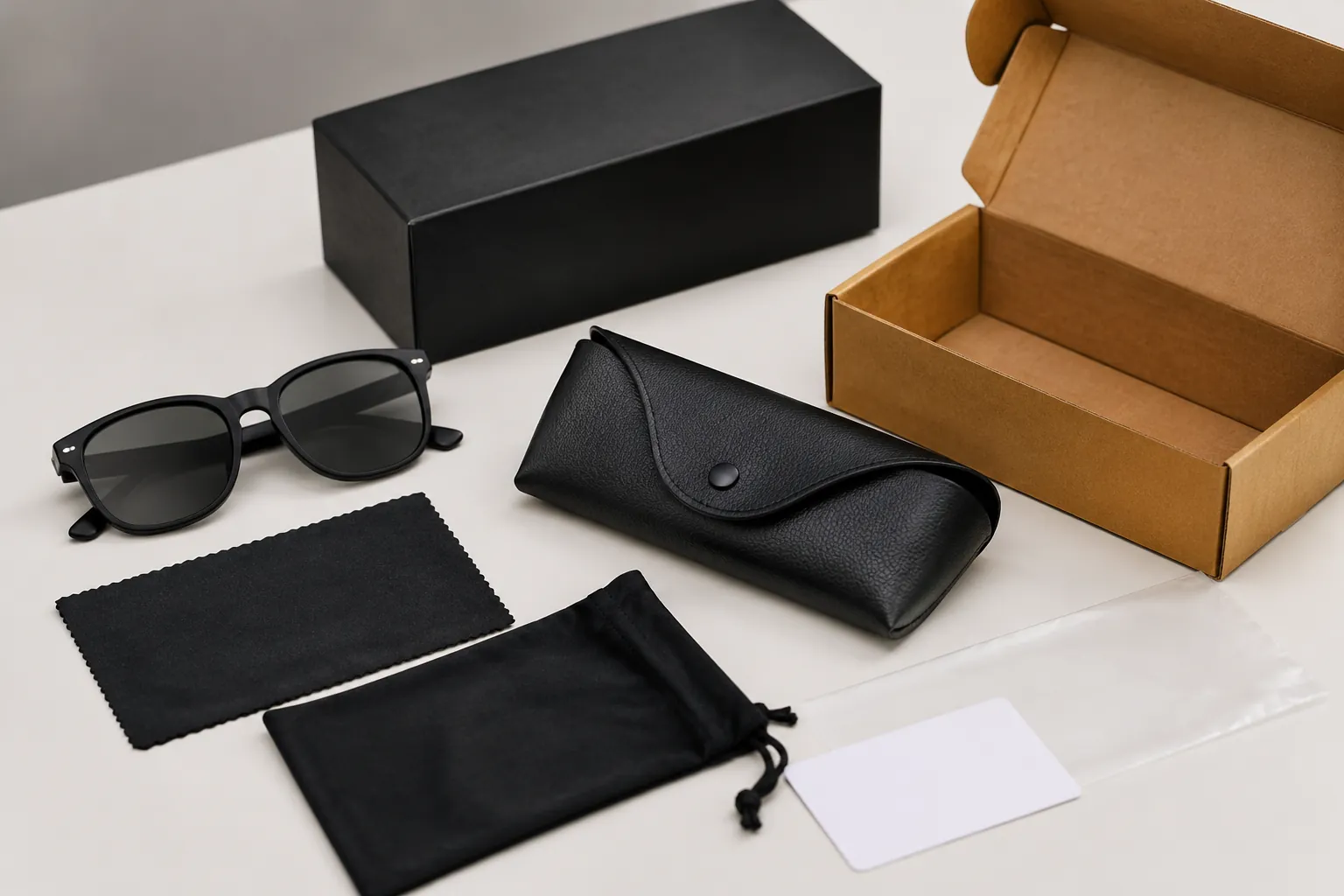
This guide is for brands, importers, distributors, and retailers buying custom sunglasses in volume. Packaging is not a finishing touch. It affects freight cube, handling after import, damage exposure, labeling control, and how fast goods move into retail or e-commerce fulfillment. If you are choosing between factory-finished retail-ready presentation and simpler bulk import packing, compare the full landed process, not just the ex-factory pack charge. The sections below show where each option adds value, where it adds avoidable cost, and what to confirm before you place the PO.
Start with the sales channel, not the package
Many buyers start by pricing the pouch, box, or hang card. Wrong starting point. Choose packaging from the sales channel backward, because the channel determines how many times the product will be handled after import and what the final sale unit must look like.
Retail-ready packing means each pair leaves the factory cleaned, inspected, placed in its final pouch or case, packed in a printed box or on a hanging card if needed, labeled, and packed by SKU into export cartons. Bulk-pack means the sunglasses are packed for safe international transit but not fully merchandised. Common formats include polybag plus partition tray, nested inner boxes, or layered divider packs with final retail components added later.
A simple rule helps: the fewer touches after arrival, the more retail-ready packing tends to make sense. If product will move from receiving to shelf, Amazon prep, or 3PL pick-and-pack with little extra handling, origin packing can cut local labor and presentation mistakes. If you expect market-specific relabeling, mixed assortments, late retailer changes, or distributor repacking, bulk-pack usually gives you more flexibility.
For custom programs, this choice also affects minimums and approvals. A frame style and its packaging components are often sourced and approved on separate timelines. Even when the eyewear MOQ works, custom boxes, sleeves, insert cards, or pouches may have their own production minimums and artwork approvals. Confirm those packaging minimums early. Do not assume they follow the sunglass MOQ.
Head-to-head: cost, labor, damage, and lead time
The better option usually shows up in four places: pack cost, cubic efficiency, warehouse labor, and damage risk. Looking only at the factory packing charge hides the real operating difference.
| Factor | Retail-ready pack | Bulk-pack |
|---|---|---|
| Factory packing materials | Higher: printed box or card, pouch or case, insert, barcode label, tissue or protective bag | Lower: polybag, tray, divider, simple inner carton |
| Carton density | Usually lower because retail presentation takes more space and can reduce pairs per carton | Usually higher when trays and partitions are designed around the frame shape |
| Warehouse labor after import | Lower if barcode, warnings, and importer details are already finalized | Higher if the local team must bag, wipe, ticket, label, box, or assort |
| Damage risk | Often lower when each pair is individually contained and the retail pack is strong enough for export transit | Can be equally safe if tray cells fit correctly; rises if frames rub, shift, or stack under pressure |
| SKU flexibility | Lower; artwork or presentation changes can create rework or obsolete packaging stock | Higher; easier to relabel, bundle, or route by customer after arrival |
| Lead-time impact | Longer when custom packaging components require sourcing, artwork approval, and pack-out control | Shorter packing stage because final presentation steps are reduced or moved downstream |
Separate the frame price from the packaging price. A sunglass program can look competitive at the product level and still turn expensive once custom retail components, extra handling, and lower carton efficiency are added. The reverse is also true. A low ex-factory bulk-pack quote can lose its advantage if the destination warehouse has to do repeated manual prep work.
Lead time follows the same pattern. A basic product sample often moves faster than a full retail pack because packaging artwork, labels, and inserts need separate review. If the job includes custom boxes, EVA cases, multilingual text, foil stamping, or molded inserts, the schedule depends on packaging component approval and delivery as much as sunglass production.
Where retail-ready packing pays off
Retail-ready packing works best when downstream handling is expensive, slow, or tightly controlled. That is common in markets with high warehouse labor costs, strict retailer prep rules, or strong presentation requirements at the point of sale.
- DTC and e-commerce: Each pair arrives cleaned, bagged, boxed, and barcode-ready. A 3PL can scan and ship without adding accessories or reopening units, which helps reduce handling errors.
- Chain retail and gift channels: Shelf presentation needs to be consistent. Barcode position, hang orientation, insert count, and carton assortment are standardized before shipment instead of being assembled locally under time pressure.
- Fixed-date promotional programs: If units must arrive ready for a launch date, origin packing removes one local preparation step before release.
- Higher-finish products: Mirrored lenses, flash coatings, pad-printed logos, and applied logo hardware usually benefit from individual containment because decorative surfaces are less tolerant of friction.
There can also be a QC advantage. When the factory handles final presentation, QC can inspect the completed sale unit rather than only the loose frame. That means checking lens cleanliness, logo orientation, accessory count, barcode readability, label position, and carton assortment before sealing. Useful. Especially when the buyer wants one approved presentation standard applied across the full run.
The trade-off is rigidity. Once retail packaging is printed and packed, changes get expensive fast. If a retailer updates barcode format, importer address, warning text, or assortment instructions after packaging is complete, packed units may need to be opened and reworked locally. At that point, retail-ready packing stops saving time.
Where bulk-pack saves money and trouble
Bulk-pack is often the practical option when presentation changes by customer, region, or season. Importers using one frame across several private-label programs often protect the product in transit first, then finish the sale unit closer to market where labeling and assortment decisions are clearer.
Bulk-pack works especially well in these situations:
- Distributor channels: The customer applies its own labels, bundles, or packaging system.
- Multi-country programs: Language sets, warning text, and importer details vary by destination.
- Style testing: Inventory lands first, and final presentation follows after demand is clearer.
- Price-sensitive retail: Discount channels and wholesale counters may not require premium shelf packaging.
Done well, bulk-pack is engineered packing, not loose packing. Frames should sit in shaped trays or partitioned cells so temples do not press into adjacent lenses. Cell width should match frame front width and fold geometry closely enough to control movement without creating pressure marks in transit. Acetate frames can be sensitive to heat and sustained side load during shipment. Mirrored and coated lenses need separation to prevent abrasion.
Decoration changes the risk profile too. Pad printing can scuff when contact points rub. Laser engraving is usually more stable because the mark is cut into the surface, but any painted infill or surface coating still needs protection. Applied metal logo plates need enough clearance to avoid imprinting adjacent parts during vibration.
The key point is simple: bulk-pack saves money only when tray design, layer count, and carton compression are right. A cheap divider that allows abrasion or shape distortion is not a real saving once claims, returns, or repacking are added back in.
Hidden costs buyers miss on first quotes
Many quote comparisons stop at ex-factory unit price. That misses the cost categories that usually decide the better packaging route.
- Cubic volume: Retail boxes often reduce pack-out efficiency compared with well-designed bulk trays. If the shipment is constrained by cube rather than weight, freight can change materially even when unit pack cost looks close.
- Local labor: Repacking, wiping, barcode application, ticketing, and accessory insertion can add real cost per pair, especially when throughput is low or multiple handling steps are involved.
- Rejection and return exposure: In premium channels, damaged retail packaging can make an otherwise good sunglass unsellable. In bulk-pack programs, the opposite risk is extra local handling that creates presentation inconsistency or missing components.
- Packaging component minimums: Printed cartons, sleeves, EVA cases, and insert cards often have their own minimum order quantities and proofing cycles.
- Approval drag: A product sample may be approved quickly, but packaging can add extra rounds for artwork, barcode checks, market text, and physical mockups.
Ask suppliers for a packaging scenario sheet, not just a product quote. A useful breakdown separates frame and lens cost, decoration cost, retail components, carton pack-out, accessory insertion, barcode application, and any special labor such as mixed assortments or retailer-specific sticker placement.
Then compare two complete scenarios side by side: factory-finished retail-ready and transit-safe bulk-pack with destination finishing. That comparison is far more useful than asking which option is cheaper in general. The answer depends on your channel, labor structure, and compliance workflow.
Compliance and labeling can slow the shipment
Sunglass compliance is driven mainly by product performance, but packaging and labels still affect customs clearance, retailer acceptance, and how smoothly goods move through receiving. A compliant product can still be delayed or rejected if the final sale unit carries the wrong market information.
Depending on destination market and product specification, buyers may work with requirements or references such as CE EN ISO 12312-1, ANSI Z80.3, AS/NZS 1067, and chemical controls such as REACH. Supplier management systems may also include ISO 9001, BSCI, or, where relevant to the business structure involved, FDA registration. None of this should be assumed from a quote. Confirm which standard or system applies to the specific SKU, target market, and documentation set.
Packaging choice changes where those details sit. Retail-ready units may carry barcode, importer name, warnings, care instructions, and country-specific text on the box, hang card, or pouch. Bulk-packed goods may use origin carton identification for transport and receive final sale-unit labeling later in the destination market before retail sale.
Common failures are routine but expensive:
- Carton SKU labels do not match the inner assortment count
- Retail box text approved for one market ships to another market
- Importer details or warning text are missing from the final sale unit
- Lens category or standards references remain on obsolete artwork after a lens specification change
Good process control prevents most of this. Approve the product sample and the packaging mockup as two separate checkpoints. Freeze artwork early. Then approve one packed pre-production sample exactly as it will ship. That step catches barcode placement errors, language mismatches, and missing accessories before the full run is sealed.
How factory packing changes the result
Packaging quality depends on process flow, not just materials. Whether production is vertically integrated or split across multiple suppliers, the issue is control. Every extra handoff creates another chance for scratches, mix-ups, or packaging mismatches.
A typical retail-ready flow looks like this:
- Frame production and assembly
- Lens tinting, coating, and fitting where required by the program
- Decoration such as laser engraving, pad printing, hot foil on packaging, or logo hardware fitting
- Initial QC for alignment, hinge action, finish, tint consistency, and logo position
- Cleaning, protective bagging, and insertion into pouch or case
- Placement into retail box or card set with barcode and inserts
- Final QC on the packed unit, then carton assortment verification before sealing
Bulk-pack flow is shorter because final presentation steps are removed, but packing engineering matters more. Oversized fashion shapes, wrapped sport frames, and thick acetate temples do not behave the same way in transit. Tray depth, partition height, and layer stacking need to fit the actual frame profile. If the tray is too shallow, parts can rotate and create pressure. If coated lenses face rough partitions, abrasion risk rises during vibration.
Ask two direct questions. First: who checks for lens scratches after final packing, not only before? Second: how are mixed-color assortments counted and verified before the master carton is sealed? Clear answers usually signal a controlled process. Vague answers usually predict shipment discrepancies.
Buyer rule: approve one fully packed sample exactly as it will ship. Loose product approval is not enough, because some issues appear only after bagging, insertion, labeling, and carton compression.
A practical checklist for the next PO
If you need a quick answer before quoting both routes, use this checklist.
- Choose retail-ready when shelf speed matters, local labor is costly, artwork and barcode data are already frozen, and each unit will move to consumer or store with little additional handling.
- Choose bulk-pack when labels vary by market, assortments may change after import, presentation is simple, or your distributor will repack anyway.
- Request both quote versions when freight cube is a major cost driver or when your downstream team is unsure whether local finishing will be economical.
- Use a transit-test mindset for mirrored lenses, pad-printed logos, rubberized finishes, and applied logo hardware, because these features are less forgiving of friction and pressure.
- Split channels if needed. One production run can sometimes feed two pack styles: retail-ready for e-commerce and key accounts, bulk-pack for distributors or test markets.
There is no prestige answer here. Only operational fit. The right route is the one that lowers total landed cost without adding rework, compliance mistakes, or shelf delays. If your team cannot forecast final channel mix and labeling with confidence, bulk-pack usually preserves flexibility. If your downstream operation is already stretched, factory-finished retail packs can justify a higher origin cost by removing local handling and reducing avoidable errors.
Have a custom sunglasses project in mind?
Send us your styles, target market and quantities and we will return a detailed quote with MOQ, lead time and a sample plan.
Get a QuoteWhy source this from Wenzhou with LumiShades
Wenzhou in Zhejiang Province is widely regarded as China’s eyewear manufacturing capital, producing a large share of the world’s sunglasses. That concentration matters to buyers: a deep local supply chain for acetate sheet, hinges, lens blanks, plating and packaging means shorter component lead times, easier color and material matching, and a workforce with decades of eyewear-specific skill. LumiShades has manufactured in this ecosystem since 2009, and our vertical integration — in-house injection molding, acetate cutting, CNC milling, lens tinting, decoration and quality control — means no part of your order is quietly subcontracted to a workshop you cannot audit.
For international buyers, that vertical control translates into accountability. When a single factory owns every step, defects are traced and fixed at source rather than bounced between vendors, and your specifications survive intact from first sample to bulk. We back this with 15+ years of experience, shipments to 60+ countries, more than 5 million pairs produced per year and a 98.5% on-time delivery rate. Our certifications — CE EN ISO 12312-1, FDA registration, ANSI Z80.3, AS/NZS 1067, REACH, ISO 9001 and BSCI audit — mean the compliance documentation your market requires already exists. Explore our manufacturing capabilities and quality control process to see how this works in practice.
Frequently asked questions
Does retail-ready packaging always reduce damage rates? No. Retail-ready packaging can reduce handling damage when each pair is individually contained and the export carton is designed for transit, but it is not automatically safer. Ask the supplier to show the packed sample, inner pack method, and master-carton configuration together. Confirm that the retail box or card is not only attractive but strong enough for stacking, vibration, and long-haul shipment. If you use third-party inspection, include checks for lens contact, box crush, accessory fit, and barcode readability on the packed unit.
Can I mix retail-ready and bulk-pack in one production order? Often yes, if the sunglass specification stays the same and quantities by packing style are fixed before production starts. Confirm three points in writing before issuing the PO: the exact units allocated to each pack style, the separate carton markings and SKU counts for each stream, and how accessories and labels will be assigned so nothing is short-packed. Also request one pre-production sample for each packing route, because the same frame can perform differently in different pack formats.
How much lead time should I allow for custom retail packaging? Allow extra time beyond basic sunglass production for packaging artwork, barcode confirmation, packaging material production, and packed-sample approval. The exact timing varies by supplier and packaging complexity, so do not rely on a generic production estimate. Ask for a milestone schedule that separates product sample approval, artwork sign-off, packaging component readiness, pre-production packed sample approval, and final assembly. That gives you a usable critical path instead of one blended lead-time number.
What should be checked on a pre-shipment packaging sample? Check the product and the presentation as one unit. At minimum, verify frame finish, lens scratches, hinge function, logo position, accessory count, barcode scan readability, retail text, importer details, warnings, country-of-origin marking if required by your program, and carton assortment. Then review how the unit sits inside the pouch, case, box, or card and whether parts can move under pressure. The most useful approval sample is one fully packed unit taken from the real packing method, plus photos or details of the inner pack and master carton.
Is bulk-pack acceptable for compliant sunglasses in Europe, the US, and Australia? Yes, bulk-pack can be acceptable if the product itself meets the applicable market requirements and the final sale unit is correctly labeled before retail sale. Packaging choice does not replace compliance with standards such as CE EN ISO 12312-1, ANSI Z80.3, or AS/NZS 1067 where applicable, and it does not remove the need to manage market-specific labeling, importer details, or chemical controls such as REACH where relevant. Before shipping bulk-pack goods, decide exactly when and where final consumer-facing labels will be applied, and assign responsibility for that step in the PO or supply agreement.
Ready to start?
Explore our wayfarer sunglasses or request a quote — our sales team replies within 12 hours.
Request a Quote