
Memory Metal vs Stainless Steel vs Alloy Frames
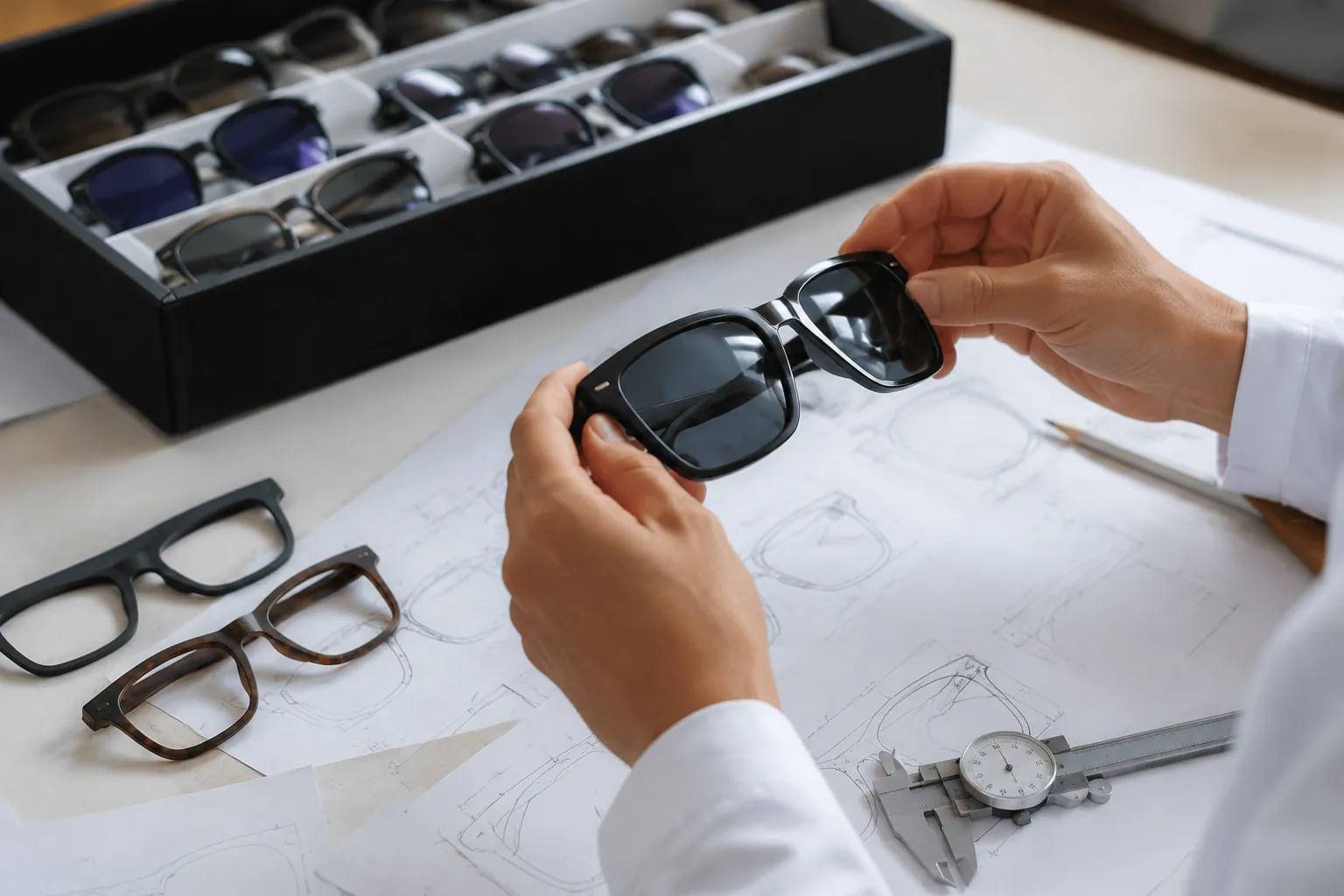
If you source metal sunglass frames for private label, you are not just choosing a look. You are choosing flex, corrosion resistance, weight, finish durability, and what a factory can reliably make at your volume. Get it wrong and the problem shows up later: returns, plating failure, slow production, or a frame that feels cheap on first touch. This guide compares memory metal, stainless steel, and alloy across price bands, MOQ levels, production limits, and real-use performance.
The three metal frame families, plainly explained
Buyers often use these terms loosely. They should not. These materials behave differently in production and in wear.
- Memory metal usually refers to a nickel-titanium alloy, often called nitinol. Its main job is flex and shape recovery after bending. In eyewear, it is most common in temples, bridge elements, and light front-wire structures.
- Stainless steel is the commercial workhorse. It holds shape well, resists corrosion better than many basic alloys, and supports polished, brushed, or PVD finishes. It is common in mid-price and premium-value frames.
- Alloy is the catch-all term. In sunglasses, it often means zinc alloy, copper alloy, or mixed metal used for fronts, temples, bridges, or decorative parts. It is popular for sculpted fashion shapes, but durability depends heavily on the base metal and plating quality.
The sourcing question is not which material is best. It is which one fits your retail target, design brief, and likely abuse case. A frame at $2 FOB and a frame at $6 FOB are not built the same way. They should not be.
Simple rule: memory metal is for recovery and comfort, stainless steel is for balanced commercial performance, and alloy is for cost-driven fashion shapes. If a supplier is vague about the base metal, ask for the actual material spec. Not the marketing label.
How each material behaves in wear and transit
Most buying decisions come down to four things: recovery, stiffness, weight, and finish stability. Failure points also matter. Watch the hinges, nose pad arms, solder joints, and temple tips first.
| Material | Recovery after bending | Corrosion resistance | Feel on face | Typical use |
|---|---|---|---|---|
| Memory metal | High. Can flex repeatedly and spring back, especially at temples and thin bridge components | Good when the surface finish and plating system are controlled | Light, flexible, thin-profile, often more comfortable for long wear | Travel-friendly, comfort-driven frames; flexible temples; kid-friendly or active-use SKUs |
| Stainless steel | Moderate. Holds shape well, but does not bounce back like memory metal | Very good, especially with proper polishing, passivation, and plating | Balanced, clean, not too heavy, usually easy to present as premium value | Core commercial sunglasses, premium-value fashion, optical-inspired frames |
| Alloy | Low to moderate depending on alloy composition and section thickness | Depends heavily on base alloy quality and plating stack | Can feel solid or heavy; works well for bold fashion silhouettes | Decorative fronts, chunky shapes, lower-cost fashion, statement styles |
In transit, memory metal usually handles compression better than brittle decorative alloy. It still needs proper packaging and tray spacing. Stainless steel sits in the middle. It is dimensionally stable, but thin temples can still twist if cartons are overpacked. Alloy can pass incoming inspection and still fail later if the hinge zone was over-polished or the plating stack is too thin.
Before scale-up, ask for a basic wear-test program. Common checks include hinge open-close cycling, a short salt-spray screen where relevant, and a temple flex test. Put the method and pass criteria in writing before bulk production. No assumptions.
Price bands: where each material fits
At volume, theory matters less than landed cost. Material choice affects raw cost, tooling, finishing time, scrap, and QC load.
| Price band | Best-fit material | Why it works | Common risk |
|---|---|---|---|
| Entry: under about $3 FOB | Basic alloy | Lower raw cost, simpler decorative shapes, easier to hit aggressive retail pricing | Corrosion issues, plating wear, heavier feel, higher return risk if finish is weak |
| Mid: about $3 to $5 FOB | Stainless steel or mixed stainless/alloy | Better perceived value and a cleaner durability balance | Overcomplicated structures increase scrap, slow assembly, and raise inspection time |
| Upper mid to premium: $5+ FOB | Memory metal or higher-spec stainless steel | Recovery, comfort, and a more technical value story that can justify margin | Cost rises quickly if tolerances, spring parts, or finishing controls are poor |
Think in total program cost, not material cost alone. A cheap alloy frame can become expensive if plating rejects rise or returns spike in humid markets. Stainless steel often wins on total cost of ownership because the finish is usually more stable. Memory metal costs more up front, but it can cut complaints if flexibility is a real selling point.
Volume changes the math. At 50 pairs per design, factories usually optimize for speed and low risk. At 300 pairs, the economics improve enough to support cleaner stainless builds or one upgraded finish. At 1000+ pairs, tighter process control and deeper QC become easier to justify.
Lead times also move with the spec. Custom hinges, multiple plating colors, and spring components all add time. Treat any sample or bulk timeline as provisional until the final material spec and finish plan are approved.
Factory limits: what can actually be made well
Material choice has to match the factory's real process capability. A good acetate supplier is not automatically a good metal-frame supplier. Different tools. Different risks.
In practical terms, these are the main limits:
- Memory metal needs tight control of wire forming, joining, and spring-back behavior. If the bend radius is too aggressive, the part may look fine in approval and fail later in wear tests. Small dimensional drift can change both feel and recovery.
- Stainless steel works well with CNC detailing, laser cutting, and precise front geometry. It holds crisp lines, but thin sections need careful deburring and edge finishing so the frame does not feel sharp at the bridge, temple tip, or nose pad mount.
- Alloy suits molded decorative fronts, embossed logos, and heavier shapes. But thin walls, long unsupported temples, and weak bridge geometry can lead to warping, mismatch, and alignment issues after polishing or plating.
Ask for real tolerances, not vague promises. Useful checkpoints include bridge width, temple length, lens groove alignment where relevant, and left-right symmetry under hand inspection. On fashion metal frames, small cosmetic drift shows fast under retail lighting.
Decoration adds more limits. Common methods include laser engraving, etching, embossing, enamel fill, pad printing, anodized color effects on compatible parts, and PVD-coated finishes. PVD is often used for dark gunmetal, black, and champagne tones because it can wear better than basic electroplating. Low-cost electroplating can still work for short-run fashion pieces, but adhesion and color consistency need closer QC.
At low MOQ, factories will push simpler builds. That is sensible. A 50-pair run is not the place for complex spring hinges and multiple plated finishes. By 300 pairs, you may have room for one upgraded feature. At 1000+ pairs, one full plating setup and one tighter QC standard become more practical.
Blunt rule: do not ask for premium metal feel at alloy pricing. Something will give. Usually finish life, weight, or lead time.
Corrosion, plating, and compliance: where bad frames fail
Most metal-frame failures are small, not dramatic. Green marks near nose pads. Pitting at the hinge. Dulling at the temple tip. Plating flake after wear in humid weather. That is a material-and-process problem, not just a material problem.
Compliance matters too. Relevant export requirements may include CE EN ISO 12312-1, ANSI Z80.3, AS/NZS 1067, REACH, FDA registration, ISO 9001, and BSCI, depending on market and product class. REACH is especially important for plated parts, adhesives, and decorative coatings. A frame can look fine and still fail later if the chemistry is wrong.
Ask these questions before approval:
- What is the actual base metal: stainless steel grade, nickel-titanium alloy, zinc alloy, or mixed metal?
- What plating stack is used: nickel, palladium, PVD, or standard electroplating?
- What is the coating thickness target, and where is it measured?
- Is there salt-spray testing for coastal, humid, or long-transit markets, and what is the agreed pass criterion?
- How are hinge screws, nose pad arms, and temple tips protected, since those are usually the first failure points?
As a rule, stainless steel gives the best corrosion resistance per dollar. Memory metal can also perform well, but only if the finish system is sound and the joining points are protected. Alloy can work for short-life fashion drops, but expect tighter QC and more returns risk if plating is thin or decorative effects are pushed too far.
If your frames will ship into hot, humid, or coastal channels, ask for sweat resistance and abrasion checks as well. Sample-room performance is not enough.
Recovery vs perceived value: what customers notice first
Customers notice three things quickly: weight, flex, and finish. Memory metal scores well on flex. Stainless steel scores well on clean lines and a refined look. Alloy often wins on sculpted shapes and a heavier, more substantial feel. Some retail buyers still like that first-touch weight.
But perception flips fast. If the frame feels nose-heavy or the plating looks cheap, the effect is gone. A thick alloy frame with bright gold plating may look expensive in a tray and feel wrong on the face. Stainless steel is usually the safer repeat-purchase option because it tends to be more predictable in wear. Memory metal works best when the sales story is comfort, travel, kid-friendly recovery, or active use.
Weight targets matter, but they are a design brief, not a guarantee. Total frame weight depends on lens size, geometry, hinge design, temple build, and nose pad hardware. Large or decorative metal frames can weigh more and still make sense if the style supports it. If the design claims comfort, extra weight becomes a problem.
Practical buying note: If your pitch is "flexible and durable," use memory metal or a proper stainless spring component. If your pitch is "fashion metal with crisp lines," stainless steel is usually the cleaner choice.
What to order by volume: 50, 300, 1000, and 5000+ pairs
The right material changes with volume because setup cost, scrap, and QC labor do not scale evenly.
- 50 pairs/design: choose the simplest construction that delivers the target look. Basic alloy or straightforward stainless steel is usually safest. Avoid too many custom finishes, mixed metals, or multi-stage plating.
- 300 pairs: this is where stainless steel starts to make more sense for stable quality. You can also add one premium finish, one custom logo method, or one flexible element if the design stays disciplined.
- 1000 pairs: memory metal becomes more workable if you want a recovery-driven selling point. You have enough volume to justify better process control, more detailed QC, and more sample iteration.
- 5000+ pairs: this is where material optimization pays off hard. A small drop in scrap, rejects, or rework can matter more than a small raw-material saving. At this level, you can negotiate better finishing consistency and tighter packaging controls.
MOQ logic matters. At 50 pairs, you are paying for setup and factory attention more than scale. At 300 pairs, material yield improves. At 1000+, you are buying process stability. That is why a design that barely works at 50 can become a strong-margin SKU later if the build is simple enough to scale.
For highly customized programs, the limit is often not the raw material. It is the process count: cutting, forming, joining, polishing, plating, color matching, assembly, and final inspection. Every added step creates one more chance for the approved sample and bulk run to drift apart.
A buyer's decision path that saves time
Use material choice to narrow the design. Do not do it the other way around. That cuts revision loops and gives suppliers a fair shot at accurate quoting.
- Set the retail target. If you need low-ticket fashion, alloy may be enough. If you need a stronger durability story, move to stainless steel or memory metal.
- Define the abuse case. Travel retail, kids, sports, and high-return channels need better recovery and stronger finish resistance. Static fashion display lines do not.
- Check MOQ and SKU mix. At 50 pairs, keep the structure simple. At 1000+, more technical metal work and more decoration options start to make sense.
- Approve the finish system. Base metal and plating are linked. This is where many programs fail, especially at hinge zones and nose pad arms.
- Test before scale. Ask for sample handling, open-close cycles, abrasion checks, and corrosion checks that match your market.
If you are unsure, start with stainless steel for the core line. It is the safest middle ground on durability, appearance, and manufacturability. Use memory metal for a hero SKU, not the whole range, unless flexibility is central to the retail story. Use alloy where price is the main lever and you can accept shorter product life.
That is the honest hierarchy: memory metal is best for recovery, stainless steel is best for balanced commercial risk, and alloy is best for cost-driven fashion if plating is controlled and expectations are realistic.
Have a custom sunglasses project in mind?
Send us your styles, target market and quantities and we will return a detailed quote with MOQ, lead time and a sample plan.
Get a QuoteWhy source this from Wenzhou with LumiShades
Wenzhou in Zhejiang Province is widely regarded as China’s eyewear manufacturing capital, producing a large share of the world’s sunglasses. That concentration matters to buyers: a deep local supply chain for acetate sheet, hinges, lens blanks, plating and packaging means shorter component lead times, easier color and material matching, and a workforce with decades of eyewear-specific skill. LumiShades has manufactured in this ecosystem since 2009, and our vertical integration — in-house injection molding, acetate cutting, CNC milling, lens tinting, decoration and quality control — means no part of your order is quietly subcontracted to a workshop you cannot audit.
For international buyers, that vertical control translates into accountability. When a single factory owns every step, defects are traced and fixed at source rather than bounced between vendors, and your specifications survive intact from first sample to bulk. We back this with 15+ years of experience, shipments to 60+ countries, more than 5 million pairs produced per year and a 98.5% on-time delivery rate. Our certifications — CE EN ISO 12312-1, FDA registration, ANSI Z80.3, AS/NZS 1067, REACH, ISO 9001 and BSCI audit — mean the compliance documentation your market requires already exists. Explore our manufacturing capabilities and quality control process to see how this works in practice.
Frequently asked questions
Which metal frame is best for humid or coastal markets? Stainless steel is usually the safest choice because it offers strong corrosion resistance when the surface finish and plating are well controlled. Memory metal can also work if the supplier manages the finish system and protects the joining points. Basic alloy is the riskiest option in corrosion-heavy environments, so use it only if the price target demands it and plating QC is strict.
Can I order memory metal sunglasses at 50 pairs per design? Yes, but keep the construction simple and confirm that the supplier has made similar memory-metal frames before. At that MOQ, avoid complex spring assemblies, multiple finish combinations, and heavily customized hinges. Ask for a sample plan, finish approval, and a written tolerance check before placing bulk production.
Which material gives the best perceived value at retail? For most mainstream buyers, stainless steel gives the best balance of look, durability, and price. Memory metal sells best when flexibility is part of the product story, such as travel, comfort, or kid-friendly use. Alloy can look substantial on display, but customers notice poor plating, sharp edges, and heavy nose feel quickly.
What certifications matter for metal sunglasses? Use the certifications and compliance documents that apply to your market and product class. Common references include CE EN ISO 12312-1, ANSI Z80.3, AS/NZS 1067, REACH, FDA registration, ISO 9001, and BSCI. Ask the supplier for current test reports or factory documents, and do not assume a good-looking sample is automatically compliant.
How should I choose between stainless steel and alloy for a mid-price private label line? Choose stainless steel if you want better corrosion resistance, more stable finish quality, and a cleaner retail presentation. Choose alloy if lower cost and decorative shaping matter more than long-term finish stability. If you pick alloy, allow extra time for plating approval, wear testing, and close inspection of hinges, nose pad arms, and temple tips.
Ready to start?
Explore our sport wrap sunglasses or request a quote — our sales team replies within 12 hours.
Request a Quote