
Kids Sunglasses OEM Guide for Importers
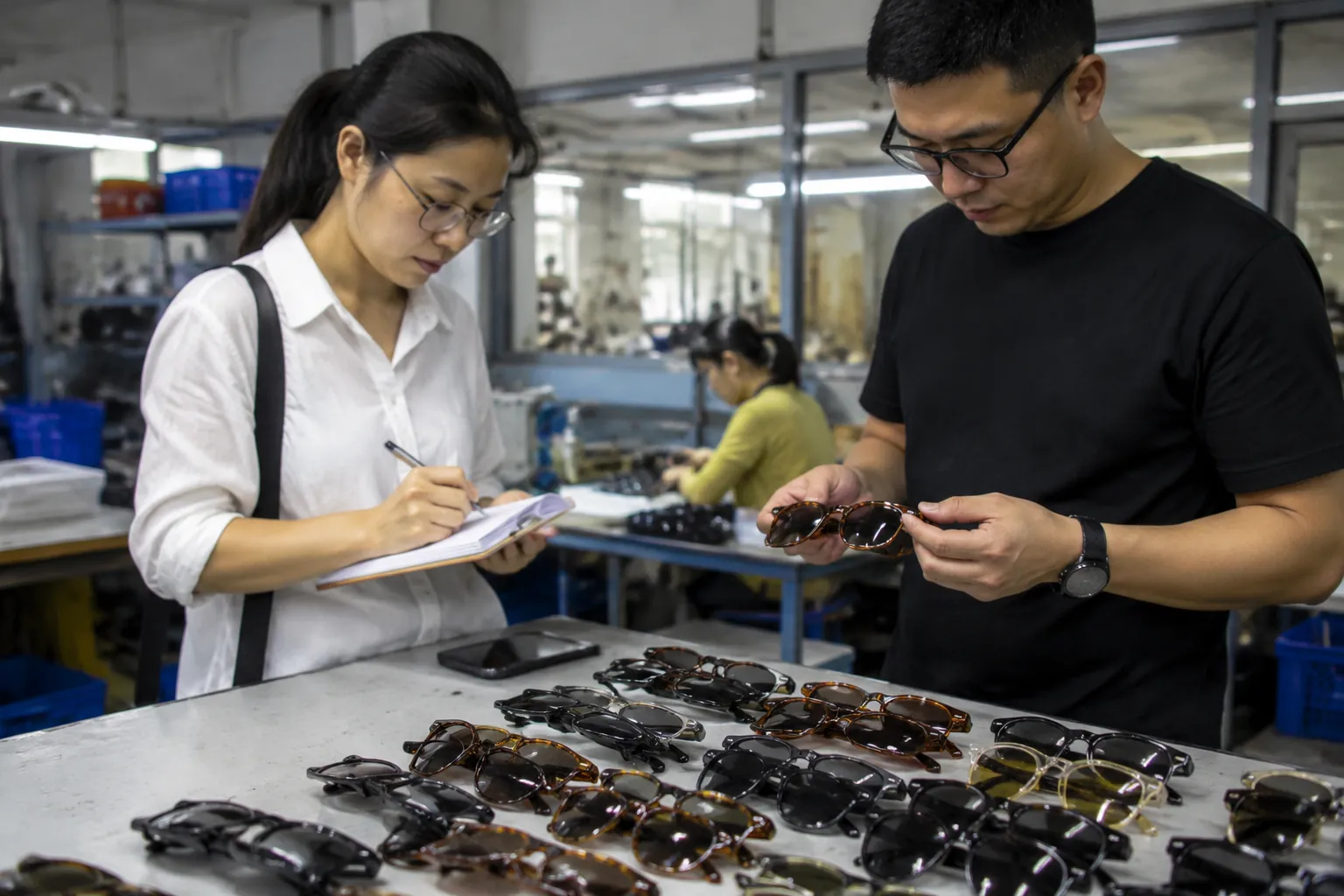
This guide is for importers, retailers, distributors, and eyewear brands developing private-label kids sunglasses. Children's sunglasses are not small adult frames. Fit is less forgiving. Handling is rougher. Detachable parts, sharp edges, lens retention, and label claims all need tighter control. A good OEM brief defines sizing, frame material, lens performance, decoration, packaging, testing, and QC before production starts. That prevents avoidable re-sampling, failed inspections, label errors, and shipment delays.
Start With Buyer Risk, Not the Frame Sketch
Kids sunglasses can look simple on a line sheet. They are not simple in use. A child may bend the temples with both hands, chew temple tips, drop the frame, twist the front while removing it, or push the lenses from the inside. Small errors in bridge width, hinge tension, lens groove depth, screw control, or edge finishing can turn into returns, complaints, or inspection failures.
Start with the risk file. Define the age band, destination market, applicable standard, lens category, frame material, hinge type, decoration method, packaging, barcode requirements, and required test documents before artwork begins. Do not send only a logo file and ask for "kids size." That usually creates three problems: the sample does not fit the target user, the packaging claim does not match the tested product, and approvals restart after materials or packaging have already been prepared.
For kids programs, process control matters. A 1 mm bridge change can decide whether the frame slides down the nose. A loose lens groove can cause lens popping when the front flexes. A decorative plate that looks premium on a sample can become a detachment or sharp-edge risk if the fixing method is weak.
LumiShades manufactures in Wenzhou, Zhejiang, with in-house processes including injection molding, acetate cutting, CNC milling, lens tinting, laser engraving, pad printing, metal logo plate fitting, assembly, and QC. For first validation, low-volume orders from 50 pairs per design may be possible when suitable existing molds, materials, and decoration methods are available. This can work for buyer presentations, photography, online tests, or limited retail trials.
Unit price usually improves at higher quantities such as 300, 1000, and 5000+ pairs per design. Material purchasing, lens processing, decoration setup, and packaging setup become more efficient. Final pricing must be quoted against the confirmed material, lens type, hinge, logo process, packaging, testing, and inspection requirements. Samples from existing molds typically take about 7-10 days after specification confirmation. Bulk production commonly takes about 25-35 days after sample approval, packaging approval, deposit, and final specification lock, depending on order complexity and factory capacity.
Child Sizing: Age Labels Are Not a Spec
Retail age labels such as 3-6 or 7-12 help with shelf planning. They are not accurate enough for production. Children's head width varies by market, growth stage, and face shape. A frame that fits one five-year-old may squeeze another child's temples or slide down the nose. The factory needs dimensions, not guesses.
The key dimensions are frame front width, lens width, bridge width, temple length, temple opening, pantoscopic angle, and frame weight. For younger children, bridge fit and temple grip often decide comfort more than the printed age range. A bridge that is slightly too wide can make the frame unstable. A temple that is too short can create pressure behind the ear. A frame that is too heavy may slide during play even when the front width looks correct.
| Retail age band | Common frame front range | Temple length range | Typical weight target | Buyer control point |
|---|---|---|---|---|
| 2-4 years | 105-115 mm | 105-115 mm | 14-20 g | Use rounded edges, soft curves, light materials, and avoid detachable trims. |
| 4-7 years | 115-125 mm | 115-125 mm | 16-24 g | Good range for flexible TR-type or light PC frames with controlled hinge tension. |
| 7-10 years | 125-132 mm | 125-130 mm | 18-28 g | More style options are possible, but nose fit and lens retention still need testing. |
| 10-13 years | 132-138 mm | 130-135 mm | 20-32 g | Close to small adult sizing, but adult tooling should not be assumed suitable. |
Use these ranges for planning only. They are not universal fit guarantees. Before bulk production, ask the factory to measure approved samples with calipers and record tolerances on the specification sheet. For stable molded plastic frames, a practical production tolerance is often around ±1.0 mm on frame front width and temple length. Some designs need tighter control. Bridge width is more sensitive; a target of about ±0.5-0.8 mm may be appropriate when tooling and material behavior allow.
Lens size also needs discipline. If the lens is too small for the groove, it may rattle or pop out. If it is too large, assembly can stress the frame and cause warpage. Do not leave this to final inspection.
For final QC, inspect more than printed dimensions. Open and close the temples. Place the frame on a flat surface. Check symmetry, hinge feel, lens seating, and comparison against the sealed golden sample. Temple opening angle and hinge resistance often reveal problems before cartons leave the factory.
Frame Materials: Cost, Behavior, and Safety Risk
The cheapest material on a quote sheet is not always the lowest-risk option. Kids bend frames, sit on them, drop them in sand, and pull them open unevenly. The material and construction must handle normal use without sharp edges, cracked fronts, loose lenses, or small detachable parts.
- PC injection frames: Polycarbonate frames are light, economical, and suitable for many promotional or entry retail programs. They mold well and support bright colors. Main risks include brittleness from poor material selection, thin wall sections, poor processing, or rough finishing. Ask for smooth edges, consistent color, and drop or flex checks suitable for the design.
- TR90 or similar flexible nylon frames: These materials offer better flexibility and recovery than many rigid plastics. They often suit active kids and sports-inspired styles. Cost is usually higher than basic PC, but the frame may handle bending better if hinge fit and lens groove design are correct.
- Acetate frames: Acetate gives deeper color effects and a more premium retail appearance. It is usually heavier and less flexible than many injection materials, so it is often better for older youth ranges than toddlers. Acetate requires careful polishing around the nose area, brow, edges, and temple tips.
- Metal frames: Metal is usually not the first choice for young children. Screws, nose pads, pad arms, solder points, and thin rims all add inspection points. If metal is used, control material requirements, screw torque, pad attachment, rim security, and sharp-edge finishing.
Match material selection to the age band, retail channel, target price, and required claims. A beach gift shop may need a simple PC UV-protective style with basic packaging. A specialty children's retailer may accept a higher frame cost for a more flexible material and better finishing. A fashion brand targeting older youth may choose acetate for appearance, but should confirm weight, nose fit, and temple comfort before committing.
For molded kids frames, check wall thickness around the bridge, end pieces, hinge areas, and lens groove. Thin bridge areas can crack. Thick areas can shrink or warp after molding. Flashing is another common risk. Sharp flashing near the nose, brow, temple tips, lens rim, or hinge is a functional defect. Treat it that way.
Decoration: Good Branding Without Loose Parts
Branding matters, but children's sunglasses should not carry decoration that creates avoidable safety or QC risk. The right method depends on frame material, order quantity, logo color, artwork detail, surface texture, and age band.
| Decoration method | Best use | Typical risk | QC check |
|---|---|---|---|
| Pad printing | Simple one- or two-color logos on PC, TR-type materials, or suitable coated surfaces | Poor adhesion, smearing, color variation, weak curing | Rub test, tape test, curing check, color comparison to approved sample |
| Laser engraving | Clean, durable branding on suitable plastic or metal parts | Low contrast on some colors, inconsistent depth, heat marks | Position check, depth check, readability check, comparison to golden sample |
| Metal logo plate | Premium youth or fashion ranges where the trim is justified | Detachment, sharp edges, inconsistent placement, corrosion or coating issues | Pull check, edge check, alignment check, fixing-method review |
| Heat transfer or decal | Colorful graphics or multi-color decorative effects | Peeling, scratching, poor abrasion resistance, artwork/claim mismatch | Adhesion check, scratch check, artwork approval against packaging and label claims |
For younger children, laser engraving or controlled pad printing is usually easier to manage than glued trims. If a metal logo plate is required, it should be smoothly finished, securely fixed, and free of raised sharp corners. The factory should confirm whether it is fixed by adhesive, mechanical pin, heat setting, or a combined method. Buyers should request a basic pull check during sampling and final inspection, with acceptance criteria agreed before production.
Logo placement needs control too. On small temples, a logo shifted by 2-3 mm can look careless or interfere with temple flex. Use an approved artwork file with logo size, position from hinge or temple tip, color reference, and finish. Golden samples should show the exact logo scale and placement, not just the frame shape.
Lenses: UV Protection Is Non-Negotiable
The lens carries the main performance claim. A dark lens is not the same as a UV-protective lens. Require UV protection documentation. Then make sure the shipped lens material, tint, coating, and category match the approved and tested specification.
Common OEM lens choices include PC lenses, TAC polarized lenses, and standard tinted non-polarized lenses. PC lenses are often used for children's sunglasses because they are light and have good impact resistance for normal sunglass use. TAC polarized lenses reduce glare and work well for beach, water, snow, fishing, outdoor retail concepts, and some sport-inspired lines. They also add cost and require polarization orientation checks. Basic tinted lenses can meet entry price points, but they still need UV and visible light transmission testing for the relevant market claim.
Specify the visible light transmission category for the destination market. Very light lenses may not provide the expected glare reduction. Very dark lenses may be unsuitable for certain uses and must be labeled correctly. If the program includes six lens colors, do not assume one test report covers every color. Grey, brown, green, blue mirror, pink gradient, and smoke lenses can have different visible light transmission values. Verify them.
Relevant standards may include CE EN ISO 12312-1 for sunglasses sold in applicable markets, ANSI Z80.3 for non-prescription sunglasses in the United States, and AS/NZS 1067 for Australia and New Zealand. Material and chemical documentation may also include REACH where applicable. FDA registration may be relevant for companies placing sunglasses into the U.S. market, depending on the role of the manufacturer, importer, and product classification.
LumiShades can support production and documentation requests related to CE EN ISO 12312-1, ANSI Z80.3, AS/NZS 1067, REACH, FDA registration, ISO 9001, and BSCI where applicable to the order and selling market. Buyers should request documents that match the product type, destination market, and label claims.
Lens QC should include UV blocking, visible light transmission, tint consistency, surface scratches, optical distortion, lens retention, polarization alignment if applicable, and warpage. For lens retention, check whether lenses stay seated when the frame is flexed and when reasonable pressure is applied from the inside. Lens popping is commonly linked to shallow groove design, incorrect lens size, frame shrinkage, or inconsistent assembly pressure.
Compliance, Labels, and Packaging Control
Compliance is shared work. The factory can manufacture, inspect, and arrange testing. The importer is responsible for placing the product on the target market with correct labels, warnings, importer details, language, and retail claims.
A children's sunglasses file should include the approved sample, bill of materials, lens specification, test reports, packaging artwork, instruction text, inspection records, and retained samples from the shipped batch. Keep the file clean. You may need it later.
For the EU, buyers commonly check CE EN ISO 12312-1 performance alignment and REACH requirements where applicable. For the United States, ANSI Z80.3 is commonly requested for non-prescription sunglasses, and FDA registration may be relevant depending on the company's role and the product. For Australia and New Zealand, AS/NZS 1067 is relevant. The product, lens category, label wording, and test report must agree.
Labels should state intended use clearly. Do not imply industrial impact protection, sports eye protection, prescription performance, medical benefit, or absolute safety unless the product is specifically designed, tested, and labeled for that claim. "UV400" should be supported by actual lens performance. If the sunglasses are not toys, avoid toy-like packaging claims that may trigger extra regulatory review or confuse the product category.
- Confirm the destination market before sampling.
- Identify the applicable standard: CE EN ISO 12312-1, ANSI Z80.3, AS/NZS 1067, or a required combination.
- Lock lens material, tint color, mirror coating, polarization, and category before testing.
- Approve label wording, language, barcode, warnings, importer details, and country-specific information before mass packaging.
- Keep retained samples from the tested batch and the shipped batch, with batch references where possible.
Blunt buyer rule: never test one black lens and then ship several lens colors without checking whether each color still supports the claimed UV protection and lens category.
MOQ, Cost, and Lead-Time Logic
Kids sunglasses often have lower retail price targets than adult fashion frames. That does not remove the need for controlled materials, correct lenses, safe finishing, accurate labels, and protective packaging. Cost is driven by mold status, frame material, lens type, hinge structure, decoration method, packaging, testing, inspection level, and order size.
Existing molds are usually the fastest and lowest-risk route for first orders. New tooling should be used only when the buyer has a clear retail reason: unique fit, exclusive design, licensed shape, or long-term program volume. For many importers, the better first order is an existing kids mold with custom color, lens, logo, and packaging. Prove fit and sell-through before paying for private tooling.
| Order stage | Typical quantity | Use case | Lead-time and cost logic |
|---|---|---|---|
| Validation run | 50 pairs/design may be possible with available molds | Photography, buyer presentation, online test, small retailer review | Samples from existing molds are typically 7-10 days after specification confirmation; unit cost is higher because setup and material efficiency are limited. |
| Small retail launch | 300+ pairs/design | First store drop or limited online launch | Better decoration and packaging efficiency; bulk production is commonly 25-35 days after approvals for existing molds. |
| Importer program | 1000+ pairs/design | Multiple colors and carton planning for distribution | More efficient lens processing, color batching, production scheduling, and carton planning. |
| Volume program | 5000+ pairs/design | Chain retail, seasonal campaign, promotional program | Best suited to negotiated component purchasing, stable production planning, and more efficient packaging setup; final price depends on confirmed specification. |
Packaging can quietly raise landed cost. A microfiber pouch, printed retail card, hang tag, barcode sticker, instruction sheet, polybag, and retail box all require artwork control, materials, and packing labor. For children's products, packaging should be accurate, clean, and strong enough to protect lenses from scratches during transport.
Lead time is not only production time. Add time for artwork correction, pre-production sample approval, testing, packaging proofing, carton mark approval, inspection booking, and freight planning. If new tooling is required, add tool design, mold making, trial injection, adjustment, and re-sampling before the normal production clock begins.
Sampling and QC: Where Kids Sunglasses Fail
Most kids sunglasses failures can be caught early. The common mistake is approving a good-looking sample and skipping fit, lens, and durability checks. That gets expensive later. Children's sunglasses often fail in practical use, not in photos.
A proper sample review should include controlled hand-flex checks, child fit feedback if available, hinge opening and closing, lens push testing, logo rub testing, color comparison, frame weight, bridge comfort, temple pressure, packaging review, and barcode scanning. If the product has polarized lenses, check several pieces with a polarization tester or a simple LCD-screen method. If the temples are printed, rub the logo. If a logo plate is attached, pull it and check for sharp edges.
- Lens too loose: Usually caused by poor groove depth, frame shrinkage, or lens size tolerance. Fix it before production, not during final inspection.
- Temple screws backing out: Requires torque control, screw quality review, thread-locking process, or hinge redesign.
- Sharp flashing: Common on poor injection finishing. It must be trimmed and inspected, especially near the nose, brow, hinge, lens rim, and temple tips.
- Uneven tint: Caused by lens process variation or mixed batches. Check color under consistent lighting and compare against the approved lens sample.
- Logo print falling off: Usually caused by ink selection, surface treatment, curing, or handling problems. Require adhesion checks before bulk.
- Packaging mismatch: Often caused by late artwork changes. Compare barcode, lens category, warnings, color name, importer details, and market language before packing starts.
LumiShades' in-house molding, lens tinting, decoration, assembly, and QC help reduce handoff risk because key processes stay in one production flow. Still, buyers should request a pre-production sample after final material, color, lens, and packaging approval. Golden samples should be sealed, labeled, photographed, and kept by both buyer and factory. During final inspection, compare production pieces against those golden samples for fit, finish, lens color, logo placement, lens retention, and packaging accuracy.
Have a custom sunglasses project in mind?
Send us your styles, target market and quantities and we will return a detailed quote with MOQ, lead time and a sample plan.
Get a QuoteWhy source this from Wenzhou with LumiShades
Wenzhou in Zhejiang Province is widely regarded as China’s eyewear manufacturing capital, producing a large share of the world’s sunglasses. That concentration matters to buyers: a deep local supply chain for acetate sheet, hinges, lens blanks, plating and packaging means shorter component lead times, easier color and material matching, and a workforce with decades of eyewear-specific skill. LumiShades has manufactured in this ecosystem since 2009, and our vertical integration — in-house injection molding, acetate cutting, CNC milling, lens tinting, decoration and quality control — means no part of your order is quietly subcontracted to a workshop you cannot audit.
For international buyers, that vertical control translates into accountability. When a single factory owns every step, defects are traced and fixed at source rather than bounced between vendors, and your specifications survive intact from first sample to bulk. We back this with 15+ years of experience, shipments to 60+ countries, more than 5 million pairs produced per year and a 98.5% on-time delivery rate. Our certifications — CE EN ISO 12312-1, FDA registration, ANSI Z80.3, AS/NZS 1067, REACH, ISO 9001 and BSCI audit — mean the compliance documentation your market requires already exists. Explore our manufacturing capabilities and quality control process to see how this works in practice.
Frequently asked questions
Can we sell the same kids sunglasses in the EU, US, and Australia? Possibly, but do not assume one label and one test file are enough. Before ordering, list the destination countries and ask the factory or test lab to confirm the required standard and label content for each market. CE EN ISO 12312-1 is relevant for applicable EU sunglasses programs, ANSI Z80.3 is commonly used for non-prescription sunglasses in the United States, and AS/NZS 1067 is relevant for Australia and New Zealand. The lens category, UV claim, warning text, importer details, and language on the packaging must match the product and test documentation.
Is 50 pairs enough for a real kids sunglasses launch? Usually no. It is enough for sampling, photography, buyer presentations, influencer seeding, small online tests, or limited retail validation when existing molds are used. It is not ideal for a full retail launch if you need the best unit cost, stable packaging setup, multiple colorways, or formal distribution planning. For a commercial launch, ask for quotes at 300, 1000, and 5000+ pairs per design so you can compare price, lead time, packaging efficiency, and inspection cost.
Should kids sunglasses always be polarized? No. Polarized lenses reduce glare from surfaces such as water, snow, roads, and sand, but they add cost and require orientation checks during QC. For many general children's retail lines, non-polarized PC lenses with verified UV protection and correct visible light transmission may be suitable. Choose polarized lenses when glare reduction is part of the product positioning. Then make sure the packaging claim, lens test, and inspection checklist all include polarization.
What is the biggest compliance mistake buyers make with youth eyewear? The biggest mistake is changing the shipped product after testing. Common changes include switching lens color, adding a mirror coating, changing lens material, changing the supplier, modifying packaging claims, or using one test report for multiple unverified variants. Treat the tested sample as the control version. If any lens, coating, material, or claim changes, ask whether additional testing or documentation is required before shipment.
How long should we plan from sample request to bulk shipment? For existing molds, plan about 7-10 days for samples after the specification is clear, then about 25-35 days for bulk production after sample approval, packaging approval, deposit, and final specification lock. Add time for artwork correction, test booking and reporting, packaging proof approval, carton mark approval, inspection booking, and freight planning. If new tooling is required, add mold design, mold making, trial injection, adjustment, and re-sampling before normal production timing begins.
Are metal logo plates safe on kids sunglasses? They can be used, but they add risks that must be controlled. Before approving a metal logo plate, confirm the fixing method, check for sharp edges, run a pull check, and inspect alignment on several samples. For younger children, laser engraving or pad printing is often easier to control because there is no separate trim piece that can detach. If a metal plate is required for brand positioning, include plate attachment and edge finishing in the QC checklist.
Ready to start?
Explore our square sunglasses or request a quote — our sales team replies within 12 hours.
Request a Quote