
Sunglasses Injection Tooling: Cost, Lead Time, ROI
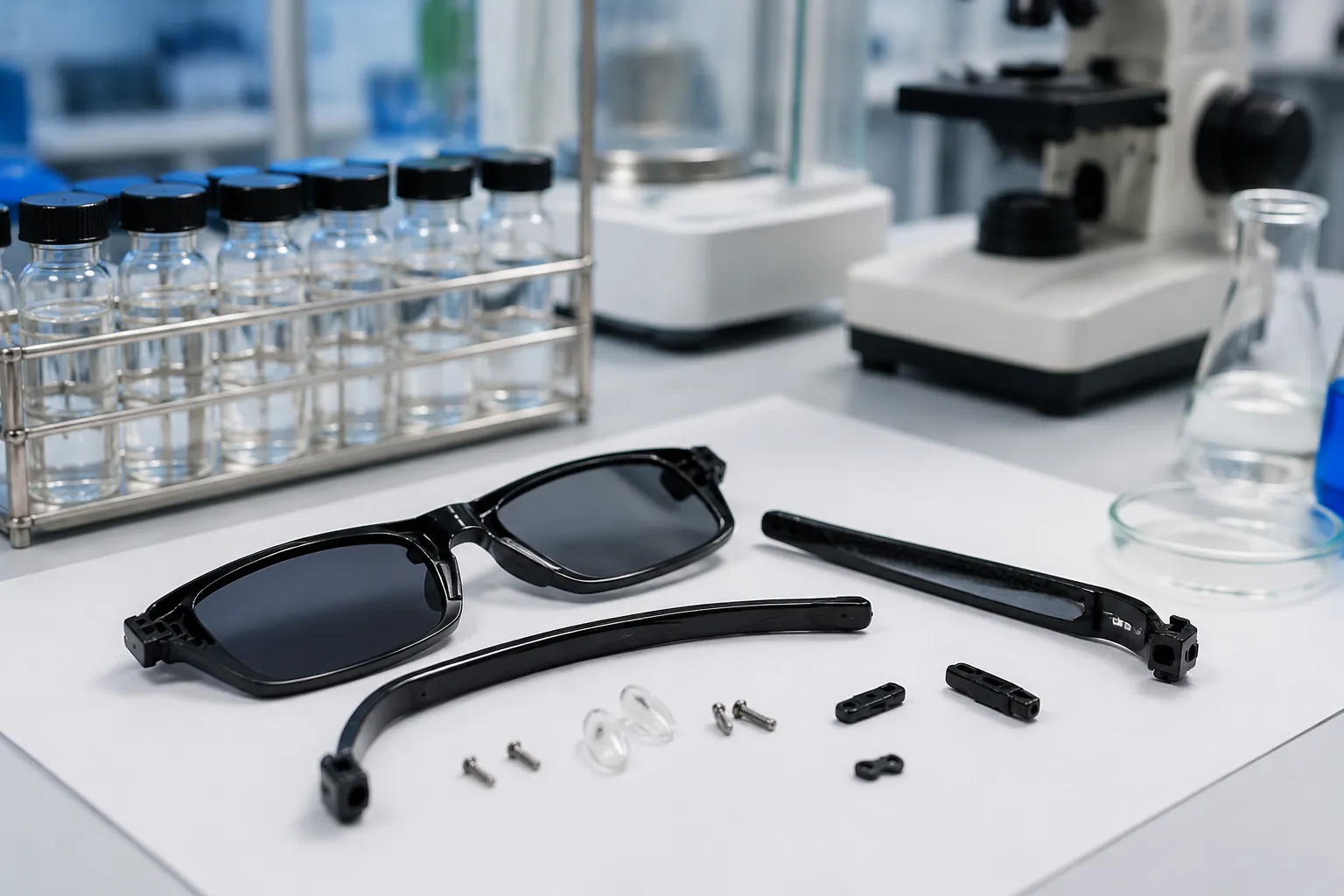
This guide is for brand owners, importers, distributors, and retail buyers facing a real sourcing choice: pay for new injection tooling or launch from a stock frame and customize it. The wrong call ties up cash, delays launch, and leaves you funding a shape that never earns repeat orders. The right call depends on volume, geometry, development risk, compliance, and whether exclusivity will actually pay back. Use the framework below to judge the decision on facts, not instinct.
Start with the business requirement, not the sketch
Many buyers start with appearance and ask for tooling too early. Start with the commercial need instead: do you need a new frame geometry, or do you need your brand on a proven frame that already fits your market?
If your brief is mostly color, logo, lens tint, packaging, or a small hardware change, a stock model is often the better first move. It lowers development risk because the frame geometry, assembly method, and lens fit already exist. It also lets you test demand before paying for steel.
That matters because early eyewear programs usually fail for commercial reasons, not technical ones. A brand testing e-commerce, boutique retail, or a seasonal drop often gets more value from speed and lower exposure than from mold ownership on day one.
New tooling starts to make sense when the business case depends on shape or construction. Common examples include:
- Sport wrap geometry with a front curve a stock fashion frame cannot deliver.
- Bridge fit changes for a specific wearer profile, where small dimensional shifts affect comfort and sell-through.
- Thicker or wider temples to support inlaid logo hardware or a signature side profile.
- Exclusive silhouette that you do not want sold to competing importers or retailers.
Be realistic about forecast. If you are testing the market with one modest opening order, tooling is usually a poor use of cash. If you expect stable reorders over multiple seasons, need design control, and can spread development cost over real volume, then tooling deserves a serious look.
Three sourcing paths compared: cost, MOQ, timing, and risk
| Option | Typical upfront cost | Typical MOQ | Sample lead time | Bulk lead time | Best use case | Main trade-off |
|---|---|---|---|---|---|---|
| Stock frame + private label | Low; usually sample, logo, and packaging charges only | Supplier-dependent; often lower than full custom programs | Usually shorter than custom tooling because no new mold is required | Typically standard production lead time after approval | Fast launch, market testing, promotional programs, lower-risk retail trial | Shape is generally non-exclusive |
| Stock frame + minor modification | Low to medium; decoration, lens upgrade, hardware, or packaging can add cost | Supplier-dependent; often higher than unchanged stock but lower than full custom tooling | Usually shorter than full custom if geometry stays unchanged | Typically close to standard production timing, depending on modification | Private label with stronger brand identity but no new frame geometry | Fit and core frame geometry remain limited |
| New injection mold | Highest; tooling, trials, corrections, and approval rounds required | Usually best justified when repeat volume is expected | Longest; includes DFM, toolmaking, trial molding, correction, and approval | Standard production timing starts only after tool approval | Exclusive shape, repeat volume, tighter long-term design control | More cash, more development time, more technical risk |
Do not compare these options on ex-factory unit price alone. That is too narrow. A stock frame may cost more per pair than a mature custom program and still be the better commercial choice because it avoids tooling cost and reaches market sooner.
The reverse can also be true. If a custom frame cuts long-run unit cost, improves fit, or creates exclusivity you can monetize, the economics may favor tooling. The real question is simple: can your reorder pattern repay the upfront spend in a useful timeframe?
What you are actually paying for in a new sunglasses mold
Tooling is not one line item. It is a chain of engineering choices that affect cost, correction risk, cycle stability, and part consistency. A typical injected sunglass frame includes at least a front and two temples. Depending on the design, you may also pay for inserts, hinge-seat features, or secondary fixtures for trimming, assembly, or decoration.
Main cost drivers include:
- Part count: front and temples are commonly separate mold components or cavities.
- Material choice: polycarbonate, nylon-based materials, and other injected plastics shrink, flow, and polish differently.
- Cavity count: single-cavity tooling can reduce initial spend; multi-cavity tooling supports more output but usually costs more upfront.
- Surface finish: high-gloss polish, texture, or paint-ready cosmetic finish requires extra tool work.
- Tolerance demands: hinge alignment, lens groove accuracy, and left-right symmetry increase machining and correction demands.
- Revision risk: weak DFM work often leads to more trial and correction rounds.
In eyewear, small dimensional errors cause obvious problems. Fast. A lens groove that is off by a fraction of a millimeter can change insertion force and retention. Temple alignment errors can create uneven closing pressure. Front warpage shows up on a flat surface or during lens mounting.
Typical technical checks on trial parts include:
- Lens groove consistency: stable enough to hold the intended lens thickness without stress or loose fit.
- Temple symmetry: left-right closing alignment and balanced opening feel.
- Bridge comfort and fit: especially important if the target fit differs from standard stock geometry.
- Cosmetic quality: sink marks, flow lines, ejector witness, weld lines, gloss variation, and flash.
Material behavior matters more than many buyers expect. Polycarbonate may be chosen where impact resistance and shape definition matter. Nylon-based materials such as TR90-type formulations are often selected for flexibility and comfort, but they need suitable tooling and process control. These materials are not interchangeable from a mold-behavior standpoint. If your design includes thin walls, aggressive curves, or wide temples with hardware, review the material-tooling interaction before steel is cut. Not after.
Lead time breakdown: where the weeks actually go
"Tooling takes longer" is true, but not useful on its own. Buyers need the sequence because delays often come from approvals and corrections, not from machining.
- Design freeze: final 2D/3D data, frame dimensions, lens specification, hinge type, logo location, color standards, and packaging direction are confirmed.
- DFM review: the factory checks draft angles, wall-thickness balance, gate position, undercuts, likely sink areas, shrinkage behavior, and assembly feasibility.
- Tool manufacturing: steel cutting, EDM, fitting, polishing, and mold assembly.
- T1 trial: first molded parts are produced and assembled to review frame shape, lens fit, hinge seating, and cosmetics.
- Correction cycle: common fixes include front warp, lens groove depth, hinge-seat accuracy, temple closing offset, and comfort points around bridge and endpiece areas.
- Approval sample: decoration, lens tint, logo finish, and packaging are finalized on a stable part.
- Bulk production: normal production timing starts only after the approved sample is signed off.
A stock private-label program usually moves faster because it skips toolmaking and first-article correction on a new frame geometry. A custom tooling program adds a full development stage before standard production lead time even starts.
Assume at least one technical review cycle unless the design is very simple. T1 is not a formality. It is where screen geometry meets actual resin behavior, hinge fit, lens retention, assembly pressure, and wearer comfort. If you are working toward a fixed seasonal ship window, count back from the required ex-factory date and leave room for revision, retesting if needed, and approval delays on your side.
How far you can push a stock model before it stops being stock
Stock-frame customization is broader than many buyers think. You are not limited to a temple print. A catalog frame can often become a credible branded SKU through color, lenses, hardware, and packaging.
Common modifications include:
- Frame color matching to an approved standard, subject to material and finish limits.
- Lens options such as smoke, brown, green, gradient, mirrored, or polarized versions.
- Decoration methods including pad printing, laser engraving, hot stamping, foil effects, and metal logo plates on suitable temple widths.
- Packaging upgrades such as custom pouch, box, barcode label, hangtag, or display-ready packout.
But there are hard limits. You cannot cheaply turn a narrow fashion frame into a true sport wrap. You cannot add heavy hardware to a thin temple and expect stable balance and durability. You cannot move bridge fit in a meaningful way and still call it a minor revision. In injection eyewear, geometry is the product.
Use these rules of thumb:
- Decoration changes are usually the lowest-risk modifications.
- Lens color and coating changes are common but still require approval against the intended market claim and specification.
- Temple-width or front-curve changes usually push the project toward new tooling.
- Large lens-shape changes can affect groove fit and retention even if the front looks similar in renderings.
If your concept depends on visible shape difference from launch, do not force a stock frame to mimic a custom design. That usually burns sample rounds and internal time. Decide early whether the requirement is cosmetic or structural.
Ownership terms and compliance points to lock down in writing
Paying for tooling without a written agreement is one of the easiest sourcing mistakes to avoid. If you fund a mold, define exactly what you own, what is exclusive, and what happens if the supplier relationship changes.
Minimum points to confirm:
- Mold ownership: does ownership transfer after payment, or does the factory retain rights to any base geometry or inserts?
- Exclusivity scope: is exclusivity global, regional, channel-specific, or limited to branding only?
- Storage and maintenance: who pays for preventive maintenance, repair, refurbishment, and wear parts?
- Removal rights: can the tool be transferred out, under what conditions, and who bears freight and requalification cost?
- Tool life expectation: what production volume is the tool designed to support before major maintenance is required?
- Change control: can the supplier modify the tool or process settings without your written approval?
Link ownership to approved technical records: final drawings, approved sample, color standard, lens specification, and decoration artwork. In a dispute, those records matter more than loose email language.
Compliance also needs precision. A private-label version does not automatically inherit every claim from a stock item unless the tested configuration matches your shipped SKU. For sunglasses, confirm the applicable market requirements and exact product setup, including lens category, visible light transmission target, labeling, and supporting documents.
Programs commonly requested by buyers may involve CE EN ISO 12312-1, ANSI Z80.3, AS/NZS 1067, REACH, FDA registration where relevant to the supplier and product category, and factory-system requirements such as ISO 9001 or BSCI.
The safest question is blunt: which test report, declaration, or compliance file applies to this exact frame-lens combination for this destination market?
QC checkpoints and a simple ROI test before you approve tooling
Quality control for molded sunglasses should be set before bulk production, not after the first inspection failure. At minimum, the control plan should cover frame symmetry, hinge function, lens seating, cosmetic defects, color consistency, logo position, labeling, and packaging accuracy. For decorated parts, include adhesion and abrasion checks. For tinted lenses, confirm left-right and lot-to-lot consistency. A cheap pair becomes an expensive return fast if lens tint differs within the same unit or logos drift across the shipment.
Useful production checkpoints include:
- Incoming materials: resin identification, lens specification confirmation, hardware verification, and approved color standard review.
- In-process molding checks: warpage, sink, flash, gate finish, color consistency, and critical dimensions.
- Assembly checks: hinge function, temple balance, lens insertion, alignment, and cosmetic handling damage.
- Final inspection: labeling, packout, barcode accuracy, quantity verification, and any agreed AQL sampling plan.
Then run the payback math. Keep it simple:
- Estimate total tooling and development spend, including corrections, sample rounds, and qualification cost.
- Estimate the landed unit cost difference between stock private label and custom molded production at realistic order quantities.
- Divide the upfront spend by the per-pair saving to calculate the break-even volume.
- Test that break-even volume against your realistic reorder forecast, not your best-case sales plan.
Example formula:
- Break-even pairs = total tooling and development cost ÷ landed savings per pair
If the savings are small, the break-even volume may be too high to justify custom tooling. If the savings are meaningful and the frame is expected to repeat, the case gets stronger. You should also assign value to non-price factors such as fit control, exclusivity, and reduced direct comparability with stock-market alternatives.
Approve tooling only if at least one of these is true:
- You need exclusive shape for brand positioning.
- You expect reorder volume that repays tooling within your planned buying cycle.
- The stock market cannot provide the fit, wrap, or construction your product requires.
Otherwise, use a phased approach: launch from a stock design, learn what sells, then tool version two once the market gives you proof.
Have a custom sunglasses project in mind?
Send us your styles, target market and quantities and we will return a detailed quote with MOQ, lead time and a sample plan.
Get a QuoteWhy source this from Wenzhou with LumiShades
Wenzhou in Zhejiang Province is widely regarded as China’s eyewear manufacturing capital, producing a large share of the world’s sunglasses. That concentration matters to buyers: a deep local supply chain for acetate sheet, hinges, lens blanks, plating and packaging means shorter component lead times, easier color and material matching, and a workforce with decades of eyewear-specific skill. LumiShades has manufactured in this ecosystem since 2009, and our vertical integration — in-house injection molding, acetate cutting, CNC milling, lens tinting, decoration and quality control — means no part of your order is quietly subcontracted to a workshop you cannot audit.
For international buyers, that vertical control translates into accountability. When a single factory owns every step, defects are traced and fixed at source rather than bounced between vendors, and your specifications survive intact from first sample to bulk. We back this with 15+ years of experience, shipments to 60+ countries, more than 5 million pairs produced per year and a 98.5% on-time delivery rate. Our certifications — CE EN ISO 12312-1, FDA registration, ANSI Z80.3, AS/NZS 1067, REACH, ISO 9001 and BSCI audit — mean the compliance documentation your market requires already exists. Explore our manufacturing capabilities and quality control process to see how this works in practice.
Frequently asked questions
At what order volume does a new sunglasses mold usually make sense? There is no fixed threshold. It depends on three things: total tooling and development cost, the landed unit-cost gap versus a stock frame, and your realistic repeat volume. The practical method is to calculate break-even pairs: total tooling and development spend divided by landed savings per pair. Then compare that number with expected repeat orders over the life of the style. If you cannot credibly reach break-even, the commercial case for tooling is weak unless exclusivity or fit control is strategically important.
Can I own the mold if the factory makes it? Yes, but only if ownership is stated clearly in the quotation and tooling agreement. Do not assume. The agreement should define who owns the mold after payment, whether any base design rights remain with the factory, whether the shape is exclusive, who pays for maintenance, whether the tool can be removed to another factory, and which records define the approved product. Before paying, ask for a written tooling agreement tied to final drawings, approved samples, and revision control.
How much design change can be done on a stock frame without opening a new mold? Changes that do not alter frame geometry are usually the easiest: logo application, lens color, polarized or mirrored options, packaging, and some hardware or finish upgrades. Once you change bridge fit, front curve, lens groove geometry, temple thickness, or the structural profile of the frame, you are usually moving into new-tool territory. Send the supplier a marked drawing or reference sample and ask them to split requests into two groups: cosmetic changes that use existing tooling, and structural changes that require mold revision or a new mold.
Do compliance documents transfer automatically from a stock model to my private-label version? No. Compliance documents only support your SKU if the tested or declared configuration matches your actual product. That means the frame, lens material, lens tint or category, labeling, and destination market all need to align. Ask the supplier for the exact report or declaration that applies to your shipped configuration and target market, whether that is CE EN ISO 12312-1, ANSI Z80.3, AS/NZS 1067, REACH, or related documentation. If you change lens type, tint, or construction, confirm whether retesting or an updated declaration is needed.
What is the fastest route to launch a private-label sunglasses line? Use an existing frame and keep geometry unchanged. Limit the first program to choices that can be approved quickly: logo placement, colorways, lens options, packaging, and labeling. At the RFQ stage, ask the supplier for four dates in writing: sample lead time, approval cut-off, production lead time after approval, and testing-document availability for your target market. That gives you a real launch schedule, not a vague promise.
Ready to start?
Explore our aviator sunglasses or request a quote — our sales team replies within 12 hours.
Request a Quote