
Verify Sunglasses Supplier Compliance Fast
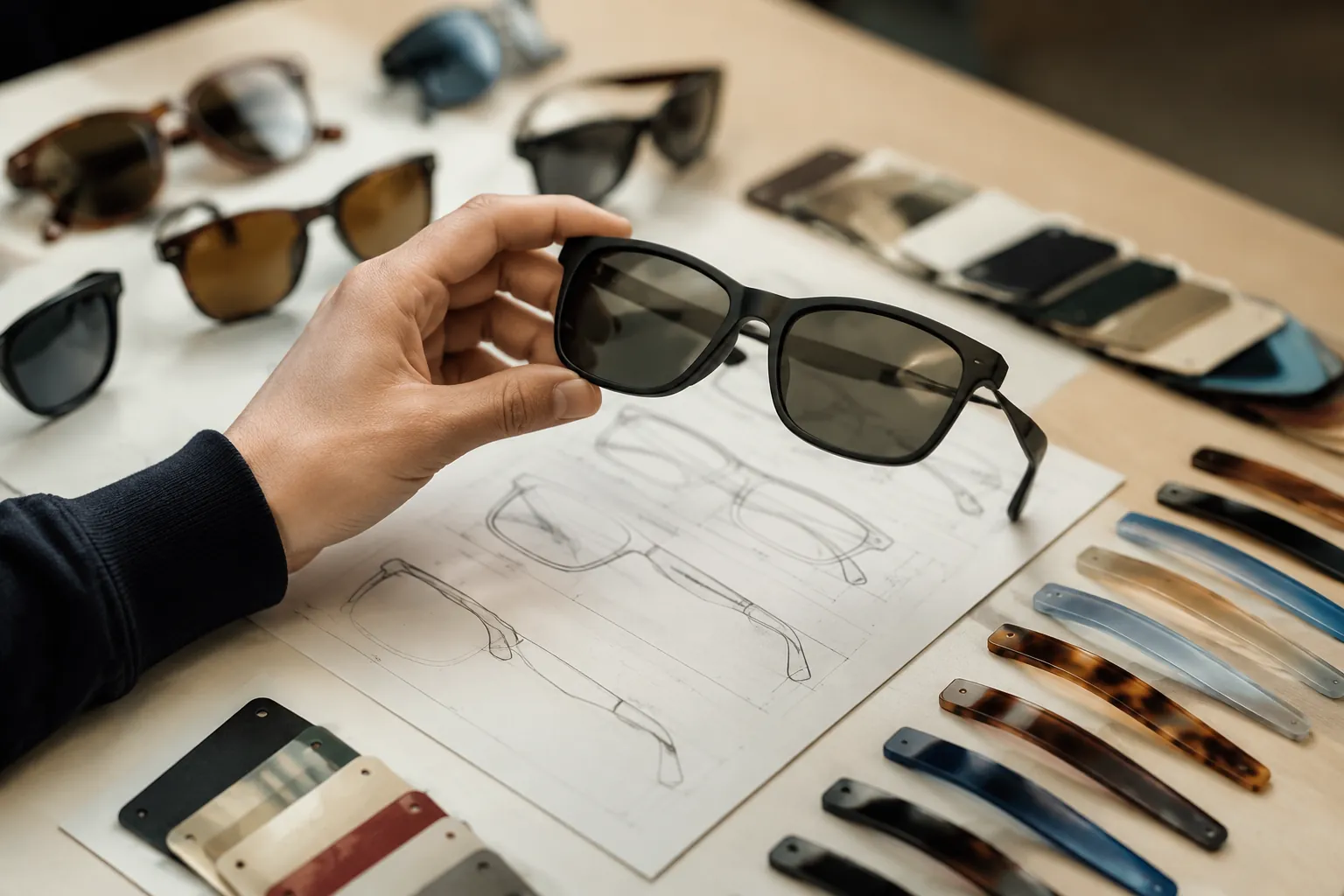
This guide is for brand owners, importers, distributors, and retail buyers who need to screen sunglasses suppliers quickly without skipping the checks that affect real buying decisions. The objective is straightforward: confirm whether a supplier's compliance claims are genuine before samples, tooling, laboratory work, or deposits consume budget and time. The fastest reliable method is to separate product compliance from factory-system and social-audit claims, request evidence in a fixed order, and verify that each document matches the exact sunglass construction you plan to buy. That final point matters in custom eyewear. A report for one frame-and-lens construction does not automatically apply to a different resin, lens material, coating, mirror finish, polarization structure, decoration method, packaging component, or production site.
Start with the claims that matter for your market
Buyers lose time when they treat CE, FDA registration, ISO 9001, BSCI, REACH, ANSI Z80.3, and AS/NZS 1067 as if they all prove the same thing. They do not. Some claims relate to the product. Others relate to the factory system, the audited site, or the materials used. Split those categories first.
For sunglasses, begin with a basic distinction: product-level evidence versus factory-level evidence. Product files should connect to a specific frame-and-lens construction and the market where the goods will be sold. Factory files should connect to a specific legal entity and site address. Chemical support should connect to the actual materials, finishes, inks, adhesives, trims, and packaging items used in the order. If those links are missing, slow down.
| Claim | What it covers | What you should ask for | Common buyer mistake |
|---|---|---|---|
| CE EN ISO 12312-1 | Product requirements for sunglasses and related eyewear under the EU market framework | EU Declaration of Conformity, supporting test report, model or construction reference, labeling information, and the responsible economic operator or legal entity | Accepting a generic "CE certificate" with no clear link to the quoted product |
| ANSI Z80.3 | US product standard for nonprescription sunglasses and fashion eyewear | Test report or supplier evidence showing the product was assessed to ANSI Z80.3 where your program requires it | Assuming FDA registration proves a model meets ANSI Z80.3 |
| AS/NZS 1067 | Product standard used for sunglasses and fashion spectacles in Australia and New Zealand | Test evidence tied to the relevant product construction, category, and marking approach | Using EU or US paperwork as automatic proof for Australia or New Zealand |
| FDA registration | Company registration status where applicable; not a model-by-model performance approval | Registration details, legal company name, address match, and explanation of the company's role in the export chain | Assuming registration alone proves optical compliance for every SKU |
| ISO 9001 | Quality management system for the certified organization and scope | Current certificate, scope, legal entity, site address, validity dates, and certification body | Thinking ISO 9001 means the product itself is certified |
| BSCI | Social compliance audit framework covering a specific audited site | Audit result or platform evidence, audit date, audited site address, and production scope | Accepting an audit from another site, office, or expired production arrangement |
| REACH | Chemical compliance obligations relevant to materials and components supplied to the EU market | Material declarations, supplier declarations, and test evidence for relevant components and finishes | Assuming one old chemical report covers all colors, coatings, inks, soft-touch paints, adhesives, and trims |
If you source custom sunglasses, also check which processes the supplier controls in-house and which are outsourced. A product test report tied to one lens supplier, coating system, or decoration method may have limited value if bulk production uses different components or subcontractors. Common outsourced steps include polarized lens lamination, mirror coating, hard coating, logo plate production, pad printing, and retail packaging. Problems often start when the supplier presents a clean file from one route, then builds bulk goods through another route.
It helps to classify every claim into one of three buckets before you review documents:
- Product claims: CE EN ISO 12312-1, ANSI Z80.3, AS/NZS 1067.
- Organization or site claims: FDA registration where applicable, ISO 9001, BSCI.
- Material and substance claims: REACH support for frames, lenses, coatings, inks, adhesives, nose pads, temple tips, cases, cleaning cloths, and packaging.
Once those buckets are clear, the review becomes faster because you know what each file should actually prove.
Use a document screen before you request samples
Before you pay for samples or tooling, send a short document request. Do not ask for every possible file at once. Ask first for the records that establish who the supplier is, where production happens, and whether the claimed compliance package is plausible.
- Ask for the supplier's full legal company name, registered address, and production address. If they use both a trading company and a factory, ask for both entities and both addresses.
- Ask for current copies of the compliance files they actively claim: CE EN ISO 12312-1 support files, ANSI Z80.3 evidence if relevant, AS/NZS 1067 evidence if relevant, FDA registration details, ISO 9001 certificate, BSCI evidence, and REACH support where applicable.
- Ask for one recent test report for a product close to your build: same frame material family, similar lens material, similar lens category, similar lens treatment, and similar decoration method.
- Ask for photos, drawings, CAD screenshots, or an internal model sheet that link the tested model to a real product.
- Ask which processes are done in-house and which are outsourced: injection molding, acetate cutting, lens production, lens tinting, hard coating, mirror coating, polarized lens lamination, assembly, logo application, packaging, and final inspection.
- Ask for the bank account name that will receive payment and compare it with the quote entity and invoice entity.
Then compare the details across the file set. If the quotation is issued by one company, the bank account belongs to another, the test report names a third, and the ISO 9001 certificate belongs to a fourth, do not proceed until the structure is explained in writing. A trader using a partner factory is not automatically a problem, but you need to know who manufactures, who controls incoming materials, who inspects, who packs, and who ships.
Use process logic as a second screen. A supplier that claims strong compliance control should be able to explain, in plain language, which model was tested, which site assembles it, which site packs it, which lens supplier is used, and which materials are fixed versus changeable. If the documents are vague and the explanations are vague as well, the claim is weak.
A practical pre-sample request list should include these exact data points:
- Legal entity name on quotation
- Factory name and address
- Main production steps by site
- Model code or internal style number
- Frame material and lens material
- Lens category or transmission classification
- Decoration method and location
- Packaging type and branded inserts if any
- Applicable market: EU, US, Australia/New Zealand, or multiple markets
This short list usually reveals whether the supplier has real document control or is simply forwarding a mixed folder of unrelated certificates.
How to check CE EN ISO 12312-1 without overreading the paperwork
You do not need to be a laboratory specialist, but you do need to know what usable CE support looks like. For sunglasses, one attractive certificate is not enough. Ask for an EU Declaration of Conformity and supporting test evidence for the same or a closely related construction.
- Model traceability: The report should show a model code, drawing number, sample description, or construction reference that can be linked to the quoted frame and lens.
- Lens category or transmission classification: The reported light transmission category should make sense for the lens being sold, including any polarized, mirrored, gradient, or photochromic feature if used.
- Material match: Frame and lens materials should be consistent with the quoted product. A report for polycarbonate lenses should not be treated as automatic proof for TAC polarized lenses or nylon lenses.
- Construction match: Hinge type, lens shape, base curve, and frame style do not need to be cosmetically identical, but the construction should be genuinely comparable.
- Document dates: Check that the files are current enough to reflect the product and supply chain now being offered.
- Responsible legal entity: The Declaration of Conformity should identify the responsible company. If the exporter, manufacturer, and brand owner roles differ, the supplier should explain who is responsible for what.
- Marking and instructions: The file set should support the labels, warnings, and user information that will accompany the goods.
Watch for technical mismatches hidden inside neat paperwork. A supplier may send support for an acetate frame with CR-39 lenses, then quote you an injected frame with polycarbonate mirrored lenses and a metal logo plate attached by adhesive. That is not a clean paper match. It is a mismatch across both product construction and material support.
If your custom design has not been tested yet, use the existing file only to judge whether the supplier has relevant experience and basic document control. Do not treat it as final proof for a changed product. Final compliance review should be based on the actual finished specification, the actual marking set, and the market where the goods will be sold.
When you review CE support, compare these details line by line:
| Item | In the supplier quotation | In the test support | What to check |
|---|---|---|---|
| Frame material | Injected TR90, PC, acetate, metal, or mixed material | Material description in report | Same material family or clearly comparable construction |
| Lens material | PC, TAC polarized, CR-39, nylon, or other | Lens description in report | No unexplained substitution |
| Lens function | Tinted, polarized, mirrored, gradient, photochromic | Sample description and category | Features should align with the tested basis |
| Decoration | Pad print, laser mark, foil, metal logo plate | May be absent from product report | If changed, check separate chemical and durability support |
| Factory or responsible entity | Quote or contract entity | DoC or supporting document entity | Relationship should be explained clearly |
This is usually enough to identify whether the CE file is usable for screening or whether it is simply generic sales material.
FDA, ANSI Z80.3, AS/NZS 1067, ISO 9001, BSCI, and REACH: what each file should prove
Suppliers often send these files in one folder. That causes buyers to overread them. Keep them separate and ask one practical question for each file type.
FDA registration should confirm company identity and registration status where applicable. It is not a product-performance approval for every sunglass model. Use it to verify the legal entity and the company's role in the US supply chain, then review product compliance separately.
ANSI Z80.3 is a product standard, not a factory-system certificate. If your US program requires conformity to ANSI Z80.3, ask for model-relevant test evidence or a clear compliance plan for the final production build. Check whether the report reflects the actual lens type, not only the frame style.
AS/NZS 1067 is also product-specific. If you are supplying Australia or New Zealand, ask for evidence that the lens classification, markings, and tested construction fit that market's requirements. Do not assume the same lens category labels used in another market will be sufficient.
ISO 9001 should show a current certificate with a scope relevant to eyewear manufacturing, assembly, or related production. Check the legal entity, address, certificate number, validity dates, and certification body. Then ask an operational question, such as how incoming lens lots are identified, how unapproved components are blocked, and how final inspection records are retained. A functioning system should produce a specific answer.
BSCI should identify the audited production site, not merely a sales office. If molding, assembly, and packing occur at different locations, ask which site is covered and which site will be used for your order. If only one site is audited but another site performs assembly or packing, note the gap.
REACH matters whenever materials, coatings, inks, adhesives, nose pads, temple tips, cases, cloths, or packaging components are supplied into the EU market. If a supplier claims REACH support, ask whether it holds material declarations, supplier declarations, or third-party test evidence for the exact components used in your project. A different mirror coating, soft-touch paint, or logo adhesive may require different support.
Use this checklist when each file arrives:
- FDA registration: Does the legal company name match the export chain documents?
- ANSI Z80.3: Does the test evidence describe a comparable model and lens structure?
- AS/NZS 1067: Does the evidence fit the actual market category and required markings?
- ISO 9001: Does the scope cover the activity the supplier says it performs?
- BSCI: Does the audited address match the site that will actually make or pack the order?
- REACH: Which exact materials and finishes does the support cover, and what is excluded?
That last point is especially important for custom programs. A supplier may have acceptable support for the base frame and lens, but no clear support for the custom rubber coating, metallic temple logo, or printed microfiber pouch included in your retail pack.
Red flags that catch weak claims fast
You can exclude many risky suppliers without paying for a factory audit. Weak claims usually leave a paper trail.
- The company name on the quote, invoice, bank account, and certificates does not match, and the supplier cannot explain the structure clearly.
- The certificate or audit address points to another city, another industrial park, or a business center office, and the supplier cannot identify which site will produce your order.
- The CE file has no EU Declaration of Conformity, no model reference, or no clear technical link to the quoted sunglass construction.
- The supplier talks about FDA registration as if it were universal product approval.
- The ANSI Z80.3 or AS/NZS 1067 evidence, if claimed, does not tie to a comparable model or is presented only as a generic marketing statement.
- The ISO 9001 certificate is expired, outside scope, or issued to a different company or location.
- The BSCI evidence is old, partial, inaccessible, or tied to another facility.
- The supplier refuses to say what is in-house versus outsourced.
- The report uses different lens material, frame material, coating, mirror treatment, polarization structure, or decoration from the item being quoted.
- The supplier claims REACH support but cannot identify which components, finishes, inks, adhesives, or packaging items that claim actually covers.
- The supplier cannot provide a basic build sheet for the sample it wants you to approve.
- The supplier states that "all our products pass all standards" without naming the tested model, test date, laboratory, or market.
Also watch behavior. A genuine manufacturer or a well-managed supplier can usually explain which site molds, which site assembles, which subcontractor handles specialized lens treatment, and how approved materials are controlled. A weak supplier relies on broad assurances and avoids specifics.
One useful test is to ask three direct questions in one email:
- Which company will invoice us?
- Which site will assemble and pack our order?
- Which existing test file is closest to our final build?
If the answer avoids names, addresses, or model references, treat the compliance package as unverified.
Match compliance to the actual production route before deposit
Once the first document screen passes, map the paperwork to the build plan. This is the step buyers most often rush.
| Build choice | What can change | Compliance or quality risk | What to confirm |
|---|---|---|---|
| Injected plastic frame | Resin grade, mold revision, hinge specification, subcontracted assembly site | Differences between tested and supplied construction; fit, durability, or traceability variation | Material designation, final drawing or approved sample, hinge specification, production site |
| Acetate frame | Sheet supplier, thickness, lamination, finishing process, logo insertion method | Differences from the tested or approved construction; appearance, dimensional, or chemical-support variation | Sheet specification, approved color reference, final build sheet, production process |
| Tinted or polarized lens | Lens material, supplier, tint, mirror treatment, hard coating, polarization film | Transmission category mismatch, labeling mismatch, and performance variation | Lens material, target transmission category, lens supplier, and any applicable test basis |
| Decoration added after testing | Pad-print ink, foil, metal logo plate, laser marking, adhesive, soft-touch or painted finish | Chemical compliance gaps, adhesion problems, appearance failure, mismatch with REACH support | Decoration method, material declarations, supplier declarations, and any required durability checks |
| Retail packaging set | Case material, pouch fabric, cleaning cloth print, paper insert, barcode sticker adhesive | Unreviewed material claims, labeling errors, mismatch between approved and shipped pack-out | Packaging specification, artwork list, material declarations where needed, final pack-out sample |
Ask for control points, not marketing language. For example: Which materials are fixed on the final specification? Which components can change only with buyer approval? Which site performs final assembly and packing? Which subcontractor provides coated lenses? How are mixed lots prevented during bulk assembly?
For custom sunglasses, create a one-page build confirmation list before deposit. It should include:
- Frame material and color code
- Lens material and lens color code
- Lens category or transmission target
- Polarized or non-polarized status
- Mirror or hard-coating details
- Hinge type and metal component finish
- Temple logo method and artwork revision
- Nose pad and temple tip materials if separate parts are used
- Retail packaging components and branding inserts
- Final assembly site and packing site
This list gives you a practical basis for checking whether the supplier's product evidence still fits the build that will actually be produced.
A practical timeline: before samples, before order, before shipment
Move in stages. Each stage should lead to the next one only after the previous check is complete.
- Before samples: verify legal entity, production address, claimed compliance scope, and at least one relevant product-support file.
- During sampling: confirm that the sample build sheet states frame material, lens material, lens category or transmission class, hinge type, decoration method, logo position, and packaging components.
- Before deposit: lock the final specification and market requirements. Include dimensions, material designation, lens specification, decoration method, labels, warnings, packaging items, and the applicable standard or standards such as CE EN ISO 12312-1, ANSI Z80.3, or AS/NZS 1067.
- During bulk production: confirm that no material, component, finish, artwork, or site substitution is made without written approval. If changes are proposed, ask whether they affect the basis of compliance support or the approved sample.
- Before shipment: review final inspection results, carton markings, accessories, and product markings. Compare one packed production unit against the approved sample and approved specification sheet.
The rule is simple: verify documents early, then verify that production still matches those documents. A clean file set at quotation stage does not protect you if the factory changes lens supplier, finish, or production site later.
A practical timing plan may look like this:
| Stage | Main documents | Main questions | Decision |
|---|---|---|---|
| Supplier screening | Entity details, site details, existing test file, ISO 9001, BSCI | Who makes the goods, and is there a credible document base? | Proceed to sample or reject |
| Sample review | Build sheet, photos, packaging draft, nearest compliance support | Does the sample match the claimed construction? | Revise sample or move to PO |
| Pre-deposit | Final specification, required labeling, market compliance plan | Is the final build defined clearly enough to buy safely? | Approve deposit or hold |
| Production control | Change notices, incoming material records, inspection checkpoints | Has anything changed from the approved basis? | Accept changes or require correction |
| Pre-shipment | Final inspection report, packing list, carton marks, production photos | Do shipped goods match the approved build and pack-out? | Ship or stop shipment |
This sequence keeps document review tied to the buying process instead of turning it into a one-time certificate collection exercise.
What a good supplier answer set looks like
Strong suppliers do not just attach files. They explain what each file covers, what it does not cover, and what still needs review for your exact program.
Example of a useful answer: "We can provide CE EN ISO 12312-1 support for a similar injected frame with the same lens material category as your project. Your artwork changes the temple decoration from laser marking to a metal logo plate, so our existing file is for screening only and final compliance should be reviewed against the finished specification. Our ISO 9001 certificate applies to the manufacturing site shown on the certificate. Our BSCI audit covers the assembly and packing site. Lens tinting is done by our approved supplier, and final assembly and inspection are done at our audited site."
That answer is useful because it shows document literacy, process visibility, and awareness of scope limits. It also tells you what to check next: final decoration materials, outsourced tinting control, and the finished build specification.
A weak answer sounds very different. It usually claims that all products are certified, all markets are covered, and any design change is acceptable. It does not state the tested model, the site used, the lens supplier, the decoration material, or the legal entity responsible for the file set.
When you assess supplier responses, look for these signs of a credible answer set:
- The supplier names the specific model or reference product used as the compliance basis.
- The supplier identifies the manufacturing site and any subcontracted process.
- The supplier distinguishes screening documents from final product-specific evidence.
- The supplier states which parts of your custom build still need confirmation.
- The supplier explains any mismatch between quote entity, factory entity, and shipping entity.
- The supplier can provide a build sheet, not just promotional photos.
The quickest reliable verification process is the one that connects paperwork, product construction, and production route before money moves. If those three elements do not line up, the supplier has not yet proved the claim.
Have a custom sunglasses project in mind?
Send us your styles, target market and quantities and we will return a detailed quote with MOQ, lead time and a sample plan.
Get a QuoteWhy source this from Wenzhou with LumiShades
Wenzhou in Zhejiang Province is widely regarded as China’s eyewear manufacturing capital, producing a large share of the world’s sunglasses. That concentration matters to buyers: a deep local supply chain for acetate sheet, hinges, lens blanks, plating and packaging means shorter component lead times, easier color and material matching, and a workforce with decades of eyewear-specific skill. LumiShades has manufactured in this ecosystem since 2009, and our vertical integration — in-house injection molding, acetate cutting, CNC milling, lens tinting, decoration and quality control — means no part of your order is quietly subcontracted to a workshop you cannot audit.
For international buyers, that vertical control translates into accountability. When a single factory owns every step, defects are traced and fixed at source rather than bounced between vendors, and your specifications survive intact from first sample to bulk. We back this with 15+ years of experience, shipments to 60+ countries, more than 5 million pairs produced per year and a 98.5% on-time delivery rate. Our certifications — CE EN ISO 12312-1, FDA registration, ANSI Z80.3, AS/NZS 1067, REACH, ISO 9001 and BSCI audit — mean the compliance documentation your market requires already exists. Explore our manufacturing capabilities and quality control process to see how this works in practice.
Frequently asked questions
Is FDA registration enough for sunglasses sold in the US? No. FDA registration is not a substitute for product-level review. Treat it as an identity and regulatory-status check for the company where applicable. If you are buying for the US market, ask separately for evidence relevant to the actual product standard your program requires, such as ANSI Z80.3, and make sure that evidence matches the frame, lens, and labeling you will sell.
Can I accept a CE file if my custom model has not been tested yet? Only as a screening reference, not as final proof. First, check whether the file is tied to a comparable construction: similar frame material, lens material, lens category, lens treatment, and decoration method. Second, ask the supplier to state in writing which parts of your final build differ from the tested reference. Third, decide whether the final build needs updated testing or a fresh conformity review before shipment.
What is the fastest way to spot a trader using another factory's documents? Compare five items side by side: the company name on the quotation, the invoice entity, the bank account name, the ISO 9001 certificate entity and address, and the BSCI audited site. Then ask one direct question: which site will make, assemble, inspect, and pack my order? If the supplier cannot map each step to a named company and address, treat the compliance package as unverified.
How current should ISO 9001 and BSCI documents be? They should be valid on the date you place the order, and the named site should match the real production site for your purchase order. Check the expiry date, certificate or audit status, and any changes in company name or address. If expiry is approaching, ask for the renewal plan and do not assume a new certificate or audit will be issued automatically.
Do decoration changes matter for compliance? Yes. Decoration changes can affect both chemical and physical performance. Pad-print inks, coatings, adhesives, foil, and metal logo plates may change the REACH support needed for EU supply and may also affect appearance or adhesion. When decoration changes, ask for the exact material list, the supplier's declarations for those materials, and confirmation of any durability checks used for the finished decoration.
Ready to start?
Explore our wayfarer sunglasses or request a quote — our sales team replies within 12 hours.
Request a Quote