
Specify Spring Hinges, End Tips, and Nose Pads Right
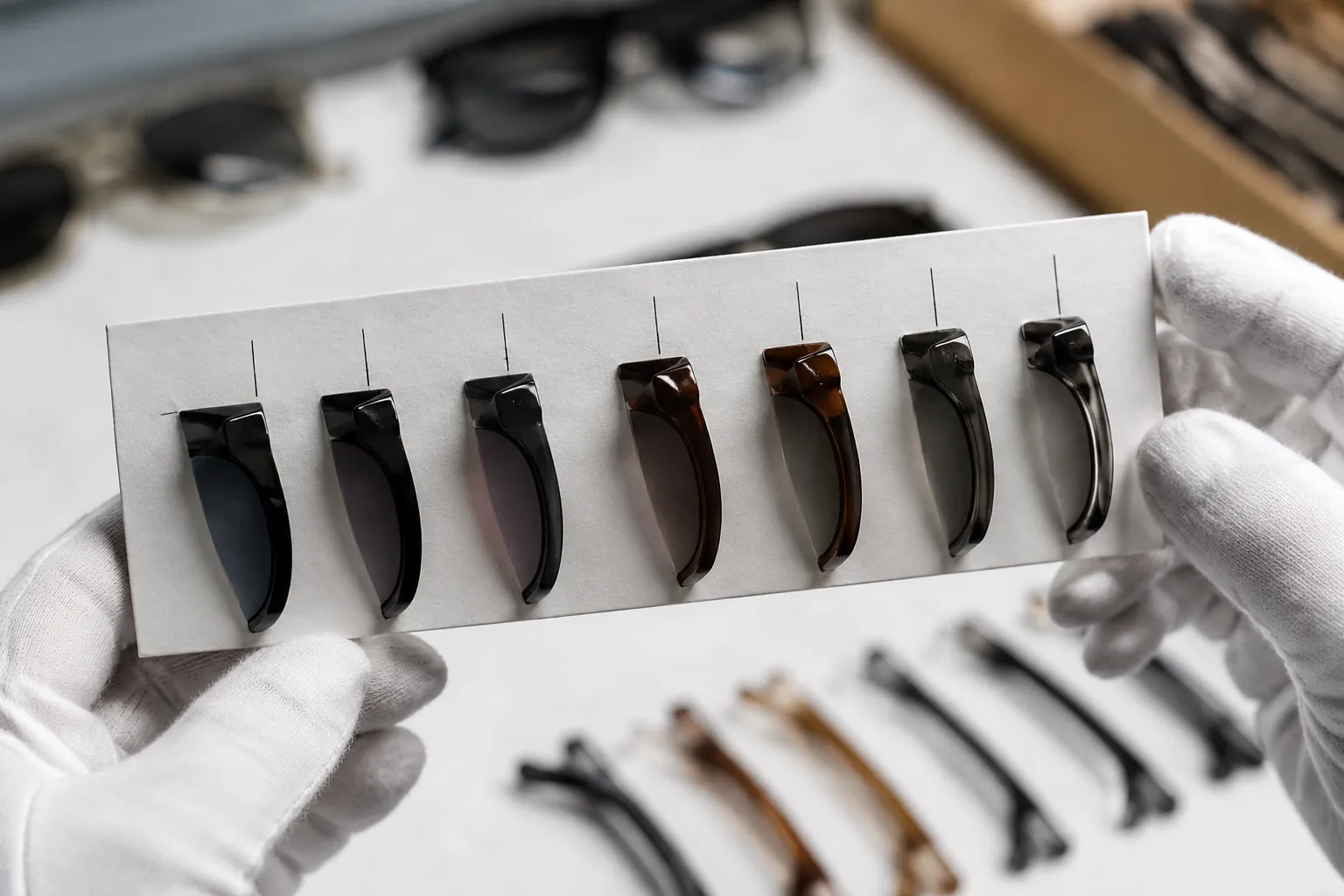
This guide is for brand owners, importers, distributors, and retail buyers developing custom sunglasses programs. It covers three small components that have an outsized effect on fit, perceived quality, complaint rates, and reorder consistency: spring hinges, end tips, and nose pads. These are not minor trim parts. They control clamp feel, ear pressure, bridge stability, and long-wear comfort. Specify them loosely and the sample may look fine but wear badly. Specify them clearly and sourcing, QC, and repeat orders get much easier to control.
Start with the use case, not the catalog part
Many fit problems start before production. Buyers often lock the frame front, lens color, and branding first, then leave springs, tips, and pads to the factory standard. That is a mistake. These parts touch the wearer. They are functional.
The right specification depends on use. A short-wear promotional frame, a fashion style for casual retail, and a comfort-led all-day model do not need the same hardware or contact materials. The target wearer matters too: broad-market fit, narrow fit, low bridge fit, oversized fashion, and wrap-influenced shapes all put different demands on hinge behavior, ear contact, and nose support.
Before approving any comfort component, answer these four questions in writing:
- How long is the frame expected to be worn at one time: brief try-on, intermittent wear, or extended wear?
- What fit category is intended: broad-market, narrow, low bridge fit, oversized fashion, or wrap-influenced?
- What is the frame construction: injected plastic, acetate, metal, or combination?
- Do you need repeatable replacement compatibility for future reorders, or is seasonal resourcing acceptable?
If those answers are vague, sample review turns subjective and bulk production gets harder to control. A frame can pass visual inspection and still trigger complaints because the hinge tension varies, the temple ends feel sharp, or the nose contact is unstable in wear.
Spring hinges: specify travel, resistance, and hinge-seat construction
Spring hinges are often sold as comfort upgrades. Treat them as mechanical assemblies instead. They can widen fit range and make frames easier to wear. They can also create failure points if the hinge type, mounting method, or frame structure is wrong.
Review these three points explicitly:
- Extension travel: how far the temple can open beyond the normal position without overstressing the assembly.
- Opening resistance: the hand feel when the temple is opened and closed. Left-right consistency matters as much as the absolute force.
- Mounting method: whether the hinge is screw-fixed, embedded as a spring unit, or built into a riveted or other structural assembly suited to the frame material.
On injected plastic temples, the hinge seat is often the weak point. The plastic around the insert or spring housing needs enough support, and the geometry should avoid sharp internal transitions that concentrate stress. More spring force is not automatically better. On a thin or light temple, high resistance can increase stress at the hinge seat and make the frame less comfortable.
On acetate temples, spring hinges can help fit range, but only if the routed pocket is accurate, the hinge sits flush, and finishing does not distort the seating surface. Small alignment errors here show up fast. Temple skew. Uneven closure. Poor first impression.
Your specification should state the hinge type, finish, screw size if applicable, acceptable travel behavior, and the requirement for left-right consistency against an approved sample. If corrosion resistance matters for the sales region or use case, write that into the hardware standard. Do not leave it implied.
End tips: material, hardness, and edge finish drive comfort fast
Temple end tips shape comfort within seconds. The wearer may not know the polymer type, but they notice hardness, slip, rough finishing, and sharp edges right away. These contact points influence perceived quality almost immediately.
For sunglasses, buyers usually choose between integrated temple ends and softer secondary-contact solutions. The trade-off is simple: integrated ends reduce assembly complexity, while softer or separate contact parts can improve grip and comfort but add process controls and inspection points.
| Option | Best for | Main advantage | Main risk | Cost and lead-time effect |
|---|---|---|---|---|
| Integrated injection temple end | Entry-level or time-sensitive programs | Lowest assembly complexity | Can feel hard or slippery depending on surface finish and geometry | Lowest cost, fastest sampling |
| Acetate temple with polished end shape | Fashion retail, acetate frames | Better hand feel and visual quality | Poor finishing can leave edges or pressure points | Higher labor, longer finishing time |
| Soft over-molded tip | Comfort-led or sport-influenced lines | Better grip and softer ear contact | Bonding, flash control, and color-match issues | Added tooling and process cost |
| Metal temple with sleeve tip | Wire or combo frames | Softer contact zone and easier fit tuning | Sleeve rotation or slip if retention is loose | Moderate added assembly time |
If you use a soft-touch material, specify the material family and hardness range in the tech pack. Otherwise, a supplier may swap in a harder compound that looks fine in photos but wears differently on the face. Cosmetic criteria should also be written clearly: no flash on skin-contact edges, no sharp parting-line feel, no obvious sink marks at bends, and no unacceptable color variation where two materials meet.
Geometry matters as much as material. A well-shaped integrated end can outperform a poorly fitted soft tip. Ask for rounded edge profiles, smooth transitions, and fingertip-safe finishing. If the tip feels sharp in a basic handling check, the frame will feel cheap to the customer. Simple as that.
Nose pads: match support to bridge shape, frame weight, and wearer range
Nose support should be set early, not after the front shape is already fixed. Bridge comfort depends on several factors working together: bridge width, front curvature, frame weight, lens mass, pantoscopic position, and intended fit category.
There are three common approaches:
- Molded-in saddle bridge: lower part count, common on injected plastic sunglasses. Usually most effective on lighter frames designed for broad-market wear.
- Embedded or applied soft contact points: useful when more grip or cushioning is needed on plastic frames without adding full pad arms.
- Adjustable nose pads on pad arms: most suitable when fit range matters, frame weight is higher, or the frame architecture already includes metal support.
For many fashion sunglasses, a soft-contact solution can improve stability on smoother skin surfaces or in warmer conditions. For metal and combination frames, adjustable pads offer a wider fitting range, but they also add assembly and inspection requirements. Pad alignment matters. Arm symmetry matters. Pack-out protection matters.
Material documentation matters too. The exact skin-contact material should be identified in the BOM and product file, especially where REACH-related material control applies. For finished sunglasses, market-facing compliance and documentation may include CE EN ISO 12312-1, ANSI Z80.3, AS/NZS 1067, REACH, and FDA registration where applicable to the destination market and product category. Factory systems such as ISO 9001 and social compliance programs such as BSCI can support supplier qualification, but they do not replace product-specific fit review or component approval.
Also plan for reorder continuity. If the style is expected to repeat, use a pad size and mounting format that can be sourced consistently. Visually similar pads can differ in softness, geometry, or transparency. Those differences change how the frame sits on the face.
Write the component spec so production does not guess
Comments like "make the temple softer" or "improve nose comfort" are not specifications. They describe preference, not control points. If you want less interpretation during manufacturing and QC, the component spec needs objective detail.
Your purchase specification should define measurable or observable checkpoints for each component:
- Temple springs: hinge type, finish, screw size if applicable, mounting method, expected travel behavior, and left-right consistency requirement.
- End tips: material, hardness range for soft-touch parts, color reference, surface finish, and allowable visibility of parting lines or assembly marks.
- Nose pads: type, material, color or transparency, pad size, mounting method, and replacement compatibility for future reorders.
Add photos of acceptable and unacceptable conditions. Include closure-gap tolerance, hinge alignment standards, and cosmetic rejection criteria for contact parts. Even basic callouts improve repeatability. Typical examples include:
- No sharp edge detectable by fingertip at the temple end
- No clear left-right difference in opening resistance by hand compared with the approved sample
- No hinge squeak after repeated opening and closing during in-line inspection
- No nose pad rotation under light manual pressure where the design should remain fixed
- No visible flash on pad or tip contact surfaces
Keep the approved sample tied to the exact BOM. If the hinge, tip, or pad reference changes, review that as a formal substitution. Not as a minor factory adjustment.
Use a practical approval workflow for comfort-led bulk orders
Do not approve comfort from a quick showroom try-on. Use a short, disciplined workflow that separates geometry, hardware choice, and consistency checks.
- Approve geometry first. Do not try to fix a poor bridge shape, incorrect temple angle, or unstable front with a softer pad alone.
- Review two or three hardware levels. Compare standard hinge versus spring hinge, and compare integrated temple ends with soft-contact alternatives where relevant.
- Wear-test for a meaningful period. Pressure at the bridge or behind the ear often appears only after extended wear, not during a quick mirror check.
- Check left-right consistency. Open and close both temples repeatedly and compare resistance, alignment, and closure behavior.
- Run a pilot when the program is new or the component choice is changing. A small validation run is safer than discovering fit complaints after full bulk assembly.
- Freeze the BOM and golden sample. Keep one signed approval sample linked to the exact hinge, tip, and pad references used for production.
For repeat programs, require written approval for any component substitution before bulk assembly starts. This is especially important for nose pads and soft-contact parts, where visual similarity can hide performance differences.
Where to spend, where not to cut, and how to quote it
Two sourcing mistakes show up again and again. First, buyers overspend on visible decoration while leaving skin-contact components at the lowest standard. Second, they strip out every comfort upgrade to lower unit cost, then pay later through complaints, slower sell-through, or inconsistent reorders.
Spend where the wearer feels the frame. On a light plastic style, a better temple-end shape and improved bridge contact may do more for comfort than adding a spring hinge. On a broader-fit model, a correctly specified spring hinge can help, but only if the hinge mounting area is structurally suitable.
When quoting, ask the supplier to price the same frame in multiple hardware configurations while keeping lens and decoration constant. That isolates the cost effect of the comfort component and makes comparison clearer.
| Configuration | Typical use case | Process impact | Main commercial logic |
|---|---|---|---|
| Base spec: standard hinge, integrated end, molded bridge | Promo or price-sensitive launch | Fastest sampling, least assembly complexity | Best when speed and entry cost matter most |
| Mid spec: moderate spring hinge, refined end geometry, soft nose contact | Core retail or comfort-led fashion | Extra QC and hardware sourcing, manageable tooling effect | Often the best balance of comfort and margin |
| High comfort spec: premium spring hinge, soft over-molded tips, adjustable pads | Extended wear, metal/combo, wider fit targets | Higher assembly time, more inspection points, possible added tooling | Use when repeat wear and lower complaint risk justify the added cost |
Rule of thumb: if the wearer notices the part in the first minute, it is not a minor part.
Buyer checklist before releasing bulk production
Use this final check before bulk approval:
- Spring hinge specification written with hinge type, finish, screw details if applicable, travel behavior, and left-right consistency requirement
- Temple end material and hardness range defined where soft-touch parts are used
- Nose support system matched to frame geometry, weight, and intended wearer range
- Golden sample retained with signed BOM and exact hardware references
- Wear test completed beyond a brief try-on
- Cosmetic limits defined for sharp edges, flash, closure gaps, pad rotation, and hinge noise
- Compliance file aligned with target markets: CE EN ISO 12312-1, ANSI Z80.3, AS/NZS 1067, REACH, and FDA registration as applicable
- Supplier qualification records reviewed where relevant, including quality-system or audit documentation such as ISO 9001 or BSCI if part of your sourcing requirements
These components are small. Their commercial effect is not. Get them right and you improve comfort, tighten QC, and make repeat orders easier to manage.
Have a custom sunglasses project in mind?
Send us your styles, target market and quantities and we will return a detailed quote with MOQ, lead time and a sample plan.
Get a QuoteWhy source this from Wenzhou with LumiShades
Wenzhou in Zhejiang Province is widely regarded as China’s eyewear manufacturing capital, producing a large share of the world’s sunglasses. That concentration matters to buyers: a deep local supply chain for acetate sheet, hinges, lens blanks, plating and packaging means shorter component lead times, easier color and material matching, and a workforce with decades of eyewear-specific skill. LumiShades has manufactured in this ecosystem since 2009, and our vertical integration — in-house injection molding, acetate cutting, CNC milling, lens tinting, decoration and quality control — means no part of your order is quietly subcontracted to a workshop you cannot audit.
For international buyers, that vertical control translates into accountability. When a single factory owns every step, defects are traced and fixed at source rather than bounced between vendors, and your specifications survive intact from first sample to bulk. We back this with 15+ years of experience, shipments to 60+ countries, more than 5 million pairs produced per year and a 98.5% on-time delivery rate. Our certifications — CE EN ISO 12312-1, FDA registration, ANSI Z80.3, AS/NZS 1067, REACH, ISO 9001 and BSCI audit — mean the compliance documentation your market requires already exists. Explore our manufacturing capabilities and quality control process to see how this works in practice.
Frequently asked questions
Do spring hinges always improve comfort on sunglasses? No. A spring hinge can improve fit range and ease of wear, but it is not automatically a comfort upgrade. Ask the supplier to provide both a standard-hinge sample and a spring-hinge sample on the same frame if possible. Compare four things: opening feel, left-right consistency, temple alignment when closed, and comfort after extended wear. Also confirm that the temple construction has enough structural support around the hinge seat. If the frame is very light or the temple is thin, a stronger spring may create more stress and a tighter feel rather than a better fit.
For low-MOQ orders, which comfort upgrade usually gives the best return? Usually the best first upgrade is the one that improves direct contact without adding major tooling complexity. In practice, that often means refining temple-end geometry, improving edge finishing, or choosing a better nose-contact solution rather than defaulting to a more expensive hinge. Ask for a side-by-side quote with the same front, lenses, and branding, changing only the comfort component. Then review sample comfort against the added unit cost. That makes the tradeoff clear and easier to defend internally.
What should I ask the factory to test on these small parts? Request checks that can be repeated during sample review and in-line QC: hinge alignment, left-right opening feel, screw security, smoothness at temple-end contact points, nose pad retention or rotation, and closure behavior when the frame is folded. Also require a wear assessment on the approved sample for a meaningful period, not just a visual try-on. For production control, keep one golden sample with the exact approved hinge, tip, and pad references and instruct QC to compare bulk output against that sample.
Can nose pads affect compliance? Yes, mainly through material documentation and product-file control. The exact skin-contact material should be identified in the BOM and supporting records, especially where REACH-related controls apply. Beyond the pad itself, the finished sunglasses may need to meet market-specific requirements such as CE EN ISO 12312-1, ANSI Z80.3, AS/NZS 1067, or FDA registration where applicable. The practical step is to align component records, test planning, and market documentation before bulk production, not after goods are packed.
How do I prevent component substitutions on repeat orders? Freeze the BOM with exact hinge, tip, and pad references, including material and finish details. Keep a signed golden sample from the approved production version, not just an early prototype. Add a written clause to the purchase order stating that no substitutions are allowed without prior written approval. For repeat orders, ask the supplier to confirm the original component references before production starts. If a change is unavoidable, require a new counter-sample and compare function as well as appearance, because visually similar parts can feel different in wear.
Ready to start?
Explore our wayfarer sunglasses or request a quote — our sales team replies within 12 hours.
Request a Quote