
Sourcing Sunglasses for Subscription Boxes & Gift Sets
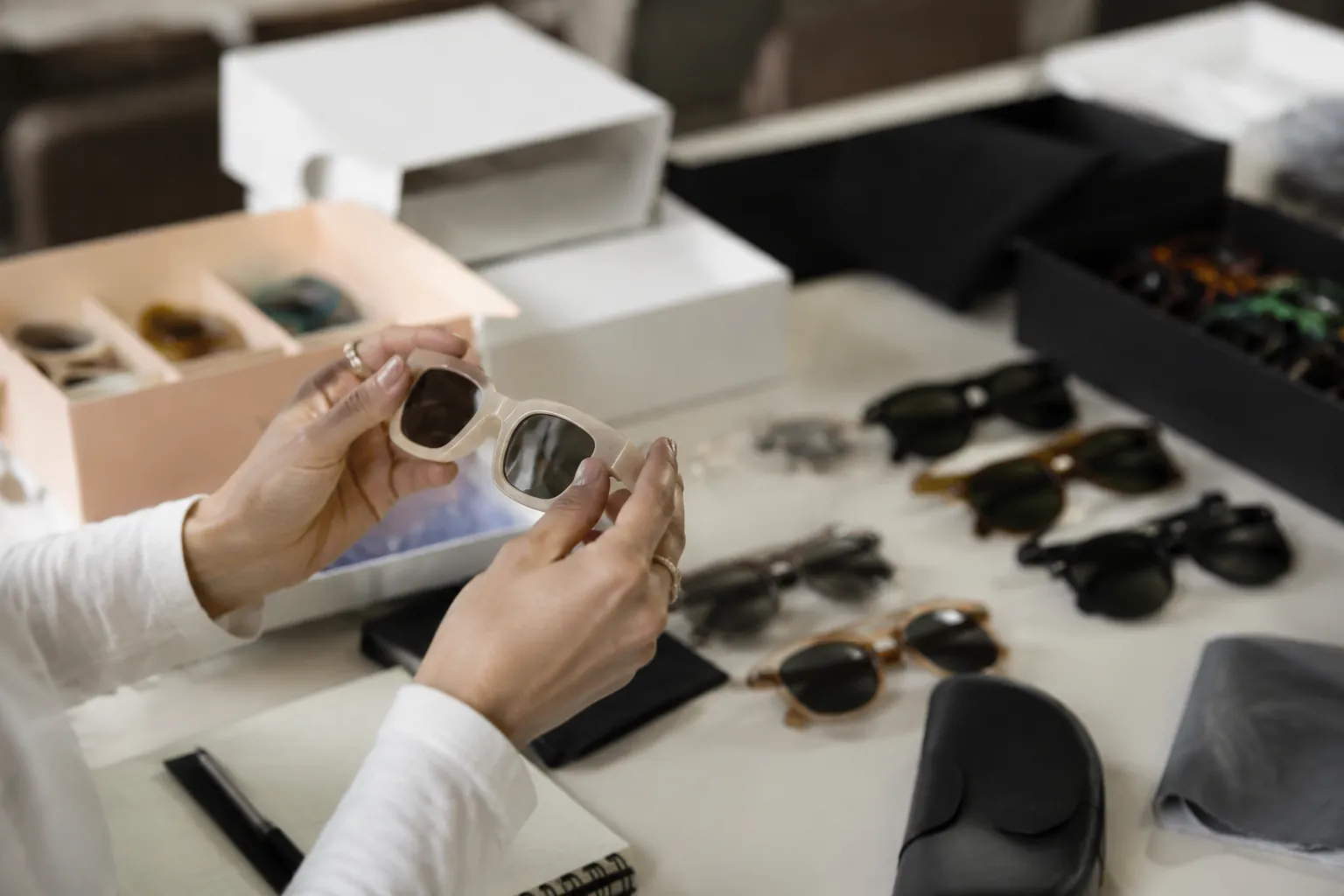
This guide is for subscription box teams, gift set buyers, lifestyle brands, importers, and retailers planning recurring sunglasses drops. It explains how to brief a sunglasses manufacturer, compare quotes, control packed size, vary designs across drops, and reduce return risk. The goal is simple: build a sourcing plan you can price, sample, inspect, and repeat without starting from zero every season.
Start With Box Economics Before Design
Subscription and gift set programs usually win or lose on landed cost, packing volume, and schedule reliability. Start there. A frame that looks strong in a mood board may fail if the case makes the box too tall, the mirrored lens scratches in handling, or the logo method needs slow manual alignment.
Build the first brief around five numbers: target ex-factory unit cost, maximum packed size, order quantity per SKU, required ship date, and acceptable defect level. A low-cost lifestyle box may need a lightweight PC sunglass in a microfiber pouch. A corporate gift set may justify polarized lenses, a printed pouch, a branded insert, and a cleaner logo finish.
LumiShades supports MOQs from 50 pairs per design. Treat 50 pairs as a pilot, VIP run, or approval quantity, not a bulk-cost benchmark. Efficiency improves as quantities rise because lens purchasing, color batching, logo setup, packing materials, and inspection work are spread across more units. Exact pricing depends on the confirmed frame material, lens type, decoration, packaging, testing requirement, and shipment plan.
Do not ask for "the cheapest sunglasses" without defining the use case. Ask for a costed breakdown showing frame material, lens type, hinge, logo method, pouch or case, carton count, sample timing, bulk timing, and target compliance market. That is how buyers compare quotes without being misled by missing packaging, testing, labeling, or documentation costs.
Match Material to Drop Strategy
The best frame material is not always the most expensive one. For subscription drops, the right material holds shape, accepts color consistently, packs safely, and can be repeated with controlled variation. Material choice also affects lead time. Injection frames, acetate frames, and metal frames move through different tooling, finishing, and inspection steps.
| Material | Best Use | Process Detail | Buyer Watch Point |
|---|---|---|---|
| PC injection | Low-cost fashion drops, bright colors, youth styles | Efficient for repeatable molded designs; color batching and mold setup affect cost | Check gate marks, warpage, lens fit, and hinge pull strength |
| TR90 | Sport, travel, flexible lifestyle sets | Lighter and more flexible than basic PC; needs stable lens seating after flex | Test temple recovery, bridge shape, and lens pop-out resistance |
| Acetate | Premium gift sets and retail collaborations | Cut, CNC milled, tumbled, polished, and hand-finished; more labor intensive | Approve actual sheet stock because tortoise and pattern distribution vary |
| Metal | Aviators, thin-frame gifts, executive sets | Cost depends on plating, solder joints, screws, nose pads, and coating thickness | Inspect plating coverage, solder strength, pad alignment, and screw security |
LumiShades offers production options including injection molding, acetate processing, and CNC milling. A mixed program can use one PC frame for a summer box, repeat the same mold in new colors for a travel drop, and reserve acetate for a higher-value holiday gift set.
For injection frames, approve Pantone targets and acceptable color tolerance before bulk production. Small color shifts can occur across batches, so define the limit early. For acetate, request photos of the actual sheet lot before cutting. For metal, confirm plating color, coating requirement, screw treatment, and any corrosion or handling test required by the sales channel.
Create Variation Without Rebuilding Engineering
Recurring boxes need freshness. Factories need repeatability. The safest model changes visible details while keeping frame engineering stable. Every new mold, hinge, screw, lens base curve, or nose pad adds fit, tooling, and QC risk.
- Reuse one mold and change color: Best for monthly or seasonal drops where cost control matters.
- Keep the frame and change lens tint: Useful for beach, festival, travel, and outdoor themes.
- Change decoration only: Pad print, laser engraving, hot stamping, or a small metal logo can refresh the product without new tooling.
- Use two shared shapes: One square and one round platform covers more face shapes while simplifying purchasing.
- Limit hardware changes: New hinges, screws, or nose pads often create avoidable inspection issues.
A practical annual eyewear plan can use a small set of frame platforms, several frame colors, a limited lens-tint library, and one or two approved logo methods. Customers see variety. The factory repeats known structures and makes inspection findings useful across drops.
Decoration affects production. Pad printing is cost-effective and visible, but ink adhesion should be checked with tape pull and rub tests, especially on flexible TR90 or coated temples. Laser engraving is durable, but it can look subtle on dark frames. Metal logo plates raise perceived value, but alignment tolerance matters; a slight tilt can cheapen a narrow temple. For gift programs, define logo placement tolerance in millimeters and confirm it against an approved production fixture.
Always approve a pre-production sample made with bulk-intent materials and production fixtures. Do not rely only on a hand sample. Hand samples can be adjusted by technicians. Bulk production reveals the real risks: lens seating, logo drift, color variance, screw tightness, and pouch fit.
Specify Lenses and Compliance Early
Lenses are where many low-cost sunglasses fail. A frame can look fine while the product still creates compliance risk. Put the lens specification directly into the purchase order, sample approval sheet, and inspection checklist.
For general sunglasses, define UV400 or equivalent UV protection, visible light transmission category where required, lens color, coating, base curve, and applicable test standard. LumiShades can support common market requirements such as CE EN ISO 12312-1 for the EU, ANSI Z80.3 for the United States, AS/NZS 1067 for Australia and New Zealand, REACH restricted-substance expectations, and FDA registration requirements where applicable. ISO 9001 and BSCI relate to management systems and social compliance. They do not replace product-level testing or market-specific documentation.
Polarized lenses suit fishing, driving, travel, and outdoor gift sets, but they add cost and require orientation checks during assembly. Gradient lenses work well for fashion programs, but the tint transition should match between left and right lenses. Mirrored lenses can scratch if packed against rough pouch fabric, so lens film or a softer pouch lining may be needed.
Tell the supplier the sales region at the start. EU retail, US promotional gifting, Australian distribution, and multi-region ecommerce can require different labeling, warnings, test reports, and document files. If the same shipment may cross regions, align to the stricter requirement early. Reworking lens markings, inserts, hang tags, or compliance files after packing is slow and expensive.
Buyer rule: never approve sunglasses on appearance alone. Confirm UV performance, lens category labeling, applicable standard, test-document availability, and the exact markings or inserts required for the shipment.
Engineer Packaging for Carton Efficiency
Subscription boxes punish bulky packaging. A hard case may look premium, but it can increase dimensional weight, reduce units per master carton, and disrupt the final kit layout. Design packaging around the full box, not as a separate accessory.
Common options include OPP bag only, microfiber pouch, microfiber pouch with paper card, soft EVA case, foldable paper box, and hard case. For many subscription drops, a microfiber pouch is the best compromise: it protects lenses, supports logo printing, packs flat, and keeps carton volume under control. For retail gift sets, a printed paper box with a pouch inside can present better than a bulky hard case when box height is limited.
Confirm packed dimensions before ordering outer cartons. A slightly thicker pouch or wider temple can change how units stack. Ask the factory to run a packing trial with the actual frame, pouch, insert, desiccant if used, and export carton. For mirrored or gradient lenses, add lens film if pouch fabric is rough. For printed pouches, check ink drying and rub resistance to prevent transfer onto lenses or frames.
Cartons should be marked by PO number, style, frame color, lens color, quantity, and carton number. Fulfillment teams need fast identification when sunglasses are inserted into thousands of boxes. If the shipment travels by sea and then by courier or parcel network, request a packing review or transit test suited to the route. Damage often comes from weak inner packing, not the sunglass design.
Use MOQ and Price Breaks Strategically
Low MOQ is useful. It does not mean low unit cost. Small runs carry a higher share of setup labor, color preparation, logo fixture time, packing setup, and inspection overhead. Buyers get better value when they consolidate engineering and vary surface details.
| Quantity Level | Good For | Cost Logic | Main Risk |
|---|---|---|---|
| 50 pairs/design | Pilot drops, VIP gifts, approval runs | High labor share; limited material and packing efficiency | Unit cost may sit well above the intended bulk target |
| 300 pairs/design | Small box runs and regional tests | Better absorption of color, logo, and packing setup | Too many SKUs can still fragment production |
| 1000 pairs/design | Main subscription drops and importer programs | More stable purchasing for lenses, hinges, pouches, cartons, and labels | Bad forecasts can leave slow-moving colors |
| 5000+ pairs/design | Large gifting, national retail, repeat programs | Best suited to negotiated component purchasing and dedicated production planning | Requires firm QC plan, shipment schedule, and approval discipline |
A practical approach is to buy depth on one frame platform and create variety through color and lens tint. Three colors of the same injection frame usually run more efficiently than three unrelated frame shapes at the same total quantity. The customer still sees assortment. The factory avoids repeated setup changes.
Ask the supplier to separate tooling, sample, unit, packaging, testing, and freight-related assumptions. Confirm whether the quoted price includes logo decoration, pouch printing, lens category labeling, export carton marks, spare screws or nose pads, and compliance documents. A quote that omits these items may look cheaper at first and cost more at shipment.
Control Quality Before Cartons Close
Sunglasses QC must be specific. Generic "good quality" wording does not help an inspector reject crooked temples, scratched lenses, loose hinges, or poorly aligned logos. Define defects, tolerances, and sampling expectations before bulk production.
Frame checks should cover symmetry, temple opening, hinge tightness, screw condition, nose bridge finish, burrs, injection marks, acetate polishing, plating defects, and frame balance on a flat surface. Lens checks should cover UV records, tint consistency, scratches, optical distortion, lens popping, and rim gaps. Branding checks should cover logo position, color, adhesion, engraving depth, and metal plate alignment.
Useful tolerances depend on style, so set measurable rules before production. Logo position should have a millimeter tolerance based on artwork size and temple width. Lens gaps should be even and should not allow popping under normal handling. Hinges should open smoothly without gritty movement, excessive looseness, or raised screw heads. For printed logos, request adhesion checks before packing. For mirrored lenses, inspect under bright light. Fine scratches hide easily.
LumiShades can conduct in-process checks across production stages such as molding or cutting, lens tinting, decoration, assembly, and final packing. That helps catch defects before goods are sealed in export cartons. For larger runs, buyers should still consider pre-shipment inspection by an internal or third-party inspector. Agree on AQL level, critical defects, major defects, minor defects, and rework rules before production starts.
Keep one signed golden sample at the factory and one with the buyer. If there is a dispute over color, logo position, tint darkness, pouch fabric, or packing method, the golden sample gives both sides the same reference point.
Plan Sampling and Repeat Production
Timing is tight in subscription work because sunglasses are usually one item inside a larger kit. A late eyewear shipment can delay the whole box. Work backward from the box assembly date, not from an ideal factory date.
LumiShades typically needs 7 to 10 days for samples and 25 to 35 days for bulk production after approvals, depending on material, decoration, lens, packaging, quantity, and compliance documentation. Buyers should add time for sample review, revision, testing, export handling, inbound receiving, and fulfillment-center check-in. If the sunglasses must be inserted into another gift set, add a packing buffer at the assembly site.
A realistic schedule starts 60 to 90 days before box assembly. Week one covers brief, quote, and cost structure. Week two locks artwork, Pantone target, lens color, logo method, and packaging. Weeks two to four cover sampling and revision. Bulk should start only after the signed sample, PO, artwork, labeling, and packaging are frozen. Production then moves through material prep, molding or cutting, lens tinting, decoration, assembly, QC, packing, and final inspection.
For recurring drops, approve the next design while the current design is in production. If a mold, acetate shape, pouch size, or lens tint will repeat, tell the factory early so materials can be planned together where practical. On-time delivery depends on clear specifications, fast approvals, stable artwork, market-specific compliance planning, and no late changes after bulk starts.
Have a custom sunglasses project in mind?
Send us your styles, target market and quantities and we will return a detailed quote with MOQ, lead time and a sample plan.
Get a QuoteWhy source this from Wenzhou with LumiShades
Wenzhou in Zhejiang Province is widely regarded as China’s eyewear manufacturing capital, producing a large share of the world’s sunglasses. That concentration matters to buyers: a deep local supply chain for acetate sheet, hinges, lens blanks, plating and packaging means shorter component lead times, easier color and material matching, and a workforce with decades of eyewear-specific skill. LumiShades has manufactured in this ecosystem since 2009, and our vertical integration — in-house injection molding, acetate cutting, CNC milling, lens tinting, decoration and quality control — means no part of your order is quietly subcontracted to a workshop you cannot audit.
For international buyers, that vertical control translates into accountability. When a single factory owns every step, defects are traced and fixed at source rather than bounced between vendors, and your specifications survive intact from first sample to bulk. We back this with 15+ years of experience, shipments to 60+ countries, more than 5 million pairs produced per year and a 98.5% on-time delivery rate. Our certifications — CE EN ISO 12312-1, FDA registration, ANSI Z80.3, AS/NZS 1067, REACH, ISO 9001 and BSCI audit — mean the compliance documentation your market requires already exists. Explore our manufacturing capabilities and quality control process to see how this works in practice.
Frequently asked questions
What is a realistic MOQ for a subscription box sunglasses test? LumiShades can start at 50 pairs per design. Use that level for pilots, VIP gifts, photography samples, or internal approval runs. For a real box program, ask for quotes at 50, 300, 1000, and your target quantity so you can see how setup, logo, packaging, and inspection costs change. Do not judge bulk feasibility from a 50-pair unit cost alone.
How can we create new monthly drops without new tooling every time? Reuse the same frame platform and change visible elements such as frame color, lens tint, pouch print, or logo method. Keep hinges, screws, lens curve, and nose-pad structure stable unless there is a clear reason to change them. Ask the supplier to build a repeatable design matrix that shows approved frame colors, lens colors, logo methods, and packaging options for future drops.
Which packaging is best for compact gift sets? A microfiber pouch is usually the best low-volume option because it protects lenses, accepts a logo, and packs flat. For higher-value gifts, compare a printed paper box, EVA case, and hard case by packed dimensions, carton quantity, dimensional freight, and final kit layout. Before approval, request a packing trial with the actual sunglasses, pouch or case, insert, and export carton.
What lens and compliance documents should we ask for? Start with the sales market. For the EU, ask about CE EN ISO 12312-1; for the United States, ANSI Z80.3 and FDA registration requirements may apply; for Australia and New Zealand, ask about AS/NZS 1067; for restricted substances, confirm REACH expectations where relevant. Also request UV performance records, lens category labeling details, required markings or inserts, and confirmation that the approved lens specification matches the bulk order.
How long should we allow from sample to bulk shipment? Samples normally take 7 to 10 days, and bulk production usually takes 25 to 35 days after approval, depending on material, lens, decoration, packaging, quantity, and documentation. Build the schedule backward from the box assembly date. Add time for sample review, revisions, lab testing if required, pre-shipment inspection, export handling, inbound receiving, and fulfillment-center processing.
What QC tolerances matter most for sunglasses? Control lens scratches, UV documentation, lens fit, hinge movement, frame balance, temple symmetry, logo placement, pouch condition, and carton labeling. Put measurable tolerances in the inspection checklist, such as logo position in millimeters and clear accept/reject rules for lens gaps, loose screws, visible scratches, plating defects, and print adhesion. Keep signed golden samples with both buyer and factory for comparison.
Ready to start?
Explore our rimless sunglasses or request a quote — our sales team replies within 12 hours.
Request a Quote