
Seasonal Sunglasses Reorder Calendar for Buyers
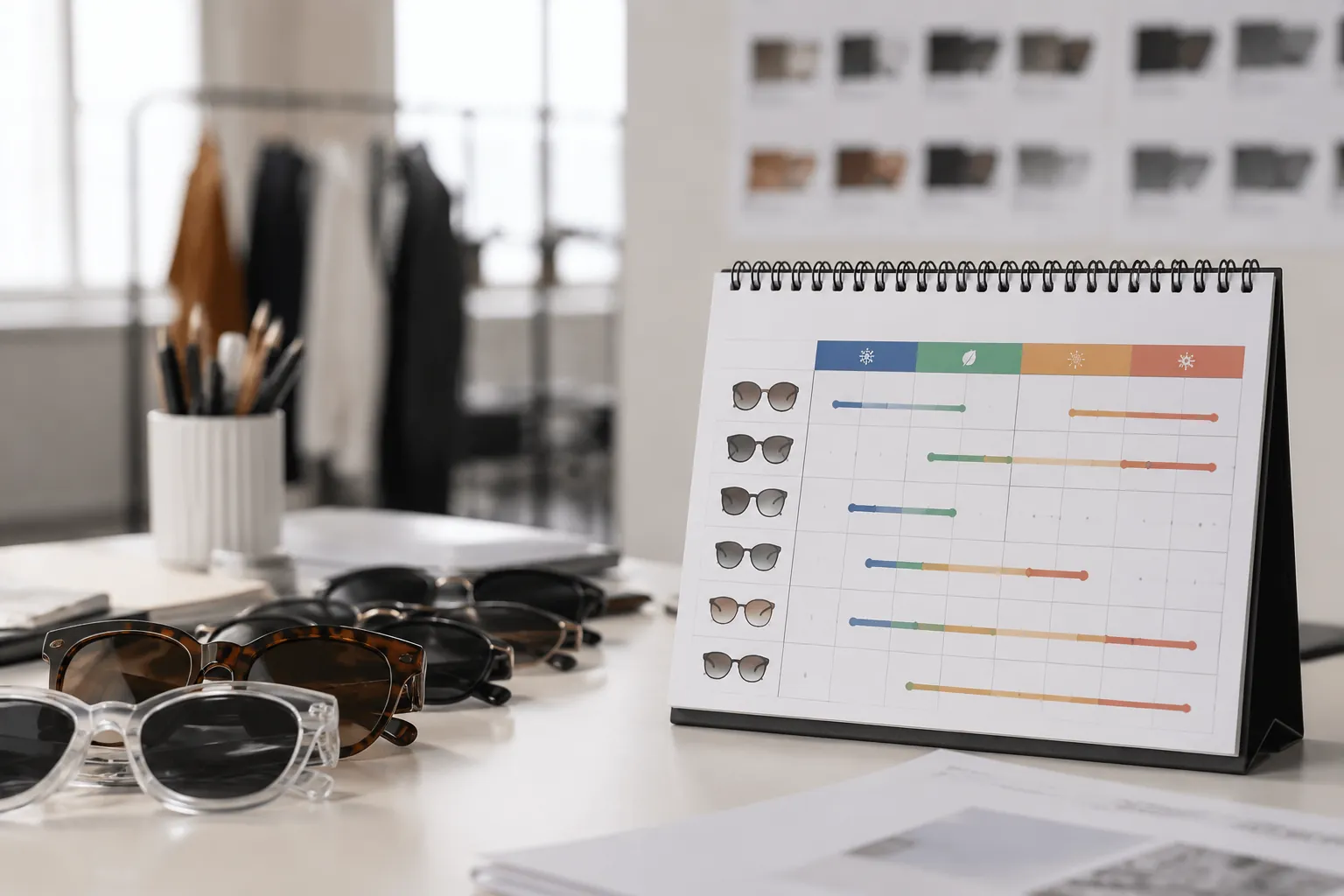
Seasonal sunglasses buying depends on calendar control. The factory may have the right tooling, materials, and production team. The order can still miss the retail window if samples, approvals, compliance checks, inspections, and freight are not timed correctly. This guide helps importers, distributors, promotional buyers, and retail sourcing teams build a reorder calendar around real factory milestones, approval gates, MOQ decisions, material behavior, and market-specific compliance needs.
Start with the retail date, not the PO date
The most common planning mistake in seasonal eyewear buying is building the schedule from the purchase order date. That is too late. By the time a PO is issued, the buyer may still need sample revisions, artwork approval, packaging confirmation, compliance document review, production booking, inspection, freight booking, customs paperwork, and warehouse intake.
Start with the date the sunglasses must be on shelf, in a distributor warehouse, or ready for a promotion. Then work backward. For a repeat sunglasses style with no major changes, start about 4 to 6 months before the selling season. For a new frame shape, new lens tint, new decoration method, new packaging format, or first-time market launch, 6 to 8 months is safer.
That window is not a transit promise. It is a planning buffer for normal buyer approvals, sample corrections, packaging reviews, inspection findings, freight scheduling, and customs documentation.
LumiShades' normal sample time is 7 to 10 days. Bulk production is typically 25 to 35 days after the order is fully approved and production-ready. Production-ready means the frame specification, lens requirement, logo method, packaging, labeling data, compliance market, deposit, and delivery terms are all confirmed. These are factory timings only. Buyers still need to add internal approvals, freight movement, customs clearance, and warehouse receiving.
Buyer rule: if you cannot state the shelf date, destination market, compliance requirement, and freight mode in one sentence, the reorder calendar is not ready.
Build the calendar around fixed milestones: range review, sample request, sample approval, specification lock, deposit, production booking, pre-shipment inspection, freight booking, customs documents, and final delivery. If one milestone moves, update the full schedule. Do not push all risk to the shipping date.
Work backward from the season and lane
Each selling window carries different timing risks. Spring launch lines often need earlier approval for frame colors, lens tints, mirror coatings, and temple decoration. Summer replenishment is usually tight because factory capacity and freight space are under pressure. Back-to-school programs need extra attention to carton labels, barcode accuracy, and account-specific packing rules. Holiday and gift programs add another layer because inserts, ticketing, packaging, and retail cutoff dates often collide.
Use the calendar below as a planning framework. Then adjust it for the shipping lane, destination market, order size, and product complexity. A local truck move is not the same as an international ocean shipment. A repeat frame with approved packaging is not the same as a mixed-material frame with custom tint, logo decoration, and retail-ready packaging.
| Sales window | Target sample approval | Production start | Factory time | Shipping buffer |
|---|---|---|---|---|
| Spring launch | January to early February | February | 25 to 35 days after full approval | Set by lane, customs process, and warehouse intake |
| Summer replenishment | March to April | April to May | 25 to 35 days after full approval | Allow for peak-season booking pressure |
| Back-to-school | May to June | June | 25 to 35 days after full approval | Include time for barcode, carton, and DC requirements |
| Holiday or gift | August to September | September | 25 to 35 days after full approval | Add time for inserts, gift packaging, and retail cutoffs |
Do not treat freight time as fixed. Ocean schedules, port congestion, transshipment points, customs examination, trucking capacity, and warehouse appointment availability can all affect delivery. Air freight can protect a critical launch quantity, but cost it before you need it. It can change landed cost fast.
Split shipping may reduce risk. Send the first retail-critical quantity by air, then move the balance by sea if the margin and launch plan support it.
The lane matters as much as the season. A coastal warehouse, an inland chain distribution center, and a distributor with strict appointment rules may each need different buffers. For a fixed retail launch week, plan against the slowest reasonable case for that lane, not the best-case transit estimate.
Use the right sample sequence
One sample is rarely enough for a seasonal eyewear order unless the style is an exact repeat with unchanged materials, colors, decoration, and packaging. A staged sample process catches problems while changes are still practical. If all feedback waits until the final sample, materials may already be ordered or production may already be scheduled. Corrections then cost more time.
- Concept sample: checks frame shape, front curvature, basic fit, lens tint direction, and decoration position
- Color and finish sample: confirms frame color, surface finish, lens tone, mirror effect, temple print, and coating appearance under agreed lighting
- Pre-production sample: locks final decoration, barcode, carton art, label placement, accessories, and packing method
This sequence matters because eyewear materials behave differently in production. Acetate can show batch-to-batch color variation, polish marks, or edge finish issues if cutting and polishing are not controlled. Injection-molded frames can show gate marks, sink marks, color variation, or changes in temple springback depending on material, mold conditions, and cooling. Metal parts can show plating variation, small scratches, hinge stiffness differences, or laser engraving that looks strong in one lighting condition and weak in another.
Use measurable approval language. Lens tint should match the approved retained sample under the agreed viewing condition. Logo placement should be checked against an approved position reference, not only a photo. Temple alignment should be reviewed from the front, top, and side. Define what is acceptable. Do not leave it to opinion on inspection day.
If the design includes a metal logo plate, confirm the centerline, height, and orientation with a ruler, template, or marked approval sample.
LumiShades supports injection molding, acetate cutting, CNC milling, lens tinting, and decoration within its production workflow. For buyers, the value is coordination. Tint changes, logo position updates, finish issues, and sample revisions can be handled before production approval. Revision time still depends on the change, material availability, and whether new tooling, printing plates, or packaging components are required.
Keep one buyer-approved retained sample and one factory-retained production standard. Label both with the date, order number, version, and approval status. Production and inspection should follow those physical standards, not memory, email screenshots, or edited product photos.
Build the calendar around factory reality
Factories schedule work around capacity, material availability, setup time, confirmed specifications, and payment status. A seasonal slot is easier to protect when the buyer has frozen the specification. Then the factory can plan labor, material purchasing, machine time, assembly, inspection, and packing around a stable order.
MOQ and pricing belong in the calendar. Do not leave them for late negotiation after the selling window is already close. LumiShades' MOQ is 50 pairs per design. Pricing improves at 300, 1000, and 5000+ pairs, with volume pricing available down to about $2.10 per pair on larger runs, depending on product specification, material, decoration, packaging, and order conditions. Buyers should confirm the current quote for each program. No tier should be treated as automatic.
The calendar should help buyers decide whether to test several small styles or consolidate demand into stronger volume tiers. Three low-volume color tests may be useful for market learning. They may also carry higher unit cost and less efficient production planning than one stronger core colorway. The right choice depends on forecast confidence, retail price, cash flow, inventory risk, and speed to shelf.
| Order size | Typical benefit | Main risk | Buyer use case |
|---|---|---|---|
| 50 pairs | Lowest cash commitment and practical market test | Highest unit cost and limited scale efficiency | New color trial, boutique launch, sample selling |
| 300 pairs | Better pricing and more efficient material planning | Limited safety stock if sell-through exceeds forecast | Regional promo, repeat seller, distributor test |
| 1000 pairs | Stronger unit-cost position and steadier production planning | Requires more accurate forecast and inventory control | Seasonal core SKU, chain test, planned replenishment |
| 5000+ pairs | Best volume leverage and stronger capacity planning | Higher inventory exposure if sell-through slows | National launch, broad rollout, established evergreen style |
Ask the factory what reserves a production slot. In many programs, a PO alone is not enough. The practical booking point is usually reached only when specifications, artwork, packaging, compliance market, deposit, and material plan are confirmed. If any of those remain open, the slot can shift as the factory prioritizes production-ready orders.
Lock the specification before booking
Late changes damage seasonal schedules. A small buyer-side adjustment can require new labels, new carton marks, revised artwork, changed components, rechecking, repacking, or a new approval sample. A lens tint change can affect product description, hangtag language, compliance records, and visual matching. A packaging change can require updated barcodes, new artwork files, or revised carton dimensions.
Freeze these items before production booking:
- Frame material, finish, color code, and approved color standard
- Lens color, UV requirement, coating type, and approved tint reference
- Logo method, including laser engraving, pad printing, heat transfer, or metal logo plate
- Case, pouch, insert card, polybag, carton art, and packing ratio
- Packaging language, barcode data, SKU data, warning text, and retail ticketing rules
Use tolerances and acceptance criteria that the buying team, factory, and inspector can all understand. Practical checks for sunglasses include front-view symmetry, temple alignment, hinge movement, lens seating, surface finish, logo position, barcode scan accuracy, and carton count. If the frame uses spring hinges, confirm smooth opening and return. If the frame is acetate, check that polishing has removed sharp edges around the bridge, nose area, temple tips, and lens groove.
Fit needs the same discipline as decoration. A frame can look strong in a product photo but fail at retail if the bridge is too tight, the temple curve presses too hard, the frame sits crooked, or the lens position looks unbalanced. Use a checklist with a clear approve, revise, or reject decision for each critical point.
If a critical item is unresolved, do not release the order to production. Fix it first.
Inspect before freight release
Inspection should happen before cargo is released for freight, not after pickup. Once freight is booked and cargo is moving, defects become harder to fix. The buyer may face storage charges, rework delays, repacking, missed cutoff dates, or pressure to accept goods that should have been corrected.
Inspect seasonal sunglasses while correction is still possible. Focus on the points most likely to cause disputes, returns, or chargebacks:
- Lens tint consistency and color match against the approved retained sample
- Surface scratches, especially on gloss finishes, mirrored lenses, coated lenses, and acetate frames
- Logo placement, print adhesion, engraving visibility, and decoration durability
- Temple alignment, hinge action, screw tightness, and opening force consistency
- Carton count, barcode scan accuracy, SKU match, packing ratio, and outer mark readability
A practical inspection plan should define the sampling method, acceptance standard, defect categories, required photos, and decision authority before inspection day. Some buyers use an AQL-based inspection. Others use account-specific acceptance rules. Either approach can work if the pass and fail criteria are clear in advance.
Do not ask whether the goods "look okay." That is not enough for a seasonal order with a fixed launch date.
For mirrored or coated lenses, check for scuffs caused by stacking, poor interleaving, or handling. For matte, rubberized, or frosted finishes, look for finger marks, uneven texture, dull spots, or coating inconsistency. For mixed packaging, verify that cases, pouches, inserts, barcode labels, and accessories match the approved assortment before final release.
Inspect before leverage is lost. Once freight is moving, correction options shrink and costs rise.
Plan compliance before sample approval
Compliance is part of the reorder calendar. It is not a final paperwork task. The correct requirement depends on the destination market, lens category, product claims, labeling, and buyer policy. If the requirement is unclear during sample approval, the buyer may lose time later correcting documents, revising labels, or retesting product claims.
LumiShades lists only the following certifications, registrations, and standards in its compliance profile: CE EN ISO 12312-1, FDA registration, ANSI Z80.3, AS/NZS 1067, REACH, ISO 9001, and BSCI. Buyers should request documents that match the destination market and product type. They should also confirm whether the available documents apply to the exact product, material, lens, and shipment being ordered.
Plan around these common compliance paths:
- EU-related sunglasses orders may require alignment with CE EN ISO 12312-1 and appropriate product labeling
- US buyers may request FDA registration information and ANSI Z80.3 performance documentation depending on product and account policy
- Australia and New Zealand buyers commonly reference AS/NZS 1067 for sunglasses requirements
- REACH may apply to substance control in frame materials, coatings, inks, metal parts, and accessories
Quality-system and social-compliance documents such as ISO 9001 and BSCI can support vendor qualification, but they do not replace product-specific sunglasses compliance. Keep the distinction clear. A factory certificate does not automatically prove that every lens, coating, label, or finished shipment meets the destination market requirement.
Confirm compliance needs during the first sample stage. Verify final labeling and documentation before production booking. If the buyer waits until goods are packed to ask for market-specific documents, the calendar may not have enough room for correction.
Use a repeatable quarterly calendar
The easiest reorder system is a repeatable quarterly rhythm. It works well for importers and distributors with evergreen sunglasses styles plus seasonal color, lens, or packaging updates. A shared calendar also helps sales, planning, operations, and sourcing teams work from the same approval dates instead of reacting to each promotion separately.
| Quarter | Buyer action | Factory action | Outcome |
|---|---|---|---|
| Q1 | Review last season sell-through, returns, and forecast repeat demand | Prepare sample updates and confirm material availability | Core specifications are updated before peak demand |
| Q2 | Place summer replenishment and confirm SKU, color, and size mix | Run production, complete inspection, and prepare freight documents | Stock is positioned before peak retail weeks |
| Q3 | Approve holiday or gift designs, packaging, labels, and compliance needs | Lock carton art, accessories, packing method, and production schedule | Late-stage packaging and labeling rework is reduced |
| Q4 | Book next-year core styles and confirm forecast assumptions | Reserve capacity and plan materials for the next cycle | Better slot control and steadier cost planning |
If you sell through distributors, chain stores, or promotional accounts, share the calendar with sales and planning teams. They need sample cutoff dates, artwork freeze dates, inspection windows, and freight deadlines before they commit to launch dates. A sales promise made before sample approval or production booking can erase margin through rush freight, repacking, or missed delivery windows.
The operating model is simple: choose the season, define the shelf date, confirm the destination market, approve the sample, lock the specification, book the production slot, inspect before freight release, and keep a lane-specific delivery buffer. That is how a reorder calendar protects revenue. It also reduces last-minute recovery costs.
Have a custom sunglasses project in mind?
Send us your styles, target market and quantities and we will return a detailed quote with MOQ, lead time and a sample plan.
Get a QuoteWhy source this from Wenzhou with LumiShades
Wenzhou in Zhejiang Province is widely regarded as China’s eyewear manufacturing capital, producing a large share of the world’s sunglasses. That concentration matters to buyers: a deep local supply chain for acetate sheet, hinges, lens blanks, plating and packaging means shorter component lead times, easier color and material matching, and a workforce with decades of eyewear-specific skill. LumiShades has manufactured in this ecosystem since 2009, and our vertical integration — in-house injection molding, acetate cutting, CNC milling, lens tinting, decoration and quality control — means no part of your order is quietly subcontracted to a workshop you cannot audit.
For international buyers, that vertical control translates into accountability. When a single factory owns every step, defects are traced and fixed at source rather than bounced between vendors, and your specifications survive intact from first sample to bulk. We back this with 15+ years of experience, shipments to 60+ countries, more than 5 million pairs produced per year and a 98.5% on-time delivery rate. Our certifications — CE EN ISO 12312-1, FDA registration, ANSI Z80.3, AS/NZS 1067, REACH, ISO 9001 and BSCI audit — mean the compliance documentation your market requires already exists. Explore our manufacturing capabilities and quality control process to see how this works in practice.
Frequently asked questions
How far in advance should I reorder seasonal sunglasses? For an unchanged repeat style, start planning about 4 to 6 months before the selling season. For a new frame, new lens tint, new logo method, new packaging, or first-time market launch, plan 6 to 8 months ahead. Work backward from the shelf date and include sample approval, specification lock, production, inspection, freight, customs clearance, and warehouse intake.
What is a realistic factory lead time for custom sunglasses? At LumiShades, samples normally take 7 to 10 days, and bulk production typically takes 25 to 35 days after the order is fully approved and production-ready. That clock should not start until the frame, lens, logo, packaging, labeling, compliance market, deposit, and delivery terms are confirmed. Add freight and customs time separately.
How do MOQ and pricing affect reorder timing? LumiShades' MOQ is 50 pairs per design. Pricing improves at 300, 1000, and 5000+ pairs, with larger-volume pricing available down to about $2.10 per pair depending on specification and order conditions. Forecast early enough to decide whether to run small market tests or consolidate demand into stronger volume tiers before production slots and materials become tight.
What should I freeze before production starts? Freeze the frame material, frame color, lens tint, UV requirement, coating, logo method, packaging, carton artwork, barcode data, SKU data, warning text, retail ticketing rules, and destination-market compliance requirement. Treat any change after production booking as a schedule risk unless the factory confirms in writing that it will not affect cost, timing, labeling, or inspection.
Which compliance documents should I ask for? Ask for documents tied to the destination market and product type. Relevant LumiShades compliance references include CE EN ISO 12312-1, ANSI Z80.3, AS/NZS 1067, REACH, FDA registration, ISO 9001, and BSCI. Confirm whether each document applies to the exact frame, lens, coating, material, and shipment. Separate factory-level documents such as ISO 9001 or BSCI from product-level sunglasses compliance.
When should I inspect the order? Inspect after production and packing are complete enough to represent the shipment, but before freight release and preferably before final balance payment. The inspection plan should define sampling, acceptance criteria, defect categories, required photos, and decision authority. Check lens tint, scratches, logo placement, hinge function, alignment, barcode scan accuracy, carton count, packing ratio, and outer marks before goods leave the factory.
Ready to start?
Explore our square sunglasses or request a quote — our sales team replies within 12 hours.
Request a Quote