
How to Verify a Sunglasses OEM's Real Output
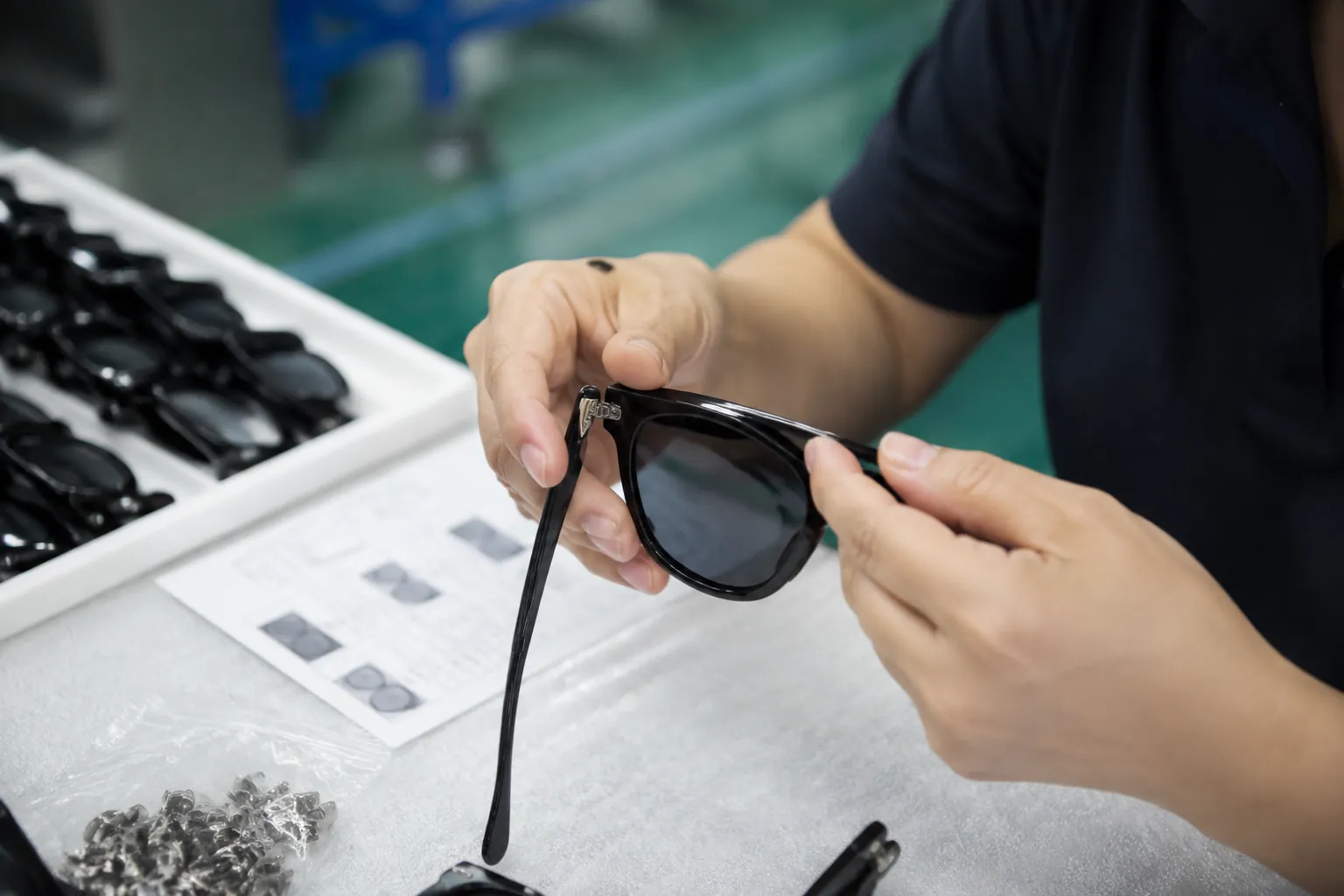
For brands, importers, distributors, and retailers buying custom sunglasses in volume, a monthly output number only matters if it repeats. A factory can quote a big figure and still miss your ship date once materials, decoration, QC, and packing are counted. This guide shows how to separate real capacity from sales talk, what documents to ask for, and how to judge whether an OEM can support your reorder rhythm.
Start with repeatable output, not peak claims
Buyers often get pulled in by one rounded number: "5 million pairs a year," "200,000 pairs a month," or something similar. That number means little unless the factory can show the product mix, shift pattern, and recent shipping history behind it. A plant that mostly runs simple injection frames is not the same as one running acetate, metal, mixed-material, and decorated orders at once.
Ask one direct question: how many finished pairs leave the dock in a normal month, not in a rush month? Then ask what changed in the rush month. Extra labor? Overtime? Outsourced polishing? Looser QC? If the answer depends on temporary measures, you are looking at peak capacity, not stable capacity.
If a supplier says it makes custom sunglasses in-house, ask which steps are actually internal. In-house injection molding, acetate cutting, CNC milling, lens tinting, decoration, and QC usually give a factory more control over timing and quality than a setup that outsources several steps. Control reduces handoff delays. It also makes bottlenecks easier to see. That is useful.
Map the line from input to packed cartons
Do not ask for "monthly output" until you understand the route a pair takes. For sunglasses, the critical path usually looks like this:
- Raw frame material or acetate sheet arrives and is checked.
- Frames are molded, cut, or milled depending on construction.
- Frames are trimmed, polished, and adjusted.
- Lenses are tinted, cut, inserted, and checked for fit.
- Decoration is applied, such as laser engraving, pad printing, or metal logo plates.
- Final QC checks cosmetics, alignment, lens color consistency, and packaging.
- Finished pairs are packed, carton-checked, and released to warehouse.
The line is only as strong as its slowest step. A factory can mold frames all day and still ship less than expected if lens tinting is a bottleneck or decoration backs up. This is common with custom orders because logos and special colors add SKUs to the same batch.
The right output question is not "How many can you make?" It is "How many finished pairs can you move through each step per day, for my product type, under your normal QC rules?"
Ask for numbers by product family
Capacity should be split by product family. A useful answer gives different numbers for injection sunglasses, acetate sunglasses, metal frames, and mixed-material styles. If a factory gives one flat monthly figure for everything, that is a warning sign. Different products use different labor, cycle times, defect rates, and tooling constraints.
| Product family | Main bottleneck | What to ask | What good evidence looks like |
|---|---|---|---|
| Injection sunglasses | Tooling cycle, trimming, assembly | Pairs per machine per shift, mold count, downtime rate | Machine list, shift plan, production log by style |
| Acetate sunglasses | Cutting, polishing, fitting | Daily output per line, scrap rate, polishing capacity | In-house cutting records, QC reject log, work-in-process counts |
| Metal / mixed-material | CNC milling, assembly, decoration | Changeover time, decoration queue, final assembly speed | Sample schedule, CNC loading plan, decoration order sheet |
| Custom logo-heavy orders | Pad printing, laser engraving, metal plates | How many decoration variants can run per day | Decoration work order, color-change frequency, rework rate |
For a buyer placing 50-pair MOQ orders, the issue is not just total factory volume. It is whether the factory can handle many small custom runs without disrupting throughput. A factory that looks strong on one large repeat order may struggle with ten 50-pair designs that each need different prints, lens tints, or packaging.
Check line balance, not just labor count
Factories often show headcount. That is weak evidence. Fifty workers can produce less than twenty well-assigned workers if the line is poorly balanced. The real question is how many operators feed each process, what each station handles, and where work waits.
Look for these signs of line balance:
- Each key process has a named owner and a daily target.
- Work in process between stations is visible and controlled.
- Changeovers are planned, not improvised.
- QC is placed after the steps that actually create defects, not only at the end.
- Decoration is scheduled against packing capacity so finished goods do not pile up waiting for logos.
If a factory says it can produce 5 million pairs a year, ask how much of that is repeat business versus new custom work. Repeat styles are easier. New designs consume more engineering time, trial output, and first-article review. A serious OEM can explain that difference. A weak one hides behind the annual number.
In-house production can reduce waiting between departments, but you should still ask where the current bottleneck sits: mold capacity, acetate cutting throughput, CNC utilization, tinting batch size, decoration queue, or final inspection. Every plant has one limiting step.
Read lead time like a capacity report
Lead time says more than a sales deck. If a factory says samples take 7–10 days and bulk takes 25–35 days, that helps only if you know what is included. Does sample time cover design confirmation, tool prep, color matching, and decoration? Does the bulk clock start at deposit receipt, purchase order approval, or production release?
Use simple logic. A factory with a 50-pair MOQ and price breaks at 300, 1,000, and 5,000+ should be able to explain why the price changes. Usually the difference comes from setup cost, labor efficiency, and material yield. If the price drops sharply without explanation, ask what gets optimized at each tier. Tool change frequency? Packing labor? Purchasing volume? You need the reason, not the slogan.
Short lead times can be real, but only if the factory has stable input supply and a controlled decoration queue. A factory promising fast bulk on heavily customized sunglasses should show how it protects critical materials, especially lenses, acetate, and printed components. If it cannot show work-in-process planning, the lead time is not proven yet.
Use audit evidence to test the story
Ask for evidence that can be checked. Not a brochure. Not an undated photo. Ask for records that show production is actually happening at the claimed scale.
- Production records by month for the last 6 to 12 months, with product family split.
- Shipment records or packing summaries showing completed pairs, not just started orders.
- Machine list and utilization by key process.
- QC reject and rework logs, especially for lens fit, surface defects, printing defects, and alignment issues.
- Tooling list and mold ownership status for private-label styles.
- Certification copies for the exact standards claimed: CE EN ISO 12312-1, FDA registration, ANSI Z80.3, AS/NZS 1067, REACH, ISO 9001, and BSCI.
These certifications do not prove capacity by themselves. They do show whether the operation has systems for consistency, traceability, and documentation. That matters when you are pushing volume and custom work at the same time.
Ask for records that can be cross-checked, not just claims that sound impressive in a pitch.
Match MOQ, pricing, and output to your buying pattern
Capacity is only useful if it fits your order rhythm. A supplier with a 50-pair MOQ can be useful for testing designs, but low MOQ does not mean low friction. Custom sunglasses still require setup time for color matching, logo tooling, lens tint control, and QC approval.
Use the price ladder to gauge where the factory becomes efficient. If unit price improves at 300, 1,000, and 5,000+ pairs, the factory is showing where setup cost gets diluted. That matters when you plan launch buys and replenishment buys. If your forecast is 600 pairs across four designs, you may face a different cost structure than if you concentrate on one or two styles.
For buyers shipping to multiple markets, ask how the factory handles compliance variants. A style may need CE EN ISO 12312-1 for some markets, ANSI Z80.3 for others, or AS/NZS 1067 for Australia and New Zealand. REACH matters for substance control in materials. FDA registration may be relevant to the supplier's U.S. compliance posture, but it is not a product certification. Ask exactly which document applies to which market and which model.
Close the gap with a practical audit checklist
If you visit the factory or run a remote audit, keep it practical. You are checking whether output is repeatable under your product mix, not whether the showroom looks neat.
- Walk the line and count work in process between each step.
- Ask for the last three months of actual output by style.
- Compare planned versus shipped quantities for at least one busy month.
- Check whether decoration, lens tinting, and QC are in-house or subcontracted.
- Confirm how the factory handles 50-pair, 300-pair, and 1,000-pair runs differently.
- Request the rejection rate for cosmetic defects, lens fit, and print registration.
The blunt test is this: if you gave them your hardest order mix tomorrow, would they still ship on time? That means mixed SKUs, small runs, logo variation, and compliance paperwork. A factory that can handle that mix has real capacity. A factory that only performs well on one clean sample order does not.
For buyers sourcing from Wenzhou, vet any supplier on the same points: in-house molding and machining, custom decoration, documented QC, and the ability to explain where output really comes from. That is the difference between a number on a brochure and a factory you can reorder from.
Have a custom sunglasses project in mind?
Send us your styles, target market and quantities and we will return a detailed quote with MOQ, lead time and a sample plan.
Get a QuoteWhy source this from Wenzhou with LumiShades
Wenzhou in Zhejiang Province is widely regarded as China’s eyewear manufacturing capital, producing a large share of the world’s sunglasses. That concentration matters to buyers: a deep local supply chain for acetate sheet, hinges, lens blanks, plating and packaging means shorter component lead times, easier color and material matching, and a workforce with decades of eyewear-specific skill. LumiShades has manufactured in this ecosystem since 2009, and our vertical integration — in-house injection molding, acetate cutting, CNC milling, lens tinting, decoration and quality control — means no part of your order is quietly subcontracted to a workshop you cannot audit.
For international buyers, that vertical control translates into accountability. When a single factory owns every step, defects are traced and fixed at source rather than bounced between vendors, and your specifications survive intact from first sample to bulk. We back this with 15+ years of experience, shipments to 60+ countries, more than 5 million pairs produced per year and a 98.5% on-time delivery rate. Our certifications — CE EN ISO 12312-1, FDA registration, ANSI Z80.3, AS/NZS 1067, REACH, ISO 9001 and BSCI audit — mean the compliance documentation your market requires already exists. Explore our manufacturing capabilities and quality control process to see how this works in practice.
Frequently asked questions
What is the first sign a sunglasses OEM is exaggerating capacity? They give one large monthly number without splitting it by product family, process step, or normal versus rush output. Ask for the last 3 to 6 months of shipped quantities, not just a sales estimate, and compare that with the claimed line capacity.
How do I verify output without a factory visit? Request recent production summaries, shipment records, machine lists, QC reject logs, and a step-by-step explanation of how your exact product moves through the plant. Ask for photos or scans that include dates, style names, and quantities so you can cross-check the story.
Is a 50-pair MOQ a sign of small capacity? Not necessarily. MOQ is a commercial rule, not a direct measure of plant size. A larger factory may still accept 50 pairs if its setup, scheduling, and decoration workflow can handle small runs efficiently. The better test is whether the factory can repeat that order on time.
Which certifications matter for sunglasses buyers? Use only the standards tied to the product and market: CE EN ISO 12312-1, ANSI Z80.3, AS/NZS 1067, REACH, FDA registration, ISO 9001, and BSCI. Ask for copies of the exact documents shown against the exact model or process; do not accept a logo sheet as proof.
What should I ask about lead time? Ask when the clock starts, what is included in sample time, what causes delays, and whether decoration, tinting, or tooling is the bottleneck. A good supplier can answer in process terms and can explain the difference between sample lead time and bulk lead time.
Can a factory with strong peak output still miss my PO? Yes. Peak output can rely on overtime, temporary labor, simplified orders, or reduced QC pressure. If the factory cannot show recent shipped quantities, work-in-process control, and a realistic explanation of its bottleneck, treat the peak number as unproven until you verify it.
Ready to start?
Explore our aviator sunglasses or request a quote — our sales team replies within 12 hours.
Request a Quote