
How to Source Sunglasses with Mixed MOQ Tiers
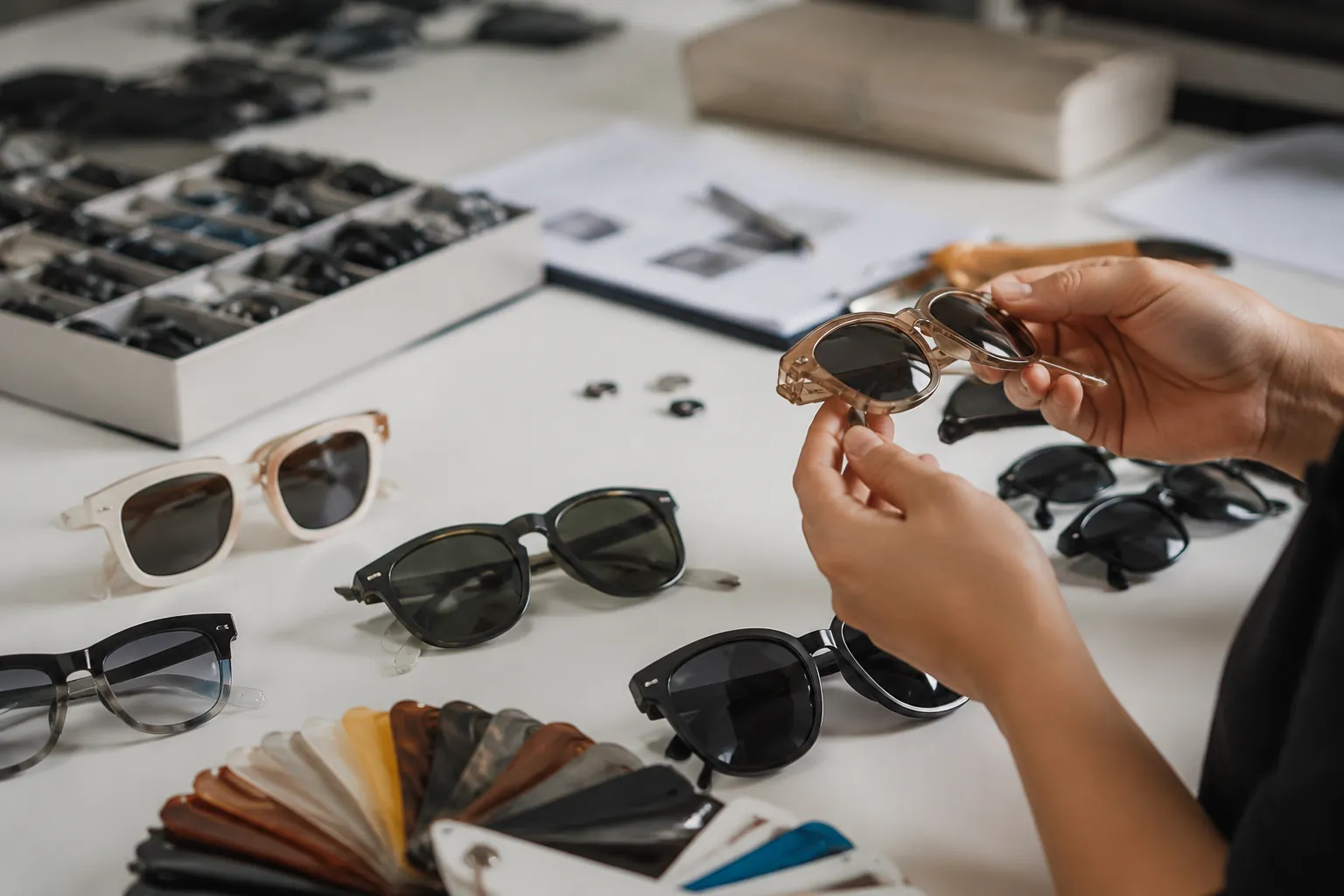
If you buy sunglasses for a brand, chain, distributor, or online store, mixed MOQ can make or break the deal. You want one collection with hero SKUs, a few test styles, and extra colorways, but the factory still needs order value and line efficiency to stay in range. This guide shows how to structure the order so you keep pricing workable, avoid dead inventory, and move samples and bulk on time.
Start with the role of each SKU
Do not treat every frame as equal. In a mixed MOQ program, the factory does not see a collection. It sees line items, each with its own tooling, color prep, decoration steps, inspection points, and packing needs. If you classify SKUs before quoting, you protect margin and avoid overbuying weak shapes.
Use three buckets before you send RFQs:
- Hero SKU: the style you expect to repeat. Usually the safest shape, color, and lens combination. Give it the highest quantity and the cleanest spec.
- Test SKU: a new shape, bridge profile, rim thickness, or lens tint you are validating with buyers or consumers. Keep the quantity low and the specs simple.
- Add-on colorway: the same frame platform with a different finish, lens tint, or temple color. It widens the assortment without adding much engineering risk.
This split matters because cost is not linear. A new front mold, a new metal logo plate, a new lens tint, or a new packing artwork file all create setup cost. On a 50-pair run, a 30-minute changeover is expensive. On a 1000-pair run, that same setup is easier to absorb.
The fastest way to improve price is usually to keep the frame platform stable and change only one variable at a time: color, tint, or decoration. For example, if a style has three colorways and one shared lens shape, ask the factory to quote it as one design family with three SKUs, not three separate projects. That lets production plan by platform instead of by one-off style. A practical starting point for a private-label sunglass program is often 50 pairs per design for validation, 300 pairs for the first commercial run, and 1000+ pairs for the core winner.
Use quantity bands, not one blanket MOQ
Mixed MOQ sourcing works better when the order is built around quantity bands, not a single minimum. Factories price for line efficiency, material purchasing, setup time, and rework risk. Buyers should think the same way. A 50-pair run is usually a test of demand and execution. A 300-pair run is the first real cost break. At 1000 pairs and above, you can negotiate more firmly on raw materials, decoration, and packaging.
The question is not "What is the MOQ?" It is "What is the cheapest quantity where this SKU is still worth running?" That number changes by material and process. Injection frames often run more efficiently in repeat colors because the mold family is fixed. Acetate styles usually need more cutting, tumbling, polishing, and manual inspection. Metal or mixed-material designs add assembly steps and alignment risk. When a factory quotes a mixed order, it is balancing all of that at once.
| Order band | Best use | Typical buyer move | Factory impact |
|---|---|---|---|
| 50 pairs/design | Prototype, buyer review, small market test | Limit colors, keep decoration basic, avoid custom tooling | High setup cost per pair; line disruption is proportionally large |
| 300 pairs/design | First commercial run | Choose 2-3 best colors, standard lenses, and one packaging style | Better machine utilization and lower unit cost; setup cost starts to amortize |
| 1000 pairs/design | Core seasonal style | Lock packaging, repeat the frame, add one extra colorway | Much better amortization of setup, QC, and material purchasing |
| 5000+ pairs/design | Volume replenishment | Negotiate raw material buys and simplify decoration | Lowest unit cost and the most stable production rhythm |
A common mistake is spreading 50 pairs across too many styles, then asking for premium customization on each one. That creates too many changeovers, too many approvals, and too much QC work. A better structure is to let one hero SKU carry the volume and keep test styles visually close to it. Same front shape, different lens tint. Same acetate front, different temple finish. Same lens base curve, different mirror coating.
Build the order around shared components
Shared components are the backbone of efficient mixed MOQ buying. The more SKUs that reuse the same technical base, the more the factory can schedule them as a family instead of as isolated jobs. In eyewear, the main shared platforms are frame geometry, lens size, temple structure, and decoration zone.
Watch the tolerance stack carefully. A lens size that looks close enough in a sketch may create real fit and yield problems in production. Temple length, hinge position, and lens groove alignment should be specified tightly enough that the line can standardize assembly. For most commercial sunglasses programs, buyers should ask the factory to confirm the critical dimensions before sampling, especially if multiple materials are involved.
- Frame platform: same injection mold family or same acetate front shape; this is the biggest cost lever.
- Lens platform: same lens size, base curve, and edge geometry; only tint, coating, or mirror finish changes.
- Temple platform: same hinge position, temple length, and temple tip style; logo or finish variations can sit on top.
- Decoration platform: same pad-print area, same laser zone, same metal plate size, and same artwork placement rules.
LumiShades handles injection molding, acetate cutting, CNC milling, lens tinting, and decoration in-house. That matters because the factory can sequence related SKUs with fewer handoffs and fewer quality gaps. Injection molded frames generally move faster when color changes stay within the same mold family. Acetate needs more labor in cutting, polishing, and surface finishing, but it also gives richer color depth and a more premium feel. CNC milling can tighten geometry and branding detail on premium acetate or metal styles, but it adds time and requires better file control. If you mix all three material families in one order, expect the factory to schedule them as separate production tracks even if the PO is technically one collection.
Keep at least one major component constant across as many SKUs as possible. If frame material, lens treatment, and decoration all change at once, you no longer have a mixed MOQ collection. You have several small orders pretending to be one.
Choose custom work with care
Not every custom feature earns its keep. In a mixed MOQ program, the biggest mistake is using extra details to rescue a weak style. Separate value-adding customization from decoration that only increases reject risk or slows the line.
Add custom work only after the style proves itself. If a frame shape is untested, start with the cleanest version you can sell. Once demand is proven, layer in more brand-specific details. This matters most on low-volume styles, where one decoration change can affect both yield and lead time.
- High-value customizations: logo engraving, pad printing, metal logo plates, selective temple finish, and brand-specific lens tints that support the collection story.
- Moderate-cost changes: frame color, lens color, matte versus glossy surface, and simple packaging updates with limited artwork variation.
- Costly changes: new tooling, unusual hinge structures, multi-layer decorations, frequent artwork revisions, and one-off packaging formats.
The process detail matters. Pad printing needs screen setup, ink matching, and cure checks. If artwork changes every few days, the line loses time on setup and rejection review. Laser engraving needs stable file control, exact placement, and sometimes a sample pass to confirm depth and legibility. Metal logo plates need consistent adhesive or fastening, and that consistency is harder in small batches because operators have less repetition. A 50-pair run with three artwork revisions is not flexible. It is expensive.
Use any customization that changes tooling, placement, or finishing sequence as a premium feature. Use it only when the customer-facing value clearly exceeds the added cost and delay.
Plan lead times by bottleneck
Sample and bulk timing should be managed by process stage, not by the date on the PO. A factory lead time is really a chain of sub-lead-times: spec confirmation, material preparation, production, finishing, QC, and packing. If one stage slips, the shipment slips.
LumiShades quotes samples in 7-10 days and bulk in 25-35 days, but those numbers only hold when the spec is stable. The biggest delays usually come from preventable buyer-side changes: late artwork edits, unconfirmed lens tints, packaging text corrections, or hardware substitutions after sampling starts.
| Stage | Typical timing | What delays it | Buyer control point |
|---|---|---|---|
| Sample making | 7-10 days | Artwork changes, lens color approval, hardware substitutions | Freeze specs before sample approval |
| Material prep | 3-7 days inside bulk lead time | Special acetate color, custom lens tint, packaging print | Confirm colors, carton text, and artwork early |
| Production | 10-18 days inside bulk lead time | Complex decoration, mixed tooling, QC rework | Keep shared components aligned |
| Final QC and packing | 3-7 days inside bulk lead time | Label errors, lens scratches, hinge torque issues | Approve QC standards before the run starts |
Mixed MOQ orders often slip because one slow SKU holds the line hostage. A hero SKU should not wait for a test style that needs extra artwork sign-off. Ask the factory for a production split by SKU, not just one total delivery date. If the order is well structured, the production manager can release the urgent SKU first and keep slower items from blocking shipment.
For buyers, the best lead-time control is a clean approval chain: sample approval, color approval, packaging approval, then bulk release. If any of those are fuzzy, the factory will protect itself with extra buffer, and that buffer usually shows up as a longer lead time or a higher price.
Group by material and finish
Material mix is one of the fastest ways to damage price efficiency. Acetate, injection, metal, and mixed-material frames do not behave the same in production, even when the finished product looks similar on a sales sheet. If you cluster them badly, the factory absorbs extra changeover time and recovers that cost in the quote.
Injection frames are usually best when you want repeat colors, standard lens shapes, and stable geometry across a larger run. Acetate frames are more premium in hand feel and color depth, but they bring extra steps such as cutting, polishing, tumbling, and more detailed inspection. Metal or mixed-material styles usually carry the highest assembly complexity because they need tighter fit control and more careful alignment.
The smartest way to protect price is to group by finish and production method. Put matte black injection frames together. Put translucent acetate styles together. Put mirrored lens variants in one batch. That lets the factory reduce cleaning, changeover, and operator fatigue. These are the costs behind small-order penalties.
Also watch the jump between quantity bands. In many eyewear programs, the difference between 50 pairs and 300 pairs matters more than the difference between 1000 and 1500 pairs, because setup cost is the largest fixed burden. Once a style is proven, the economics improve quickly. That is why the 300-pair band is often the smartest first commercial test: big enough to run cleanly, small enough to limit risk.
Check compliance before mixing markets
Mixed MOQ gets messy when one collection is sold into multiple markets. Do not assume one compliance file works everywhere. Map the target markets first, then build the SKU spec around the right standard set for each destination.
LumiShades states real certifications only: CE EN ISO 12312-1, FDA registration, ANSI Z80.3, AS/NZS 1067, REACH, ISO 9001, and BSCI. Use that list correctly and tie the right construction to the right test report. A lens tint change, frame material change, or coating change can matter for documentation, traceability, or local retail requirements.
| Market use | Key standard or requirement | What to verify on the sunglasses |
|---|---|---|
| EU and similar channels | CE EN ISO 12312-1 | Lens protection category, optical quality, labeling, and required documentation |
| US retail channels | FDA registration and ANSI Z80.3 | Impact resistance, labeling, and product traceability |
| Australia and New Zealand | AS/NZS 1067 | Lens and frame compliance for local retail sale |
| Materials and restricted substances | REACH | Material declarations and restricted substance control |
Handle compliance early because it can affect artwork, packaging, and even SKU names. If the hero SKU is for Europe and a test colorway is for the US, the warning text, carton copy, and declaration files may need to differ. Separate the file pack by market before bulk starts and confirm which SKU carries which documentation. That keeps one market from contaminating another and avoids expensive rework at the end of production.
Build a run plan the factory can use
The cleanest mixed MOQ order is one a production manager can schedule without guesswork. If your supplier cannot build a clear run plan from your RFQ, expect pricing gaps, delayed samples, and a lot of back-and-forth before bulk can start.
A workable structure looks like this: choose one hero style with the highest expected repeat volume, add one or two test styles that share tooling, lens size, or temple parts, and keep each test style at the minimum useful quantity. In practice, that often means 50-300 pairs for validation and 300-1000 pairs for styles with early pull-through. Then freeze color, lens tint, logo placement, packaging, and carton text before bulk release. Do not keep changing artwork during production unless you are willing to pay for the disruption.
Send a line list, not a mood board. The factory needs style codes, materials, colors, decoration method, lens type, target market, and target quantity by SKU. It also needs to know whether the collection is one injection family, one acetate family, or a mixed build. If one SKU is laser engraved and another uses pad print or a metal logo plate, say that plainly. The more detail you provide up front, the fewer assumptions the factory has to make. Assumptions are where pricing errors begin.
LumiShades can support that structure because it has in-house molding, cutting, CNC milling, lens tinting, decoration, and QC. That means fewer external handoffs, tighter process control, and less risk that one weak SKU will delay the whole shipment. For the buyer, the benefit is clearer cost and lead-time control. For the factory, it means a run worth scheduling. That is the balance in mixed MOQ sourcing.
Have a custom sunglasses project in mind?
Send us your styles, target market and quantities and we will return a detailed quote with MOQ, lead time and a sample plan.
Get a QuoteWhy source this from Wenzhou with LumiShades
Wenzhou in Zhejiang Province is widely regarded as China’s eyewear manufacturing capital, producing a large share of the world’s sunglasses. That concentration matters to buyers: a deep local supply chain for acetate sheet, hinges, lens blanks, plating and packaging means shorter component lead times, easier color and material matching, and a workforce with decades of eyewear-specific skill. LumiShades has manufactured in this ecosystem since 2009, and our vertical integration — in-house injection molding, acetate cutting, CNC milling, lens tinting, decoration and quality control — means no part of your order is quietly subcontracted to a workshop you cannot audit.
For international buyers, that vertical control translates into accountability. When a single factory owns every step, defects are traced and fixed at source rather than bounced between vendors, and your specifications survive intact from first sample to bulk. We back this with 15+ years of experience, shipments to 60+ countries, more than 5 million pairs produced per year and a 98.5% on-time delivery rate. Our certifications — CE EN ISO 12312-1, FDA registration, ANSI Z80.3, AS/NZS 1067, REACH, ISO 9001 and BSCI audit — mean the compliance documentation your market requires already exists. Explore our manufacturing capabilities and quality control process to see how this works in practice.
Frequently asked questions
How should I split a 1,000-pair order across mixed MOQs? Put most pairs into one hero SKU, then use smaller quantities for one or two test styles. Keep shared tooling, lens size, and decoration methods where possible so the factory can keep unit cost down. A common split is 600-700 pairs for the hero, 150-200 pairs for one test style, and the rest for a second test colorway or a replenishment color.
Can I mix acetate and injection frames in one order? Yes, but expect different cost structures and process steps. Keep the order organized by material type so the factory can plan separately and avoid repeated changeovers. If you mix them, try to keep lens size, packaging, and decoration methods consistent so the factory still has some shared work to batch.
What is the fastest way to keep pricing under control? Reuse the same frame platform and change only one variable at a time, such as color or lens tint. New tooling, special coatings, and complex decoration are the fastest ways to push price up. Keep artwork stable too, because repeated file revisions create hidden setup cost even when the frame itself does not change.
Which certifications should I ask for on a mixed market order? Match the certification to the market: CE EN ISO 12312-1 for Europe, FDA registration and ANSI Z80.3 for the US, AS/NZS 1067 for Australia/New Zealand, and REACH for restricted substances. Do not ask for standards you do not need, and make sure the tested construction matches the SKU you are selling.
How do I avoid one slow style delaying the whole shipment? Split the schedule by SKU and approve the spec sheet before production. If one test style needs extra decoration or artwork approval, keep it from blocking the hero SKU. Ask for a production plan that shows release dates by style so you can spot bottlenecks before they hit the line.
Ready to start?
Explore our aviator sunglasses or request a quote — our sales team replies within 12 hours.
Request a Quote