
Sunglasses Vendor Scorecard for Reliable Reorders
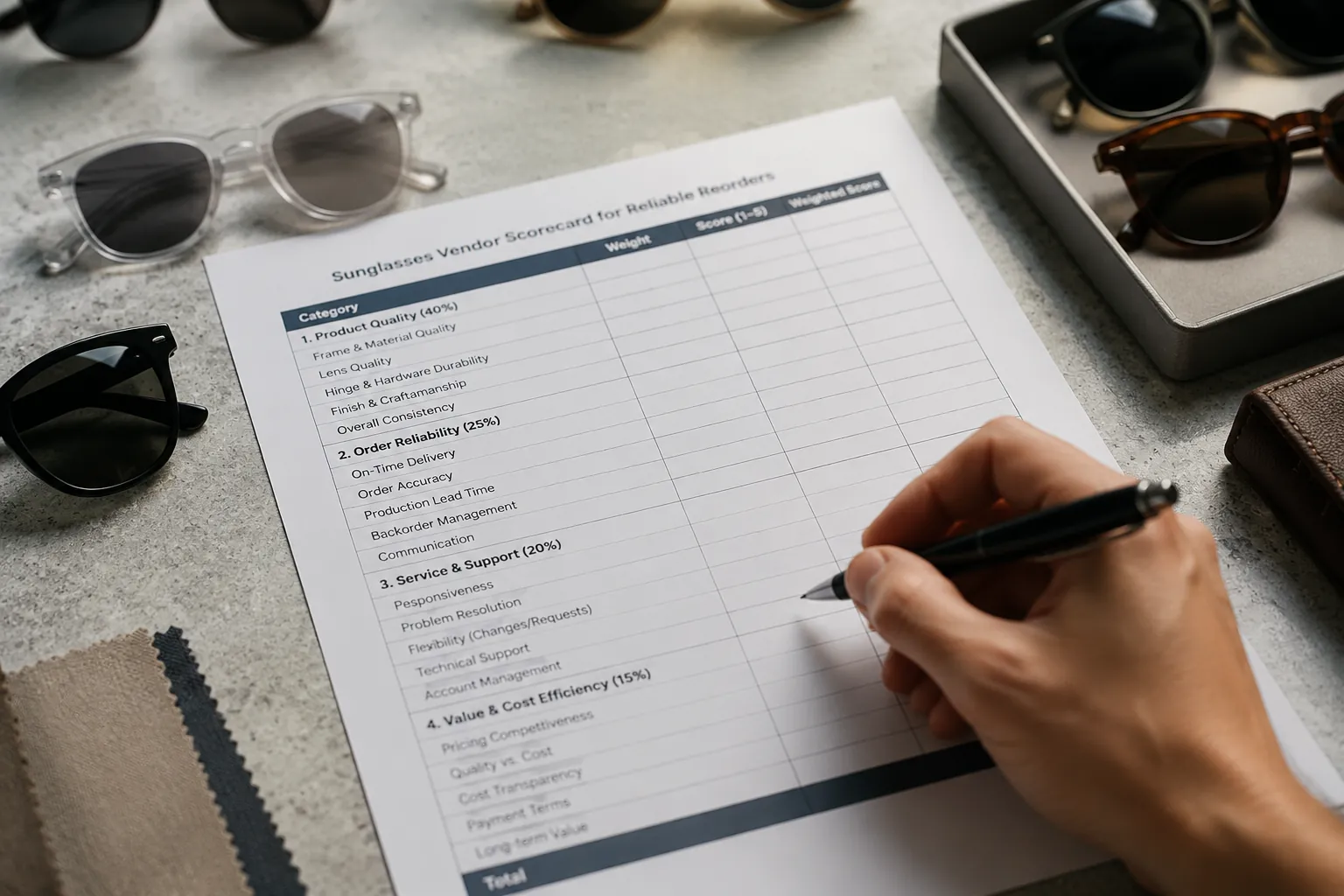
If you buy custom sunglasses for retail, private label, or distribution, the first order is only a starting point. The real test is the second and third purchase order. Can the supplier repeat the same frame, tint, logo placement, carton count, and ship date without drift? This scorecard helps you compare vendors on sample accuracy, communication, defect control, lead-time reliability, capacity, and compliance before you commit volume. Use it to avoid a cheap quote that looks fine once and fails after launch.
What a Reorder Scorecard Must Predict
Most buyer scorecards reward a clean sample and stop there. That is a mistake. A sunglasses factory can hand-build one attractive pair, then drift on hinge torque, lens tint, logo position, and packaging once the order moves into full production.
Your scorecard should measure whether the vendor can hold spec when material lots change, tooling heats up, decoration starts, and packing staff rotate. Samples matter. Repeatability matters more.
A useful reorder scorecard should predict six things: how closely the sample matches the tech pack, how quickly the vendor responds to changes, how clearly defects are defined and controlled, whether lead times stay stable after the first PO, whether the factory has real spare capacity, and whether the compliance file matches the target market.
A vendor that can make one good sample is not the same as a vendor that can ship 10,000 matching pairs.
That distinction should drive the scoring. If the supplier cannot repeat the same bridge fit, frame finish, lens tint, and decoration alignment after tooling and packing are in motion, the quote is not stable enough for scaling.
Think in production terms, not sales terms. Ask what happens when acetate humidity changes, when an injected frame cools too fast, when a lens tint batch is 3 percent darker than the previous lot, or when the logo process switches from pad print to laser marking. Reorder performance depends on those details. Not on a polished email thread.
Score the Sample Like a Production Part
Start by comparing the pre-production sample against the tech pack with a ruler, a caliper, a light box, and, if possible, a simple torque gauge for the hinges. Measure the dimensions that affect fit and appearance: frame width, temple length, bridge width, lens height, and the distance between lens centers.
For most fashion sunglasses, a practical tolerance is about plus or minus 1.0 mm on overall frame dimensions, plus or minus 0.5 mm on key fit points such as bridge width, and tighter control of logo placement, often plus or minus 0.3 to 0.5 mm depending on the decoration method.
Check the sample as if it were a production part, not a showroom piece. Open and close the temples 20 to 30 times. Watch for hinge wobble, uneven torque, spring hinge bounce, or screw movement. Hold the lenses against a white background and compare right-left tint density under the same light source. If the product uses polarized lenses, rotate them against a phone screen to confirm the effect is consistent across both lenses.
For acetate frames, inspect edge polish, lamination alignment, visible glue lines, and stress whitening around the hinge screw. For injected frames, look for sink marks, flow lines, and warpage after a warm-cold cycle. These problems often appear only after the part relaxes.
Decoration matters as much as dimensions. Pad printing should have crisp edges with no ink bleed or double image. Laser logos should be centered and consistent in depth, especially on glossy temples where surface variation can change the look. Foil or hot-stamp decoration should not crack after hinge cycling. If the supplier uses metal plates, embossing, or in-mold labels, ask for a close-up photo at 5x to 10x magnification before approval.
A practical approval routine looks like this:
- Measure the critical dimensions and confirm they stay within the agreed tolerance, usually around plus or minus 1 mm for frame dimensions and tighter for logos and lens placement.
- Cycle the temples 20 to 30 times and check for hinge wobble, asymmetrical torque, or screw back-out.
- Compare tint density, lens color, and polarization performance on a white background under the same light.
- Inspect all print, plate, or laser marks for blur, misalignment, adhesion loss, or depth variation.
- Check the box set: microfiber pouch, cleaning cloth, inserts, UPC label, and carton count should all match the packing spec.
If the sample arrives a week late, score that. If the factory needs three revision rounds to match the drawing, score that too. A supplier that can turn a sample in 7 to 10 days and lock the revision quickly is showing process control, not just speed.
Communication Shows Process Control
Communication is not about friendliness. It is about whether the factory can absorb change without losing the order.
A good supplier asks concrete questions early: target market, UV claim, lens category, frame material, decoration method, packaging standard, carton drop test, and compliance target. A weak supplier says yes to everything, then discovers later that the spec was never pinned down.
Score the interaction on behavior that predicts production discipline:
- Do they answer within one business day, or do they disappear for three days at a time?
- Do they send marked-up drawings, photos, and revision notes instead of only chat messages?
- Do they explain the effect of a color change, lens tint change, or logo change on tooling, minimum order quantity, and lead time?
- Do they assign one owner for the project, or do you get bounced between sales, engineering, and production?
- Do they keep a change log with version numbers for the tech pack, artwork, and packaging spec?
That written trail matters because sunglasses production has many handoffs. A frame color change may require a different resin lot. A lens tint change may require a new dip time or coating setting. A logo change may require a different pad, cliché, or laser file.
If the vendor cannot describe those consequences clearly, they probably do not control them consistently.
One simple test: ask the factory to restate the order in writing before tooling starts. The reply should include model name, color code, lens spec, decoration method, packaging count, carton quantity, and target ship week. If any of those are vague, reorder risk is still high.
Measure Defects by Type, Not by Apology
Do not ask for a vague quality promise. Ask for defect definitions.
A lens scratch in the optical center is not the same as a mark on the outer edge of the lens. A crooked logo is not the same as a carton scuff. A loose hinge screw is not the same as a small dust point in the pouch. If the supplier cannot separate critical, major, and minor defects before shipment, their defect rate will not help you make a reorder decision.
For sunglasses, the most useful quality system has three checkpoints: incoming raw material inspection, in-process checks, and final QC before packing. This matters because frame material, lens tint, hinge hardware, and decoration are often controlled in different steps.
An integrated factory that handles injection molding, acetate cutting, CNC milling, lens tinting, decoration, and final QC under one roof can stop a bad batch earlier than a supplier that outsources half the process.
The numbers matter too. Ask for defect counts from the last three similar production runs, not just the latest shipment. If a factory says rework was 2 percent, ask what the rework actually was: hinge alignment, missing screws, lens discoloration, poor print, or carton damage.
A supplier that tracks root cause can usually break defects into percentages by type. A weak supplier offers a general apology.
Common defect categories worth scoring separately include:
- Critical: lens optical contamination, sharp edges, severe warpage, broken temples, wrong UV spec.
- Major: off-center logo, mismatched tint, loose hinge, visible sink mark, incorrect accessory count.
- Minor: small dust speck, slight box rub, tiny surface mark outside the visible area.
Repeat defects should be penalized harder than one-off misses. If the same hinge problem appears on two consecutive runs, the issue is probably not random. It is a process gap.
Compare Lead Time, Capacity, and Price
Lead time only matters if it stays stable after the first order. A trader can quote fast and then wait on the real factory. A small workshop can build prototypes quickly and then run out of machine time.
You need to know what the supplier can do at 50 pairs, 300 pairs, 1,000 pairs, and 5,000 pairs. The economics change. So does the risk.
For a launch program, a common pattern is MOQ 50 pairs per design and 7 to 10 days for sample development. Bulk production often falls in the 25 to 35 day range once materials, decoration, and packing are confirmed, but only if the factory has inventory or a predictable supply chain.
If a vendor claims a much shorter schedule, ask whether that includes material procurement, curing or coating time, final inspection, and carton packing. Fast quotes often exclude the steps that create delays.
Price should be examined the same way. A lower unit price at 5,000 pairs can be real if setup cost is spread across more units. It can also hide downgraded lens grade, thinner packaging, skipped inspection, or a simpler decoration method.
The right question is not just what the pair costs. Ask what changes as volume increases. If 50 pairs cost $4.80 and 1,000 pairs cost $2.95, ask what drives the drop. If the quote at 5,000 pairs falls to about $2.10, confirm whether that assumes a standard frame color, basic pad print, and simple pouch only.
| Supplier model | What you usually see | What it means for reorders |
|---|---|---|
| Trading-only seller | Fast replies, limited process detail, schedule depends on outside factory | Higher risk of drift when you repeat the order |
| Small workshop | Good samples, uneven bulk timing, capacity tied to one or two machines | Fine for test runs, risky for back-to-back POs |
| Integrated factory | In-house injection, acetate cutting, CNC, tinting, decoration, QC; sample in 7 to 10 days; bulk in 25 to 35 days | Better repeatability, cleaner change control, and easier deadline management |
If the factory has documented spare capacity, ask how much is truly available without overtime. Ten extra machine hours on paper is not the same as having raw material, trained operators, and packaging space ready. Score capacity based on the most constrained step, not the biggest promise.
Compliance Documents Must Match the Market
Compliance is not a logo on a brochure. It is a document set tied to one model, one lens type, and one market.
Ask for the actual test report, not a screenshot of a certificate wall. The report should show the exact product family, sample ID, issue date, test standard, and lab name. If the vendor says the report is for a similar model, that is not enough for a reorder decision.
For Europe, buyers commonly ask for CE-related product testing against EN ISO 12312-1 for sunglasses. For the United States, FDA registration may be part of the paper trail, but it does not replace product testing or the correct product claim. ANSI Z80.3 is still a common request for impact and sun protection performance. For Australia and New Zealand, AS/NZS 1067 is the relevant reference. REACH matters when you need restricted-substance control in the EU supply chain.
If you sell into multiple markets, the compliance file should be organized by SKU and region, not by generic factory certificate.
Useful document checks include:
- Does the report match the exact frame material, lens tint, and model you plan to order?
- Is the issue date recent enough to cover the current mold, resin, decoration method, and lens supplier?
- Does the standard version match the market requirement you actually sell into?
- Are ISO 9001 and BSCI current if you care about process discipline and social-audit visibility?
- Can the factory provide a declaration, test report, and product photo without delays or excuses?
If a supplier struggles to produce documents, treat that as a production risk, not just a paperwork issue. Vendors with weak document control usually also have weak revision control and weak traceability.
Turn the Score Into a Reorder Decision
Once the data is in hand, score the supplier out of 100. A practical weighting is sample accuracy at 25 points, communication at 15, defect control at 20, lead-time reliability at 20, capacity at 10, and compliance at 10.
That weighting is not sacred, but it reflects where reorder failures usually happen: poor sample translation, slow problem solving, and missed dates.
Use hard gates, not just averages. A vendor should not score well if the sample is wrong, even when communication is excellent. A low price should not rescue weak QC. The reorder decision should be based on whether the supplier can hold the same result across a pilot lot, a repeat PO, and a slightly larger volume.
- Give full points only if the sample matches the tech pack, decoration placement is stable, and the factory resolves revisions in one or two rounds.
- Deduct hard for missed promise dates, unclear root cause, or unexplained spec changes between quote, sample, and bulk production.
- Cap the total if the vendor cannot show a live production schedule, a believable capacity plan, and a named owner for change control.
- Run a pilot reorder before scaling. A good partner should hold the same quality when the PO moves from 50 pairs to 300 or 1,000.
A useful interpretation is simple: 85 and above is worth scaling, 70 to 84 is pilot only, and below 70 is a pass. If the vendor only gets cheap by cutting packing quality, lens consistency, or inspection time, the reorder will cost more later.
Predictability beats the lowest line item.
Have a custom sunglasses project in mind?
Send us your styles, target market and quantities and we will return a detailed quote with MOQ, lead time and a sample plan.
Get a QuoteWhy source this from Wenzhou with LumiShades
Wenzhou in Zhejiang Province is widely regarded as China’s eyewear manufacturing capital, producing a large share of the world’s sunglasses. That concentration matters to buyers: a deep local supply chain for acetate sheet, hinges, lens blanks, plating and packaging means shorter component lead times, easier color and material matching, and a workforce with decades of eyewear-specific skill. LumiShades has manufactured in this ecosystem since 2009, and our vertical integration — in-house injection molding, acetate cutting, CNC milling, lens tinting, decoration and quality control — means no part of your order is quietly subcontracted to a workshop you cannot audit.
For international buyers, that vertical control translates into accountability. When a single factory owns every step, defects are traced and fixed at source rather than bounced between vendors, and your specifications survive intact from first sample to bulk. We back this with 15+ years of experience, shipments to 60+ countries, more than 5 million pairs produced per year and a 98.5% on-time delivery rate. Our certifications — CE EN ISO 12312-1, FDA registration, ANSI Z80.3, AS/NZS 1067, REACH, ISO 9001 and BSCI audit — mean the compliance documentation your market requires already exists. Explore our manufacturing capabilities and quality control process to see how this works in practice.
Frequently asked questions
What sample result is good enough to approve a reorder? The sample should match the critical dimensions, decoration placement, tint, and hinge feel in your tech pack. As a working rule, look for plus or minus 1 mm on frame dimensions, tighter control on logo placement, and no visible hinge instability after 20 to 30 open-close cycles. If it takes more than two revision rounds to get there, treat that as a risk signal.
Is the lowest quote usually the best choice? No. A low quote is only useful if the supplier can explain what happens to materials, inspection, decoration, and lead time at 300, 1,000, and 5,000 units. If they cannot explain the cost curve, the price is probably incomplete.
What compliance documents should I ask for on sunglasses? Ask for the test report that matches your model and market. Common buyer requests include CE-related testing to EN ISO 12312-1 for Europe, supporting FDA-related paperwork for the US, ANSI Z80.3, AS/NZS 1067, and REACH where relevant. Make sure the report lists the exact sample, issue date, and lab.
How do I judge lead-time reliability before I place a bigger order? Ask for the last three shipments, the promised date, the actual ship date, and the reason for any delay. Then ask what happened at each step: material intake, production, decoration, final QC, and packing. If sample work and bulk work run through different people or different factories, score that as extra risk.
Should I score a trading company and a factory the same way? Use the same scorecard, but give extra weight to transparency for traders. If they cannot identify the actual factory, process steps, revision owner, and quality checkpoints, you are not comparing like with like.
Ready to start?
Explore our square sunglasses or request a quote — our sales team replies within 12 hours.
Request a Quote