
Build a Sunglasses SKU Matrix for Wholesale
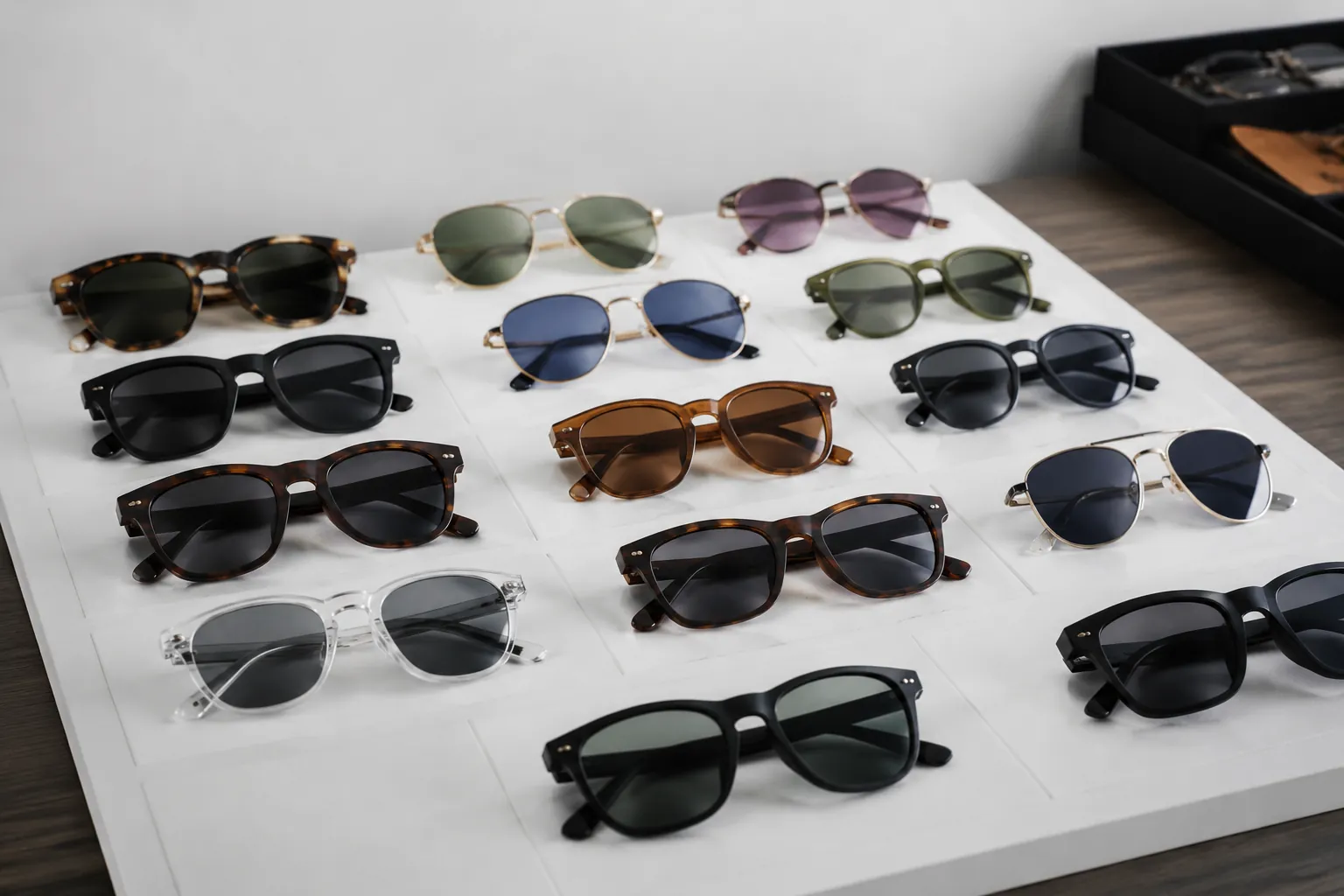
If you buy sunglasses for a brand, import business, retail chain, or distributor network, the hard part is not finding decent samples. It is keeping assortment, cost, and replenishment under control so inventory does not turn into dead stock. A strong SKU matrix shows which styles are core, which are seasonal, and which are test buys. That keeps you from over-ordering slow movers or starving the styles that sell. This guide shows how to build that matrix around price tier, style family, channel, MOQ, lead time, and compliance, using sourcing logic that fits overseas buying.
Start With the Buying Job, Not the Style Board
A useful SKU matrix starts with how the sunglasses will be sold, not how they look on a design board. A pair that works in a beach resort store may fail in a pharmacy chain, an online bundle, or an airport kiosk. Channel sets the price ceiling, the frame construction, the lens spec, the packaging standard, and how much assortment you can carry without losing control.
For wholesale buying, group demand into three jobs: core replenishment, seasonal drops, and test SKUs. Core replenishment needs repeat sales, stable margin, and a low defect rate because it will be reordered. Seasonal drops can take more color risk, more unusual lens tints, and shape changes that create interest for a limited window. Test SKUs should be inexpensive enough to fail fast. Keep them simple.
The production route should follow the buying job. Injection molding fits repeatable, lower-cost, high-volume frames with consistent fit and faster cycle times. Acetate cutting and CNC milling suit heavier premium looks, more material value, and a more refined hand-feel. Decoration can vary without changing the whole mold: laser engraving gives crisp branding, pad printing is faster and cheaper for simple logos, and metal logo plates support a more premium presentation. Set the production route before choosing colors.
Do not build a matrix around "nice-looking" samples. Build it around sales velocity, replacement logic, and channel fit. If a style is meant for a chain store, it should have a long life, stable dimensions, controlled color variance, and parts that can be reordered without drama. If it is a social or seasonal SKU, accept that it may only sell for one window and should not consume premium tooling time or oversized packaging budgets.
Each SKU should answer one business question. Does it drive volume, support brand image, test a new market, or fill a channel gap? If the answer is unclear, the SKU is probably too expensive for the first round.
Use a Three-Tier Price Ladder
Your SKU matrix should have a clear cost ladder so sourcing decisions stay grounded. A price ladder helps you choose materials, packaging, and decoration without guessing. A simple wholesale structure is entry, mid, and premium, and each tier should have a target landed-cost range, a margin expectation, and a production discipline.
| Tier | Typical Use | Target Buy Logic | Factory Fit |
|---|---|---|---|
| Entry | Promotions, bundles, large chain orders | Lowest landed cost, simple lens and frame spec, minimal decoration | Injection molding, pad print, standard pouch or carton, fewer color variants |
| Mid | Mainline retail and distributor stock | Balanced margin and shelf appeal, enough quality to support repeat purchase | Injection or acetate, laser logo, better lens tint options, upgraded packaging |
| Premium | Brand-led collections and higher-AOV channels | Higher material value, stronger perceived quality, tighter finishing standards | Acetate cutting, CNC milling, metal logo plates, polished edges, stricter QC |
MOQ and price should move together. A low-volume test order should not carry the same decoration budget as a large core frame order. At low volume, each added process step matters more. A second color, a custom temple insert, or a specialty box can push landed cost into the wrong range. At higher volume, setup costs are spread across more units, so a more refined finish can make sense.
Align the assortment by tier. Entry products should favor repeatable injection parts and standard lens packages. Premium products can justify acetate, precision milling, and tighter polish standards. Use the ladder to assign acceptable materials. A low-cost channel usually cannot recover acetate or metal temple details unless the sell price is high enough. A premium channel usually can, but only if the finishing is clean enough to justify the price.
Keep the logic simple: if the channel cannot pay for the material, the material should not be in the first sample set.
Build Around Style Families, Not Random Designs
The fastest way to create a messy catalog is to launch isolated styles with no family structure. A better matrix groups SKUs by frame shape and end use. Most wholesale sunglasses assortments can be organized into a few families: round, square, navigator, cat-eye, sport, and kids. Each family becomes a controlled product lane instead of a one-off experiment.
Within each family, vary only one or two variables at a time: frame color, lens color, finish, or logo placement. If you change everything at once, you will not know what sold, and production becomes harder to repeat. Every new shape or complex molding detail adds risk in tooling, fit, and QC. Even small dimensional changes can alter temple alignment, hinge stress, or lens seating.
A square acetate family can share the same front profile while varying temple thickness, lens tint, and decoration method. A sport family can share a base frame while changing lens category, rubber contact points, or mirrored coating. That gives you a cleaner sell-through read and a more manageable factory schedule. As a rule, a family should have one hero shape, one core lens set, and a tightly limited color palette.
- Pick one hero shape per family.
- Limit each family to 3 to 5 colors.
- Keep core lens tints consistent across channels.
- Use one decoration method where possible.
- Only add a second variant if sell-through supports it.
This keeps the matrix readable for purchasing, merchandising, and production. It also reduces changeover time. Too many one-off styles increase mold swaps, raise inspection time, and make forecasting worse. In wholesale, breadth only helps when it is organized.
Assign Every SKU a Channel Role
Each SKU should have one job in one channel. If a style is meant for wholesale distribution, do not also expect it to carry your brand story in premium retail. If a frame is built for marketplace pricing, it should not be forced into a boutique assortment with a much higher presentation expectation. The channel role determines the spec. Set that first.
Use channel roles such as core retail, promo, online only, travel, resort, optical add-on, or private label launch. Then set the design and cost structure from the role, not the other way around. A resort SKU can tolerate stronger color, mirrored lenses, or a more playful shape. A pharmacy SKU needs broad appeal, stable supply, and conservative styling. An online test SKU needs strong photos, a tight cost cap, and packaging that survives transit and returns.
For overseas buyers, channel role should also include compliance scope. Different markets require different paperwork or test standards, and the destination market should drive the file. Keep the documents aligned to the market you are actually selling into, and do not copy a compliance list from one region to another without checking the destination requirements. Real-world programs commonly reference CE EN ISO 12312-1, ANSI Z80.3, AS/NZS 1067, REACH, FDA registration, ISO 9001, and BSCI, depending on market and supply-chain requirements.
A useful practice is to add a channel code to every SKU line: for example, CR for core retail, PR for promo, ON for online, and RS for resort. Then define the allowed construction, decoration, and pack-out for that code. That prevents the common mistake of moving a high-touch premium build into a price-sensitive channel where it will never recover its cost.
Blunt rule: If you cannot explain why a SKU exists in one sentence, it should not be in the first production round.
Match Construction to Price and Risk
Material choice should follow margin and failure risk. Injection molding is efficient for volume and cost control, especially when the same base front or temple shape needs to be repeated across colors. Acetate gives a more solid feel, deeper color saturation, and better premium positioning, but it requires more careful handling, more finishing time, and better polishing discipline. CNC milling is useful where shape control and precision matter, especially on premium designs with sharper edges or more technical geometry.
Lens choice matters just as much as the frame. Tint density, color consistency, and coating quality affect both compliance and customer satisfaction. A cheap tint that varies by batch will create more returns than a slightly simpler frame. Polarized lenses, mirrored coatings, and gradient tints can improve sellability, but they also add process control requirements. If the lens spec is inconsistent, the buyer notices it before the customer does.
Decoration can also create defects if the process is not controlled. Pad printing is fast and economical, but it may wear faster than laser engraving or a metal logo plate. Laser marks are durable and clean, but they require correct placement and material compatibility. Metal plates look premium, but they increase cost and can create adhesion or alignment issues if the temple geometry is not stable. The matrix should define decoration by channel and expected handling, not by what looks good on a sample photo.
| Construction | Best For | Buyer Trade-Off | Typical Risk |
|---|---|---|---|
| Injection molded frame | Volume programs, low to mid price | Best cost control, fast repeat orders, easier scale-up | Less premium feel if overused |
| Acetate frame | Mid to premium assortment | Stronger perceived value, better brand fit, richer color depth | Higher cost, more finishing care, more QC sensitivity |
| CNC milled parts | Premium or precision-driven styles | Sharp detailing, more refined look, stronger differentiation | Higher processing cost, tighter dimensional control needed |
| Mixed construction | Branded or fashion-led programs | Flexible design language, better premium storytelling | More assembly steps and more points of failure |
Do not pay premium construction costs for a SKU that will be sold like a commodity. Put your money where the channel can recover it. Reserve the most demanding finishing work for styles with the margin to support it.
Use MOQ and Lead Time as Matrix Filters
Many buyers choose SKUs first and discover later that the factory economics do not support them. That is backward. Your matrix should start with MOQ, lead time, and replenishment speed. Once those numbers are clear, it becomes much easier to decide how wide the assortment can be and how many variants each style deserves.
At a 50-pair MOQ per design, you can test more ideas without committing too much cash. At higher MOQs, you should be looking for clearer demand signals and a more disciplined assortment. Sample development in about 7 to 10 days and bulk production in about 25 to 35 days can support a test-to-repeat cycle, but only if you keep the matrix tight and approvals fast. If artwork, packaging, or compliance review drags on, the lead-time advantage disappears.
Here is a practical filter:
- Test SKU: 50 to 100 pairs, one style, one or two colors, simple decoration, low packaging complexity.
- Seasonal SKU: 300 to 1000 pairs, proven shape, limited color risk, channel-specific packaging, moderate decoration.
- Core SKU: 1000+ pairs, stable reorder path, repeatable lens and frame spec, low defect tolerance, controlled inventory plan.
Lead time should also affect launch timing. If you need stock for summer retail, samples should be approved well ahead of the season and bulk locked before the calendar becomes tight. A 25 to 35 day bulk cycle is workable, but only if the design lock, compliance check, packaging decision, and carton marking are all finished early. Otherwise the calendar punishes you.
Match MOQ to confidence. Low-confidence ideas stay at 50 pairs. Medium-confidence styles move to 300 or 1000 pairs only after good photos, sample sell-through, or retailer feedback. High-confidence core styles should be built around reorder speed, not novelty.
Set QC and Compliance Rules by SKU Class
Do not use one inspection standard for every style. A test SKU can allow more flexibility in packaging or color spread. A core SKU cannot. The matrix should define what gets checked, what tolerances are acceptable, and what fails the lot. That way the factory knows the standard before production begins, not after a dispute appears.
For sunglasses, your compliance file should match the destination market. CE EN ISO 12312-1 covers sunglasses requirements for the EU route. ANSI Z80.3 is relevant for the U.S. market. AS/NZS 1067 applies to Australia and New Zealand. REACH matters for chemical compliance in the EU supply chain. FDA registration is part of the U.S. regulatory picture for many eyewear programs, and ISO 9001 and BSCI are commonly used to evaluate management systems and social compliance. Keep the documents aligned to the market you are actually selling into.
Operationally, ask for QC checkpoints on lens tint, frame alignment, hinge action, surface finish, and logo placement. For many wholesale programs, practical tolerances are easier to define than broad promises: lens color variation should stay within the approved reference sample, temple opening should be smooth without binding, and left-right frame symmetry should not show visible skew at arm's length. If the style uses laser engraving, pad printing, or metal logo plates, define acceptable position tolerance before production. A common working range is around ±1 mm for logo placement on standard temples, but the real target should be based on your pack-out and branding expectations.
For fit and finish, ask the supplier to confirm sample checkpoints such as bridge width, temple length, front width, and hinge torque before mass production. If the frame is meant for a repeat channel, you want consistency from batch to batch, not just one pretty sample. A practical matrix should also add one more line per SKU: inspection priority. Core SKUs get tighter AQL focus and closer pre-shipment review. Test SKUs can be lighter, but not sloppy.
Define defect categories in advance: cosmetic defects, functional defects, packaging defects, and labeling defects. That makes claim handling faster and prevents the buyer and factory from arguing over what "acceptable" means after goods are already packed.
Turn the Matrix Into a Buying Calendar
A SKU matrix is only useful if it feeds a buying calendar. Map your core, seasonal, and test styles across quarters. Then tie each one to a production window, approval deadline, compliance milestone, and reorder trigger. That turns assortment planning into an operating system instead of a static spreadsheet.
One simple way to do it:
- Lock core styles first and keep them in continuity.
- Schedule seasonal colors or lens tints around demand peaks.
- Reserve a small budget for test SKUs every cycle.
- Review sell-through monthly and cut weak variants fast.
- Reorder only when data supports the next batch size.
For example, a summer program might lock core shapes well in advance, approve seasonal colors before the peak selling window, ship before the season starts, and use the following quarter for replenishment and markdown control. A winter promotional program could be simplified further, using fewer colors and more standard packaging so the production calendar stays clear.
For overseas buyers, the best matrix is not the biggest one. It is the one that tells you what to buy, how much to buy, and when to stop. Keep the number of active SKUs under control. If a style family is not producing clear sales, reduce the variants and put the volume into the winners. That keeps the factory schedule cleaner, the inventory healthier, and the cash cycle more predictable.
If you are working with a supplier, use the matrix to align product development with real production capability: injection molding for scalable core programs, acetate and CNC for premium lines, in-house decoration for branding, and a lead-time model that matches your market calendar. That is the point of the exercise: fewer guesses, better buys, and a cleaner path from sample to reorder.
Have a custom sunglasses project in mind?
Send us your styles, target market and quantities and we will return a detailed quote with MOQ, lead time and a sample plan.
Get a QuoteWhy source this from Wenzhou with LumiShades
Wenzhou in Zhejiang Province is widely regarded as China’s eyewear manufacturing capital, producing a large share of the world’s sunglasses. That concentration matters to buyers: a deep local supply chain for acetate sheet, hinges, lens blanks, plating and packaging means shorter component lead times, easier color and material matching, and a workforce with decades of eyewear-specific skill. LumiShades has manufactured in this ecosystem since 2009, and our vertical integration — in-house injection molding, acetate cutting, CNC milling, lens tinting, decoration and quality control — means no part of your order is quietly subcontracted to a workshop you cannot audit.
For international buyers, that vertical control translates into accountability. When a single factory owns every step, defects are traced and fixed at source rather than bounced between vendors, and your specifications survive intact from first sample to bulk. We back this with 15+ years of experience, shipments to 60+ countries, more than 5 million pairs produced per year and a 98.5% on-time delivery rate. Our certifications — CE EN ISO 12312-1, FDA registration, ANSI Z80.3, AS/NZS 1067, REACH, ISO 9001 and BSCI audit — mean the compliance documentation your market requires already exists. Explore our manufacturing capabilities and quality control process to see how this works in practice.
Frequently asked questions
How many SKUs should a new sunglasses program start with? Start small enough to learn quickly. For most buyers, 3 to 8 styles is a workable launch range, but the exact number should reflect your channels, budget, and MOQ. A practical starting matrix is 1 to 2 core shapes, 1 seasonal option per family, and a few test colors. That gives you enough variety to read demand without tying up cash in slow movers. Expand only after you have sell-through data or retailer feedback that supports the next round.
Should core and test SKUs use the same material? Not necessarily. Core SKUs should use the most repeatable construction for your target price and channel, because they need to reorder cleanly and hold quality over time. Test SKUs should stay simple and low risk so you can learn without adding unnecessary finishing steps. If a material or decoration choice raises cost without improving sell-through, keep it for core or premium programs only.
What MOQ makes sense for a test style? A 50-pair MOQ per design is a practical starting point when you want to validate demand with limited risk. It keeps the entry cost lower and helps you learn whether a shape, color, or lens combination deserves a bigger order. If the style performs well, move it into a higher-volume plan and refine the spec only after the market proves the idea.
How do I decide whether a frame belongs in premium or mid-tier? Look at the whole package: material, finishing, decoration, packaging, and the price ceiling of the channel. If the channel cannot recover the cost of acetate, CNC detailing, polished edges, or premium decoration, the frame belongs in mid-tier or needs to be simplified. Premium only works when the added value is visible, consistent, and supported by the selling price.
Which compliance documents should I ask for first? Start with the documents that match your destination market. For EU sales, ask for CE EN ISO 12312-1 and any REACH-related information that applies to your supply chain. For the U.S., check ANSI Z80.3 and the relevant FDA registration status or documentation for the parties involved. For Australia and New Zealand, ask about AS/NZS 1067. ISO 9001 and BSCI are useful supplier-management references, but they do not replace product-specific compliance for the market you are selling into.
Ready to start?
Explore our square sunglasses or request a quote — our sales team replies within 12 hours.
Request a Quote