
How to Build a Three-Tier Sunglasses Line
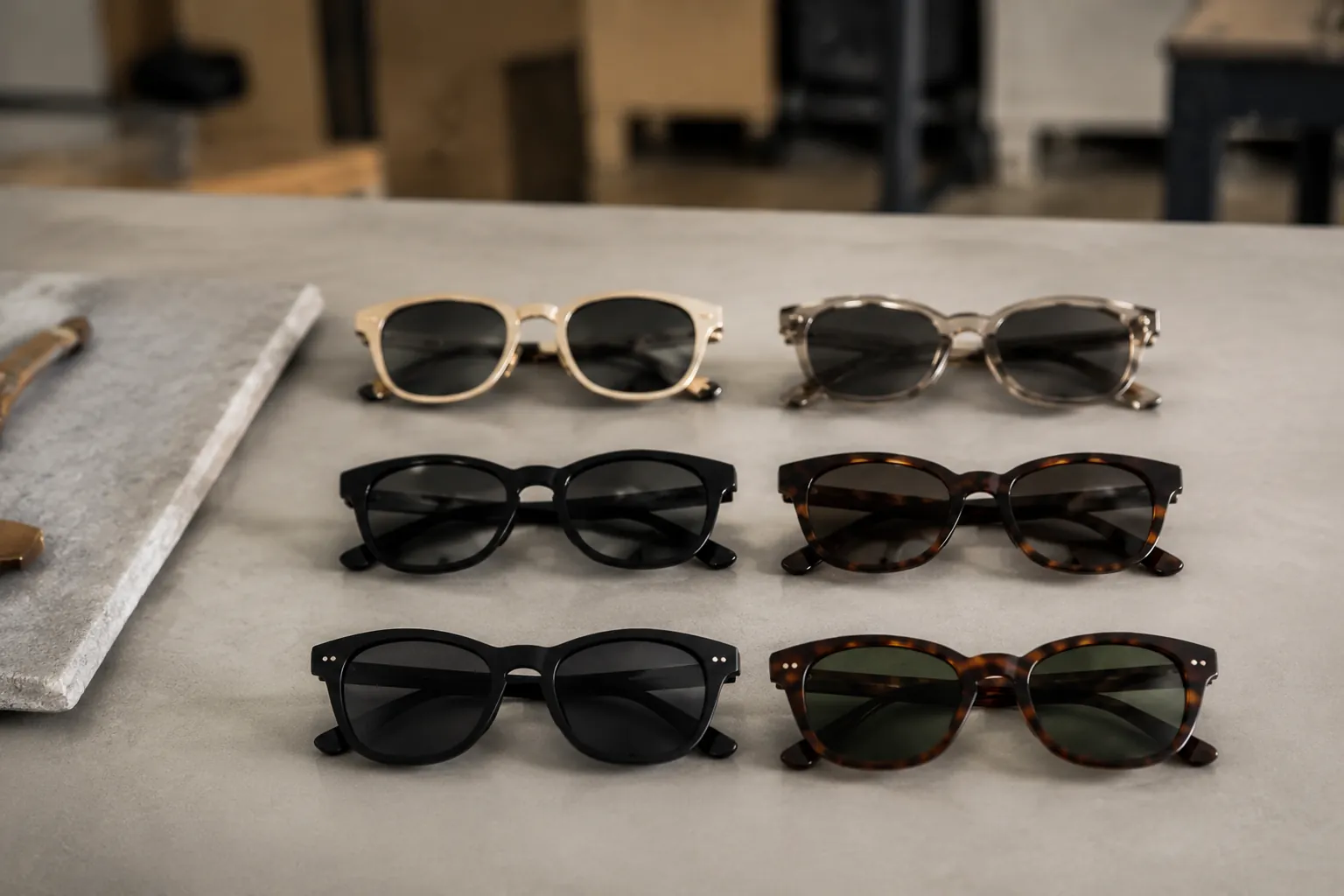
If you buy sunglasses for a brand, chain, or distribution business, a three-tier line is one of the cleanest ways to cover shelf space without filling warehouses. The idea is simple: use one product architecture to hit entry, mid, and premium price points with different materials, lens specs, and decoration levels. Done well, it protects margin at the low end and gives buyers a reason to trade up. Done badly, it gives you three SKUs that look too similar, cost too much to separate, and compete on price.
Start with the job each tier has to do
A three-tier line is not three unrelated styles. It is one family built to do three different jobs. Entry moves volume and keeps the ticket low. Mid is usually the main seller because it balances cost and perceived value. Premium supports margin, gifting, brand image, and a higher average selling price.
For overseas B2B buyers, the useful question is not "What looks nice?" It is "What can I sell at my target retail price, what can I land at my target cost, and what can I keep in stock without creating dead inventory?" If your retail channel has a low opening price, the entry model must be built differently from a premium frame. The silhouette can stay similar. The bill of materials should not.
A practical line plan usually looks like this:
- Entry: simple shape, lower-cost frame material, standard UV-protective lens, minimal decoration, fast replenishment.
- Mid: improved finish, stronger hardware, optional polarization, better branding surface, broader color choice.
- Premium: acetate or heavier mixed-material build, upgraded lens treatment, precise logo execution, tighter QC, and packaging that supports gifting.
Keep the design language consistent across tiers: same front shape, similar proportions, one brand story. The buyer should see a family, not a pile of unrelated SKUs. That also makes tooling reuse, photography, and sell-in easier.
Before sampling, define each tier in commercial terms. Set your target retail price, landed-cost ceiling, and gross-margin requirement for each one. Put it on paper. It keeps the entry SKU from getting overbuilt and the premium one from being underdone.
Build each tier around material reality
Material choice drives cost, feel, failure rate, and lead time. In sunglasses, process matters as much as design. Injection frames, acetate frames, and metal or mixed-material frames need different tooling, different quality checks, and different finishing discipline. If you try to force one process logic onto all three tiers, you get uneven fit, cosmetic defects, and avoidable rejects.
Injection-molded PC or TR90-style frames are usually the most cost-efficient choice for entry and many mid-tier programs. They work well for volume, stable dimensions, and relatively efficient production. The tradeoff is surface depth. Injection frames often look more functional than luxurious.
Acetate behaves differently. It can be cut, tumbled, polished, and finished to a richer surface, but it needs more manual work and a longer process chain. Expect more variation in polish, temple symmetry, and edge consistency if the factory rushes it. For premium models, the key checks are lens opening symmetry, temple alignment, and hinge seating. Not just gloss. A premium acetate frame that twists in the hand loses value fast.
Metal and mixed-material frames sit between the two. They can look refined, but they demand clean welding, better screw control, and tighter hinge assembly. Loose screws, uneven spring tension, or poor weld finish are the quickest ways to make a line feel cheap, regardless of lens quality.
| Tier | Typical frame build | Lens approach | Decoration | Commercial use |
|---|---|---|---|---|
| Entry | Injection-molded PC/TR90-style frame, standard hinges | UV-protective tinted lens, basic smoke or brown | Pad print or small laser mark | Volume, promotion, chain retail |
| Mid | Higher-grade injection frame or lightweight mixed-material build | UV-protective lens, optional polarization, better scratch coating | Laser engraving, pad print, or small metal logo plate | Mainline retail, distributor programs |
| Premium | Acetate cut-and-polished frame or heavier mixed build | Polarized, mirrored, gradient, or higher-grade tinted lens | Metal logo plate, precise engraving, tighter hardware finish | Fashion, gifting, higher ASP |
That table only helps if the factory can execute it. Ask for the production route in writing: molding, trimming, polishing, assembly, lens edging, logo application, and final inspection. A reliable supplier should be able to say which steps are automated, which are manual, and where rejection risk rises.
Use lens specs to create real separation
Many buyers separate tiers only by frame finish. That is weak differentiation. Lens specification is where the customer feels the difference quickly, especially outdoors. A basic frame can still sell if the lens performs well. A premium-looking frame can still disappoint if the lens haze is high or polarization is inconsistent.
Entry tier should be clean and simple: UV protection, stable tint density, decent optical clarity, and a lens thickness that does not warp visibly at the edges. For mass retail, a standard 1.0 mm to 1.2 mm lens may be acceptable depending on geometry, but the factory should confirm fit and curvature. If the target channel requires safety compliance, make sure the lens and finished product are tested to the correct market standard before bulk production starts.
Mid tier is where you can add the most commercial value without inflating cost too much. Polarized lenses are often the easiest upgrade because the difference is obvious outdoors. Anti-scratch hard coating, controlled gradient tint, or a better surface finish also help the middle tier stand apart. If you are targeting sport or travel channels, lens transmission and glare reduction matter more than decorative extras.
Premium should justify price with visible and functional upgrades, not just a fancier box. Mirrored coatings, controlled polarization, stronger optical consistency, and cleaner edge finishing all support the premium story. Ask for real specification language: tint density, visible light transmission range, whether polarization is required, UV requirement, coating stack, and base curve. "Black lens" is not a spec. It is a placeholder.
Request sample data rather than relying on verbal assurance. Ask for transmittance readings, polarization confirmation, and a simple scratch or abrasion reference so you can compare suppliers on the same basis. That matters even more when you are matching product across multiple factories or reorders.
Price the line around breakpoints, not guesswork
A workable tiered line usually follows order-size breakpoints. MOQ, tooling exposure, and process setup costs all affect unit pricing. If a supplier offers a low MOQ for a custom style, that is useful for testing a shape or a market response, but unit pricing should still improve as order size rises. The exact breakpoints depend on the factory, the spec, and the decoration method.
Final landed cost depends on frame material, lens treatment, decoration, packaging, carton structure, and compliance testing scope. The tier logic should still be clear. Entry needs the lowest BOM and the fewest process steps. Mid can absorb a better lens and stronger branding. Premium must carry enough gross margin to pay for higher rejection risk, polishing time, more demanding presentation, and sometimes slower assembly throughput.
One useful way to plan pricing is to work backward from retail and target margin. If entry retail is lower, landed cost has to stay tight enough to leave room for freight, duty, warehousing, and trade margin. If mid retail sits in a higher band, you can afford more lens value and better decoration. If premium sits in the top band, the supplier must deliver visibly better materials and finish, not just add a pouch or a bigger box.
- Set target retail for each tier and each channel.
- Back into landed cost, gross margin, and freight allowance.
- Define a maximum BOM by tier before sampling starts.
- Lock decoration options early so logo costs do not creep.
- Check whether the mid tier can keep the same silhouette with a clear feature gap.
Do not price premium by adding random extras. Price it by adding the items customers actually pay for: better material, better touch, better finish, better lens function, and better presentation. A premium line with too many low-value add-ons looks busy instead of valuable.
Use decoration to signal value without bloating cost
Decoration is where a lot of private-label programs waste money. A logo can be applied several ways, but not every method belongs in every tier. The right choice depends on material, placement, quantity, and how much abrasion the location sees during wear.
Pad printing is the cheapest and fastest option. It works well for simple logos on curved or flat surfaces, but ink durability depends on surface prep and consumer handling. On high-wear areas, pad print can fade or scratch sooner than other methods. Laser engraving is cleaner and usually more durable, especially on metal parts and many acetate surfaces, though the mark can look too subtle if the logo is small or the surface color is too close.
Metal logo plates sit at the premium end of the decoration spectrum. They add perceived value, but only if the plate size, edge finish, and mounting position are right. A plate that is too large for the temple looks clumsy. A plate that sits slightly off-center looks worse. Placement control matters. If the logo drifts on a small temple, the eye catches it immediately.
A sensible tier split is:
- Entry: one-color pad print or small laser mark.
- Mid: laser engraving with optional metal logo plate.
- Premium: metal plate, precise engraving, and tighter placement control.
Ask for decoration samples during pre-production, not after bulk starts. A good factory should show print clarity, plate adhesion, edge cleanliness, and how the logo looks under retail lighting. Also confirm whether the decoration changes any compliance or pack-out requirement, especially if you ship into multiple countries with different labeling or carton expectations.
If you want the line to feel more expensive without adding major cost, think about location before method. A small logo in the right place often works better than a large logo in the wrong one. Temple inner printing, lens corner marking, and subtle metal accents can all support the story if they are executed cleanly.
Map the line to factory process, not just design
A tiered line works better when each SKU is tied to a known process route. For many eyewear factories, that means injection molding for simpler frame bodies, acetate cutting for premium frames, CNC milling where precision matters, lens tinting in controlled batches, and in-house quality control before packing. That matters because lead time and defect control come from process discipline, not renderings.
A practical development sequence should be straightforward: sketch or reference sample, confirm frame material, lock lens type, confirm decoration, then make samples. During sampling, factories typically refine the temple angle, hinge torque, lens fit, and surface finish. That is where buyers should catch issues such as unequal temple opening, lens rattle, or logo placement drift. If those issues are left for bulk, they multiply fast.
Sample and bulk timing vary by factory, spec complexity, decoration, and whether new tooling is required. As a planning guide, samples often take about 7 to 10 days once the factory has the information it needs. Bulk production commonly takes about 25 to 35 days after sample approval when materials are ready and the spec is stable. Add time if the order needs custom packaging, special lens coatings, or market-specific compliance testing.
Lead time should also follow complexity. Entry SKUs often move faster because they use standard materials and fewer steps. Premium SKUs can stretch lead time if polishing, assembly, or logo mounting is manual. If the premium model needs too many hand operations, the line becomes harder to scale and delivery slips become more likely. A simpler premium SKU that ships on time is better than a flashy one that misses the season.
Ask the supplier to identify the main bottleneck in each tier. It is often not molding or cutting; it is inspection, polishing, or decoration rework. Once you know the bottleneck, you can decide whether the added value is worth the operational drag.
Control risk with a simple SKU architecture
The easiest way to lose money is to add too many variations. Three tiers do not mean twelve SKUs. A good rule is one core shape, three material or finish levels, and a limited color matrix. If every tier has five frame colors and four lens colors, stock gets messy quickly, replenishment slows, and the line starts to compete with itself.
For most overseas buyers, a disciplined launch plan looks like this:
- One hero silhouette per line.
- Two or three frame colors per tier.
- One default lens per entry tier.
- One upgrade lens option for mid.
- One premium lens and one premium decoration package.
Work backward from inventory risk. If a color sells slowly in one market, keep it in premium only or remove it. If a shape proves strong, keep the same front and vary temple finish or lens type across tiers. That gives you shelf coverage without creating dead stock.
A useful launch target for many B2B programs is 3 to 6 SKUs total at first release. That is enough to test demand without losing control of inventory. Once one tier proves strong, expand carefully with one new color, one new lens treatment, or one new decoration variation at a time. Fast expansion sounds attractive, but it often creates more warehouse pain than revenue.
Practical rule: if the customer cannot explain the difference between your tiers in five seconds, your line is too similar.
That rule matters in retail. Buyers and store staff need to explain the range quickly. If the tiers are clearly separated by material, lens, and branding, the upsell story is easy. If the differences are mostly internal, the line underperforms on shelf.
Build the spec sheet buyers and factories can use
Your RFQ should not be a vague mood board. It should read like a production document. State frame material, lens type, tint, coating, decoration method, logo position, packing, target quantities, and compliance requirement. If you need CE EN ISO 12312-1, ANSI Z80.3, AS/NZS 1067, REACH, FDA registration, ISO 9001, or BSCI-related documentation, state that before sampling. Compliance is easier to manage when it is planned from the start rather than patched in at the end.
A strong spec sheet includes dimensions because fit drives both comfort and tooling accuracy. Include lens width, bridge width, temple length, front width, and key thickness points. Even if you do not publish every number to the market, the factory needs them to control repeatability. If a style is built for a narrow face or oversized look, note the intended fit. That helps prevent "same style, wrong scale" errors between sample rounds.
Useful fields to include:
- Frame material, finish level, and target surface appearance.
- Lens color, polarization, UV requirement, coating, and base curve.
- Temple length, hinge type, and any fit constraints.
- Logo method, size, exact placement, and approval sample standard.
- Target order size for each tier and expected reorder pattern.
- Sample deadline, bulk delivery window, and destination market.
If you are buying for multiple channels, separate the commercial and technical parts of the brief. Channel buyers care about price points and presentation. The factory cares about repeatable specs and approval points. Put both in the document. It saves time and cuts assumptions.
Also define what "pass" means. For example: no visible glue overflow, no hinge squeak, temple opening within normal resistance, lens seated evenly, and logo placement within an agreed visual tolerance. Those checks are simple. They are enough to keep a line consistent without making QC overly complicated.
Why this structure works for overseas buyers
A three-tier line gives you a clearer margin stack. Entry brings traffic. Mid carries volume. Premium protects brand perception and gives the distributor or retailer something to trade up to. That structure also helps with factory negotiation because you can consolidate development around one family of frames instead of splitting spend across unrelated styles.
With a supplier that handles injection molding, acetate cutting, CNC milling, lens tinting, decoration, and quality control in-house, you can keep the line tighter and more predictable. That is where the operational advantage comes from: fewer handoffs, better control, less guesswork, and faster problem solving when a spec needs revision.
For most B2B buyers, the best plan is not to launch ten styles. It is to launch one good family, price it correctly, and use the spec ladder to separate the tiers cleanly. That is how you get shelf coverage without turning inventory into a problem. It also makes replenishment easier because the factory can reuse tooling, lens programs, and packaging logic across the line.
The simplest version is this: let the entry tier win on price discipline, let the mid tier win on balanced value, and let the premium tier win on material, finish, and detail. When those three jobs are clear, the line sells more smoothly and the supply chain is easier to manage.
Have a custom sunglasses project in mind?
Send us your styles, target market and quantities and we will return a detailed quote with MOQ, lead time and a sample plan.
Get a QuoteWhy source this from Wenzhou with LumiShades
Wenzhou in Zhejiang Province is widely regarded as China’s eyewear manufacturing capital, producing a large share of the world’s sunglasses. That concentration matters to buyers: a deep local supply chain for acetate sheet, hinges, lens blanks, plating and packaging means shorter component lead times, easier color and material matching, and a workforce with decades of eyewear-specific skill. LumiShades has manufactured in this ecosystem since 2009, and our vertical integration — in-house injection molding, acetate cutting, CNC milling, lens tinting, decoration and quality control — means no part of your order is quietly subcontracted to a workshop you cannot audit.
For international buyers, that vertical control translates into accountability. When a single factory owns every step, defects are traced and fixed at source rather than bounced between vendors, and your specifications survive intact from first sample to bulk. We back this with 15+ years of experience, shipments to 60+ countries, more than 5 million pairs produced per year and a 98.5% on-time delivery rate. Our certifications — CE EN ISO 12312-1, FDA registration, ANSI Z80.3, AS/NZS 1067, REACH, ISO 9001 and BSCI audit — mean the compliance documentation your market requires already exists. Explore our manufacturing capabilities and quality control process to see how this works in practice.
Frequently asked questions
How many SKUs should I launch in a three-tier sunglasses line? Start with one core silhouette and 3 to 6 SKUs total. Keep the shape consistent and vary material, lens, and decoration. Too many colors or temple options usually creates dead stock and weak sell-through.
What should separate entry, mid, and premium tiers most clearly? Material and lens specification. Entry can be injection molded with a basic UV-protective lens, mid can add polarization or a better finish, and premium should usually use acetate or a heavier mixed build with stronger decoration and cleaner detailing.
What MOQ should I expect for custom sunglasses? MOQ depends on the factory, style complexity, and decoration method. Ask for the minimum quantity per design, then confirm how pricing changes at higher breakpoints such as 300, 1000, and 5000 pairs. The best way to compare suppliers is to request the same spec sheet and quote each order size on the same basis.
How long do samples and bulk production usually take? As a planning guide, samples often take about 7 to 10 days once the factory has complete information. Bulk production commonly takes about 25 to 35 days after sample approval when materials are ready and the specification is stable. Add time for new tooling, special packaging, or compliance testing.
Which compliance documents should I ask for? Ask for the documents that match your destination market and product spec. Common requests include CE EN ISO 12312-1, ANSI Z80.3, AS/NZS 1067, REACH, FDA registration, ISO 9001, and BSCI where applicable. Do not assume one certificate covers every market or every product configuration; ask the supplier to show which standard applies to which SKU.
Ready to start?
Explore our shield & oversized sunglasses or request a quote — our sales team replies within 12 hours.
Request a Quote