
Custom Sunglasses Mold Ownership Checklist
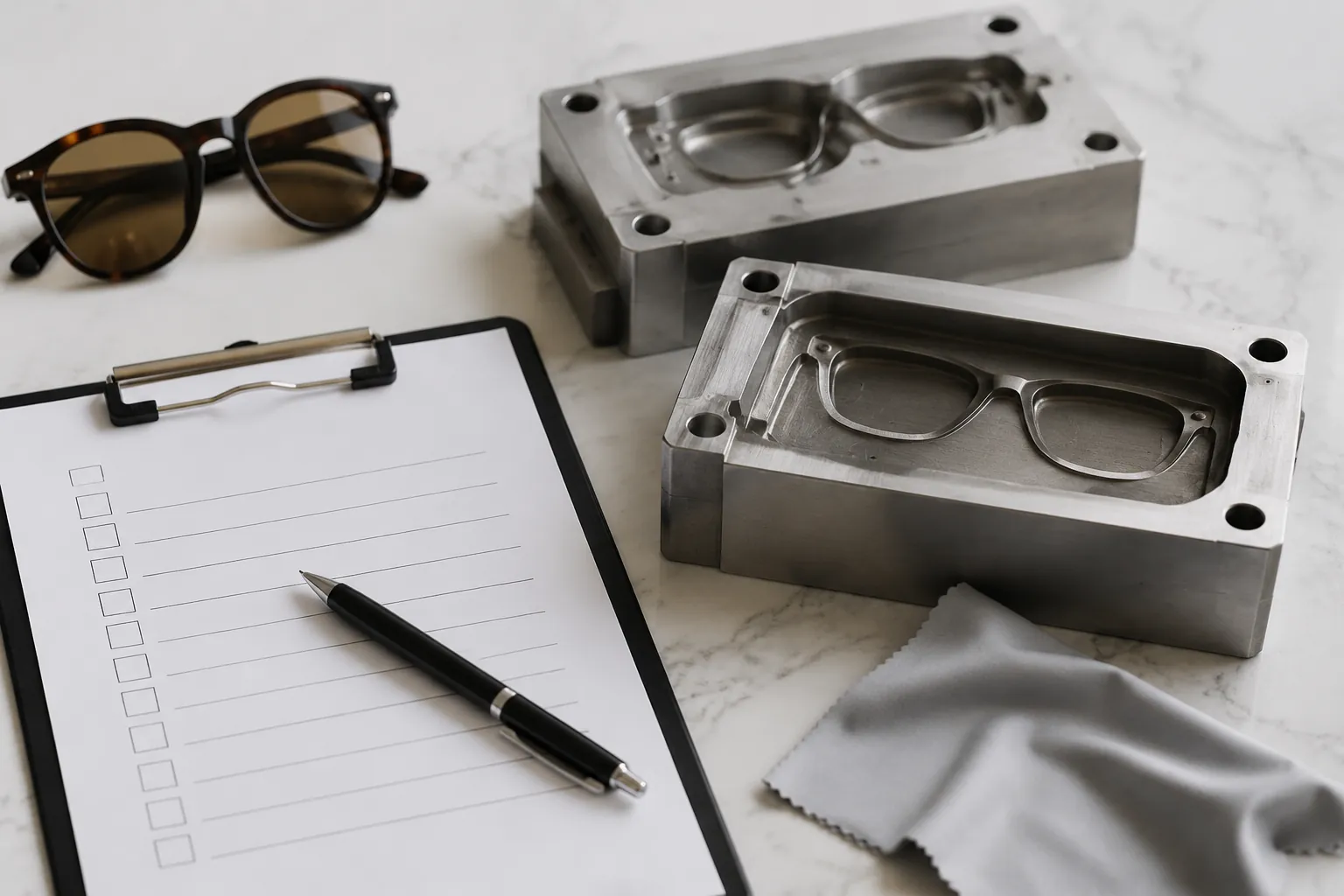
This guide is for brands, importers, distributors, and retailers paying for custom sunglasses frame tooling. It explains what to confirm before a mold is cut, so your design does not quietly become a shared factory asset. The goal is simple: clear ownership, fewer disputes, better exit options, and a tooling record your next production manager can use.
Set Mold Ownership Before Cutting Steel
A custom sunglasses mold is not just a production cost. It controls who can make the frame, who can sell it, who can modify it, and what happens if the buyer changes supplier later. If ownership is vague in the purchase order, the dispute usually starts after the first successful bulk run. Not before. By then, leverage is weaker and the tool is already on someone else's floor.
For injection-molded PC, TR90, and nylon frames, the tooling package may include cavity inserts, core inserts, sliders for hinge or temple undercuts, ejector systems, gate layout, and separate lens gauges or assembly jigs. For acetate frames, the word "mold" may refer to CNC programs, cutting fixtures, polishing jigs, bending forms, metal logo plate tooling, and lamination patterns rather than one steel injection tool. Define the asset. Do not just write "mold fee."
At a Wenzhou eyewear factory, a custom project may pass through injection molding, acetate cutting, CNC milling, lens tinting, laser engraving, pad printing, metal logo plate assembly, and QC. Each step can create tooling, fixtures, or production files with value. If the agreement only covers the main frame mold, the brand may still be exposed on decoration plates, temple logo jigs, lens shapes, or CAD files.
That distinction matters because a mold is usually only one part of a broader production system. Buyers may think they bought a single asset. The supplier may still hold the drawings, nesting files, decoration artwork, acceptance standard, and fit reference sample. If those items are missing, moving production later becomes slower, costlier, and easier to fight over.
Blunt rule: pay for tooling only after the contract says who owns the physical tool, who owns the design data, and who can use both.
Define What the Mold Fee Covers
A mold fee should be itemized. Ask for a tooling quotation that separates design engineering, prototype adjustments, steel or aluminum tooling, sample shots, texture or polishing, and correction rounds. A lump sum is easy to quote. It is hard to control. It also hides what you are paying for if the first sample needs a second cut, a hinge correction, or a lens fit adjustment.
For sunglasses frames, the tool must match the material and the expected production volume. A low-volume promotional frame does not need the same tool life as a high-volume reorder program. A practical factory may quote a quick-turn prototype tool for a limited run, then a harder steel tool once the design is proven. That split can be cheaper than overbuilding the first version.
Tooling decisions should follow the business plan. If the fit is still changing, do not approve an expensive high-cavity steel tool yet.
| Tooling Item | What to Confirm | Typical Buyer Risk if Unclear |
|---|---|---|
| 3D CAD and 2D drawings | File format, revision number, ownership, and release rights | Supplier can produce, but buyer cannot move the design |
| Injection mold cavities | Material, cavity count, expected shot life, storage location | Tool wears early or is mixed with factory-owned tooling |
| Lens shape tooling | Lens curve, thickness range, tint reference, edging data | Replacement lenses do not fit the frame cleanly |
| Logo and decoration tooling | Pad print plates, laser files, metal logo plate dies, placement jigs | Brand mark is reproduced without proper control |
| Inspection gauges | Temple opening, bridge width, lens groove, hinge alignment checks | Bulk production drifts from approved samples |
Ask whether the fee includes one round of minor correction after sample testing. Most good projects need it. The first sample may reveal a tight hinge pin, a shallow lens groove, a coating that adds thickness, or a logo position too close to the temple bend. Schedule samples before bulk production. Start the bulk lead time only after approval.
Also ask how the quote changes by material. PC and TR90 tools depend heavily on cooling control, flow balance, and wall thickness consistency. Acetate programs involve more cutting, polishing, tumbling, and hand finishing, so the "tooling" cost may sit partly in fixtures and process setup rather than steel. The clearer the breakdown, the easier it is to compare factories.
Separate Ownership, Exclusivity, and Reuse
Buyers often mix three rights: ownership, exclusivity, and reuse. They are different. A buyer may own the tool but allow the factory to store and operate it. A buyer may have exclusivity in one market but not globally. A buyer may block reuse of the frame shape while allowing the factory to use generic hinge parts or standard nose pad components.
Write separate clauses for each right. Ownership answers "who owns the asset." Exclusivity answers "who may produce from it." Reuse answers "which parts of the design may be used elsewhere." This matters because many factories run custom projects and catalog frames on the same floor. Without written limits, a slightly changed temple or lens shape can become a gray area.
Make the scope clear enough for production staff to follow six months later. If the buyer owns the custom front frame but the temple core is based on a shared platform, say that. If only the outer silhouette is exclusive but the internal hinge structure is common, say that too. If the supplier may reuse a generic spring hinge or screw spec, that should not weaken the buyer's right to the overall design.
- Physical mold ownership: state whether the buyer owns the injection mold, inserts, logo plates, and gauges after payment.
- Design ownership: state whether CAD files, drawings, lens outlines, and decoration artwork belong to the buyer.
- Factory operating right: state that the supplier may use the tool only for the buyer's approved purchase orders.
- Territory exclusivity: define whether exclusivity is worldwide or limited to certain countries, channels, or customer classes.
- Similarity restriction: define how close a factory-owned frame can be before it violates the agreement.
Do not rely on "private mold" as the full term. It sounds strong, but it is too vague. Put the rights in plain language and attach the approved drawings. Attach photos of the golden sample. Mark the revision number on every supporting file. Small habits prevent large arguments.
Clarify what the supplier can keep after the job ends. A factory may reasonably keep process know-how. It should not keep or reuse your brand artwork, lens shape file, or customer-specific decoration data. If the buyer paid for development, the buyer should control how that development is used.
Freeze Technical Specs Before Tooling
Tooling locks in decisions that are expensive to change later. Before cutting starts, freeze the frame size, lens base curve, material, hinge type, temple length, nose bridge, logo position, and packing requirements. If the team is still debating a 145 mm temple versus a 150 mm temple, wait. Five millimeters can change comfort, balance, and how the frame looks on face.
For injection frames, dimensional tolerance matters. Critical lens-seat dimensions need tighter control than cosmetic edges. A lens groove that is slightly off can cause rattling lenses, stress marks, or difficult assembly. Temple opening angle, hinge alignment, and bridge symmetry should be checked against a signed sample, not only a drawing. For acetate, CNC milling and tumbling remove material, so the approved sample must reflect the final finishing process. Not a raw-cut shape. Polishing can soften edges, heat forming can change bridge feel, and buffing can shift the final look.
Material choice changes process behavior. PC is tough and transparent, but it can show stress and gate marks if flow is not balanced. TR90 is flexible and comfortable, but wall thickness and cooling must stay consistent or the frame can warp. Nylon can work well for outdoor styles, but moisture control and mold temperature need attention. Acetate gives a premium hand-feel, yet it needs controlled cutting, tumbling, and color matching because sheets vary by batch. Reflect those differences in the drawing package and QC standard.
Compliance belongs in the tooling discussion. CE EN ISO 12312-1, ANSI Z80.3, and AS/NZS 1067 cover sunglass performance, including optical quality and UV protection. REACH affects restricted substances in frame and accessory materials. FDA registration may matter for U.S. distribution. A compliant lens still has to fit the frame. Poor tooling can create lens stress, misalignment, or uneven tint appearance after assembly. Design the tooling around the target compliance outcome.
- Approve technical drawings with dimensions and tolerances before cutting starts.
- Confirm material grade and color method, such as injection color, spray coating, or acetate sheet.
- Approve hinge specification, screw size, and opening angle.
- Confirm lens base curve, thickness, tint, and UV requirement.
- Record decoration method: laser engraving, pad printing, metal logo plate, or a combination.
- Attach the signed sample standard to the bulk production order.
At the tooling stage, ask the supplier for recommended measurement points. A factory may check front width, temple length, lens height, bridge width, groove depth, and lens tilt angle. Put those points into the order so the next repeat run is measured the same way, even if a different production manager handles it.
Write Rules for Storage, Maintenance, and Tool Life
A mold sitting in a factory is not automatically safe. Steel rusts. Inserts get dented. Sliders wear. Logo plates disappear. A practical tooling agreement should say where the mold is stored, who maintains it, who pays for wear parts, and how often the buyer can request photos or inspection. Without records, the buyer may discover wear only after a rejected repeat order.
For injection molds, maintenance usually includes cleaning, anti-rust oil, ejector pin checks, slider checks, and protection for polished surfaces. For acetate fixtures and CNC programs, maintenance is more about file control, fixture labeling, and preventing unauthorized changes. Both need records. Engrave a mold number on the tool and reference it on the purchase order. Keep a simple log showing last use date, shot count, repair history, and current storage location.
Tool life should be realistic. A high-output tool for repeat orders should be built differently from a short-run test tool. If the buyer expects repeated orders, ask about steel grade, number of cavities, expected shot count, and replacement inserts. If the buyer only needs a first-market trial, a lower-cost tool may be reasonable. Call it that. Otherwise, the buyer may pay for a tool that was never meant to survive multiple seasons.
Maintenance cost can be handled several ways. Some factories include normal maintenance while the buyer places regular orders. Others charge for major repairs after a defined shot count or after long storage. The model matters less than the clarity. State whether maintenance includes rust prevention, polishing touch-up, replacement of standard wear parts, and testing after reactivation.
Also define acceptable storage condition. If a tool is stored off-site, require dry storage, protective coating, and controlled access. If the buyer wants inspection rights, define notice periods and whether the factory can send photos or video of the stored tool. These details seem small until production has been quiet for twelve months and the buyer needs a fast restart.
Plan Exit Terms Before You Need Them
Exit terms are uncomfortable, so buyers skip them. That is a mistake. A brand may change supplier because of price, capacity, compliance policy, distributor pressure, or ownership change. If the mold agreement is silent, the tool may be legally owned by the buyer but practically trapped. The same problem appears when the supplier will not release files or when poor storage makes removal slow and expensive.
The contract should state whether the buyer can remove the physical mold after paying all open invoices. It should also state the notice period, packing method, export documents if needed, and whether the factory will provide tool drawings, maintenance records, and last production settings. Moving a mold is not always simple. A tool designed around one factory's machine tonnage, water lines, cooling layout, and setup habits may need adjustment at the next facility. That is not a reason to avoid exit rights. It is a reason to document them early.
A good exit package includes more than metal. It includes the latest CAD, 2D drawings, BOM, color references, lens specs, QC records, approved sample photos, and decoration files. Without those, the next supplier may spend weeks reverse-engineering details that should have been documented from day one. The right package can save a full production cycle.
- Removal trigger: payment complete, no open quality dispute, and written notice submitted.
- Release timing: define a reasonable number of working days for packing and handover.
- Condition report: include photos, mold number, visible wear, and missing parts if any.
- Data handover: include drawings, files, BOM, and inspection standard.
- Retirement rule: state whether the mold can be scrapped and who approves disposal.
Decide whether the factory must keep the tool available for a final reorder window. In practice, a 30- to 60-day handover period after final payment is often workable, but the exact timing should fit the product calendar. A seasonal eyewear style needs a different exit plan than a core evergreen frame.
Use Payment Milestones as Control Points
Tooling payment should match real progress. Paying 100% before engineering review gives the buyer little control. Paying nothing until perfect samples is also unrealistic; the factory is buying steel, assigning engineers, and blocking machine time. A balanced structure works better. Tie each payment to a visible deliverable.
A common structure is a deposit at drawing approval, a second payment after first sample shots or CNC prototype review, and final payment after approved pre-production samples. The exact split depends on project size. The milestone should be backed by evidence: drawings, mold photos, sample measurements, lens fit, hinge testing, and decoration results. If the project has multiple revisions, state how many are included before extra engineering charges apply.
Use the sample window to verify fit, lens retention, color, logo position, and packaging assumptions before bulk production. Bulk lead time should start only after sample approval, material confirmation, and purchase order lock. Do not rush this stage. That is how brands end up with frames that look fine in photos but fail on hinge feel or lens alignment.
One useful rule: link each payment to a measurable package. Release one tranche after signed drawings and material confirmation, another after first samples with dimensional notes, and the final balance after golden sample approval. This keeps the factory funded while preserving leverage if the sample needs correction.
| Milestone | Factory Deliverable | Buyer Checkpoint |
|---|---|---|
| Drawing approval | 2D dimensions, 3D render, BOM, tooling scope | Confirm size, material, lens curve, logo method |
| Tooling start | Mold or fixture production schedule | Confirm ownership and exclusivity clauses are signed |
| First samples | Frame samples, lens fit, decoration trial | Check wear comfort, hinge action, tint, UV requirement |
| Pre-production approval | Corrected sample and QC standard | Approve golden sample and bulk inspection criteria |
| Bulk release | Production plan and packing details | Confirm quantity tier, shipment date, and compliance documents |
Payment logic should also reflect volume. If the buyer expects only a short run, a complex tool package may never pay back. If the buyer expects repeated larger orders, spending more on tool quality, better inserts, and a cleaner finish usually makes sense. The cheapest tool is not always the cheapest project.
Use a Practical Buyer Clause Checklist
Before issuing a tooling purchase order, put the commercial and technical controls in one document. It does not need legal poetry. It needs to be specific enough for a merchandiser, engineer, or factory production manager to follow six months later. The best checklist reads like a production instruction, not a vague promise.
The checklist should cover mold ownership after payment, factory use restrictions, storage location, maintenance responsibility, exclusivity scope, similar-product limits, correction policy, sample approval process, compliance targets, and exit rights. Attach drawings. Attach artwork. Attach the BOM. If a clause refers to "the mold," define the mold number and related accessories. If the tool has inserts or auxiliary jigs, list them.
Also confirm what is not exclusive. Standard screws, spring hinges, generic nose pads, common lens tints, and stock packaging materials are normally shared supply-chain items. Trying to claim ownership over standard components creates friction and is hard to enforce. Protect the custom frame shape, custom lens outline, logo tooling, and buyer-specific decoration files. That is where the commercial value sits.
Spell out decoration methods too. A pad print plate can wear with repeated runs. A laser file can be reused, but it should be controlled. A metal logo plate die may need replacement after a certain volume. A spray finish may require a color standard and gloss range. If brand consistency matters, define how these methods are approved and archived.
Buyer discipline: if the mold is important enough to pay for, it is important enough to document properly.
Small custom runs and larger volume programs both work better when tooling rights are clear. A strong mold agreement does not slow production. It prevents expensive confusion after the frame starts selling.
Final check: can the factory deliver the next run without reopening the design debate? If not, the buyer probably does not control the process well enough yet. Better documentation makes reorders, audits, and supplier moves easier.
Have a custom sunglasses project in mind?
Send us your styles, target market and quantities and we will return a detailed quote with MOQ, lead time and a sample plan.
Get a QuoteWhy source this from Wenzhou with LumiShades
Wenzhou in Zhejiang Province is widely regarded as China’s eyewear manufacturing capital, producing a large share of the world’s sunglasses. That concentration matters to buyers: a deep local supply chain for acetate sheet, hinges, lens blanks, plating and packaging means shorter component lead times, easier color and material matching, and a workforce with decades of eyewear-specific skill. LumiShades has manufactured in this ecosystem since 2009, and our vertical integration — in-house injection molding, acetate cutting, CNC milling, lens tinting, decoration and quality control — means no part of your order is quietly subcontracted to a workshop you cannot audit.
For international buyers, that vertical control translates into accountability. When a single factory owns every step, defects are traced and fixed at source rather than bounced between vendors, and your specifications survive intact from first sample to bulk. For procurement review, buyers can request process records, approved samples, quality checkpoints and project-specific compliance files before placing a bulk order. Required testing and documentation are confirmed against the destination market and product specification rather than assumed from a generic certificate list. Explore our manufacturing capabilities and quality control process to see how this works in practice.
Frequently asked questions
If I pay the mold fee, do I automatically own the mold? No. The tooling agreement or purchase order should state who owns the physical mold, inserts, logo plates, fixtures, and related files after payment. If the paperwork is silent, the factory may argue that it charged only for development or production services. Name the assets, list the files, and state when ownership transfers.
Can the factory use my custom sunglasses mold for another buyer? Only if your agreement allows it. State that the tool may be used only for your approved orders, and define whether similar frame shapes, lens outlines, or decoration files are also restricted. If you want exclusivity, define the territory, channels, and term. If you do not want the factory to reuse the design at all, say that directly.
Should I ask for the mold to be shipped to me? Usually only if you are changing suppliers or moving production in-house. Many buyers leave molds at the factory for repeat production, but the contract should still give you removal rights after open invoices are paid. If the mold is shipped, ask for a condition report, packing list, tool number, cavity photos, wear-surface photos, and every related file used to make the parts.
What documents should I receive with custom eyewear tooling? Ask for 2D drawings, 3D CAD where available, BOM, mold number, approved sample record, lens specs, decoration files, QC checklist, and maintenance notes. If the project has multiple finishes or colorways, request revision-controlled files for each version. Also keep the signed ownership and exclusivity clause with the engineering files.
How does compliance relate to mold ownership? Ownership does not prove compliance. The finished sunglasses still need the correct lens performance and material controls for CE EN ISO 12312-1, ANSI Z80.3, AS/NZS 1067, REACH, and any FDA registration requirements that apply to the business. A poor mold can cause lens stress, misalignment, or coating defects that affect compliance. Write the tooling standard around the approved compliance target.
When should bulk production start after tooling? Start only after corrected samples are approved, material and lens specs are locked, and the QC standard is signed. Bulk production should not begin while fit, hinge feel, or lens retention is still changing. If the supplier gives sample and bulk lead times, make sure the bulk timer starts only after final sample approval and written order release.
Ready to start?
Explore our aviator sunglasses or request a quote — our sales team replies within 12 hours.
Request a Quote