
How Many Sunglasses Samples Before Production?
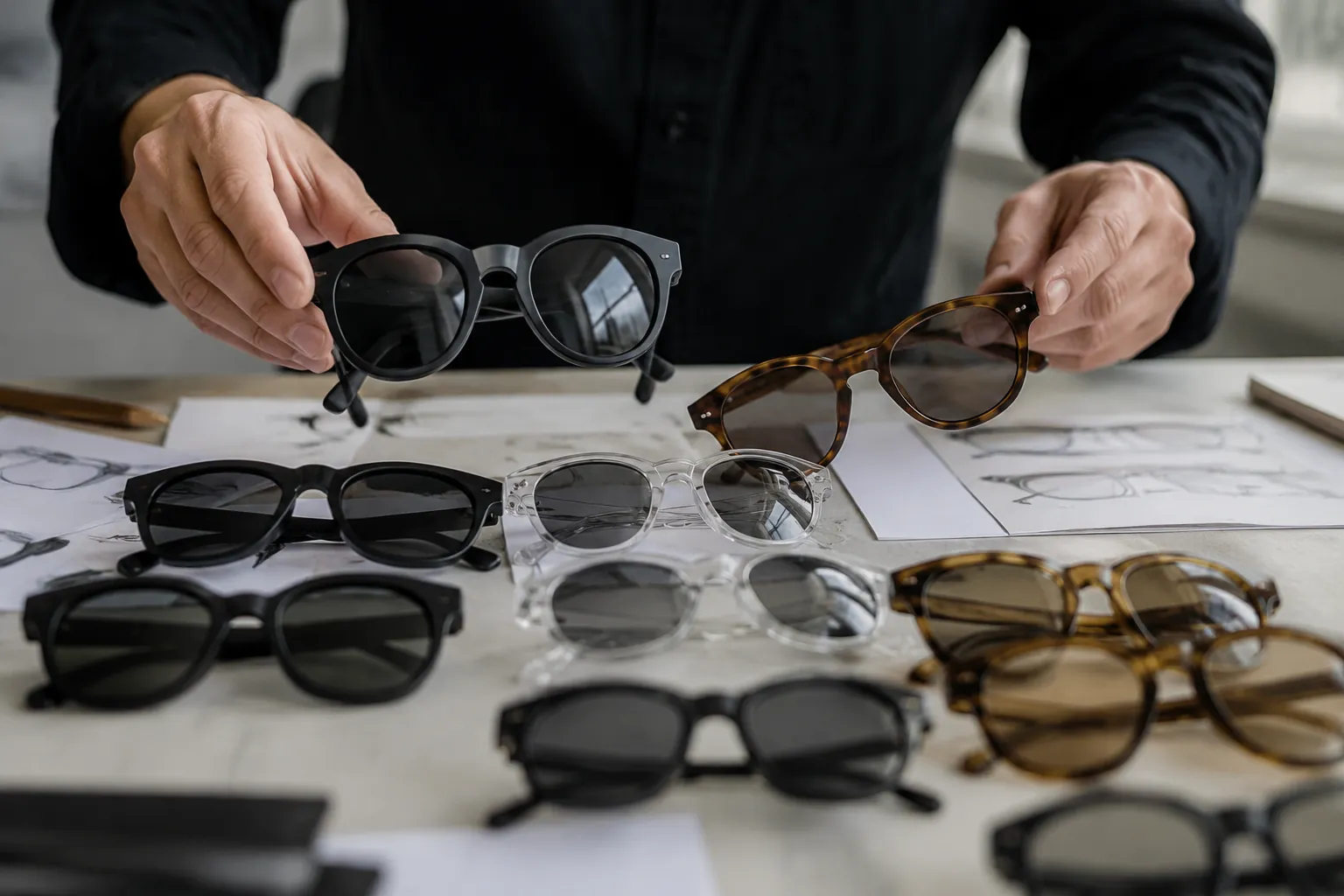
This guide is for brand owners, importers, distributors, and retail buyers ordering custom sunglasses in volume. The goal is not to collect extra prototypes. It is to approve the few samples that actually reduce production risk before bulk starts. A clear sample plan helps you catch issues in fit, finish, color, branding, packaging, labeling, and compliance before they spread across a full run. It also saves time because each sample has a specific purpose, reviewer, and approval standard.
Sample quantity is a risk decision
There is no fixed number of sunglasses samples that works for every project. The right number depends on how many variables can still change before production. A simple style based on an existing construction may need only a small set of approval samples. A new style with custom materials, decoration, and packaging usually needs more checkpoints. More variables. More failure points.
In eyewear, the main risk variables are usually frame material, lens specification, decoration method, hardware, and packaging. A standard injected frame with a basic tint and simple logo print is easier to control than an acetate frame with CNC details, metal logo plates, gradient or mirrored lenses, and custom retail packaging. Each added feature creates another place where appearance or assembly can drift from the approved standard.
Buyers often make two avoidable mistakes. First, they request too many early samples that answer the same question. Second, they approve too few production-intent samples, which leaves open issues until bulk is already underway.
A practical sample plan follows four control points: concept, sales, pre-production, and golden sample. Each stage should remove a different category of risk:
- Concept: geometry, proportion, and basic fit direction
- Sales: near-final appearance for internal review or customer presentation
- Pre-production: proof that the factory can reproduce the approved specification with production-intent materials and processes
- Golden sample: signed physical master for production reference, QC comparison, and repeat-order consistency
Even if a supplier handles molding, cutting, CNC work, lens processing, decoration, and assembly in-house, these stages still matter. Vertical integration may reduce handoff risk. It does not replace approval control.
The four sample stages and what each should prove
| Sample stage | Main purpose | Typical quantity | What to verify |
|---|---|---|---|
| Concept sample | Check shape, size, fit direction, and material feasibility | 1-2 units | Front shape, bridge feel, temple geometry, hinge position, early comfort, key dimensions against drawing intent |
| Sales sample | Show the near-final look to buyers, sales teams, or retailers | 2-6 units | Approved colorway, branding method, lens appearance, packaging mockup, photo readiness |
| Pre-production sample | Confirm the factory can reproduce the approved product under production conditions | 2-3 units | Production-intent material, actual lens specification, finish consistency, assembly standard, required markings, packaging execution |
| Golden sample | Create the signed master reference for bulk QC and repeat orders | 2-3 units | Final frame, lens, logo, measurements, carton marking, accessories, and full pack-out standard |
These labels should refer to real physical checkpoints, not just names on a purchase order. A concept sample may use a substitute lens color if the main question is frame geometry. A pre-production sample should not. At that stage, the material, hinge, logo application, lens treatment, markings, and packaging should match bulk intent as closely as possible.
Golden samples matter because many eyewear disputes are visual, not purely dimensional. A logo can be present but still look wrong if it sits visibly high or low on a slim temple. A gradient lens can be close to target but still look inconsistent if the shade transition differs from the approved sample. Signed golden samples reduce that ambiguity. One copy should stay with the buyer, one with the factory, and ideally one with the QC team that will compare outgoing goods.
How many prototypes to order at each stage
Most B2B buyers do not need large sample quantities at the beginning. They need enough units for the right people to review the right risks.
- Concept stage: Order 1 unit if you are making minor changes to an existing mold or stock shape. Order 2 units if the frame is new, if fit should be checked on more than one wearer, or if you are comparing materials such as TR90 and acetate.
- Sales stage: Order 2 to 4 units for most programs. Increase to 5 or 6 only if separate samples are needed for sales meetings, internal approvals, photography, or retailer review.
- Pre-production stage: Order 2 to 3 units. One unit is for approval, one can be used for extended handling or testing, and one serves as a backup if damage or delay occurs in transit.
- Golden sample stage: Keep at least 2 signed units. For repeat styles, multi-market programs, or programs managed by separate sourcing and QC teams, 3 units is safer.
For many projects, the total sample count before bulk production stays modest. Add units only for a clear reason, such as another reviewer, a second market with different labeling needs, or a feature with unstable visual results.
A simple rule: increase sample quantity only when one of these conditions applies:
- More than one department requires physical sign-off, such as sourcing, packaging, compliance, and sales
- The product uses materials or finishes with visible variation, such as patterned acetate or mirrored coatings
- The order includes multiple colorways that must each be visually approved
- The product will be sold into regulated markets with stricter testing or documentation requirements
Do not order extra concept samples just because the schedule feels uncertain. If the same geometry is being reviewed by the same decision-makers, one or two units are usually enough. Save budget for the pre-production stage. That is where mistakes get expensive.
Adjust the plan for product complexity and material behavior
Complexity should drive the sample plan. Not every sunglass style needs the same path.
| Complexity level | Typical construction | Recommended sample plan | Main risks |
|---|---|---|---|
| Low | Injected frame, standard smoke lens, one-color pad print, basic polybag packing | 1 concept, 2 sales, 2 pre-production, 2 golden | Color mismatch, gate marks, hinge feel, print durability |
| Medium | Custom color match, polarized lens, laser logo, pouch or folding case | 1-2 concept, 3-4 sales, 2-3 pre-production, 2-3 golden | Lens consistency, engraving clarity, packaging execution, labeling errors |
| High | Acetate frame, CNC bevels, metal logo plates, gradient or mirrored lens, multi-SKU pack-out | 2 concept, 4-6 sales, 3 pre-production, 3 golden | Acetate variation, bevel definition, logo alignment, lens shade drift, pack-out mix-ups |
Acetate usually needs closer review because sheet pattern and color distribution can vary by batch. Polishing can also change the visual sharpness of bevels and edges. Heat adjustment affects temple spread and fitting angle, which changes how the frame sits on the face. For acetate styles, buyers should document visually sensitive points such as bevel depth, polish standard, and fitting angle along with basic dimensions.
Injected frames bring a different risk set. Common issues include sink marks near thick areas, visible gate marks, warpage after cooling, and hinge retention if inserts are molded into the frame. Color consistency may also shift between resin lots. For mirrored or flash-coated lenses, review coating uniformity, edge condition, and scratch sensitivity during assembly and packing.
Decoration method matters too. Pad printing can shift if the fixture is not tightly controlled. Laser marking is durable, but fine lines may look lighter or deeper depending on settings and material response. Metal logo plates require accurate pocket depth, alignment, and adhesive control. On narrow temples, even small movement is obvious. Approval should define both placement and appearance.
What to check before approving any sample
Approval should be based on a checklist, not general impression. Bulk losses usually come from small, repeatable issues that were easy to miss during casual review.
- Dimensions: Confirm lens width, bridge, temple length, front width, and other critical measurements against the approved drawing. Tolerances should be defined in your technical pack or sample approval record, not assumed verbally.
- Symmetry and alignment: Place the frame on a flat surface to check rocking, front levelness, temple balance, and left-right consistency.
- Finish quality: Inspect for polishing haze, burrs, sharp edges, flow lines, color streaking, coating defects, contamination, and scratches.
- Decoration: Measure logo position from fixed reference points such as hinge center, temple end, or lens edge. Record the reference in the approved file so the factory and QC team use the same method.
- Hinges and assembly: Open and close the temples repeatedly to assess hinge resistance, screw seating, and alignment after handling.
- Lens appearance and function: Confirm tint depth, gradient position, mirror consistency, polarization if specified, and visual cleanliness. If the product will be sold as protective sunglasses, make sure the approved lens specification matches the compliance path planned for the target market.
- Markings and labels: Check model code, size marking, country-of-origin marking, barcode, carton labels, and any warnings or legal text before artwork is released to bulk.
- Packaging fit: Verify that the frame fits correctly in the pouch, case, tray, inner pack, and master carton. Packaging should protect the product during normal transport and handling.
For regulated markets, sample review is also the point to align testing and documentation. Depending on the market and product category, buyers may need to review requirements under CE EN ISO 12312-1, ANSI Z80.3, or AS/NZS 1067. Chemical compliance requests may include REACH. If the product is being imported into the United States, buyers should also confirm whether FDA registration is relevant to the specific product classification and import setup. Clarify these points before bulk starts. Late changes to lens material, tint, markings, or packaging can delay shipment and trigger rework.
Lead times, MOQ, and price: how sample choices affect the order
Sample planning has to match commercial reality. A low MOQ can help, but weak approval control can erase that benefit if bulk goods need rework, replacement, or delayed shipment.
As order volume rises, the cost of one bad approval rises with it. A small issue in tint, logo placement, or label content may be manageable on a small order. Across a full run, it is not.
Sampling lead time varies by construction, revision depth, and component availability. Straightforward revisions are usually faster than new acetate development, custom metal trim, or retail packaging mockups. Bulk production lead time also changes with material, factory load, and whether testing or packaging components are still pending. Ask the supplier to confirm lead time for each sample stage, not just one general estimate.
| Order level | Commercial effect | Sample discipline needed | Main risk if rushed |
|---|---|---|---|
| Low-MOQ trial order | Useful for market testing, but often with less room for error on margin | Lean sample plan with clear written approval records | Paying for avoidable post-approval changes |
| Medium-volume order | Better unit economics with moderate rework exposure | Full pre-production review strongly recommended | Cosmetic or assembly defects repeated across the run |
| High-volume order | Stronger pricing, but much higher exposure if a spec is wrong | Golden sample, packaging lock, and version control are essential | Large-value loss from one incorrect approval |
| Repeat order | Operationally efficient if the standard is well controlled | Use the signed master and confirm no material or process changes | Silent drift from the original approved specification |
In practice, one extra pre-production sample often costs far less than reprinting temples, replacing nonconforming lenses, or relabeling packed cartons after bulk is complete.
How to build a usable golden sample package
A golden sample should work as a production control package, not just a display pair.
- Identify the exact unit: Record the date, style code, colorway, version number, and approver name on the bag, tag, or approval sheet rather than directly on the product.
- Attach a short specification sheet: Include frame material, lens material, lens category if applicable, hinge type, decoration method, hardware color, and approved packing method.
- Record critical tolerances: Note the dimensions and visual checkpoints that matter most for function or appearance, such as front width, temple length, logo position, and lens shade reference.
- Include color references: If custom colors are used, attach the approved color reference and keep controlled photos as supporting records only, not as the sole approval standard.
- Add all packaging components: Include the pouch, case, cloth, sticker, insert card, barcode label, carton mark, and any accessories that belong to the final pack-out.
- Store duplicates properly: Keep one copy with the buyer, one with the factory, and ideally one with the outgoing QC team for final inspection comparison.
The purpose is simple: reduce interpretation risk over time. Staff changes. Raw material lots change. Memory is not a control system. A complete golden sample package gives sourcing, production, and QC one shared physical benchmark for shipment approval, repeat orders, and claim handling.
A practical sample plan most buyers can use
For a standard custom sunglasses program, a solid default is: 1 to 2 concept samples, 2 to 4 sales samples, 2 to 3 pre-production samples, and 2 to 3 signed golden samples. That is enough for many projects without adding unnecessary cost or delay.
Increase quantity only when complexity, reviewer count, SKU count, or compliance exposure rises. If one frame will be offered in several lens colors, you may not need multiple concept samples for the same geometry. You may instead need additional production-intent units for the final lens executions. If the style uses acetate, mirrored lenses, and metal logos, it is usually worth adding at least one more pre-production review unit because more variables can drift.
The logic is straightforward. Concept samples answer geometry questions. Sales samples answer presentation questions. Pre-production samples answer manufacturability questions. Golden samples answer consistency and accountability questions.
Simple rule: do not approve bulk sunglasses until one signed sample clearly represents what the factory will actually make, including frame, lens, decoration, required markings, and final packaging.
That one step prevents many common eyewear disputes. The cheapest problem to fix is the one found before the line runs.
Have a custom sunglasses project in mind?
Send us your styles, target market and quantities and we will return a detailed quote with MOQ, lead time and a sample plan.
Get a QuoteWhy source this from Wenzhou with LumiShades
Wenzhou in Zhejiang Province is widely regarded as China’s eyewear manufacturing capital, producing a large share of the world’s sunglasses. That concentration matters to buyers: a deep local supply chain for acetate sheet, hinges, lens blanks, plating and packaging means shorter component lead times, easier color and material matching, and a workforce with decades of eyewear-specific skill. LumiShades has manufactured in this ecosystem since 2009, and our vertical integration — in-house injection molding, acetate cutting, CNC milling, lens tinting, decoration and quality control — means no part of your order is quietly subcontracted to a workshop you cannot audit.
For international buyers, that vertical control translates into accountability. When a single factory owns every step, defects are traced and fixed at source rather than bounced between vendors, and your specifications survive intact from first sample to bulk. For procurement review, buyers can request process records, approved samples, quality checkpoints and project-specific compliance files before placing a bulk order. Required testing and documentation are confirmed against the destination market and product specification rather than assumed from a generic certificate list. Explore our manufacturing capabilities and quality control process to see how this works in practice.
Frequently asked questions
Can I skip the pre-production sample if the sales sample looks correct? Usually not. A sales sample is often prepared to show appearance, not to prove stable bulk execution. Before approving production, ask for a pre-production sample made with production-intent material, lens specification, decoration method, markings, and packaging. Review it against your tech pack, approved artwork, and target market requirements. If the supplier wants to skip this stage, ask them to confirm in writing that the sales sample and bulk process are identical in material, component, and finishing method.
How many golden samples should I keep? Keep at least 2 signed units: one for your team and one for the factory. For repeat programs, large orders, or programs using third-party inspection, keep 3 so the QC team also has a physical master during final inspection. Each unit should be linked to the same approval record, version number, and packaging set.
Should I test compliance at sample stage or after bulk production? Start at sample stage. First, confirm which market standard applies, such as CE EN ISO 12312-1, ANSI Z80.3, or AS/NZS 1067. Then verify that the approved sample uses the same lens material, tint, markings, and construction that will be used in bulk. If REACH or other chemical requirements apply, raise them before raw materials are locked. Waiting until finished goods are packed can force retesting, relabeling, or component replacement.
What is the biggest sampling mistake bulk buyers make? Approving appearance without approving production intent. A sample can look acceptable in a meeting or photo but still fail in bulk because hinge resistance, lens repeatability, logo placement method, legal markings, or packaging details were never fully confirmed. To avoid this, require a written approval sheet that covers materials, dimensions, decoration, markings, and pack-out, not just a general comment that the sample 'looks good.'
Do I need more samples for acetate than for injected frames? Often yes. Acetate can show natural variation in pattern, color distribution, polish result, bevel sharpness, and fitting after heat adjustment. If the style also includes CNC detailing, gradient lenses, or metal logos, add at least one extra pre-production review unit and make sure the golden sample records the visually sensitive points. For injected frames, the sample count may be lower, but you should still check warpage, gate marks, hinge retention, and color consistency.
Ready to start?
Explore our shield & oversized sunglasses or request a quote — our sales team replies within 12 hours.
Request a Quote